Bhuvaneshwari Mantra
ॐ ह्रीं भुवनेश्वर्यै नमःIn Devanagari, Tamil, Telugu, Kannada, Malayalam and English — with the meaning of every word, and the one syllable most people pronounce wrongly.
The Bhuvaneshwari Homa, performed for youBook →
Who Bhuvaneshwari is
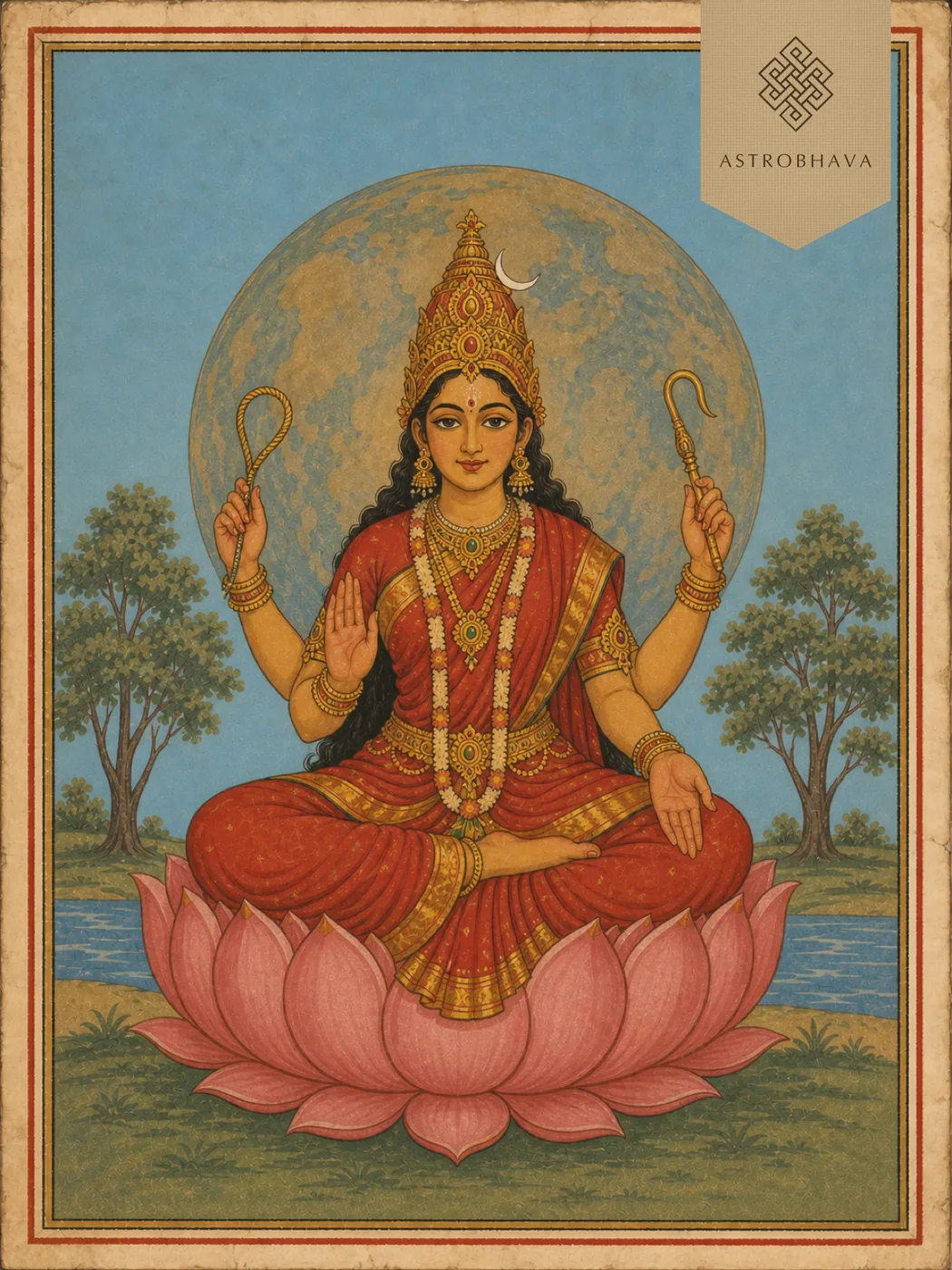
Bhuvaneshwari is the Mahavidya who personifies the expanse of the worlds themselves. Her name compounds bhuvana, meaning realm or being, with ishvari, the feminine sovereign. Among the ten great wisdom goddesses she occupies the place of the spatial matrix in which every other form appears. Tantric sources such as the Todala Tantra and the Jnanarnava Tantra describe her as the colour of the rising sun, holding the noose and the goad, making the gestures of boon and fearlessness, and seated upon a lotus that floats in the causal waters. She is not a warrior like Chandi nor a destroyer like Kali; her sovereignty is the quiet fact that nothing exists outside her. In the Sri Vidya stream she is sometimes aligned with pure samvit, the awareness that is the ground of the Sri Chakra, yet she retains independent worship as the fourth Mahavidya whose body is the cosmos.
The Space That Holds Forms
According to the Mahavidya cycle preserved in several tantras and in later elaborations of the Devi Bhagavata Purana, the ten forms arise when the Goddess reveals the full spectrum of her power. Bhuvaneshwari’s particular revelation is the demonstration that the universe is her own body. One account relates that when the worlds contracted in fear or ignorance she expanded her form until every bhuvana, from the highest satyaloka to the nether realms, was seen to rest within her. Her myth is therefore less an episode of combat than a disclosure of containment: the Goddess shows that what beings take to be external space is simply the openness of her own being. This disclosure becomes the contemplative heart of her worship in the tantric lineages that transmit her mantra.
The mantra, in six scripts
The seed mantra, and the form most devotees chant daily. No initiation is required — it is open to anyone, including a parent chanting for a child.
- ॐ
- oṃ — the sacred syllable
- ह्रीं
- hrīṃ — the māyā-bīja of the Goddess
- भुवनेश्वर्यै
- bhuvaneśvaryai — to Bhuvaneshwari, sovereign of the realms
- नमः
- namaḥ — salutations
More Bhuvaneshwari mantras
Bhuvaneshwari Gayatri Mantra
The verse in the Gayatri metre, asking for understanding as well as presence.
- ॐ
- oṃ — the sacred syllable Om
- नारायण्यै
- nārāyaṇyai — Narayani, the Goddess
- च
- ca — and (connective particle)
- विद्महे
- vidmahe — may we know
- भुवनेश्वर्यै
- bhuvaneśvaryai — Bhuvaneshwari, sovereign of the worlds
- धीमहि
- dhīmahi — may we meditate on
- तन्नो
- tanno — therefore ... us (tat + naḥ)
- देवी
- devī — the Goddess
- प्रचोदयात्
- pracodayāt — may she inspire / impel
Source: Bhuvaneshwari Gayatri, from the Gayatri Mantra-s collection (Linga Purana, Mantra Maharnava, Gayatri-mahatantra).
Bhuvaneshwari Dhyana Shloka (Balaravidyutim)
The verse recited to picture the deity before japa.
- बालरविद्युतिम्
- bālaravidyutim — radiant as the young (rising) sun
- इन्दुकिरीटां
- indukirīṭāṃ — crowned with the moon
- तुङ्गकुचां
- tuṅgakucāṃ — full-breasted
- नयनत्रययुक्ताम्
- nayanatrayayuktām — having three eyes
- स्मेरमुखीं
- smeramukhīṃ — smiling-faced
- वरदाङ्कुशपाशाभीतिकरां
- varadāṅkuśapāśābhītikarāṃ — whose hands show the boon gesture, goad, noose and the gesture of fearlessness
- प्रभजे
- prabhaje — I worship
- भुवनेशीम्
- bhuvaneśīm — Bhuvaneshi, sovereign of the worlds
Source: Dhyana verse of Devi Mahatmya (Durga Saptashati) chapter 11, the Narayani Stuti, meditating on Bhuvaneshi; also verse 1 of the Bhuvaneshwari Dhyanam.
The syllable people get wrong
In bhuvaneśvaryai the consonant cluster śv is often pronounced as a simple English shw, flattening the palatal ś into a postalveolar sound. The correct ś places the tongue against the hard palate while the following v remains light. Equally common is the reduction of the final dative ending yai to a short i, so the name is heard as bhuvaneshwari rather than bhuvaneśvaryai.
When Bhuvaneshwari is chanted
Weekday. Friday
Questions
Have your chart read before you decide
Chanting is yours to do, and free. But which deity your situation calls for — and whether a mantra alone is the right response — depends on your chart. Sometimes it is; sometimes it is not.
- Over 30 years in the Guru–Sishya Parampara, from the age of five
- He reads every chart himself — 60 minutes, one to one, never delegated
- Charts are read only between sunrise and sunset, following tradition
