Planetary transits — where every graha stands now.
A transit is simply where a planet is in the sky today, read against where it was when you were born. The slow planets — Saturn, Jupiter, Rahu and Ketu — shape years at a time and carry most of the weight in Vedic prediction. The fast ones colour weeks and days. Current positions below, with full readings by rashi.
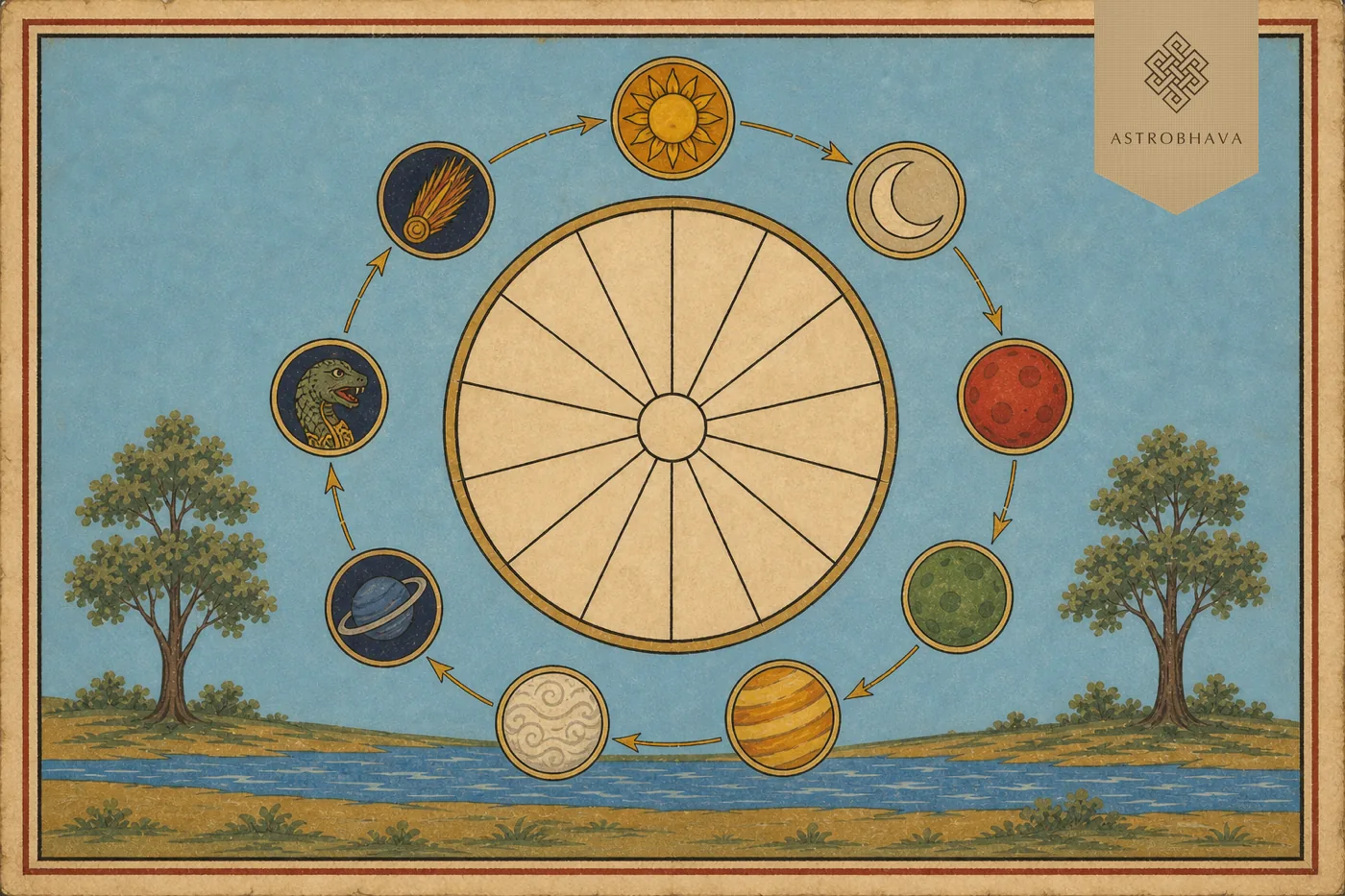
Live ephemeris snapshot for Columbus, Ohio, United States · as of 4:31 AM local time on 19 September 2026 · Lahiri ayanamsa
These shape years, not weeks
Saturn, Jupiter and the nodes are what Vedic astrology means when it speaks of a major transit. Each has a full reading for all twelve rashis.
SaturnShani · Shani Peyarchi
2½ yearsNext sign change to Mesha on 2 June 2027
Discipline, delay, labour and consequence. The transit devotees ask about most, and the one that determines Sade Sati, Ashtama Shani and Kantaka Shani.
Saturn transit for all 12 rashis →JupiterGuru · Guru Peyarchi
1 yearNext sign change to Simha on 31 October 2026
Growth, learning, marriage and children. Jupiter's twelve-year circuit is the counterweight to Saturn, and its sign change is watched almost as closely.
Jupiter transit for all 12 rashis →Rahu & KetuThe lunar nodes
18 monthsAxis shifts on 5 December 2026
The nodes move together and backwards through the zodiac. Read for sudden turns, foreign matters, and obstruction that has no obvious cause.
Nodal transit for all 12 rashis →Two transits that are watched by date, not by rashi
These do not get twelve rashi readings — nobody reads them that way. What families actually need is the calendar, and both are planned around in Tamil Nadu and Kerala.
Sun — Sankranti calendarSurya · solar month change
MonthlyNext Sankranti 17 October 2026 into Tula
The Sun's entry into each sign begins a solar month and is observed as a festival — Makara Sankranti, Mesha Vishu, Aadi Perukku. All twelve dates for the year, with what each marks.
All twelve Sankranti dates →Venus — Shukra AstangataShukra moudhyam · combustion
Twice yearlySee the exact dated windows in the Astangata calendar
The weeks Venus is too close to the Sun to be seen. Marriages and several auspicious undertakings are traditionally not performed during them — which is why families plan around these dates.
Astangata dates & what they affect →Mars, Mercury and the Moon
These change sign too often to be worth twelve readings each, and Vedic practice does not read them that way. Their current positions are in the table below; what matters about Mars and Mercury is their retrograde periods.
~45 days per sign. Watched where Mangal dosha is present, and during retrograde.
~3 weeks per sign. Budha peyarchi is lightly read; the retrograde is what matters.
2¼ days per sign. Used for choosing a day, never for describing a year.
Every planet's motion, station dates and when each turns direct →
All nine grahas — current positions
Updated from the ephemeris. Retrograde motion is marked; the Sun and Moon never retrograde, and Rahu and Ketu are always retrograde.
| Graha | Sign now | Motion | Next change | Time in each sign |
|---|---|---|---|---|
| Surya — Sun | Kanya | Direct | 17 October 2026 | 1 month |
| Chandra — Moon | Dhanu | Direct | 21 September 2026 | 2¼ days |
| Mangal — Mars | Karka | Direct | 12 November 2026 | ~45 days |
| Budha — Mercury | Kanya | Direct | 26 September 2026 | ~3 weeks |
| Guru — Jupiter | Karka | Direct | 31 October 2026 | 1 year |
| Shukra — Venus | Tula | Direct | 5 November 2026 | ~4 weeks |
| Shani — Saturn | Meena | Retrograde | 2 June 2027 | 2½ years |
| Rahu | Kumbha | Always retrograde | 5 December 2026 | 18 months |
| Ketu | Simha | Always retrograde | 5 December 2026 | 18 months |
Which of these transits is actually falling on your chart?
Every reading on this site is written by rashi — one twelfth of everyone. What each transit does to you depends on the house it occupies from your own Moon, and whether it triggers Sade Sati, Ashtama Shani or a dasha you are already running. Free, and it takes half a minute.
Registered before? Your saved profiles fill this in one tap. New here? One tap creates your account — no password — and your details carry across all 25 tools.
How transits are read in Vedic astrology
Counted from the Moon, not the Sun
Vedic transit readings are measured from your birth Moon sign — your rashi. Western astrology counts from the Sun, which is why the two give different answers for the same person and neither is a mistake.
If you have only ever known a Sun sign, the rashi readings on this site are probably not for the sign you would pick. A free kundli settles it in a minute.
Slow planets carry the weight
Saturn spends two and a half years in a sign, Jupiter one, the nodes eighteen months. Those are the transits that shape a period of life, and they are what the classical texts weigh when reading a year ahead.
The Moon changes sign every two and a quarter days. It matters for choosing a day, not for describing a year.
Retrograde refines rather than reverses
A retrograde planet appears to move backwards and re-covers degrees it has already crossed. The classical reading is that matters from earlier in the transit return for completion — a poor time to begin, a good one to finish.
Rahu and Ketu are always retrograde by nature. The Sun and Moon never are. Live retrograde tracker →
A transit is weighed against the dasha
Classical practice reads your running Vimshottari period first and the transit second. A favourable transit during a difficult mahadasha behaves quite differently from the same transit during a supportive one.
This is the commonest reason two people with the same rashi report opposite experiences of the same year. Check your dasha →
What these pages can and cannot tell you
A rashi reading is a general indication. It applies equally to one twelfth of humanity — hundreds of millions of people — and it is genuinely useful at that level. It is not a reading of your chart, and we would rather say so than imply otherwise.
Three things change what a transit actually does. The house it occupies from your own Moon. The condition of that planet in your birth chart — strong, debilitated, or supported by benefics. And the dasha you are running while it happens.
The free check above covers the first. For the rest — what a transit means for a decision in front of you, and whether a remedy is warranted — Ask Nirnaya where to begin with the full chart rather than one transit.
Sade Sati Checker
Whether Saturn's seven and a half years are running, and which phase.
Retrograde Checker
What is retrograde now and when each planet turns direct.
Dasha Calculator
The period you are running — weighed before any transit.
Planetary Homas
The rites prescribed for each graha, on a muhurta from your own chart.
About planetary transits
A transit reading is general. Your chart is not.
If a transit is falling heavily — or you want to know which of the nine is actually driving a difficult year — a live session reads all of them against your own chart.