Annapoorna Mantra
ॐ अन्नपूर्णे सदापूर्णे शङ्करप्राणवल्लभे ज्ञानवैराग्यसिद्ध्यर्थं भिक्षां देहि च पार्वतिAlso known as Annapurna Mantra
In Devanagari, Tamil, Telugu, Kannada, Malayalam and English — with the meaning of every word, and the one syllable most people pronounce wrongly.
Who Annapoorna is
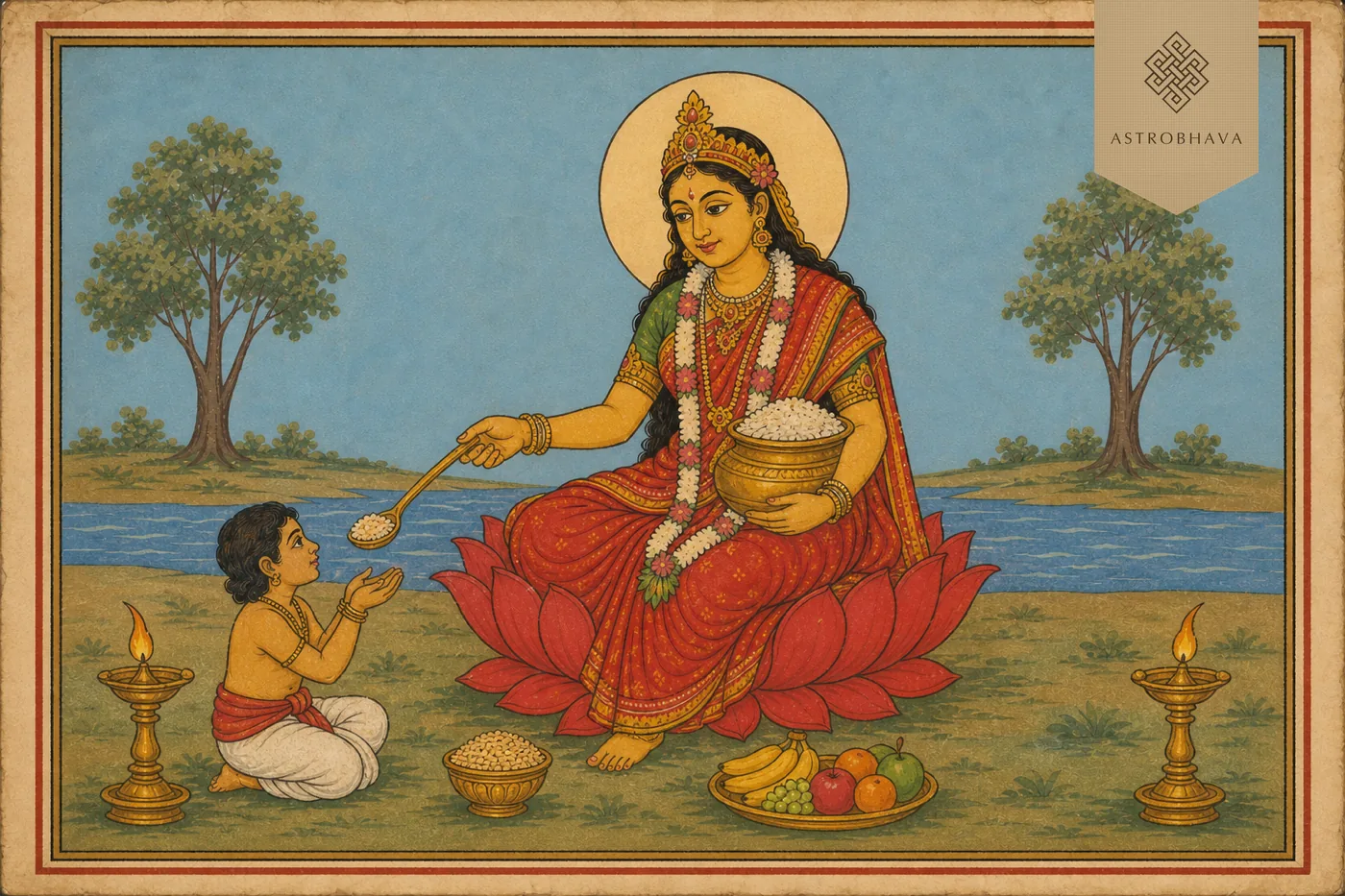
Annapoorna is the full-bowl goddess of Varanasi, the form of Parvati who alone holds the ladle and the vessel of cooked rice when even Shiva appears as a mendicant. In the city’s lore she is not a distant bestower but the kitchen-sovereign of Kashi whose temple stands beside the Visvanatha shrine; her golden image is shown serving food, never empty-handed. The name anna-pūrṇā means she whose nature is the complete filling of grain. Popular tradition relates that she manifested when the world starved after Shiva playfully declared the universe illusion and food unnecessary. Her presence restores the dignity of nourishment itself as sacred, not merely useful.
When Kashi went hungry
A popular tradition of Kashi relates that Shiva once told Parvati that the entire world is maya, including the food that sustains it. In response she withdrew her presence from the grain itself. Crops failed, kitchens grew cold, and the gods and sages wandered famished. Shiva himself came as a beggar to Kashi. There the goddess reappeared as Annapoorna, seated with a jeweled vessel and a golden ladle, serving infinite rice. Only after Shiva received alms from her hand did abundance return. The episode is not a moral against philosophy but the revelation that nourishment is the goddess’s own body, and that even the lord of ascetics must accept it from her. Varanasi’s Annapoorna temple still enacts this daily offering.
The mantra, in six scripts
The name mantra, and the form most devotees chant daily. No initiation is required — it is open to anyone, including a parent chanting for a child.
- ॐ
- oṃ — the primal sound
- अन्नपूर्णे
- annapūrṇe — O she who is complete with food
- सदापूर्णे
- sadāpūrṇe — O ever-full one
- शङ्करप्राणवल्लभे
- śaṅkaraprāṇavallabhe — O you who are dear to Shankara as his very life
- ज्ञानवैराग्यसिद्ध्यर्थं
- jñānavairāgyasiddhyarthaṃ — for the accomplishment of knowledge and dispassion
- भिक्षां
- bhikṣāṃ — alms
- देहि
- dehi — grant
- च
- ca — and
- पार्वति
- pārvati — O Parvati
More Annapoorna mantras
Annapurna Gayatri Mantra
The verse in the Gayatri metre, asking for understanding as well as presence.
- ॐ
- oṃ — the sacred syllable Om
- भगवत्यै
- bhagavatyai — the Blessed Goddess
- च
- ca — and (connective particle)
- विद्महे
- vidmahe — may we know
- माहेश्वर्यै
- māheśvaryai — Maheshwari, the consort of Maheshwara (Shiva)
- च
- ca — and (connective particle)
- धीमहि
- dhīmahi — may we meditate on
- तन्नोऽन्नपूर्णा
- tanno'nnapūrṇā — therefore ... us, Annapurna (tat + naḥ + annapūrṇā)
- प्रचोदयात्
- pracodayāt — may she inspire / impel
Source: Annapurna Gayatri, from the Gayatri Mantra-s collection (listed twice there, once written तन्न अन्नपूर्णा without sandhi).
Annapurna Stotram, Verse 1 (Nityanandakari)
The verse recited to picture the deity before japa.
- नित्यानन्दकरी
- nityānandakarī — who gives everlasting joy
- वराभयकरी
- varābhayakarī — who grants boons and fearlessness
- सौन्दर्यरत्नाकरी
- saundaryaratnākarī — an ocean (mine of jewels) of beauty
- निर्धूताखिलघोरपावनकरी
- nirdhūtākhilaghorapāvanakarī — who purifies by shaking off all that is dreadful
- प्रत्यक्षमाहेश्वरी
- pratyakṣamāheśvarī — Maheshwari made visible
- प्रालेयाचलवंशपावनकरी
- prāleyācalavaṃśapāvanakarī — who sanctifies the lineage of the snow mountain (Himavan)
- काशीपुराधीश्वरी
- kāśīpurādhīśvarī — queen of the city of Kashi
- भिक्षां
- bhikṣāṃ — alms
- देहि
- dehi — give
- कृपावलम्बनकरी
- kṛpāvalambanakarī — who gives the support of her grace
- मातान्नपूर्णेश्वरी
- mātānnapūrṇeśvarī — O Mother Annapurneshwari (mātā + annapūrṇeśvarī)
Source: Annapurna Stotram (Annapurnashtakam, traditionally attributed to Adi Shankaracharya), verse 1. This page's main mantra is the closing verse of the same hymn.
The syllable people get wrong
In annapūrṇe the conjunct pūr contains a long ū that must be held; many speakers collapse it to a short u and soften the retroflex ṇ into a dental n, yielding anna-purn-e. The correct form keeps the full ū and the tongue curled for ṇ before the final e.
When Annapoorna is chanted
Weekday. Friday
Festival. Annapurna Jayanti, observed on the full moon of Margashirsha
Questions
Have your chart read before you decide
Chanting is yours to do, and free. But which deity your situation calls for — and whether a mantra alone is the right response — depends on your chart. Sometimes it is; sometimes it is not.
- Over 30 years in the Guru–Sishya Parampara, from the age of five
- He reads every chart himself — 60 minutes, one to one, never delegated
- Charts are read only between sunrise and sunset, following tradition
Related
Chanting is yours to do. Some things are performed for you.
Where a matter carries real weight, devotees sponsor the homa alongside their own practice. Performed for you and any family members you name, at our Yagna Ashram, in your name and gotra, on a muhurta calculated from your chart, and telecast live so you can watch it done for you.