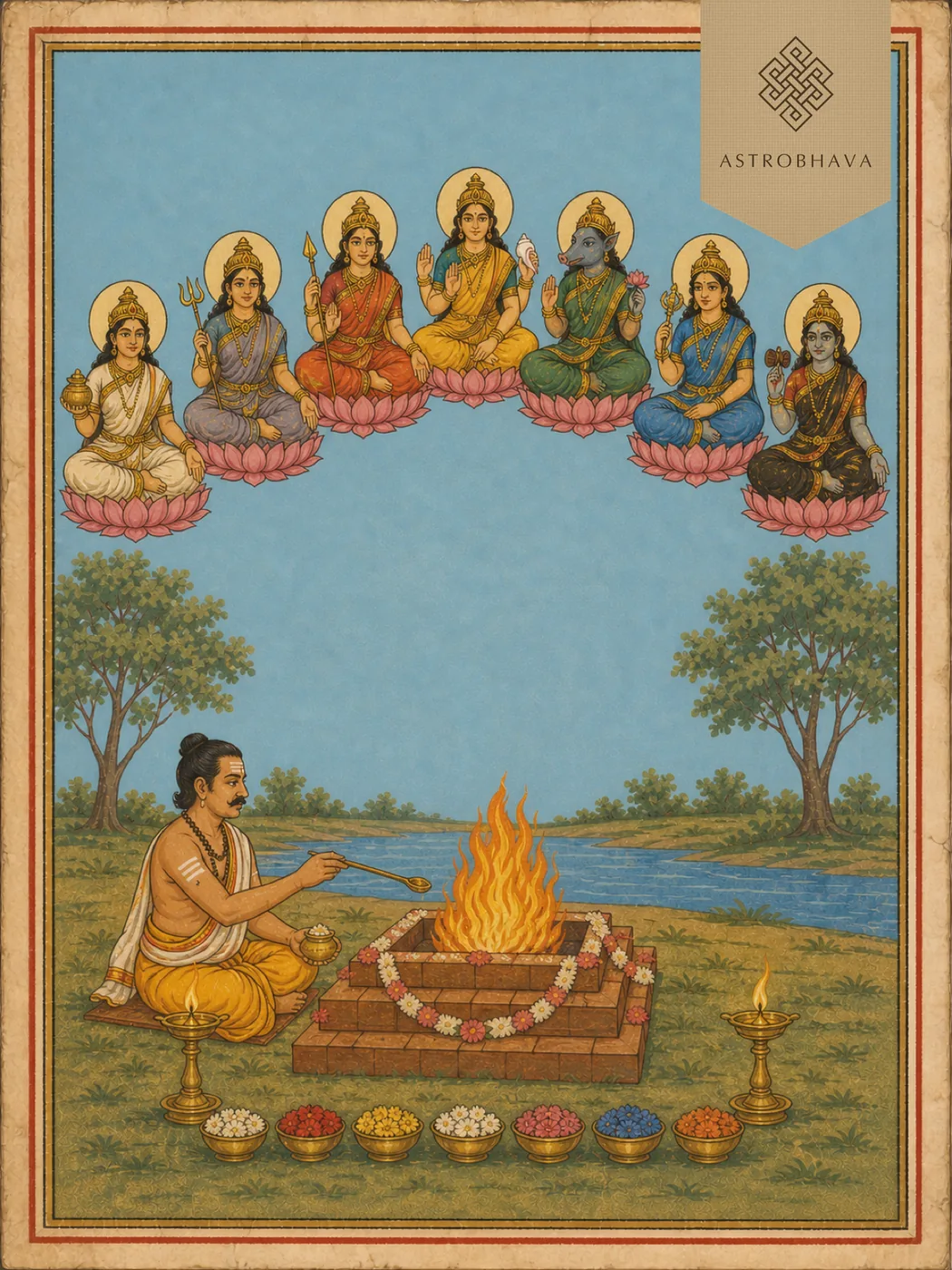
Saptamatrika Homa
Also spelled Saptamatrika Homam
सप्तमातृका होमSeven Mothers stand around the fire, one at every direction, and the ash they leave is asked to guard your home and your name.
- Never a group ceremony — only the names you give are spoken
- Muhurta fixed from your own birth chart, confirmed within 24–48 working hours
- Free energised Saptamatrikas Yantra, sealed in a silver amulet, shipped worldwide at no charge
The Ritual and Its Weight
The Saptamatrika Homa is offered to the seven Mother energies — Brahmani, Maheshwari, Kaumari, Vaishnavi, Varahi, Indrani and Chamunda — who, in the Puranas, emerged from the great gods to encircle the battlefield when a single form was not enough. Each Mother carries the weapon and the vahana of the deity she springs from. Together they form a closed ring. That ring is what this rite asks for: a boundary drawn in fire around a person, a household, a lineage.
Tradition turns to the Saptamatrika pooja when the trouble has no visible cause. Sleep that will not come. A house where quarrels start over nothing. A child who fades after being admired too loudly. Work that unravels at the last step, again and again. In such seasons the Matrikas are invoked as fierce guardians rather than as distant goddesses — mothers who do not negotiate with what threatens their children. As a Maha homa, the Saptamatrika puja carries an extended japa count and separate offerings for each of the Seven, which is why the rite is set aside for concerns of weight.
ब्राह्मी माहेश्वरी चैव कौमारी वैष्णवी तथा। वाराही च तथेन्द्राणी चामुण्डा सप्तमातरः॥ Brahmani, Maheshwari, Kaumari, Vaishnavi, Varahi, Indrani and Chamunda — these are the Seven Mothers, and we bow to them as our guardians.What a Maha Homa is
Not every fire ritual is performed at the same scale. A Maha Homa is our largest form — more priests, a longer fire, and the complete chanting sequence the rite prescribes rather than an abridged one. This is what that means in practice.
A Maha Homa is never a group ceremony, the same as any homa we conduct. What the scale changes is the weight of the offering — ten trained voices holding one hymn for two hours is a different undertaking from one voice for an hour, and it is reserved for the intentions that warrant it.
Why Devotees Book This
The Saptamatrika homa is prescribed in the tradition for these concerns. What follows is what the rite is offered for, in the words of those who keep it.
A Ring of Protection
The Seven are invoked at the seven directions of the kunda, so the household is placed inside a guarded circle rather than left in the open.
Relief from Drishti
Offered when a person, a child or a new venture seems to falter after drawing attention — the classic reading of evil eye in our households.
Against Abhichara
Chamunda and Varahi are invoked specifically as the Mothers who face black magic, prayoga and deliberate ill-will directed at a family.
Quiet in the Mind
Sought when sleep is broken, when dread arrives without reason, and when the mind will not settle — the traditional signs of psychic disturbance.
Peace Within the Home
Offered for houses where friction keeps returning, where guests feel uneasy, or where a new property is being entered for the first time.
Cover for the Lineage
The Matrikas are also honoured as protectors of children and continuity, which is why families book this Saptamatrika puja on behalf of the whole household, not one person.
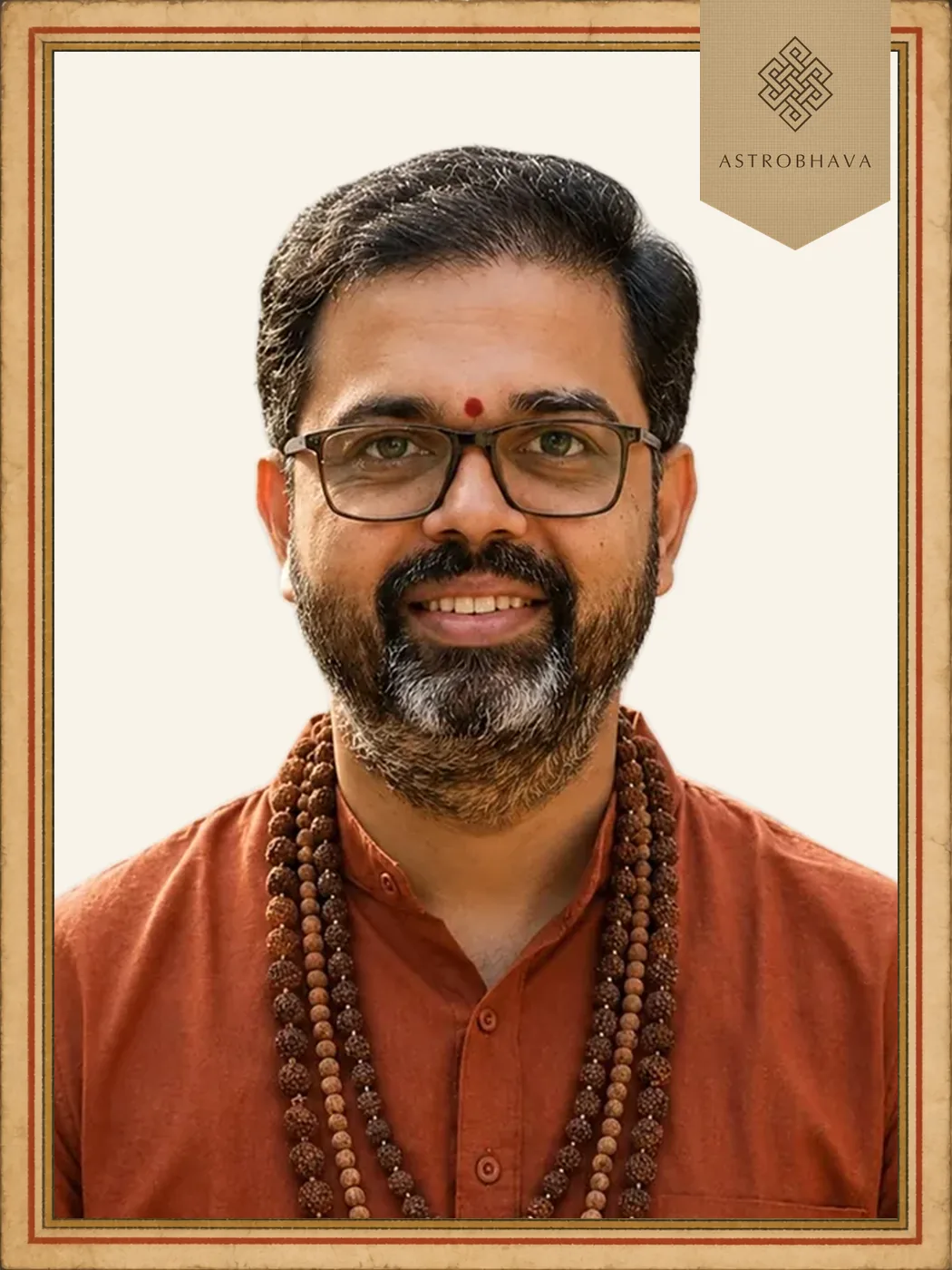
Under the guidance of Brahmashree Shivaaya
Every priest who performs your Saptamatrika Homa is trained in a traditional Padashala and personally recruited by Brahmashree Shivaaya — Chief Operating Officer & Head of Astrological & Spiritual Solutions at AstroBhava. Your ritual is conducted at our own Yagna Ashram — never a rented venue.
Meet our priests →- Certified Vedic priests — trained in traditional Padashalas
- 100% Agama Vidhi — as prescribed in the scriptures
- One chart, one sankalpa, one fire — never a group ceremony
- Muhurta from your chart — date fixed to your birth details
- Free worldwide delivery — prasadam & energised Saptamatrikas Yantra
Choose how many priests will chant
- The complete Saptamatrika Homa, with the same ritual stages and the same kinds of offerings
- A private ceremony for you and up to four family members, never combined with anyone else’s booking
- Live telecast from our Yagna Ashram, and prasadam shipped free
- The energised Saptamatrikas Yantra, sealed in a silver amulet
Only the number of priests: 5 or 10. Every priest makes their own offerings, and all of them perform at the same time, in one ceremony.
216 ahutis by each priest, with the mula mantras of the Saptamatrikas — so 1,080 or 2,160 in all, by package.
Has your astrologer prescribed a different number of ahutis? Our priests can review it and arrange a customised homa. Call our Devotee Relationship Team on +91 96295 55442 — they confirm the count, the priests, the approximate duration and the total price before you book.
All prices are all-inclusive — no shipping charges, no additions at checkout. See everything included →
You book — and add birth details on the next page, straight after payment.
Within 24–48 working hours — your muhurta is confirmed by email.
The day before — your telecast link arrives by email.
After the homa — tracking email with how and when to wear the Saptamatrikas Yantra.
The most auspicious days for a Saptamatrika Homa
These are the windows the tradition favours.
The eighth and ninth lunar days belong to the Mother forms. Krishna Paksha Ashtami is especially held for rites of protection.
Both Sharada and Vasanta Navaratri carry the strongest current for Matrika worship, and the Ashtami of Navaratri is the most sought date of the year.
Mangalvara suits the fierce aspect of the Mothers; Shukravara suits their nurturing aspect. Many devotees choose one or the other by the nature of their concern.
These stars are associated with the Matrika energies and are chosen when the concern is longstanding rather than recent.
You do not need to wait for one of these days. Whenever you book, our astrologers calculate the muhurta from your own birth chart — a date chosen for you personally, which tradition regards as more precise than a calendar date chosen for everyone. If you would like the homa on one of the days above, tell us at checkout and we will fix the muhurta within it.
What you receive
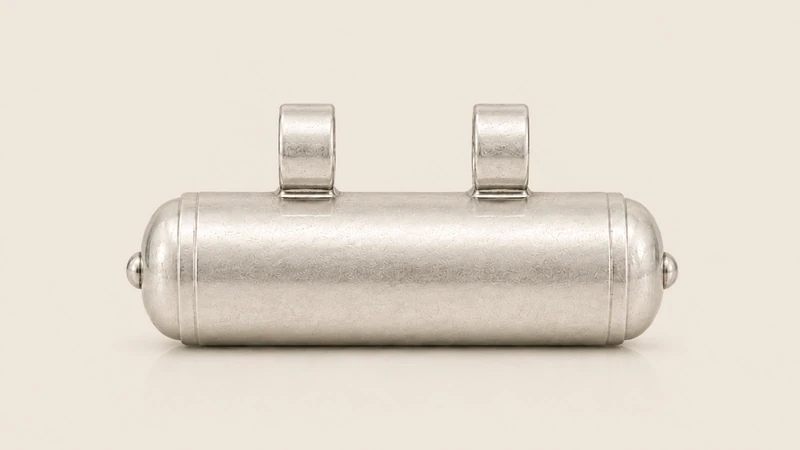
The sealing of the Saptamatrikas Yantra
The Saptamatrikas Yantra is consecrated over three days — Jala (holy-water consecration with mantras), Prana (life force through pranayama & chants) and Jeeva Pratishta (awakened with 108 recitations & offerings) — then present through your homa, receiving the energies raised in the fire. When your homa concludes, it is rolled and locked inside its silver amulet according to Agama vidhi — the practice by which those energies are held within a consecrated object rather than dispersing. It is why a homa performed at our ashram can still reach a devotee ten thousand miles away: what the fire raised travels to you, sealed.
This is what arrives at your door, at no extra cost, with your prasadam.
Personal sankalpa
Your name, gotra & nakshatra — and up to four family members if you wish. No one else is named.
Live telecast
Watch your own homa in real time from the ashram. Streamed openly on our YouTube channel by default — or request an unlisted telecast at checkout.
Free energised Saptamatrikas Yantra, sealed in a silver amulet
Shipped to you with your prasadam.
Prasadam, shipped free
Sacred vibhuti, sandalwood powder & kumkum from your fire — delivered to any country.
How to wear your energised Saptamatrikas Yantra
Your auspicious time to wear it
Wear it for the first time on the day named in your dispatch email, between 6.30 and 7.30 in the morning. Bathe first, place the yantra on your pooja altar and offer your prayers, then wear it around your neck or your waist, on a red or black thread or a silver chain.
At a funeral
Take the yantra off before you attend a funeral.
Purify the amulet
Whenever the yantra has been taken off, or if it was worn at a funeral, dip it in raw milk or Ganga jal, show it incense, dhoop or attar (perfume), and then wear it again.
Keep the energy intact
You may repeat this energising once a week or once a month.
How your Saptamatrika Homa is performed
Sankalpa
The priest states your name, gotra and nakshatra — and those of up to four family members — with the intention this homa is performed for.
Ganapati Puja
The customary invocation to Ganapati, clearing obstacles before the deity is approached.
Agni Pratishtha
The fire is consecrated in the homa kunda and Agni invoked as the carrier of every offering that follows.
Saptamatrika Avahana
The mula mantras of the Saptamatrikas are chanted, inviting the deity's presence into the fire — by five or ten priests as your scale sets.
Ahuti
Ghee and akshata, with the flowers, grains and dravyas proper to this deity, are offered in sequence with mantra. Each priest makes 216 of these offerings with the mula mantras of the Saptamatrikas — 1,080 or 2,160 in all, by package.
Purnahuti
The final complete offering seals the sankalpa stated at the opening.
Aarti & Dispatch
Aarti is performed live on your telecast. Vibhuti, sandalwood powder, kumkum and your energised Saptamatrikas Yantra are then packed and shipped free to your door.
The Saptamatrikas
Seven mother goddesses stand together as the shakti of the great gods, each carrying the weapon, ornament and mount of the deity she springs from. Brahmani holds the water pot and rides the swan. Maheshwari bears the trident on the bull. Kaumari carries the spear with the peacock, Vaishnavi the discus with Garuda, Varahi the plough with her boar face, Indrani the thunderbolt on the elephant, and Chamunda the fierce, gaunt form of the cremation ground. The Devi Mahatmya describes them emerging in battle when one form alone would not suffice, and Puranic and Agamic texts place them in a row or a ring on temple walls. Devotees approach them as mothers of the fierce kind, invoked for guardianship over children, household and lineage.
In this homa that grace is invoked through fire, with your own name and birth details spoken in the sankalpa.
Ask before you book
Nirnaya, our free ritual guide, recommends the traditional ritual for your situation instantly. For a full reading of your chart, book a live session with our astrologers.
Frequently asked
Other rituals devotees book alongside this one
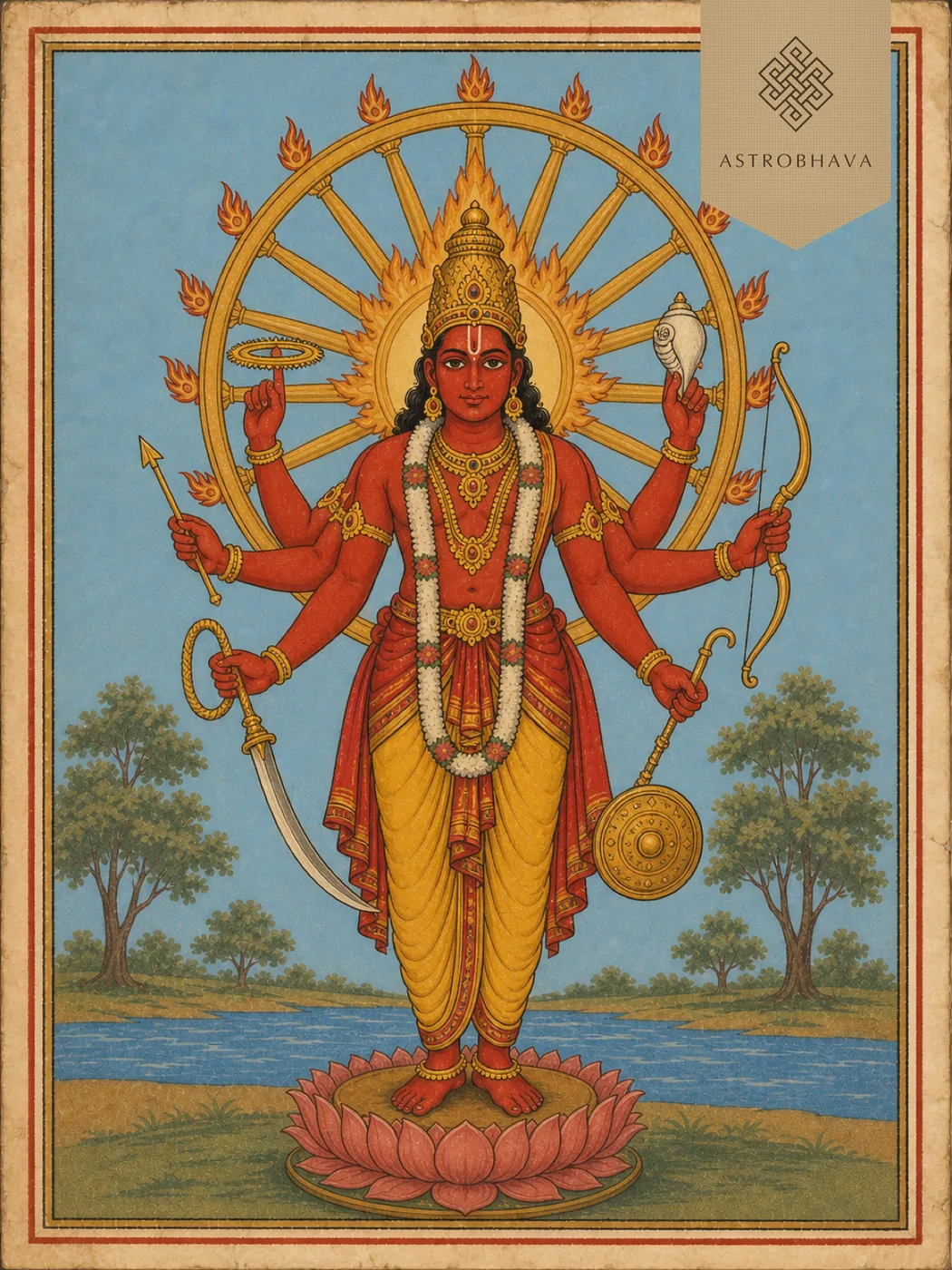
Sudarshana Homa
For protection from evil eye, black magic, psychic harm and unseen negative energy.
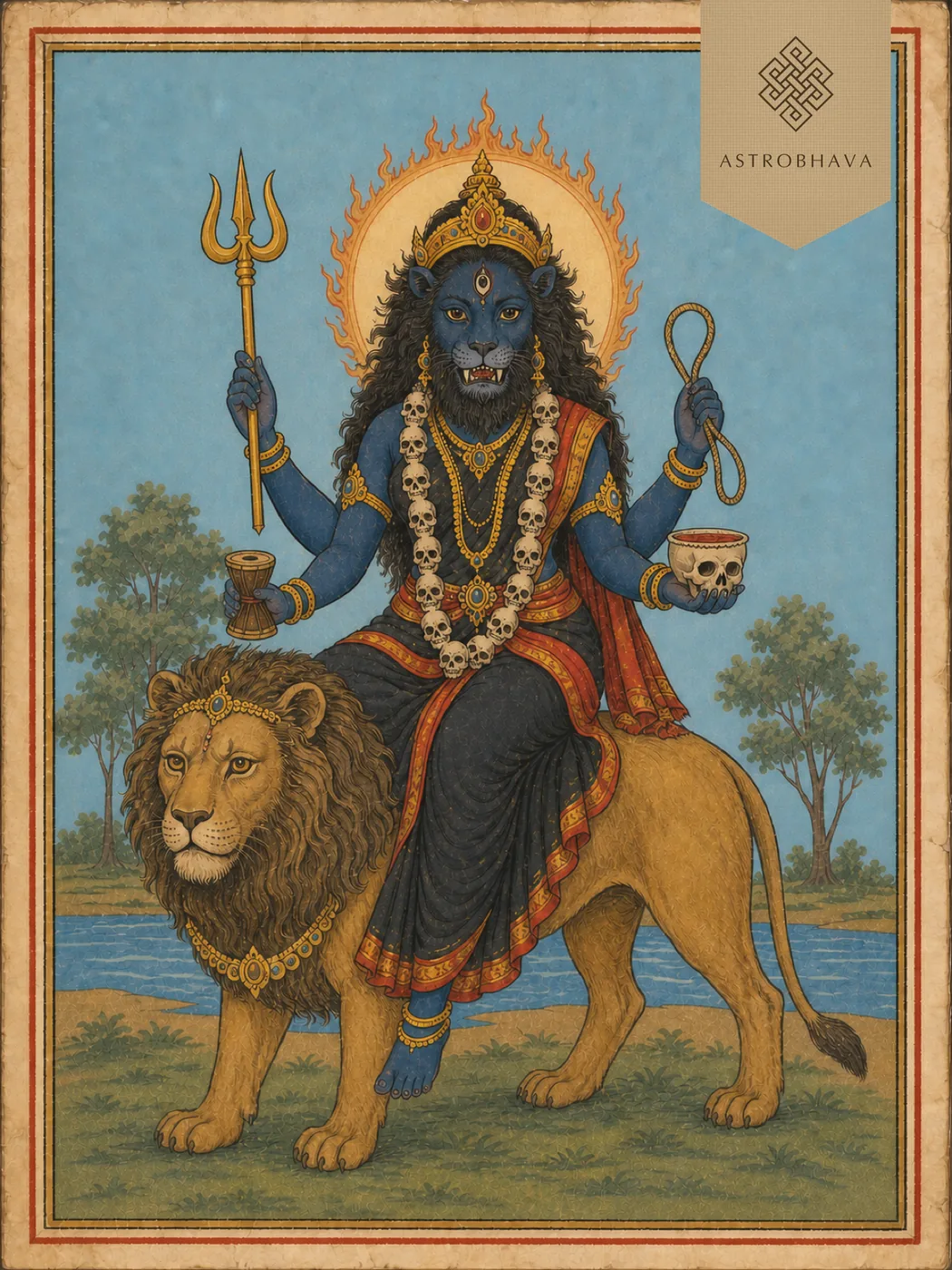
Pratyangira Devi Homa
Booked for protection from evil eye, black magic, psychic harm and hostile intent.
Maha Homa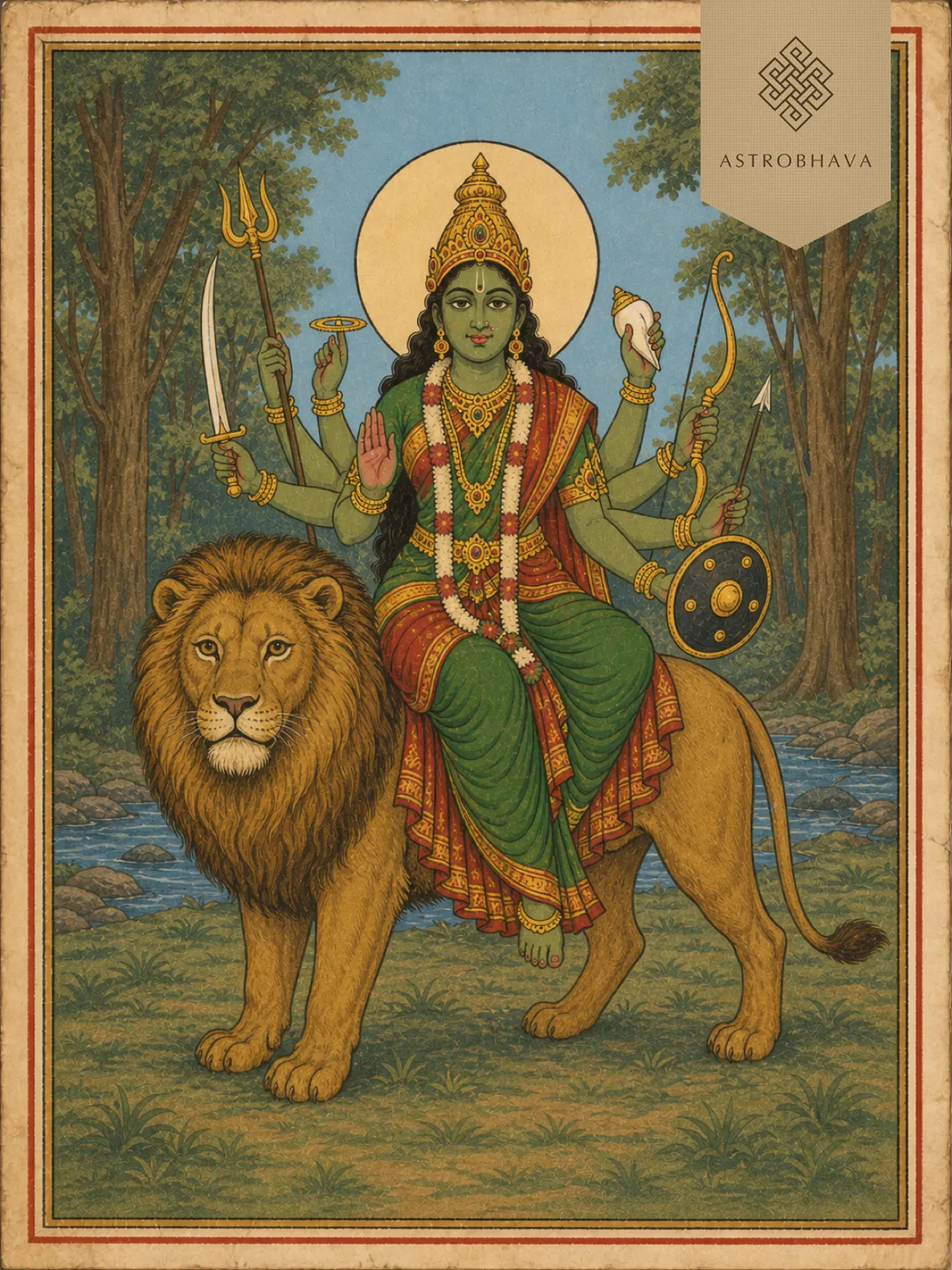
Vana Durga Homa
Booked for protection from evil eye, black magic, psychic harm and hostile energies.
Let the names of the Saptamatrikas be spoken with yours
Book your Saptamatrika Homa, watch it performed live from our Yagna Ashram, and receive your energised Saptamatrikas Yantra anywhere in the world.
Choose Your Package