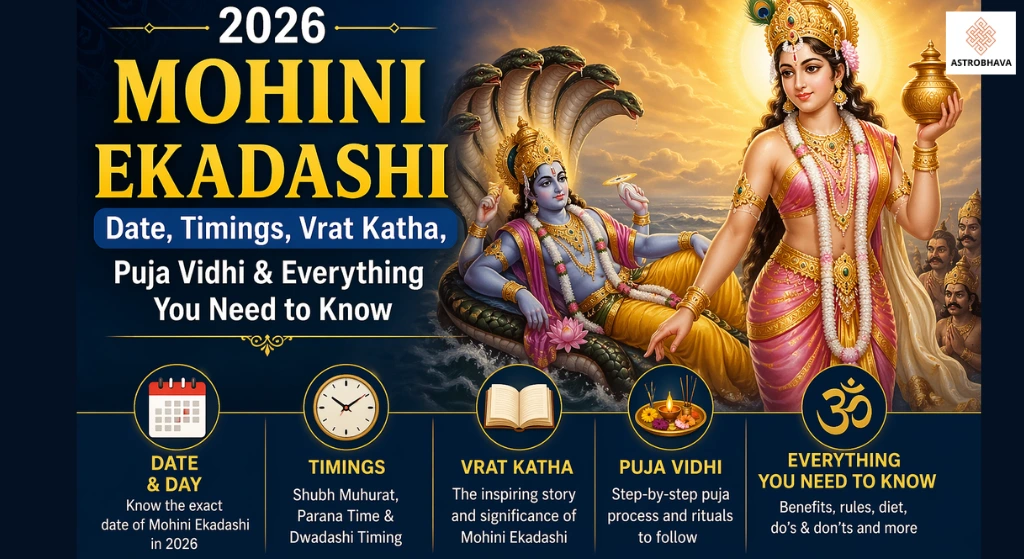
If you have been wondering about the 2026 Mohini Ekadashi date, the right Parana time, how to fast properly, or what makes this particular Ekadashi so spiritually powerful — you have landed in exactly the right place. This blog covers absolutely everything, from the sacred legend behind this Ekadashi to a step-by-step fasting and puja guide. So let’s get into it!
What Is Mohini Ekadashi and Why Is It So Special?
Out of the 24 Ekadashis observed throughout the Hindu lunar calendar year, Mohini Ekadashi stands in a class of its own. Observed on the 11th day (Ekadashi Tithi) of the Shukla Paksha (waxing moon fortnight) in the holy month of Vaishakha, this fast is dedicated to Lord Vishnu in His enchanting Mohini Avatar.
The name “Mohini” itself is loaded with meaning. In Sanskrit, Mohini means “the one who captivates or enchants.” But more deeply, it refers to the concept of Moha — the illusion, attachment, and confusion that keeps our souls entangled in the cycle of birth and death. Observing Mohini Ekadashi is essentially a spiritual act of cutting through that illusion and seeking the liberating grace of Lord Vishnu.
What makes this Ekadashi even more extraordinary is its scriptural weight. Lord Krishna Himself explained the significance of Mohini Ekadashi to Dharmaraja Yudhishthira in the Mahabharata, saying that observing this fast with sincerity bestows merit far greater than performing grand Yagnas, visiting sacred pilgrimage sites, or giving enormous amounts in charity. Scriptures also say that the merit of this Ekadashi equals that of donating a thousand cows — a virtue considered among the highest in ancient Hindu tradition.
This is not just a fast. It is a full-scale spiritual reset.
2026 Mohini Ekadashi Date and Tithi Timings
Let’s get straight to what you are probably here for — the exact date and timings for 2026 Mohini Ekadashi.
Mohini Ekadashi 2026 Date: Monday, 27th April 2026
Here are the Tithi timings:
- Ekadashi Tithi Begins: 6:06 PM on Sunday, 26th April 2026
- Ekadashi Tithi Ends: 6:15 PM on Monday, 27th April 2026
- Fast Observed On: Monday, 27th April 2026
Since the Ekadashi Tithi is present at sunrise on April 27, the fast is observed on that day as per the Udaya Tithi (sunrise rule) followed in traditional Hindu practice.
Parana Time (Time to Break the Fast):
The Parana — the auspicious window to end your Ekadashi fast — falls on Tuesday, 28th April 2026. The general Parana window for most locations in India is between 5:43 AM and 8:21 AM (New Delhi timing). Note that Hari Vasara — the first quarter of the Dwadashi Tithi — must end before you break your fast. Breaking it before Hari Vasara ends is considered to nullify the merit of the entire fast.
Please do check your local Panchang for city-specific timings, as sunrise and Hari Vasara end times will vary slightly across India and other locations.
A quick summary for your ease:
| Detail | Timing |
| Ekadashi Tithi Begins | 6:06 PM, April 26, 2026 |
| Ekadashi Tithi Ends | 6:15 PM, April 27, 2026 |
| Fast Date | Monday, April 27, 2026 |
| Parana (New Delhi) | 5:43 AM – 8:21 AM, April 28, 2026 |
The Sacred Legend: Mohini Ekadashi Vrat Katha
Every Ekadashi has a story behind it, and the Vrat Katha of Mohini Ekadashi is one that hits close to home for many of us — because it is a story of radical transformation.
In the Vaishakha Mahatmya, Sage Vashistha narrates this legend to Lord Rama. In the city of Bhadravati, there lived a wealthy Vaishya named Dhanpala. He was deeply righteous and generous. However, his son Dhrishtabuddhi was the complete opposite — wayward, irresponsible, and addicted to vices. He wasted all the family’s wealth, broke every moral code, associated with thieves and sinners, and was eventually thrown out of his home.
Destitute, hungry, and abandoned, Dhrishtabuddhi wandered from place to place. Despite his condition, his sins continued because of his deeply ingrained habits. One day, exhausted and completely broken, he wandered into the hermitage of Sage Kaundinya on the banks of the Tungabhadra River. By divine grace, the sage took pity on him and explained the power of Mohini Ekadashi. He told Dhrishtabuddhi that this Ekadashi of Vaishakha Shukla Paksha had the power to wash away the sins of many lifetimes and free a soul from the bondage of Moha.
Dhrishtabuddhi observed the fast with complete devotion, stayed awake through the night chanting the name of Lord Vishnu, and surrendered himself entirely. The result? He was completely freed from all his sins, and at the end of his life, attained Vaikuntha — the divine abode of Lord Vishnu.
The message is simple and yet utterly profound: no matter how lost you are, sincere devotion and one act of surrender can change the entire course of your spiritual journey.
The Story Behind Mohini Avatar: Why Is It Called Mohini Ekadashi?
The Mohini form of Lord Vishnu has its roots in the story of Samudra Manthan — the cosmic churning of the ocean by the Devas and Asuras. When the precious Amrit (nectar of immortality) emerged from the ocean, a fierce battle broke out between the gods and the demons over who would get to drink it.
To protect the Amrit and ensure it reached the Devas alone, Lord Vishnu assumed the breathtakingly beautiful form of Mohini — an enchanting woman of incomparable grace and intelligence. The demons were completely mesmerized by Her appearance and handed over the Amrit willingly. Mohini then cleverly distributed it only among the Devas, protecting cosmic order.
It is believed that Lord Vishnu manifested in this Mohini form specifically on the Ekadashi Tithi of Vaishakha Shukla Paksha — which is why this day is celebrated as Mohini Ekadashi. The avatar of Mohini is not simply about beauty; it is a symbol of divine intelligence overcoming brute force and delusion.
Spiritual Significance of 2026 Mohini Ekadashi
Why do millions of Hindus fast on this day year after year? Here is what the scriptures and spiritual tradition tell us:
Freedom from Past Karmas: This Ekadashi is believed to dissolve not just the sins of this lifetime but the accumulated karmic weight of many past lives. For anyone who feels stuck — in relationships, health, career, or mental peace — this is a deeply meaningful day to seek renewal.
Liberation from Moha: Moha is the root of suffering in Hindu philosophy. It is the illusion that makes us over-attached to people, outcomes, possessions, and identities. Mohini Ekadashi specifically targets this force. Fasting and worshipping Lord Vishnu on this day is said to loosen the grip of Moha on the devotee’s mind.
The Power of Vaishakha Month: Mohini Ekadashi falls in Vaishakha, which the Vedic tradition considers one of the most sacred months of the year — associated with charity, devotion, sacred bathing, and Vishnu worship. Fasting in this month amplifies spiritual merit significantly.
Merit Beyond Pilgrimage: Scriptures specifically state that the punya (spiritual merit) of observing Mohini Ekadashi cannot be matched even by visiting all the sacred pilgrimage sites of India. That is quite a statement from the ancient texts.
Mental Clarity and Inner Peace: Many devotees report that Ekadashi fasting — especially one as powerful as Mohini Ekadashi — brings a profound sense of mental stillness. It is a physiological and spiritual detox happening simultaneously.
How to Observe Mohini Ekadashi Vrat: Step-by-Step Puja Vidhi
Observing Mohini Ekadashi the right way is not complicated, but there are a few important steps that tradition recommends. Here is a complete guide:
The Day Before (Dashami — April 26, 2026):
- Have a single, light sattvic meal in the afternoon.
- Avoid rice, lentils, non-vegetarian food, onion, and garlic.
- Going to sleep early and setting the intention for the fast is ideal.
On the Day of the Fast (Ekadashi — April 27, 2026):
- Wake up during Brahma Muhurta (approximately 4:30 AM – 6:00 AM).
- Take a bath and wear clean, preferably yellow or light-coloured clothes. Yellow is auspicious for Vishnu worship.
- Take the Sankalp (vow) — hold a little water in your palms and sincerely resolve to observe the fast with full devotion.
- Set up the puja space — place a clean yellow or red cloth on a wooden platform (paat).
- Place a picture or idol of Lord Vishnu or Sri Hari Narayan on it.
- Perform Abhishekam with Panchamrit (milk, curd, honey, ghee, and sugar) if observing a proper ritual.
- Light a lamp, incense, and camphor.
- Offer Tulsi leaves — Lord Vishnu is particularly pleased by Tulsi.
- Offer yellow flowers, fruits, and sweets.
- Chant the mantra: Om Namo Bhagavate Vasudevaya — 108 times with a Tulsi mala or Rudraksha mala.
- Recite Vishnu Sahasranama or listen to it if you cannot recite it yourself.
- Perform Aarti and distribute Prasad among family members.
- Read or listen to the Mohini Ekadashi Vrat Katha.
- Observe a night vigil (Jagran) if possible, continuing chanting and devotional singing through the night.
Fasting Rules:
- No grains, cereals, rice, wheat, or legumes on this day.
- Depending on your capacity, you may observe: Nirjala Vrat (no water), Jalahar (only water), Phalahari (only fruits), or Ksheerbhoji (only milk-based products).
- Avoid sensory indulgences — television, social media, gossip, anger.
On Parana Day (April 28, 2026):
- Wake up early and wait until Hari Vasara ends.
- Break the fast within the Parana window (5:43 AM – 8:21 AM for New Delhi; check local timings).
- Begin with a sip of Tulsi-infused water or plain water.
- Offer a short prayer to Lord Vishnu before eating.
- Eat a simple, sattvic meal — avoid heavy or rajasic food.
What to Donate on Mohini Ekadashi?
Charity is an essential part of Ekadashi observance, and Mohini Ekadashi in particular is considered highly auspicious for giving. Here is what tradition recommends:
- Food and grains — donating to the underprivileged on this day is considered extremely virtuous.
- Tulsi plants — gifting Tulsi carries special merit during Vaishakha.
- Yellow items — yellow cloth, yellow sweets, and yellow flowers are associated with Lord Vishnu.
- Books and scriptures — donating religious texts or books for education is highly regarded.
- Water — providing clean drinking water on a hot April day is considered a great act of seva.
Even a small act of generosity done with a pure heart on Mohini Ekadashi is believed to multiply the merit of the fast many times over.
Foods to Eat and Avoid on Mohini Ekadashi
What You Can Eat (Phalahari Food):
- Fresh fruits — mangoes, bananas, grapes, pomegranates, apples
- Dry fruits — almonds, cashews, raisins, pistachios
- Milk, curd, paneer, and milk-based sweets
- Sendha namak (rock salt)
- Sabudana (sago) preparations
- Kuttu atta (buckwheat flour) dishes
- Singhare atta (water chestnut flour) dishes
- Potatoes, sweet potatoes, raw banana
What to Avoid Strictly:
- Rice, wheat, and all grains and cereals
- Lentils and legumes of any kind
- Onion and garlic
- Non-vegetarian food
- Regular table salt (use rock salt instead)
- Eggplant (brinjal)
- Alcohol or tobacco
Mohini Ekadashi Across India: Regional Names and Celebrations
One of the interesting aspects of Mohini Ekadashi is how it is observed across different regions of India, often under different calendar systems:
- North India (Vaishakha Calendar): Observed as Mohini Ekadashi during the Vaishakha Shukla Paksha. This is the most widely followed date.
- Tamil Nadu (Tamil Calendar): Falls in the month of Chithirai and is observed with great fervour in Vaishnava temples.
- Bengal (Bengali Calendar): Observed during the month of Jyestho.
- Kerala (Malayalam Calendar): Falls during the month of Edava.
In South India particularly, this day holds an added layer of significance — at temples like the famous Srirangam and Tirupati, the presiding deity is adorned in the divine Mohini Alankaram (costume). At Tirupati, Lord Venkateswara is dressed as Mohini on the fifth day of the Brahmotsavam festival, and witnessing this darshan is considered an extraordinary blessing.
The Role of Night Vigil (Jagran) on Mohini Ekadashi
One practice that devotees are strongly encouraged to follow is staying awake through the night of Ekadashi, known as Jagran or Ratri Jaagaran. The scriptures say that a devotee who spends the night in continuous devotion — chanting Vishnu’s names, reading scriptures, listening to devotional music, or meditating — accumulates spiritual merit far beyond that of the daytime worship alone.
You do not need to force yourself to stay awake all night if your health does not permit it. Even a few extra hours spent in devotional activity after sunset will add tremendous value to your observance.
Recommended ways to spend Ekadashi night:
- Chant Om Namo Bhagavate Vasudevaya with a mala
- Listen to the Vishnu Sahasranama
- Read or listen to the Bhagavad Gita
- Sing devotional bhajans for Lord Vishnu
- Meditate on the image or form of Lord Vishnu
Mohini Ekadashi and Modern Life: Making It Work for You
Let us be real — most of us live busy lives. We have work, family responsibilities, and countless distractions. But Mohini Ekadashi does not demand perfection. It demands sincerity.
If you cannot observe the full Nirjala fast, do a Phalahari one. If you cannot do a full Jagran, spend even thirty minutes in quiet prayer or meditation after sunset. If you cannot perform an elaborate puja, simply light a lamp in front of Lord Vishnu’s image, offer a Tulsi leaf, and chant His name.
The scriptures consistently say: devotion is measured by the quality of intention, not the quantity of ritual. Lord Vishnu, known as the most compassionate among the Trinity, responds to even the smallest sincere gesture.
Start small if you are new to Ekadashi fasting. Many long-time devotees began exactly that way.
 Benefits of Observing 2026 Mohini Ekadashi
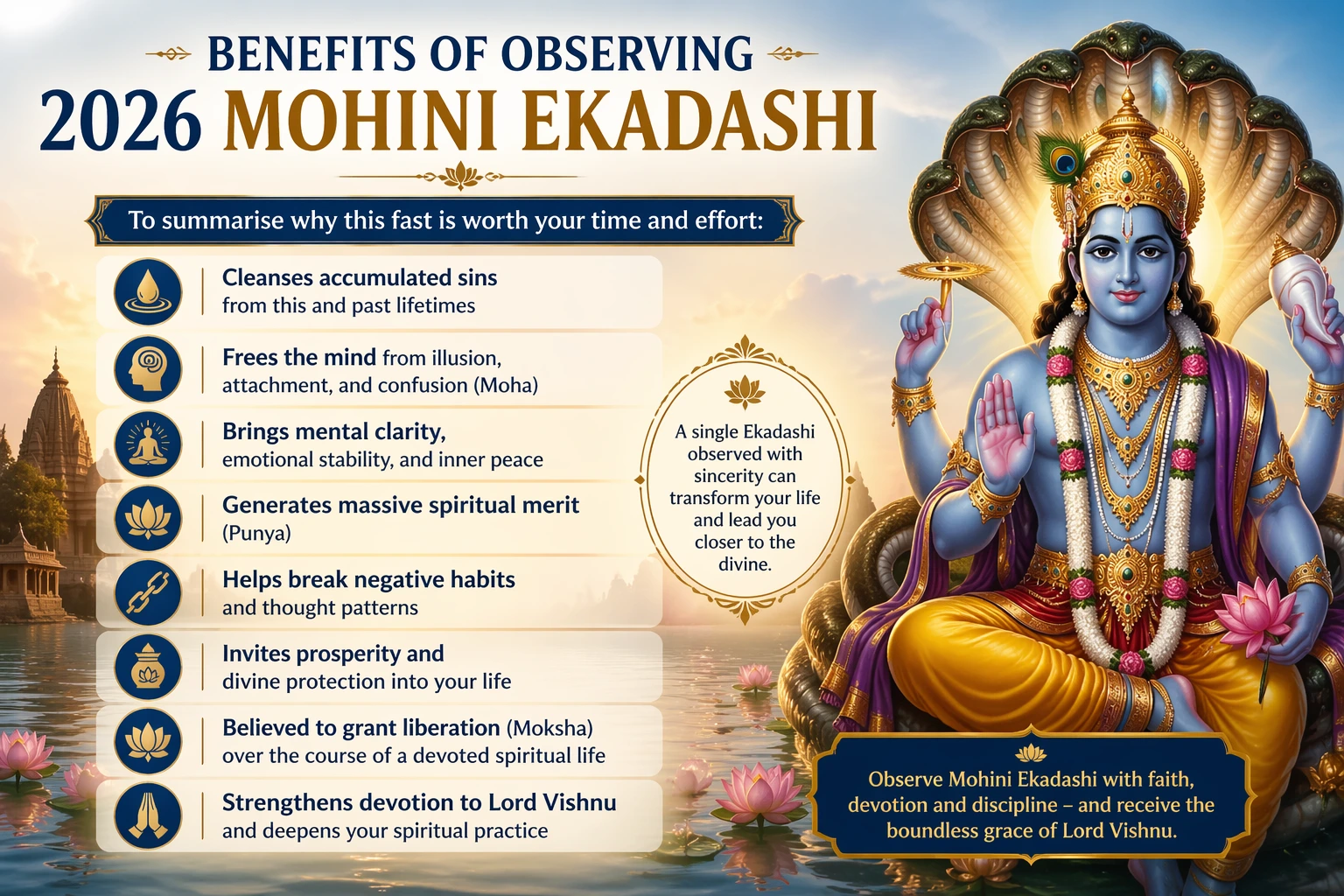
To summarise why this fast is worth your time and effort:
- Cleanses accumulated sins from this and past lifetimes
- Frees the mind from illusion, attachment, and confusion (Moha)
- Brings mental clarity, emotional stability, and inner peace
- Generates massive spiritual merit (Punya)
- Helps break negative habits and thought patterns
- Invites prosperity and divine protection into your life
- Believed to grant liberation (Moksha) over the course of a devoted spiritual life
- Strengthens devotion to Lord Vishnu and deepens your spiritual practice
Conclusion
2026 Mohini Ekadashi on Monday, 27th April 2026 is one of the most spiritually significant days of the year — and an opportunity you genuinely don’t want to miss. Whether you are a lifelong devotee or someone who is only just beginning to explore the wisdom of Hindu fasting traditions, this Ekadashi offers something profoundly valuable: a chance to pause, purify, and reconnect with what truly matters.
Fast with intention. Worship with love. Break your fast at the right Parana time on 28th April. And carry the clarity and grace of this day into the weeks and months that follow.
May Lord Vishnu’s Mohini Avatar bless you with freedom from all illusions, karmic healing, and the deepest peace of your life. 🙏
Frequently Asked Questions (FAQs) About 2026 Mohini Ekadashi
Q1. When is Mohini Ekadashi in 2026?
Mohini Ekadashi 2026 falls on Monday, 27th April 2026.
Q2. What is the Parana time for Mohini Ekadashi 2026?
The Parana (fast-breaking) time for New Delhi is 5:43 AM to 8:21 AM on Tuesday, 28th April 2026. Timings may vary slightly by location — check your local Panchang for precision.
Q3. When does the Ekadashi Tithi begin and end in 2026?
The Ekadashi Tithi begins at 6:06 PM on 26th April 2026 and ends at 6:15 PM on 27th April 2026.
Q4. Why is it called Mohini Ekadashi?
It is named after the Mohini Avatar of Lord Vishnu — the divine feminine form He assumed during the Samudra Manthan to retrieve Amrit from the demons and distribute it to the Devas. Lord Vishnu is believed to have manifested in this form on this particular Ekadashi Tithi.
Q5. What is Hari Vasara and why does it matter?
Hari Vasara is the first one-quarter duration of the Dwadashi Tithi (the day after Ekadashi). Breaking the Ekadashi fast during Hari Vasara is considered inauspicious and nullifies the merit of the fast. Always wait for Hari Vasara to end before breaking your fast.
Q6. Can beginners observe Mohini Ekadashi fast?
Absolutely. Beginners can start with a Phalahari Vrat (fruit-only fast) or even a partial fast. What matters most is the sincerity of intention. You don’t need to jump straight into a Nirjala (waterless) fast.
Q7. Can I drink water during Mohini Ekadashi Vrat?
Yes, for most types of fasting. Only those observing Nirjala Vrat abstain from water entirely. Jalahar Vrat allows water only. Phalahari allows water, fruits, and milk-based products.
Q8. What should I donate on Mohini Ekadashi?
Food and grains are considered the most auspicious donations. You can also donate Tulsi plants, yellow flowers, yellow cloth, books, or provide clean drinking water to those in need.
Q9. Is Mohini Ekadashi the same across all regions of India?
The spiritual significance is the same, but the regional calendar name differs. In Tamil Nadu it falls in Chithirai month, in Bengal during Jyestho, and in Kerala during Edava. The date may vary slightly based on regional Panchang calculations.
Q10. What mantra should I chant on Mohini Ekadashi?
The most recommended mantra is: Om Namo Bhagavate Vasudevaya. Chanting it 108 times with a Tulsi mala is highly auspicious. Reciting the Vishnu Sahasranama and the Hare Krishna Mahamantra are also deeply rewarding on this day.
Q11. Can women observe Mohini Ekadashi fast?
Yes, Mohini Ekadashi is open to everyone — men, women, and children (based on their capacity). There are no gender-based restrictions for observing this fast.
Q12. What happens if I break the fast by mistake before Parana time?
If you break the fast accidentally before the Parana window, offer a sincere prayer to Lord Vishnu, acknowledge it, and continue your devotion throughout the day. The scriptures emphasize intention and devotion above rigid rule-following.