Every month, when the Sun shifts from one zodiac sign to another, a powerful cosmic door opens. This moment is called Sankranti — and among the twelve in a year, Vrishabha Sankranti 2026 holds a uniquely grounding and prosperous energy. It marks the Sun’s transition from fiery Aries into earthy Taurus, a shift that fundamentally changes the nature of solar energy around us — from impulsive and fast to stable, patient, and wealth-oriented.
If you’re a spiritual devotee, an NRI trying to stay connected with your roots, or someone who follows Vedic traditions closely, this day is not one to miss. Let’s walk through everything you need to know — the exact date and timing, what makes this particular Sankranti special in 2026, how to observe it the right way, and most importantly, how it is going to affect your zodiac sign.
 Vrishabha Sankranti 2026: Date and Exact Time
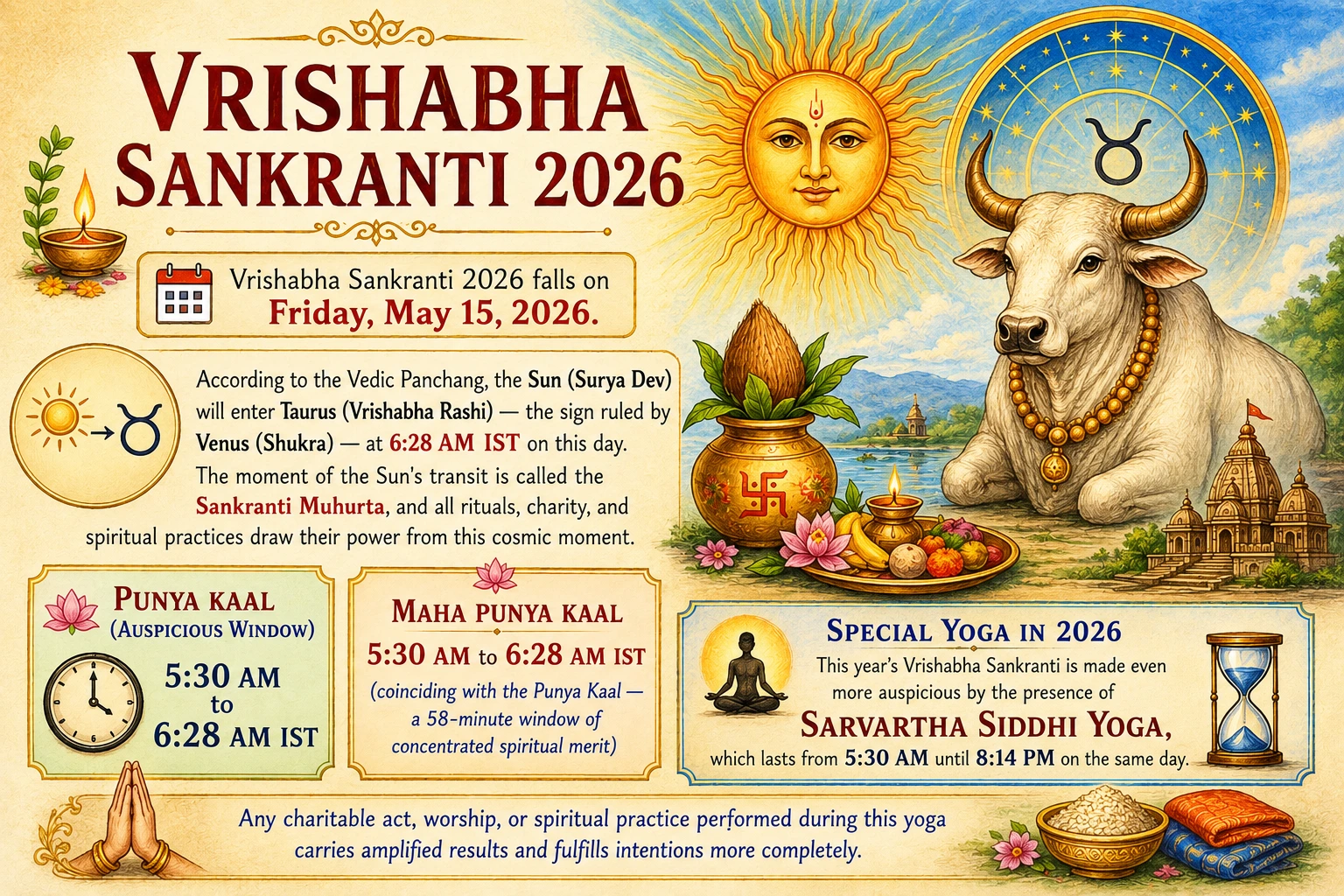
Vrishabha Sankranti 2026 falls on Friday, May 15, 2026.
According to the Vedic Panchang, the Sun (Surya Dev) will enter Taurus (Vrishabha Rashi) — the sign ruled by Venus (Shukra) — at 6:28 AM IST on this day. The moment of the Sun’s transit is called the Sankranti Muhurta, and all rituals, charity, and spiritual practices draw their power from this cosmic moment.
Punya Kaal (Auspicious Window): 5:30 AM to 6:28 AM IST
Maha Punya Kaal: 5:30 AM to 6:28 AM IST (coinciding with the Punya Kaal — a 58-minute window of concentrated spiritual merit)
Special Yoga in 2026: This year’s Vrishabha Sankranti is made even more auspicious by the presence of Sarvartha Siddhi Yoga, which lasts from 5:30 AM until 8:14 PM on the same day. Any charitable act, worship, or spiritual practice performed during this yoga carries amplified results and fulfills intentions more completely.
For devotees in the USA, UK, Canada, Australia, or other parts of the world: the IST timings can be converted to your local time zone. The spiritual merit, however, is not limited by geography — your Sankalpa (intention) performed with sincerity connects to the same divine energy.
What Is Vrishabha Sankranti? Understanding the Vedic Significance
In the Hindu solar calendar, Vrishabha Sankranti marks the beginning of the second solar month — Vrishabha Masa (also called Vaishakha Masa in some regional traditions). Across twelve Sankrantis in a year, each one carries a distinct cosmic signature based on the sign the Sun enters.
Taurus (Vrishabha) is an earth sign governed by Venus. It represents:
- Material stability and long-term abundance
- Agricultural prosperity and the earth’s fertility
- Patient effort, sensory beauty, and grounded spiritual practice
- The divine principle of Nandi — the sacred bull, vehicle of Lord Shiva
When the Sun, the cosmic king and significator of the soul (Atma Karaka), enters this Venusian earth sign, the energy turns toward tangible blessings — health, wealth, fertile land, and stable relationships. Ancient Vedic texts describe this as a time when nature itself becomes more receptive to sincere prayer.
Vrishabha Sankranti is classified as a Vishnupadi Sankranti — one of the four Sankrantis that occur when the Sun enters cardinal or fixed signs of the zodiac. These are considered more potent for religious observance than the others.
Do you know which planet is ruining your life?
Listen Now to explore
The Vahana (Celestial Vehicle) of Vrishabha Sankranti 2026
Vedic astrology personifies each Sankranti and describes its Vahana (mount), direction of gaze, and physical attributes — all of which serve as cosmic omens for the month ahead.
For Vrishabha Sankranti 2026:
- Vahana: Mahisha (Buffalo) — suggesting a period of steady, slow-moving but powerful momentum
- Karana: Vanija — associated with trade and merchants, indicating the month is favorable for business dealings
- Nakshatra at Sankranti moment: Ashwini (classified as Kshipra or swift nakshatra)
- Moon Sign at Sankranti: Mesha (Aries)
The classical Sankranti Phalam (monthly omen) for Vrishabha Sankranti 2026 indicates:
- Generally good health conditions for the population
- Positive conditions for traders and businessmen
- Harmony among communities and nations
- Increased grain and food stocks — prosperity for the earth
Why Vrishabha Sankranti 2026 Is Especially Powerful
Most years, the spiritual window of Vrishabha Sankranti is powerful in itself. But 2026 offers something extra:
- Sarvartha Siddhi Yoga: This rare yoga, formed by the combination of specific tithi, nakshatra, and weekday, means that intentions set and actions taken during this period reach their fulfillment. It is among the most auspicious yogas in the Panchang.
- Friday (Shukravar): The day itself is ruled by Venus (Shukra), the owner of Taurus. The Sun entering Shukra’s own sign on Shukra’s own day creates a harmonious alignment between the solar deity and the planetary lord of the sign — a rare coincidence that amplifies blessings related to wealth, beauty, relationships, and material well-being.
- Ashwini Nakshatra: The Moon at Sankranti time is placed in Ashwini Nakshatra, which is ruled by the Ashwini Kumaras — the divine physicians of the gods. This is considered an auspicious nakshatra for healing, new beginnings, and swift blessings.
Vrishabha Sankranti 2026 Rituals: How to Observe This Day
The observance of Vrishabha Sankranti is rooted in simplicity and sincerity. Here is a detailed, step-by-step guide drawn from Vedic tradition and the ritual framework at Astrobhava:
1. Brahma Muhurta Snan (Pre-Dawn Sacred Bath)
Wake up before sunrise — ideally by 5:00 AM IST. Take a purifying bath with a few drops of Ganga jal (Ganges water) or sesame oil mixed into the water. If you are in the USA, UK, or abroad and cannot visit a river, a bath at home with sincere Sankalpa is fully valid. The Punya Kaal begins at 5:30 AM, so completing your bath before this window opens is the ideal preparation.
2. Surya Arghya (Offering Water to the Sun)
Stand facing east. Fill a copper vessel with clean water, add red flowers, red sandalwood powder, and a few grains of rice. While pouring the water toward the Sun (or in the direction of sunrise), chant:
“Om Suryaya Namaha” “Om Adityaya Namaha” “Om Bhaskaraya Namaha”
This single act, performed with a clean heart, is considered equivalent to a holy river dip in the Punya Kaal of Sankranti.
3. Rishabharudra Puja (Special Worship for Vrishabha Sankranti)
Vrishabha Sankranti is traditionally linked to Lord Shiva in his form as Rishabharudra — the one who rides the bull (Nandi). Worship of Shiva’s Nandi aspect and of Lord Vishnu is highly recommended. Offer bilva leaves, white flowers, sesame seeds, and a lamp of ghee. Prepare a bhog (sacred food offering) of payasam (sweet rice pudding) and plain rice — these are the traditional offerings of this Sankranti.
4. Godan or Tuladan (Charitable Gifting)
One of the most powerful acts of merit on Vrishabha Sankranti is Godan — the gifting of a cow or a symbolic cow donation to a Brahmin or temple trust. Since gifting an actual cow may not be practical for those living abroad, a monetary donation equivalent — given with a pure heart and declared as “Godan Sankalpa” — carries the same Vedic merit.
Other highly meritorious donations on this day:
- Ghee, sesame seeds, jaggery, and whole grains
- Yellow and white cloth
- Copper vessels
- Donations to food banks or annadana (food charity) programs — this is especially powerful for NRIs seeking to accumulate spiritual merit from abroad
5. Pitra Tarpan (Ancestral Offerings)
Vrishabha Sankranti is a deeply auspicious day for Pitra Tarpan — offering water and sesame seeds to departed ancestors. Performed during the Punya Kaal window, this act is believed to free ancestral souls from any lingering suffering and send merit forward in your family lineage. If you have had unresolved Pitra Dosha (ancestral affliction) in your chart, this is an ideal day to address it with a formal tarpan and, ideally, a dedicated Puja.
 6. Surya Mantra Japa (Solar Mantra Chanting)
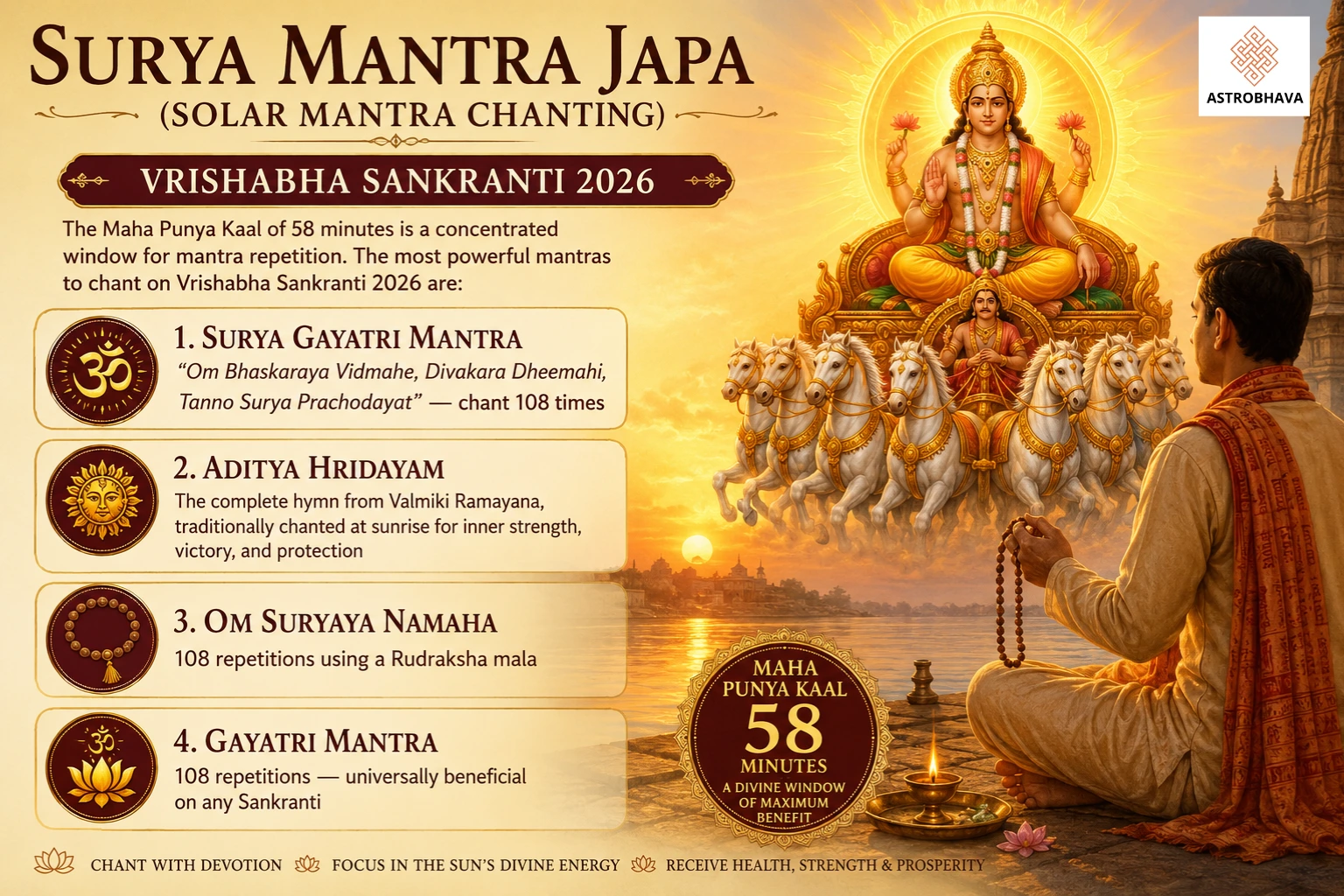
The Maha Punya Kaal of 58 minutes is a concentrated window for mantra repetition. The most powerful mantras to chant on Vrishabha Sankranti 2026 are:
- Surya Gayatri Mantra: “Om Bhaskaraya Vidmahe, Divakara Dheemahi, Tanno Surya Prachodayat” — chant 108 times
- Aditya Hridayam: The complete hymn from Valmiki Ramayana, traditionally chanted at sunrise for inner strength, victory, and protection
- Om Suryaya Namaha: 108 repetitions using a Rudraksha mala
- Gayatri Mantra: 108 repetitions — universally beneficial on any Sankranti
7. Avoid on This Day
- Initiating auspicious ceremonies like marriages, Griha Pravesh, or new business launches (Sankranti days are for penance and charity, not new auspicious beginnings)
- Sleeping during the daytime — traditionally, one sleeps on the floor as an act of humility and devotion
- Consuming non-vegetarian food or alcohol
Vrishabha Sankranti 2026: Impact on All 12 Zodiac Signs
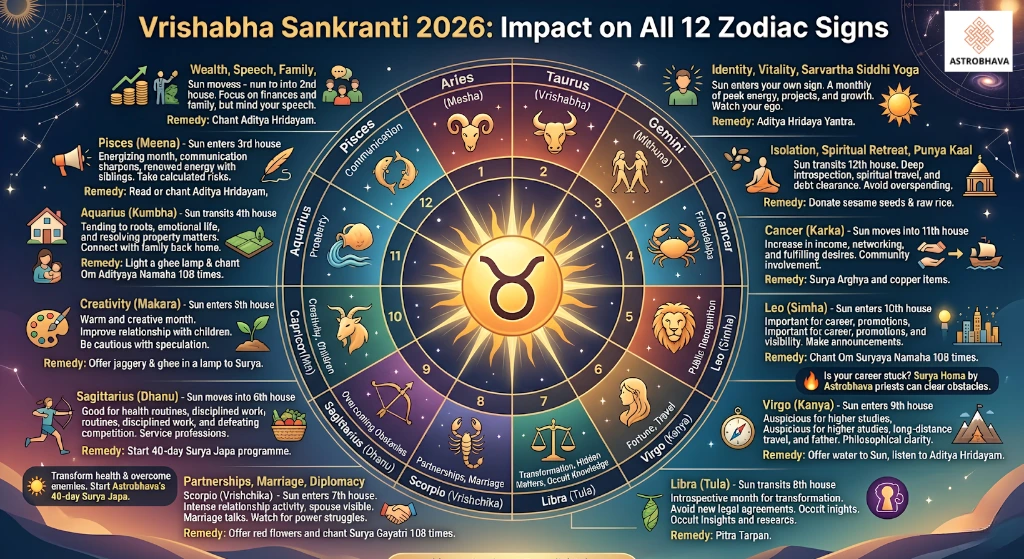
When the Sun moves into Taurus, its placement in your natal chart activates a specific house of your life. Here’s how Vrishabha Sankranti 2026 will affect each sign:
Aries (Mesha)
The Sun moves from your own sign into your second house of wealth, speech, and family. This is a welcome shift from intense personal energy to financial building. Family bonds strengthen, and accumulated efforts over the past month begin to show tangible results. However, be careful with harsh speech — the second house governs how you communicate, and words carry weight now. Donate sesame-based food to honour the transition.
Best remedy: Chant Aditya Hridayam at sunrise for 7 consecutive days starting May 15.
Taurus (Vrishabha)
The Sun enters your own sign — your first house of self, identity, and vitality. This is one of the most energetically charged months of your year. You feel more confident, visible, and driven. Health, personal projects, and leadership initiatives receive a boost. The Sarvartha Siddhi Yoga on Vrishabha Sankranti further amplifies personal growth for you more than any other sign. The only caution: the Sun in your first house can also stoke ego — stay grounded.
Best remedy: Place an Aditya Hridaya Yantra energised by Astrobhava on your altar and worship it daily through June.
Gemini (Mithuna)
The Sun transits your twelfth house of isolation, spiritual retreat, and moksha. This is a deeply introspective phase — not ideal for outward career pushes, but excellent for meditation, sleep healing, spiritual travel (or virtual pilgrimages for those abroad), and clearing old debts, both financial and karmic. Avoid unnecessary expenses. The Sankranti’s Punya Kaal is especially powerful for you to release old patterns through Tarpan and charity.
Best remedy: Donate white sesame seeds and raw rice to a temple or food bank on May 15.
Cancer (Karka)
The Sun moves into your eleventh house of gains, friendships, social networks, and fulfillment of desires. This is a broadly positive transit for you! Income streams may expand, old social connections get reactivated, and long-delayed goals inch closer to fulfillment. This is an ideal time to ask for help, network professionally, and collaborate on group projects. For NRIs, connections with community groups and diasporic professional networks become particularly fruitful.
Best remedy: Perform Surya Arghya daily through June and donate copper items as a part of your Sankranti observance.
Leo (Simha)
The Sun enters your tenth house — the most important house for career, reputation, and public recognition. As a Sun-ruled sign, this transit is especially significant for you. Authority figures notice your work. Career advancements, promotions, and public visibility peak during this period. It is an excellent month to make professional announcements, launch career-related projects, and establish your reputation in your field.
Best remedy: Chant Om Suryaya Namaha 108 times every morning facing east — your career sector lights up with each recitation.
Virgo (Kanya)
The Sun enters your ninth house of dharma, fortune, long-distance travel, spirituality, and father. This is a highly auspicious transit for Virgo. Philosophical clarity increases. Your relationship with your father or father-figure improves. If you’ve been considering higher education, long-distance travel, or spiritual studies — this is the green light. For NRIs and those living abroad, this transit often brings blessings related to your adopted homeland and your connection with Indian roots.
Best remedy: Offer water to the Sun daily and read or listen to the Aditya Hridayam hymn each morning.
Libra (Tula)
The Sun transits your eighth house of transformation, inheritance, hidden matters, and longevity. This is typically an introspective and somewhat challenging transit, calling you toward deeper spiritual enquiry rather than outward activity. Avoid signing new legal agreements without careful review. However, the eighth house Sun also brings power through Tantra, occult knowledge, and deep research — so if you are spiritually inclined, this is a rich period for transformation.
Best remedy: Perform Pitra Tarpan on the Sankranti day to mitigate eighth house intensity and restore ancestral protection.
Scorpio (Vrishchika)
The Sun enters your seventh house of partnerships, marriage, and business relationships. For Scorpio, Vrishabha Sankranti initiates a month of significant relationship activity. If you are married, your spouse becomes more visible and active in your joint life. Business partnerships can be formalized. Marriage negotiations for single Scorpios get momentum. Be aware, though — the Sun in the seventh can also bring power struggles with partners. Diplomacy is essential.
Best remedy: Offer red flowers to Surya and chant the Surya Gayatri 108 times for harmony in partnerships.
Sagittarius (Dhanu)
The Sun moves into your sixth house of health, daily work, enemies, and service. This transit is energetically useful for clearing obstacles and defeating competition. Your physical health can be actively improved through disciplined routine. For those in service professions — doctors, lawyers, military, healthcare — this is a powerful month. Donate food generously during the Punya Kaal, as sixth house charity has direct karmic returns in clearing debts.
Best remedy: Begin a 40-day Surya Japa programme on Vrishabha Sankranti to systematically clear sixth-house obstacles and health concerns.
Capricorn (Makara)
The Sun enters your fifth house of children, creativity, intelligence, speculation, and romance. A warm and creative month lies ahead for Capricorn. Students and those in creative fields get a significant boost. Relationship with children improves. If you have been working on a creative project — writing, art, music, entrepreneurial ideas — the fifth house Sun gives it wings. Speculative investments, however, should still be approached with caution.
Best remedy: Offer jaggery and ghee in a lamp to Surya and pray for the well-being of your children or students in your care.
Aquarius (Kumbha)
The Sun transits your fourth house of home, mother, property, and inner peace. This is an internalized transit that asks you to tend to your roots — your home, your family, and your inner emotional life. Property matters can be resolved. Your relationship with your mother benefits from intentional connection. For NRIs, this transit often triggers homesickness or a desire to reconnect with family back in India — honour that impulse; it is spiritually meaningful.
Best remedy: Light a ghee lamp at home and chant Om Adityaya Namaha 108 times as a daily home worship practice through June.
Pisces (Meena)
The Sun enters your third house of courage, siblings, communication, and short journeys. This is an energizing transit for Pisces. Communication skills sharpen. Sibling relationships get renewed energy. Courage and initiative rise — this is the time to take those smaller, calculated risks you’ve been avoiding. For spiritual seekers, the third house Sun also activates devotional writing, journaling, and short pilgrimages (even virtual ones). Sign up for that astrology course, write that blog, make that call.
The Deeper Spiritual Meaning of Vrishabha Sankranti
Beyond the outer rituals, Vrishabha Sankranti carries a profound teaching. In Vedic cosmology, the bull (Rishabha) is the symbol of Dharma — the cosmic bull of righteousness that stands on its four legs: Satya (truth), Shauch (purity), Daya (compassion), and Daan (charity). When the Sun enters this sign, we are collectively called to examine how firmly we stand on these four legs.
Lord Shiva’s Nandi — the great bull — is not merely a mount but a guardian of the divine threshold. Worshipping the Nandi principle on Vrishabha Sankranti is an act of seeking entry into that sacred space where material prosperity and spiritual richness are not in opposition, but in perfect union.
This is why Godan (cow gifting) is so central to this Sankranti. The cow, the bull, the earth’s fertility, and the Sun’s stabilizing energy in Taurus all point toward the same principle: true wealth flows from right conduct, from patience, and from generosity freely given.
Vrishabha Sankranti 2026 for the NRI and Global Devotee
One of the most common questions from devotees in the USA, UK, UAE, Canada, and Australia is: “Can I observe Sankranti rituals properly from abroad?”
The answer is a clear and resounding yes. Here’s how:
Adjust your timing: The Punya Kaal on May 15, 2026 runs from 5:30 AM to 6:28 AM IST. In US Eastern Time (EDT), this corresponds to approximately 8:00 PM to 8:58 PM on May 14 (the night before). In BST (UK), it is 1:00 AM to 1:58 AM on May 15. Set an alarm, wake up, and observe even a simple sunrise arghya if you can physically be awake at that hour in your timezone.
Delegate the ritual: If waking at midnight isn’t practical, book a Surya Homa or Puja with Astrobhava. Their expert priests in India will perform the ritual during the auspicious Punya Kaal with your personal Sankalpa, name, nakshatra, and gotra — and the live telecast link is sent to you beforehand so you can participate virtually, from wherever you are in the world.
Perform a simple home ritual: At any point during the day of May 15, light a ghee lamp, face east, chant Om Suryaya Namaha 108 times, and donate to a food bank or spiritual cause in your locality. This sincere act of Daan-Punya during Sankranti carries real merit regardless of geography.
Conclusion
Vrishabha Sankranti 2026 is more than a date on the calendar — it is a cosmic invitation. The Sun’s transition into Venus-ruled Taurus on Friday, May 15, 2026, powered by the rare Sarvartha Siddhi Yoga, creates a unique 58-minute window of Maha Punya Kaal between 5:30 AM and 6:28 AM IST. This is your moment — for purification, for generous giving, for ancestral healing, and for planting seeds of material and spiritual prosperity that the Sun in stable Taurus will faithfully nourish.
Whether you are in Jaipur or New Jersey, Bengaluru or Birmingham, the cosmic door opens equally for every sincere seeker. Observe the rituals as best you can, chant the Surya mantras, give generously, and consider dedicating a Surya Homa, Puja, or Japa at Astrobhava to anchor the divine blessings of this day specifically to your life and your family.
The bull stands firm. The Sun shines steady. This Vrishabha Sankranti, let your intentions do the same.
Frequently Asked Questions (FAQs)
Q1. What is Vrishabha Sankranti 2026 date and time?
Vrishabha Sankranti 2026 falls on Friday, May 15, 2026. The Sun enters Taurus (Vrishabha Rashi) at 6:28 AM IST. The Maha Punya Kaal runs from 5:30 AM to 6:28 AM IST — a 58-minute window considered most auspicious for rituals, charity, and prayer.
Q2. Which yoga is formed on Vrishabha Sankranti 2026?
This year’s Vrishabha Sankranti is graced by Sarvartha Siddhi Yoga, lasting from 5:30 AM to 8:14 PM IST — one of the most powerful yogas in the Vedic Panchang for fulfillment of intentions and success of spiritual and worldly actions.
Q3. What should I donate on Vrishabha Sankranti?
The most meritorious donations include sesame seeds, jaggery, ghee, whole grains, yellow cloth, copper vessels, and food. Godan (symbolic cow donation) is considered especially powerful on this day. Donating to annadana (food charity) programs is highly recommended for NRIs abroad.
Q4. Can Vrishabha Sankranti rituals be performed outside India?
Absolutely. The Sankranti Punya Kaal energizes the entire planet, not just India. Devotees in the USA, UK, UAE, and other countries can perform Surya Arghya, mantra japa, and charity at home. Additionally, Astrobhava performs personalized rituals on your behalf during the exact Punya Kaal in India, with live telecast access for global participation.
Q5. Which zodiac sign benefits most from Vrishabha Sankranti 2026?
While every sign benefits to varying degrees, Taurus (Vrishabha), Leo (Simha), Virgo (Kanya), and Cancer (Karka) receive particularly strong blessings from this transit in 2026, especially due to the additional influence of Sarvartha Siddhi Yoga.
Q6. What is the significance of Godan on Vrishabha Sankranti?
Godan — the donation of a cow or a symbolic monetary equivalent — carries immense merit on this day because Taurus is the sign of the bull, directly associated with Dharma and Lord Shiva’s Nandi. Ancient Vedic texts state that Godan on Vrishabha Sankranti brings prosperity, good health, and the alleviation of Pitru Dosha.
Q7. Can I perform Pitra Tarpan on Vrishabha Sankranti?
Yes, and it is highly recommended. All twelve Sankrantis are auspicious for ancestral rites, and Vrishabha Sankranti in particular is ideal because of its stable earth-sign energy. Performing Pitra Tarpan during the Punya Kaal with sesame seeds and water offered to departed ancestors is believed to bring peace to the family lineage and remove inherited karmic blockages.
Q8. What is the difference between Punya Kaal and Maha Punya Kaal?
The Punya Kaal is the broader auspicious window around Sankranti — traditionally 16 Ghatis (approximately 6.5 hours) before the Sankranti moment. The Maha Punya Kaal is a shorter, more concentrated window of even higher spiritual potency within the Punya Kaal. In 2026, both the Punya Kaal and Maha Punya Kaal are the same 58-minute window from 5:30 AM to 6:28 AM IST, making this an exceptionally intense period of merit.
Q9. Is starting new work or business allowed on Vrishabha Sankranti?
Sankranti days, including Vrishabha Sankranti, are traditionally reserved for charity, prayer, and penance — not for initiating auspicious ceremonies like weddings, Griha Pravesh, or major new ventures. However, after the Sankranti moment passes and the new solar month begins, auspicious activities can resume.
Q10. How can I book a Surya Homa or Puja at Astrobhava for Vrishabha Sankranti 2026?
Visit Astrobhava and browse the Surya Homa, Surya Puja, and Surya Japa packages. Once you book, you share your birth details (name, nakshatra, rashi, gotra), and the Astrobhava team confirms the auspicious Muhurta for your ritual. All Homas are live-telecasted from the Yagna Ashram in Coimbatore, and prasad along with an energised Yantra is shipped worldwide free of charge.