If you’re a devoted Shiva bhakta wondering when to observe Pradosh Vrat in May 2026, what the exact timings are, how to perform the puja correctly, or what makes this particular Pradosham so spiritually significant — you’ve come to the right place. This guide covers everything you need, straight from an authentic Vedic perspective.
Whether you’re living in New York, London, Toronto, Sydney, or anywhere else in the world as an NRI or spiritual seeker, the sacred observance of Pradosh Vrat transcends geography. Lord Shiva’s grace knows no borders. And May 2026 brings not one, but two powerful Pradosh Vrat opportunities — each with its own distinct planetary energy and blessings.
Let’s dive in.
What Is Pradosh Vrat? A Quick Refresher
Before we get into the May 2026 specifics, let’s quickly understand what Pradosh Vrat actually is — because it’s not just another fast on the Hindu calendar.
The word “Pradosh” is derived from Sanskrit — Pra meaning “remover” and Dosha meaning “malicious karma or sin.” So literally, Pradosh means the remover of negative karma. This is the essence of why this Vrat is so deeply revered.
Pradosh Vrat is observed on the Trayodashi Tithi — the 13th lunar day — of both the Shukla Paksha (waxing moon fortnight) and the Krishna Paksha (waning moon fortnight) of every Hindu lunar month. That means two Pradosh Vrats every month, totalling 24 to 25 observances in a year.
The most sacred window for worship is the Pradosh Kaal — the twilight period that begins approximately 45 minutes before sunset and extends roughly 45 minutes after it. This window of around 1.5 to 2.5 hours is considered the most spiritually charged time of the entire day. According to Vedic scriptures and the Shiva Purana, this is the exact time when Lord Shiva performs his cosmic Tandava — the divine dance of creation, preservation, and dissolution — and He is said to be in the most accessible, grace-bestowing mood.
In short, worshipping Lord Shiva during Pradosh Kaal on Trayodashi is like knocking on a door when you know for certain the master of the house is home and eager to bless.
 May Pradosh Vrat 2026: Dates and Timings
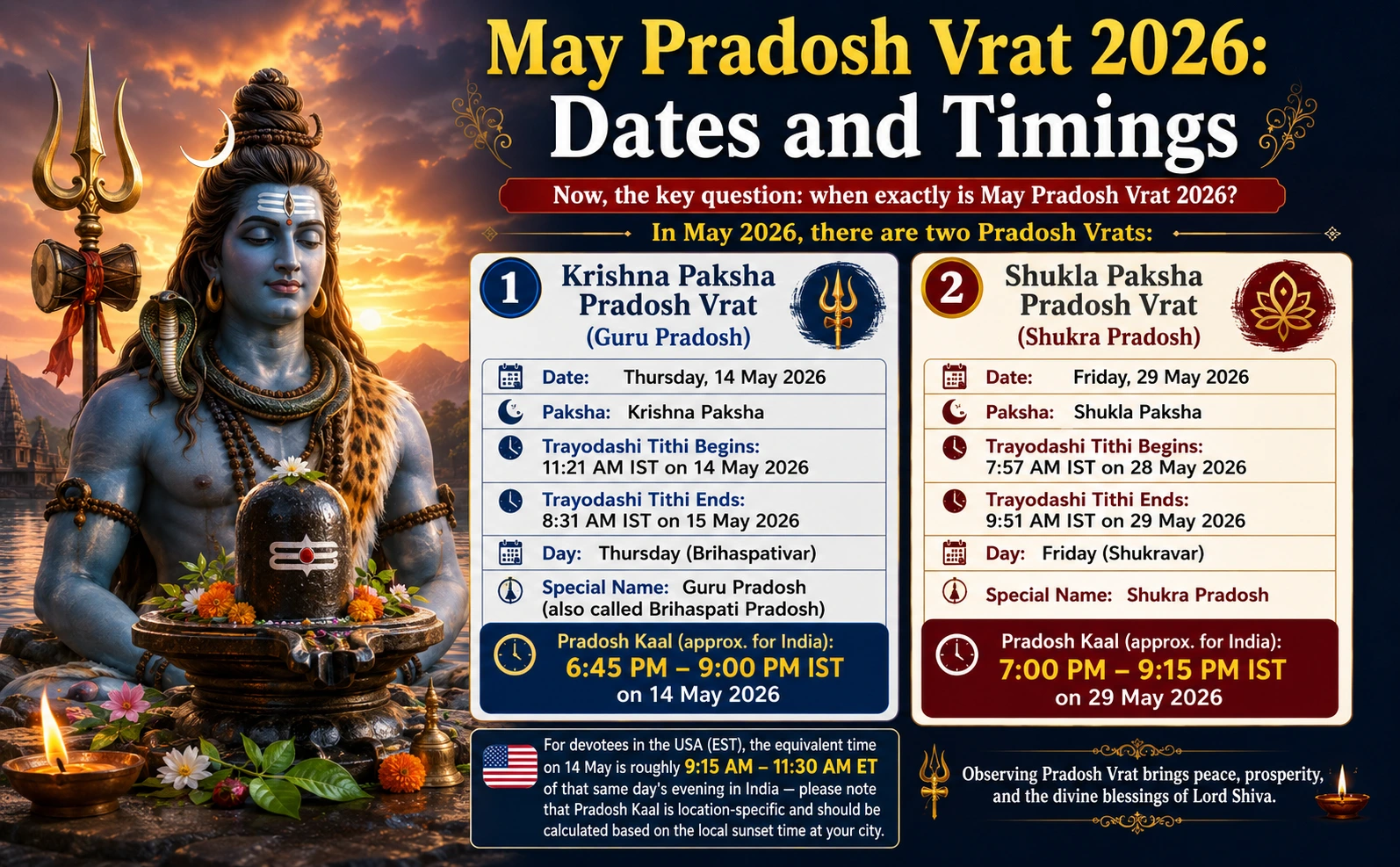
Now, the key question: when exactly is May Pradosh Vrat 2026?
In May 2026, there are two Pradosh Vrats:
1. Krishna Paksha Pradosh Vrat — Thursday, 14 May 2026 (Guru Pradosh)
Paksha: Krishna Paksha Trayodashi Tithi Begins: 11:21 AM IST on 14 May 2026 Trayodashi Tithi Ends: 8:31 AM IST on 15 May 2026 Day: Thursday (Brihaspativar) Special Name: Guru Pradosh (also called Brihaspati Pradosh) Pradosh Kaal (approx. for India): Approximately 6:45 PM – 9:00 PM IST on 14 May 2026
For devotees in the USA (EST), the equivalent time on 14 May is roughly 9:15 AM – 11:30 AM ET of that same day’s evening in India — please note that Pradosh Kaal is location-specific and should be calculated based on the local sunset time at your city.
2. Shukla Paksha Pradosh Vrat — Friday, 29 May 2026 (Shukra Pradosh)
Paksha: Shukla Paksha Trayodashi Tithi Begins: 7:57 AM IST on 28 May 2026 Trayodashi Tithi Ends: 9:51 AM IST on 29 May 2026 Day: Friday (Shukravar) Special Name: Shukra Pradosh Pradosh Kaal (approx. for India): Approximately 7:00 PM – 9:15 PM IST on 29 May 2026
Important Note for Global Devotees: Since Pradosh Kaal is dependent on the local sunset time at your location, the exact timing will vary significantly between India, the USA, UK, Canada, Australia, and other countries. Always calculate Pradosh Kaal based on the sunset time in your city and observe the vrat during the twilight window accordingly. Trayodashi Tithi must be prevailing at the time of sunset for the vrat to be valid on that day.
The Significance of Guru Pradosh Vrat (14 May 2026)
This is a big one for spiritual seekers. When Pradosh Vrat falls on a Thursday — the day governed by Guru (Jupiter) — it is called Guru Pradosh or Brihaspati Pradosh. This combination amplifies blessings in areas that Jupiter governs: wisdom, spiritual growth, higher knowledge, dharma, prosperity, marriage, and progeny.
In Vedic astrology, Jupiter is the planet of grace, expansion, and divine blessings. When his day coincides with the Pradosh of Lord Shiva — the Mahadeva who is himself the supreme Guru of all Gurus — the synergy is extraordinary.
Guru Pradosh is especially recommended for:
- Those seeking blessings for children or having difficulty conceiving
- Students and professionals seeking knowledge, promotions, or academic success
- Individuals with a weak or afflicted Jupiter in their horoscope
- Anyone walking a path of spiritual seeking and wanting deeper wisdom
- Couples seeking harmony and a blessed married life
🔥 Amplify the blessings of Guru Pradosh — Book a Rudra Homam performed by AstroBhava’s expert Vedic priests and let the sacred fire invoke Shiva’s grace directly into your life.
The Significance of Shukra Pradosh Vrat (29 May 2026)
The second Pradosh of May 2026 falls on a Friday, making it Shukra Pradosh — governed by Venus, the planet of love, beauty, relationships, comfort, and material abundance.
Shukra Pradosh combines the bhakti energy of Lord Shiva with the auspiciousness of Shukra (Venus). This Pradosh is particularly powerful for:
- Removing obstacles in marriage or long-term relationships
- Attracting love, harmony, and domestic peace
- Overcoming Venus-related issues in the horoscope (weak Shukra, Venus afflictions)
- Clearing financial hurdles and attracting material stability
- Those seeking beauty, creativity, and artistic growth
In Vedic tradition, worshipping Goddess Parvati alongside Lord Shiva during Shukra Pradosh is considered especially auspicious for marital harmony — as Parvati herself is the embodiment of Shakti and the divine feminine energy.
Step-by-Step Pradosh Vrat Rituals and Puja Vidhi
Now let’s talk about the actual practice. How do you observe May Pradosh Vrat 2026 the right way? Here is the complete, authentic procedure as followed in the Vedic tradition.
Morning Preparation (Sunrise to Afternoon)
- Wake Up Early and Take a Sacred Bath Begin the day of Pradosh Vrat by waking up before or at sunrise. Take a purificatory bath (ideally with water mixed with a few drops of Ganga Jal if available). Wear freshly washed, clean clothes — preferably white or light-colored, as these represent purity and Shiva’s energy.
- Take the Sankalpa (Sacred Vow) After your bath, face East, hold water in your right palm, and take a conscious vow (Sankalpa) that you are observing this Pradosh Vrat for the blessings of Lord Shiva and Goddess Parvati. State your name, your Gotra (lineage), and your intention. This step is not optional — the Sankalpa is what formally initiates the vrat and activates its spiritual power.
- Observe the Fast The Pradosh fast begins from sunrise. You may observe either:
- A complete Nirjala fast (no food, no water) — the most rigorous and meritorious
- A Phalahar fast (fruits, milk, and permitted items only) — widely followed by most devotees
- A partial fast where you avoid grains, non-vegetarian food, alcohol, and onion/garlic
Eat only Sattvic, pure food if you choose the partial observance. Avoid tamasic food (meat, alcohol), negative speech, and anger throughout the day. Observing celibacy on this day is also recommended.
Evening Puja During Pradosh Kaal
This is the heart of Pradosh Vrat — the actual puja during the sacred twilight window. Everything before this is preparation. The Pradosh Kaal puja is where the real divine connection happens.
- Take a Second Ritual Bath Before Sunset About 45 to 60 minutes before sunset, take a fresh bath. This second purification before the Pradosh Kaal puja is specifically prescribed in the Shiva Purana and prepares the body and mind for the sacred act of worship.
- Set Up the Puja Space Create a clean, sacred altar facing either East or North. Place a Shivalinga at the center — this is non-negotiable for authentic Pradosh puja. If you don’t have a Shivalinga at home, you can also perform puja at your nearest Shiva temple, which is always recommended.
Place a Kalash (copper or brass pot) filled with water nearby, with mango leaves and a coconut on top. Draw a lotus symbol beneath the Kalash using sacred powder (rangoli or rice flour). Spread Darbha (Kusha) grass beneath it. This Kalash represents Lord Shiva’s invoked presence.
- Invoke Lord Ganesha First Always begin any puja by invoking Lord Ganesha — the remover of obstacles and the lord of beginnings. Offer him Modak, Durva grass, and red flowers with a simple prayer: “Om Gam Ganapataye Namaha.” This clears the path for the Shiva puja that follows.
- Perform the Shiva Panchayatana Puja On Pradosh Vrat, the complete worship includes Shiva’s divine family:
- Lord Shiva (center)
- Goddess Parvati
- Lord Ganesha
- Lord Kartikeya (Murugan)
- Nandi (the sacred bull and Shiva’s gatekeeper)
Offer individual prayers and flowers to each deity before beginning the main Abhishek.
- Perform Rudrabhishek (Sacred Ritual Bathing of the Shivalinga) This is the most powerful act of the entire Pradosh puja. Abhishek of the Shivalinga is performed with Panchamrit — the five sacred substances:
- Milk (Dugdha): For purity and peace of mind
- Curd (Dadhi): For progeny, prosperity, and strength
- Ghee (Ghrita): For longevity and intelligence
- Honey (Madhu): For sweet speech and harmonious relationships
- Sugar (Sharkara): For happiness and fulfillment of desires
After Panchamrit Abhishek, pour pure water (or Ganga Jal if available) over the Shivalinga while chanting “Om Namah Shivaya” continuously. The sound of water flowing over the Shivalinga during Pradosh Kaal, combined with mantra chanting, creates a powerful vibrational field of divine presence.
- Make the Sacred Offerings (Upachar) After the Abhishek, make the following offerings to Lord Shiva:
- Bilva Patra (Bel Leaves): The single most beloved offering of Lord Shiva. Always use trifoliate, unbroken Bel leaves. Offer them with the back of the leaf facing upward. A minimum of 108 Bel leaves offered with the Panchakshara mantra (Om Namah Shivaya) is considered highly auspicious.
- Dhatura Flower: Sacred to Shiva and specifically mentioned in the Shiva Purana as a pleasing offering.
- White Flowers (Aparajita, Jasmine, or white lotus): Representing purity and devotion.
- Sandalwood Paste (Chandan): Apply to the Shivalinga for cooling and purification.
- Sacred Ash (Vibhuti/Bhasma): The most fundamental Shiva offering — representing the truth that all returns to ash.
- Unbroken Rice Grains (Akshat): Symbolizing completeness and prosperity.
- Fruits: Coconut is particularly auspicious. Offer whole fruits, not cut pieces.
- Camphor (Kapoor): Light camphor during the puja and aarti — its fragrance purifies the atmosphere.
⚠️ Never offer Tulsi (Holy Basil) to Lord Shiva. It is dear to Lord Vishnu, not Shiva, and offering it to Shivalinga is considered an error in Pradosh puja. Also avoid Ketaki (Pandanus) flower.
- Chant the Pradosh Vrat Mantras Mantra chanting is the soul of Pradosh puja. The primary mantras for May Pradosh Vrat 2026:
Panchakshara Mantra (chant continuously throughout puja): ॐ नमः शिवाय | Om Namah Shivaya
Maha Mrityunjaya Mantra (chant 108 times): ॐ त्र्यम्बकं यजामहे सुगन्धिं पुष्टिवर्धनम् | उर्वारुकमिव बन्धनान् मृत्योर्मुक्षीय माऽमृतात् || Om Tryambakam Yajamahe Sugandhim Pushthivardhanam, Urvarukamiva Bandhanan Mrityor Mukshiya Maamritat
The Maha Mrityunjaya Mantra is especially powerful during Pradosh Kaal. It is the mantra of liberation from the cycle of death and suffering, and Lord Shiva is its presiding deity.
Shiva Panchakshara Stotram: Recite the complete hymn by Adi Shankaracharya — Nagendra Haraya Trilochanaya… — which praises each syllable of Om Namah Shivaya.
🕉️ Want the Maha Mrityunjaya Mantra chanted 10,000 or 1,25,000 times in your name by trained Vedic pandits? Book Mrityunjaya Japa at AstroBhava — healing, protection, and longevity await.
- Listen to or Read the Pradosh Vrat Katha According to Vedic tradition, the Pradosh Vrat is incomplete without listening to or reading the Pradosh Vrat Katha — the sacred story that describes the origin and power of this observance. The Katha corresponding to the day of the week (Guru Vrat Katha for Thursday’s Pradosh, Shukra Pradosh Katha for Friday’s) should be read or listened to after the puja.
- Perform the Aarti Conclude the puja with the Shiva Aarti — waving a lamp of ghee or camphor in a circular motion before the Shivalinga while singing devotional songs. The Har Har Mahadev Aarti, Om Jai Shiv Onkara, or Shiva Aarti from the Shiva Purana are all appropriate.
- Distribute Prasad and Break the Fast After the Aarti, distribute the blessed prasad — typically fresh fruits, milk sweets, or any sattvic offering that was placed before the deity. Break your fast after this offering, ideally after receiving the prasad. If you observed a complete Nirjala fast, begin with water, then proceed to light food.
What Happens During Pradosh Kaal? The Cosmic Significance
Here’s something that many devotees don’t fully appreciate. During Pradosh Kaal, according to the Shiva Purana and Pradosha Mahatmiyam (from Skanda Purana), all the cosmic beings — Devas, Rishis, Siddhas, Gandharvas, and Apsaras — are said to descend to earth and participate in Lord Shiva’s worship. The Pradosh Kaal is not simply an auspicious time window — it is described as a time when the entire cosmos joins in worship.
This is why performing even a simple 15-minute Pradosh puja during the correct Pradosh Kaal is believed to be equivalent to elaborate pujas done at other times. Quality of presence during Pradosh Kaal far outweighs quantity of ritual at any other time.
 Pradosh Vrat Fasting Rules — Dos and Don’ts
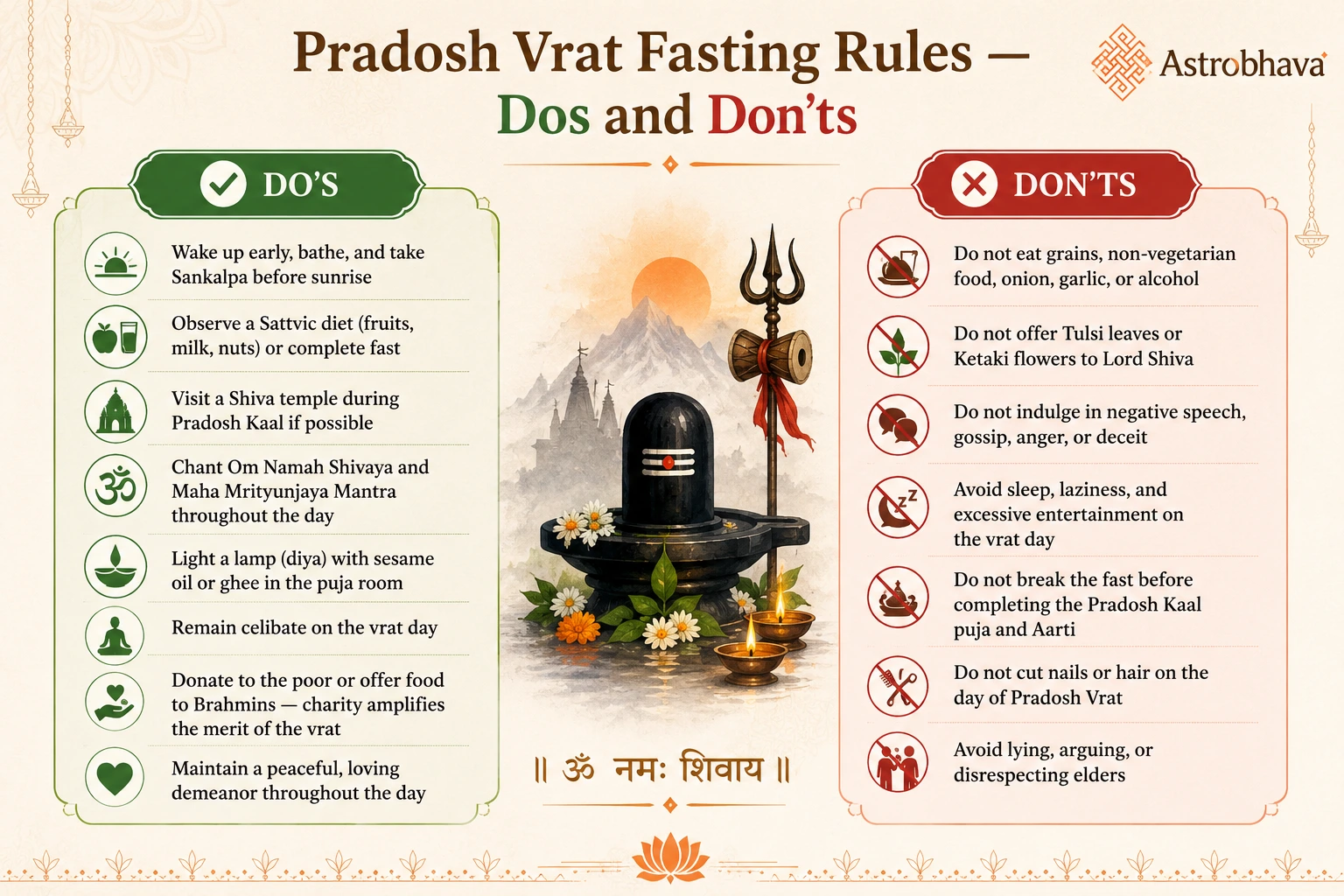
Do’s:
- Wake up early, bathe, and take Sankalpa before sunrise
- Observe a Sattvic diet (fruits, milk, nuts) or complete fast
- Visit a Shiva temple during Pradosh Kaal if possible
- Chant Om Namah Shivaya and Maha Mrityunjaya Mantra throughout the day
- Light a lamp (diya) with sesame oil or ghee in the puja room
- Remain celibate on the vrat day
- Donate to the poor or offer food to Brahmins — charity amplifies the merit of the vrat
- Maintain a peaceful, loving demeanor throughout the day
Don’ts:
- Do not eat grains, non-vegetarian food, onion, garlic, or alcohol
- Do not offer Tulsi leaves or Ketaki flowers to Lord Shiva
- Do not indulge in negative speech, gossip, anger, or deceit
- Avoid sleep, laziness, and excessive entertainment on the vrat day
- Do not break the fast before completing the Pradosh Kaal puja and Aarti
- Do not cut nails or hair on the day of Pradosh Vrat
- Avoid lying, arguing, or disrespecting elders
Benefits of Observing May Pradosh Vrat 2026
The scriptural and traditional benefits of Pradosh Vrat are extensive. Here are the key ones that devotees seek:
Spiritual Benefits:
- Dissolution of past-life negative karma (dosha)
- Acceleration of spiritual growth and inner awakening
- Deepening of meditation and mantra practice
- Progress on the path to Moksha (liberation)
Material and Life Benefits:
- Relief from chronic debt and financial struggles
- Removal of obstacles in career, business, and education
- Healing from chronic illnesses — especially when combined with Maha Mrityunjaya Japa
- Resolution of marital conflicts and family disputes
- Granting of children to those seeking progeny
Planetary Remedies:
- Guru Pradosh (14 May) mitigates the negative effects of weak or afflicted Jupiter
- Shukra Pradosh (29 May) addresses Venus-related issues — failed relationships, financial blockages, artistic frustrations
Also explore Masik Shivaratri Vs Maha Shivaratri
How NRIs and Global Devotees Can Observe May Pradosh Vrat 2026
One of the most common questions from devotees in the USA, UK, Canada, Australia, and the Middle East is: “How do I observe Pradosh Vrat when I’m thousands of miles away from India, can’t access a proper temple, and may not know the exact Pradosh Kaal for my city?”
Here’s the practical guidance:
- Calculate Local Pradosh Kaal: The Pradosh Kaal in your city starts approximately 45 minutes before your local sunset and extends 45 minutes after. So if sunset in London on 14 May 2026 is around 8:47 PM BST, your Pradosh Kaal window would be approximately 8:00 PM – 9:30 PM BST.
- Create a Sacred Space at Home: You don’t need a grand temple. A clean, quiet corner with a Shivalinga or image of Lord Shiva, a lamp, some Bel leaves (or dried ones if fresh aren’t available), milk for Abhishek, and genuine devotion is entirely sufficient.
- Stream or Join Online Pujas: AstroBhava offers live-streamed Pradosh pujas and Homas performed from sacred temples in India by authentic Vedic priests, with your name and Sankalpa included. Many NRI devotees across 40+ countries use this service to fulfil the complete spiritual merit of Pradosh Vrat even while living abroad.
- Perform Maha Mrityunjaya Japa: If a full puja isn’t possible on the day, simply chanting the Maha Mrityunjaya Mantra 108 times during the Pradosh Kaal with sincere devotion and your Sankalpa is itself deeply auspicious.
🌍 Living abroad and missing the sacred energy of Indian temples? AstroBhava’s priests perform authentic Pradosh Puja and Homa from consecrated temples in India — with your Sankalpa — and courier blessed prasad to your doorstep, wherever in the world you are.
Pradosh Vrat and Rudrabhishek: The Sacred Connection
If there is one ritual that perfectly complements Pradosh Vrat observance, it is Rudrabhishek — the ceremonial bathing of the Shivalinga with sacred substances while chanting the Sri Rudram and Chamakam from the Krishna Yajurveda.
The Sri Rudram is the most powerful Vedic hymn dedicated to Lord Shiva, and its chanting during Pradosh Kaal creates a field of divine sound vibration that purifies the environment, dissolves negative karma, and directly invokes Shiva’s protective grace. Rudrabhishek performed during Pradosh Kaal — especially on a Guru Pradosh or Shukra Pradosh — magnifies the spiritual merit many times over.
Many devotees who cannot perform Rudrabhishek at home due to not knowing the complete Vedic recitation can have it done through AstroBhava’s trained Sri Rudram chanters and priests, who perform it on their behalf.
Pradosh Vrat Katha: The Story Behind the Observance
The Pradosh Vrat Katha comes to us from the Skanda Purana and tells the story of a poor Brahmin widow and her devoted son. After the father’s death, the family fell into severe poverty. Despite their hardships, the mother and son continued to observe Pradosh Vrat with deep devotion and faith in Lord Shiva.
Their sincere observance attracted the grace of a king’s son, who eventually helped them, and through a series of divine events orchestrated by Shiva’s grace, their poverty was reversed, their troubles removed, and they attained both material abundance and spiritual liberation.
The Katha teaches that Pradosh Vrat is not about the grandeur of the ritual — it is about the purity of intention and the constancy of devotion. Even in hardship, when worshipped with a sincere heart during Pradosh Kaal, Lord Shiva responds.
Conclusion: Don’t Miss May Pradosh Vrat 2026
May 2026 brings two extraordinary Pradosh Vrat opportunities — the Guru Pradosh on 14 May (Thursday) for wisdom, growth, and spiritual deepening, and the Shukra Pradosh on 29 May (Friday) for love, harmony, and material blessings. Together, they form a powerful spiritual arc across the month of May.
Whether you are a lifelong Shiva devotee, someone going through a difficult karmic phase, an NRI wanting to stay connected to your Vedic roots, or a spiritual seeker simply drawn to the timeless energy of the Pradosh tradition — these two dates deserve a place in your calendar.
Observe the fast with sincerity. Worship during the Pradosh Kaal. Chant Om Namah Shivaya. Offer Bel leaves. Light a lamp. And trust that Lord Shiva — who is always waiting at the door of devotion — will hear you.
Har Har Mahadev.
🕉️ Ready to make this May Pradosh Vrat 2026 truly transformative? Book an authentic Rudra Homam, Maha Mrityunjaya Japa, or Pradosh Puja with AstroBhava’s Vedic priests — performed from sacred temples in India, with your Sankalpa, and prasad delivered worldwide.
Visit AstroBhava.com to Book Now
Frequently Asked Questions (FAQs) — May Pradosh Vrat 2026
Q1. What are the dates for May Pradosh Vrat 2026?
There are two Pradosh Vrats in May 2026. The first is on Thursday, 14 May 2026 (Krishna Paksha Guru Pradosh) and the second is on Friday, 29 May 2026 (Shukla Paksha Shukra Pradosh).
Q2. What is Pradosh Kaal and how do I calculate it for my city?
Pradosh Kaal is the sacred twilight window that begins approximately 45 minutes before local sunset and lasts about 45 minutes to 1.5 hours after sunset. To find it for your city, simply look up the sunset time in your location on the Pradosh date and calculate accordingly. The Trayodashi Tithi must be prevailing at the time of your local sunset for the vrat to be valid on that day.
Q3. Can I observe Pradosh Vrat in the USA, UK, or abroad?
Absolutely yes. Pradosh Vrat can be observed from anywhere in the world. The key is to worship during the Pradosh Kaal at your local sunset time on the correct Trayodashi date. Many NRI devotees also book online puja services through platforms like AstroBhava.com to have the ritual performed on their behalf at temples in India with their Sankalpa.
Q4. What should I offer Lord Shiva during Pradosh Vrat puja?
The most important offering is Bilva Patra (Bel leaves) — always unbroken, trifoliate leaves. Other offerings include Panchamrit (milk, curd, ghee, honey, sugar), Dhatura flowers, white flowers, sandalwood paste, Vibhuti (sacred ash), unbroken rice grains, and fruits. Never offer Tulsi leaves to Lord Shiva.
Q5. What is the significance of Guru Pradosh on 14 May 2026?
Guru Pradosh occurs when Pradosh Vrat falls on a Thursday — Jupiter’s day. This combination is particularly auspicious for wisdom, higher learning, spiritual growth, prosperity, children, and remedies for weak or afflicted Jupiter in the horoscope.
Q6. Can women observe Pradosh Vrat?
Yes, Pradosh Vrat is observed by both men and women. However, some regional traditions advise women to refrain from touching puja items or the Shivalinga directly during menstruation. In such cases, sincere mantra chanting and mental worship during Pradosh Kaal carry equal spiritual merit.
Q7. What is the Maha Mrityunjaya Mantra and should I chant it on Pradosh Vrat?
The Maha Mrityunjaya Mantra (Om Tryambakam Yajamahe…) is the supreme mantra of Lord Shiva, invoking his power as the conqueror of death and suffering. Chanting it 108 times during Pradosh Kaal is one of the most powerful practices on Pradosh Vrat. It is especially recommended for health, healing, protection, and liberation from fear.
Q8. What if I accidentally break the Pradosh Vrat fast?
If the fast is broken unintentionally, do not panic or feel guilty. Sincerely seek forgiveness from Lord Shiva through prayer, continue with the Pradosh Kaal puja with full devotion, and resolve to observe the next Pradosh Vrat with greater discipline. In Vedic tradition, sincere intention and devotion always matter more than rigid external adherence.
Q9. Is Rudrabhishek the same as Pradosh puja?
They are related but distinct. Rudrabhishek is the ritual Abhishek of the Shivalinga performed with chanting of the Sri Rudram and Chamakam. It can be performed on any day. Pradosh puja is the specific worship ritual performed during Pradosh Kaal on Trayodashi. Performing Rudrabhishek during Pradosh Kaal on Trayodashi combines both and is considered the most powerful form of Shiva worship.
Q10. How is AstroBhava different from other platforms for Pradosh puja booking?
AstroBhava is a premier Vedic astrology and ritual center based in Coimbatore, India, with over 400,000 seekers served across 40+ countries. The platform specializes in authentic South Indian Vedic rituals — Homas, Pujas, and Japa — performed by highly learned priests and Vedic scholars. Every ritual is performed with the devotee’s name and Sankalpa, and prasad is shipped worldwide. AstroBhava brings the sacred temple experience directly to your home, wherever in the world you are.