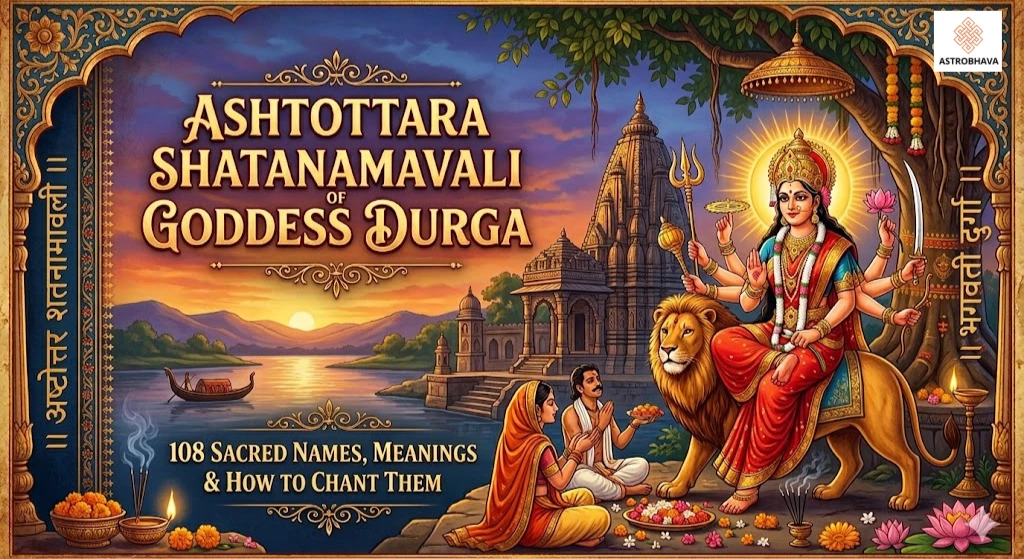
Have you ever felt an overwhelming sense of peace wash over you when you chant the names of the Divine Mother? There is a reason for that. The ancient sages of India didn’t just compose the Ashtottara Shatanamavali of Goddess Durga as a poetic exercise. They encoded cosmic energy, healing vibrations, and divine protection into every single name. And when you recite all 108 names with devotion? You are essentially opening a direct channel to the most powerful feminine force in the universe.
Whether you are a seasoned devotee or someone who has just begun exploring the world of Hindu worship, this guide will walk you through everything you need to know — the meaning behind the 108 names, how and when to chant them, the benefits they bring, and how you can connect with Goddess Durga’s grace no matter where you are in the world.
Let’s begin.
What Is the Ashtottara Shatanamavali of Goddess Durga?
The word “Ashtottara Shatanamavali” breaks down beautifully in Sanskrit:
- Ashta = Eight
- Uttara = Beyond / Above
- Shata = Hundred
- Namavali = Garland of Names
Together, it means “a garland of 108 sacred names.” The Ashtottara Shatanamavali of Goddess Durga is a devotional hymn that lists 108 unique names of Maa Durga, each reflecting a different aspect of Her divine nature — Her ferocity, Her compassion, Her cosmic form, Her role as the destroyer of evil, and Her eternal grace as the Mother of the Universe.
The number 108 is deeply sacred in Vedic tradition. There are 108 Upanishads, 108 beads on a Japa mala, and it is said that the distance between the Sun and Earth is approximately 108 times the Sun’s diameter. Chanting 108 names is considered a complete, wholesome act of worship — a full circle of devotion.
Why Chant the 108 Names of Goddess Durga?
Before we get into the actual names, let’s talk about why this practice matters so much.
The Durga Ashtottara Shatanamavali is not just a list of titles. Each name is a seed mantra in itself — a vibrational frequency that invokes a specific divine quality. When you chant these names:
- You invoke protection from negative energies, black magic, enemies, and unseen obstacles.
- You invite abundance — Durga in Her form as Mahalakshmi blesses Her devotees with material and spiritual prosperity.
- You heal emotional wounds — Many names address Her role as the remover of fear, sorrow, and suffering.
- You strengthen your aura — Regular chanting is believed to build a spiritual shield around you and your family.
- You purify karma — The Devi Purana states that sincerely reciting Her 108 names washes away accumulated negative karma from past lives.
For NRIs and devotees living abroad in the USA, UK, Canada, or Australia — who may not have access to a nearby temple or priest — chanting the Ashtottara Shatanamavali at home is one of the most powerful ways to stay connected to your roots and to the Divine Mother’s protection.
The Complete Ashtottara Shatanamavali of Goddess Durga (108 Names)
Each name below is presented with its transliteration and meaning so you can chant with full understanding and intention. Begin each name with “Om” and end with “Namah” — for example: “Om Durgaayai Namah.”
- Om Durgaayai Namah — The one who is difficult to reach; the inaccessible one
- Om Shivaayai Namah — The auspicious one; consort of Shiva
- Om Mahaadevyai Namah — The great Goddess
- Om Bhadrakalyai Namah — The Goddess of auspicious time and good fortune
- Om Ambikaaayai Namah — The universal mother
- Om Jagat-dhaatryai Namah — The one who sustains the universe
- Om Jagat-maatrai Namah — The mother of the world
- Om Jaganmayyai Namah — She who pervades the entire world
- Om Kaalaraatryai Namah — The dark night of dissolution; destroyer of time
- Om Mahaakalyai Namah — The great goddess of time and death
- Om Brahmaanyai Namah — The Shakti of Brahma; supreme consciousness
- Om Brahma-jananyai Namah — The mother of Brahma the creator
- Om Vishnumaayaayai Namah — The divine illusion of Vishnu
- Om Vishnu-poojitaayai Namah — She who is worshipped by Vishnu
- Om Maheshwaryai Namah — The great Goddess of the universe
- Om Mahaadevyai Namah — The supremely divine one
- Om Mahaaraatryai Namah — The great night of cosmic dissolution
- Om Mahaa-balaayai Namah — She of immense strength and power
- Om Simhavaahinyai Namah — She who rides the lion
- Om Mahishasura-mardinyai Namah — The slayer of the buffalo demon Mahishasura
- Om Saumyaayai Namah — The gentle, benevolent, moonlike one
- Om Saumya-mukhyai Namah — She with the calm, serene face
- Om Vikraamaayai Namah — The valiant, courageous one
- Om Chandraghantaayai Namah — She who wears the crescent moon as a bell
- Om Mahaatopaayai Namah — She of great austerity and power
- Om Sarvashastra-bhritaayai Namah — She who bears all weapons
- Om Sarva-daanavamardinyai Namah — The destroyer of all demons
- Om Sarvashaastra-mayaayai Namah — She who is the embodiment of all scriptures
- Om Satyaayai Namah — The absolute truth
- Om Sarvamangalaayai Namah — The source of all auspiciousness
- Om Kaushikyai Namah — She who emerged from the sheath (kosham) of Parvati
- Om Krishnajataayai Namah — She with dark, matted locks
- Om Baalaayai Namah — The eternal child; the young one
- Om Baalavikramaayai Namah — The fierce yet youthful warrior
- Om Nityaayai Namah — The eternal, everlasting one
- Om Sarva-vidyaayai Namah — The goddess of all knowledge
- Om Sarva-shaktipradaayai Namah — The bestower of all powers
- Om Sarva-vidyaadhidevataayai Namah — The presiding deity of all learning
- Om Mahaa-viraayai Namah — The great, supreme heroine
- Om Raksha-kartryai Namah — The one who gives protection
- Om Mahaaghora-rupinyai Namah — She of the immensely fierce form
- Om Mahaabalaayai Namah — She of immeasurable physical strength
- Om Mahaavegaayai Namah — She who moves with cosmic speed
- Om Mahaabalaparaakramaayai Namah — The supremely courageous and powerful
- Om Mahaarudraayai Namah — The great fierce form of Rudra
- Om Mahaakruddhaayai Namah — The greatly wrathful one (against evil)
- Om Mahaadurgaayai Namah — The supremely inaccessible goddess
- Om Bhayankaryai Namah — The one who is terrifying to enemies
- Om Mahaabhayaayai Namah — The great fear (for evil forces)
- Om Mahaa-viraayai Namah — The great warrior goddess
- Om Kaalaraatryai Namah — The dark night of universal dissolution
- Om Tapasvinyai Namah — She who embodies austere spiritual practice
- Om Narayanyai Namah — The feminine form of Narayana; Vishnu’s Shakti
- Om Bhadrakalyai Namah — She of auspicious and powerful time
- Om Vishnu-maayaayai Namah — The illusion-power of Vishnu
- Om Jaladharaayai Namah — She who holds and controls the waters
- Om Jagat-poojyaayai Namah — She who is worshipped by all of creation
- Om Jagattraatryai Namah — The one who protects the entire universe
- Om Jagaddhitaayai Namah — She who works for the welfare of the world
- Om Kamaakshaayai Namah — She of the desirous, enchanting eyes
- Om Kaama-daayinyai Namah — The fulfiller of desires
- Om Kaamarupinyai Namah — She who assumes any form at will
- Om Pratyangiraayai Namah — The goddess who repels all negative forces
- Om Shodashyai Namah — The sixteen-year-old eternal goddess; Sri Vidya
- Om Tripuraayai Namah — The goddess of the three cities/worlds
- Om Tripurasundaryai Namah — The most beautiful goddess of the three worlds
- Om Chaamundaayai Namah — The slayer of Chanda and Munda demons
- Om Chandraayai Namah — She who is cool and radiant like the moon
- Om Chandikaayai Namah — The fierce and passionate goddess
- Om Chandramauleeshwaryai Namah — She who is adorned with the crescent moon
- Om Aaryaayai Namah — The noble and revered one
- Om Katyaayanyai Namah — Born from the sage Katyayana; the warrior goddess
- Om Kanyaayai Namah — The eternal virgin goddess
- Om Kumaariai Namah — The youthful, unmarried goddess
- Om Kumudaayai Namah — The lotus-like one who brings joy
- Om Nanda-nandinyai Namah — The daughter of Nanda; full of bliss
- Om Sarva-bhuteshu sevitaayai Namah — She who is served by all beings
- Om Bhavaanyai Namah — The consort of Bhava (Shiva); the source of existence
- Om Parvatyai Namah — The daughter of the mountain; Uma
- Om Devakyai Namah — The divine one; the mother of Krishna
- Om Shubhaayai Namah — The auspicious one
- Om Jaya-daayinyai Namah — The bestower of victory
- Om Siddhi-daayinyai Namah — The giver of spiritual accomplishment
- Om Riddhi-daayinyai Namah — The giver of prosperity and growth
- Om Kalyaanyai Namah — The ever-auspicious, ever-benevolent one
- Om Ananta-rupinyai Namah — She of infinite, endless forms
- Om Ananta-shaktisampannaayai Namah — She endowed with limitless divine power
- Om Anaadimai Namah — The one without beginning
- Om Avyayaayai Namah — The imperishable, indestructible one
- Om Paramaayai Namah — The supreme, transcendental one
- Om Brahma-shaktaayai Namah — The power of Brahman (the ultimate reality)
- Om Chidaanadaayai Namah — The embodiment of consciousness and bliss
- Om Sarva-kaama-pradaayinyai Namah — She who grants all wishes
- Om Bhakta-priyaayai Namah — She who is dear to Her devotees
- Om Bhakta-rakshikaayai Namah — The protector of Her devotees
- Om Bhakta-vatsalaayai Namah — She who loves Her devotees like a mother
- Om Bhava-bandha-vimochinyai Namah — The liberator from the cycle of birth and death
- Om Paapaharinyai Namah — The remover of sins
- Om Taapaharinyai Namah — The remover of suffering and anguish
- Om Rogaharinyai Namah — The remover of illness and disease
- Om Shatru-nashaayai Namah — The destroyer of enemies
- Om Sarva-vighnanivaaarinyai Namah — The remover of all obstacles
- Om Vishwa-vaandyaayai Namah — She who is saluted by the entire universe
- Om Vishwa-maatrai Namah — The mother of the universe
- Om Vishwa-rupinyai Namah — She who embodies the entire cosmos
- Om Nishkalaaayai Namah — She who is flawless and without blemish
- Om Nirvikaaraayai Namah — She who is beyond all change and transformation
- Om Sachchidaananda-rupinyai Namah — The embodiment of existence, consciousness, and bliss
🪔 Let the Divine Mother’s blessings flow into your home. Commission a sacred Durga Japa Yajna — 108, 1008, or 10,008 recitations of Durga’s names performed by expert Vedic priests on your behalf.
👉 Your devotion, our service. Book at Astrobhava today.
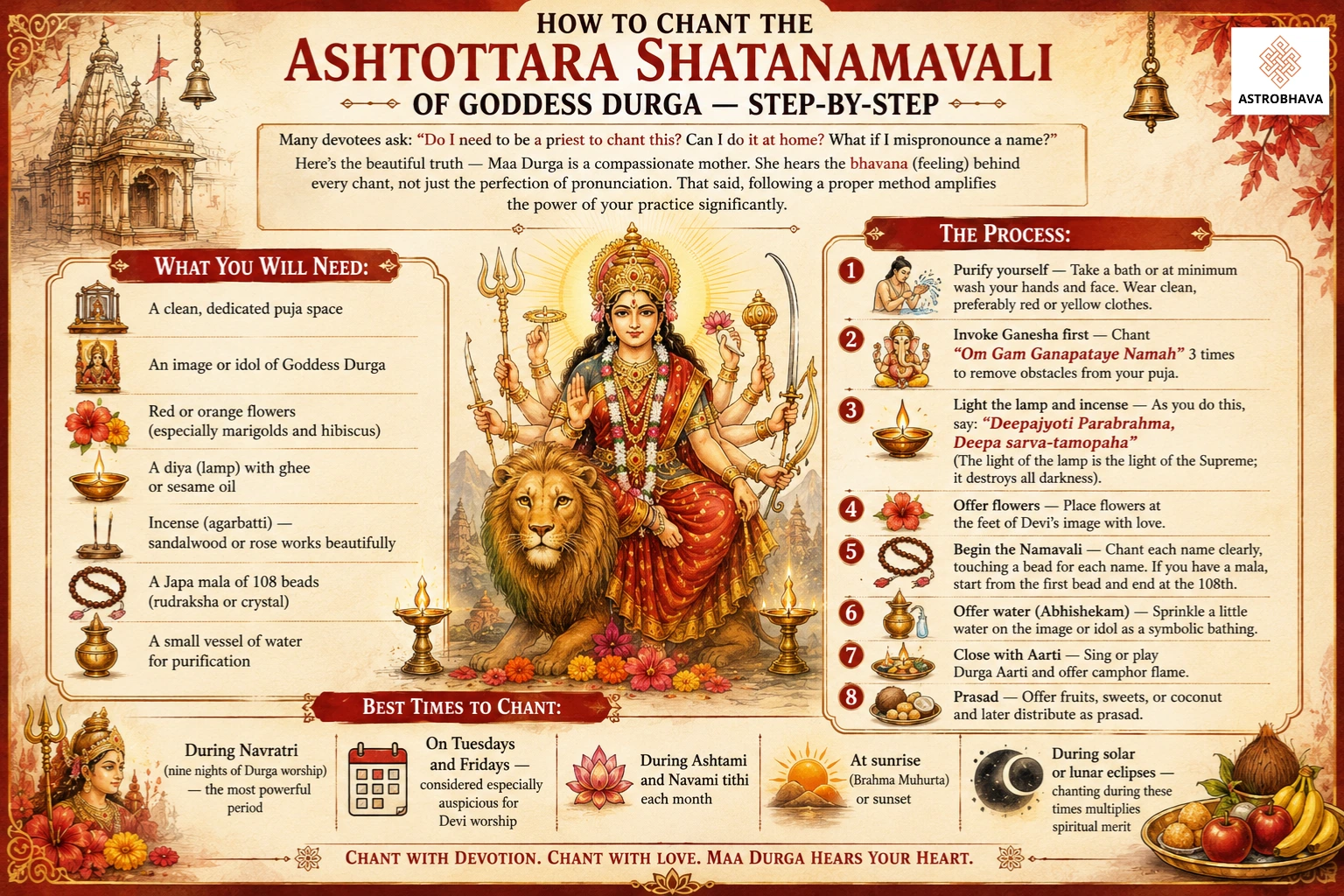 How to Chant the Ashtottara Shatanamavali of Goddess Durga — Step-by-Step
Many devotees ask: “Do I need to be a priest to chant this? Can I do it at home? What if I mispronounce a name?”
Here’s the beautiful truth — Maa Durga is a compassionate mother. She hears the bhavana (feeling) behind every chant, not just the perfection of pronunciation. That said, following a proper method amplifies the power of your practice significantly.
What You Will Need:
- A clean, dedicated puja space
- An image or idol of Goddess Durga
- Red or orange flowers (especially marigolds and hibiscus)
- A diya (lamp) with ghee or sesame oil
- Incense (agarbatti) — sandalwood or rose works beautifully
- A Japa mala of 108 beads (rudraksha or crystal)
- A small vessel of water for purification
The Process:
- Purify yourself — Take a bath or at minimum wash your hands and face. Wear clean, preferably red or yellow clothes.
- Invoke Ganesha first — Chant “Om Gam Ganapataye Namah” 3 times to remove obstacles from your puja.
- Light the lamp and incense — As you do this, say: “Deepajyoti Parabrahma, Deepa sarva-tamopaha” (The light of the lamp is the light of the Supreme; it destroys all darkness).
- Offer flowers — Place flowers at the feet of Devi’s image with love.
- Begin the Namavali — Chant each name clearly, touching a bead for each name. If you have a mala, start from the first bead and end at the 108th.
- Offer water (Abhishekam) — Sprinkle a little water on the image or idol as a symbolic bathing.
- Close with Aarti — Sing or play Durga Aarti and offer camphor flame.
- Prasad — Offer fruits, sweets, or coconut and later distribute as prasad.
Best Times to Chant:
- During Navratri (nine nights of Durga worship) — the most powerful period
- On Tuesdays and Fridays — considered especially auspicious for Devi worship
- During Ashtami and Navami tithi each month
- At sunrise (Brahma Muhurta) or sunset
- During solar or lunar eclipses — chanting during these times multiplies spiritual merit
✨ Can’t perform the puja yourself due to time or distance?
The Deeper Significance of Selected Names
Let’s explore a few of the most powerful names in greater depth, because understanding why a name is sacred makes your chanting infinitely more meaningful.
1. Mahishasura Mardini (Name #20)
This is arguably the most celebrated of all Durga’s epithets. It captures the cosmic battle in which Durga — emerging from the combined energies of Brahma, Vishnu, and Shiva — slayed the buffalo demon Mahishasura after nine days of fierce combat. On a deeper level, Mahisha (buffalo) represents Tamas — the force of inertia, delusion, and ego. When we chant this name, we invoke Her to slay the “Mahisha” within us — our laziness, arrogance, and resistance to truth.
2. Simhavahini (Name #19)
Her vehicle, the lion, is not chosen randomly. The lion represents Dharma and Kingly courage. By riding the lion, Durga demonstrates that She doesn’t just possess power — She commands power with complete mastery. Chanting this name invokes courage in the devotee, particularly useful before important decisions, legal battles, or confrontations.
3. Bhavabandha Vimochini (Name #97)
This is one of the most profound names in the entire Namavali. It means “the one who liberates from the bondage of Samsara (cyclical existence).” This name is especially precious for those on a spiritual path who seek Moksha — ultimate liberation. Chanting this with genuine vairagya (detachment) is said to burn away karmic chains across lifetimes.
4. Katyayani (Name #72)
This is Durga’s warrior form worshipped especially during Navratri’s sixth day. Katyayani is the Goddess invoked for removal of marriage obstacles — a hugely popular form among unmarried women seeking a good life partner. Her puja is mentioned in the Bhagavata Purana, where the Gopis of Vrindavan worshipped Her to attain Lord Krishna as their husband.
Durga Ashtottara Shatanamavali During Navratri — Why It’s Extra Powerful
If you are reading this around the time of Sharad Navratri (October) or Chaitra Navratri (March–April), you are in the most auspicious window of the entire year for Durga worship.
During Navratri, the veil between the human world and the divine realm is considered thinnest. The sages describe it as a time when Devi is literally “awake” and accessible. Chanting the Ashtottara Shatanamavali of Goddess Durga during each of the nine nights — ideally after sunset — is said to grant:
- Riddance of chronic health problems
- Clearing of financial blockages
- Resolution of legal disputes
- Harmonization of family and marital discord
- Spiritual awakening and clarity of purpose
Many families abroad maintain the tradition of reading the entire Namavali on each of the nine nights, creating a cumulative energy build-up over the nine days that culminates in a powerful spiritual peak on Navami.
🌺 Make this Navratri transformational for your family. Let Astrobhava conduct a 9-Day Durga Homa (Navavarana Puja) with Lalita Sahasranama, Durga Saptashati, and complete Navratri rituals performed in your name.
👉 Nine days of divine grace. One decision. Book now.
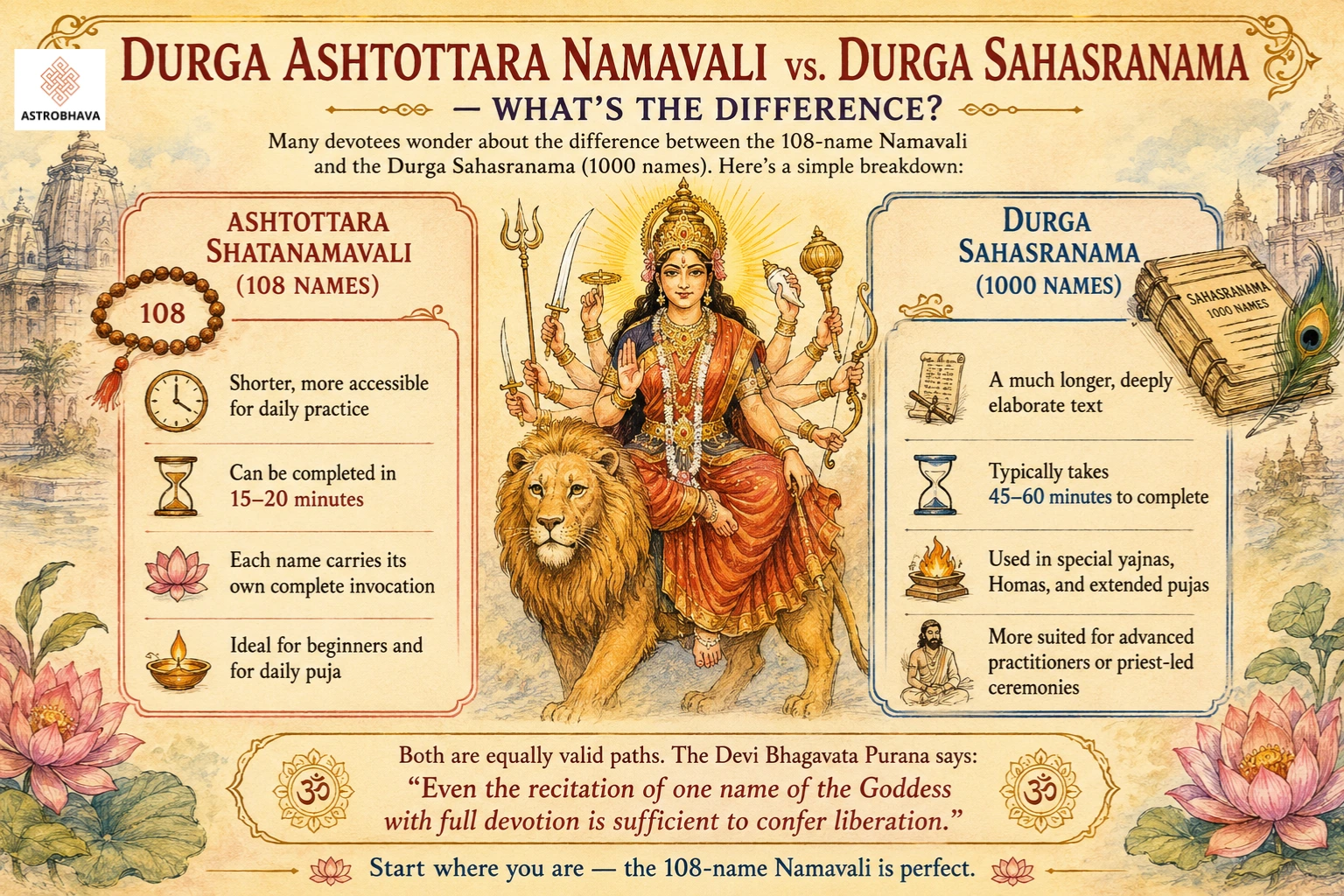 Durga Ashtottara Namavali vs. Durga Sahasranama — What’s the Difference?
Many devotees wonder about the difference between the 108-name Namavali and the Durga Sahasranama (1000 names). Here’s a simple breakdown:
Ashtottara Shatanamavali (108 Names):
- Shorter, more accessible for daily practice
- Can be completed in 15–20 minutes
- Each name carries its own complete invocation
- Ideal for beginners and for daily puja
Durga Sahasranama (1000 Names):
- A much longer, deeply elaborate text
- Typically takes 45–60 minutes to complete
- Used in special yajnas, Homas, and extended pujas
- More suited for advanced practitioners or priest-led ceremonies
Both are equally valid paths. The Devi Bhagavata Purana says: “Even the recitation of one name of the Goddess with full devotion is sufficient to confer liberation.” Start where you are — the 108-name Namavali is perfect.
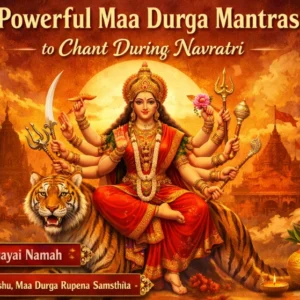
Listen to our latest podcast to learn Powerful Mantras to chant during Navaratri
Benefits of Regular Chanting — What Devotees Experience
Beyond the scriptural promises, here is what devotees who practice the Durga Ashtottara Shatanamavali regularly report experiencing:
- A palpable sense of protection and safety, especially useful for those who work in high-stress environments or live alone abroad
- Improved mental clarity and decision-making — many attribute this to the Saraswati-aspect names within the Namavali
- Better sleep and reduced anxiety — the rhythmic chanting calms the nervous system at a neurological level
- Faster resolution of legal and financial disputes
- Children becoming more disciplined and focused when parents chant on their behalf
- A gradual but noticeable reduction in fear — whether of failure, death, disease, or the unknown
This is the living testimony of devotion — not just ancient scripture but present-day experience.
Conclusion: Maa Durga Is Always Listening
The Ashtottara Shatanamavali of Goddess Durga is more than a spiritual exercise. It is a living relationship with the Mother of the Universe. Each of Her 108 names is a door — and every time you chant one with sincerity, that door opens a little wider, letting Her grace flow more freely into your life.
Whether you are battling illness, financial hardship, relationship trouble, spiritual stagnation, or simply seeking a deeper connection with the Divine, these 108 names are your anchor. They have been chanted by sages in Himalayan caves, by queens in golden temples, and today — by you, wherever you are in the world.
Maa Durga doesn’t ask for perfection. She asks for love. So pick up your mala, light your lamp, and begin.
Jai Maa Durga. Jai Maa Bhavani. Jai Maa Chandika.
🙏 Let Maa Durga transform your life. From Durga Homam and Chandi Homa to personalized Navratri pujas and Kumari Puja — Astrobhava brings ancient Vedic rituals to your doorstep, wherever you live.
👉 Explore all Durga Puja services at Astrobhava.com
Frequently Asked Questions (FAQs)
Q1. Can I chant the Ashtottara Shatanamavali of Goddess Durga without initiation from a Guru?
Yes, absolutely. Unlike some Tantric practices that require formal diksha (initiation), the Durga Ashtottara Shatanamavali is a devotional stotra open to all sincere devotees regardless of gender, age, or caste. Your pure intention is your initiation.
Q2. How many times should I chant the Namavali for maximum benefit?
Chanting it once daily is the standard practice. For specific intentions — such as overcoming illness, legal problems, or black magic — chanting it 3 times a day for 40 consecutive days (a mandala) is highly recommended. For very serious situations, Vedic priests traditionally chant it 108 times continuously as part of a formal Homa.
Q3. Can women chant the Durga Ashtottara Shatanamavali during menstruation?
Traditional texts advise against performing formal puja or touching idols during this time. However, chanting mantras and Namavali internally (mental japa) is considered perfectly acceptable and even beneficial. The Divine Mother especially understands the natural cycles of Her daughters.
Q4. I am not Hindu by birth. Can I still chant the Durga Namavali?
Maa Durga is a universal mother who transcends labels. Many non-Hindu seekers, yoga practitioners, and spiritual explorers worldwide have found profound peace and transformation through Devi worship. If you approach Her with genuine reverence and an open heart, She will respond.
Q5. What is the difference between Durga Namavali, Durga Chalisa, and Durga Saptashati?
These are three distinct but complementary texts. The Namavali is a list of 108 sacred names. The Durga Chalisa is a 40-verse devotional hymn in Hindi, easier for daily singing. The Durga Saptashati (also called Chandi Path or Devi Mahatmyam) is a 700-verse scripture from the Markandeya Purana that narrates Durga’s cosmic battles — it is the most elaborate and powerful of the three.
Q6. Can I request a Durga puja or Homa to be performed on my behalf even if I live abroad?
Yes! This is exactly what Astrobhava specializes in. Our trained Vedic priests perform authentic Durga Puja, Durga Homa, Navavarana Puja, Chandi Homa, and Navratri rituals on your behalf, with proper sankalpa (intention-setting in your name), and many services include live streaming so you can participate remotely.
Q7. Is there a specific direction I should face while chanting?
Traditionally, face East during morning chanting (toward the rising sun, symbolic of new beginnings) or North (the direction of Kubera and auspiciousness). Avoid facing South during worship as it is associated with Yama, the god of death, in traditional texts.
Q8. My child is sick. Which names from the Namavali are especially healing?
Names like Rogaharini (name #100 — remover of disease), Sarva-shaktiprada (bestower of strength), and Bhakta-rakshika (protector of devotees) are especially potent for health recovery. You can chant these specific names 108 times while holding a glass of water, then give that water to the sick person as a blessed remedy — a practice supported by many traditional texts.