If you’ve been searching for everything about Masik Shivaratri April 2026 — the exact date, the right time to do puja, what the Katha says, and how to actually observe this vrat at home — you’re in exactly the right place. This blog covers it all, from the spiritual roots of this sacred monthly fast to a complete list of all 2026 Masik Shivaratri vrat dates so you can plan your entire year of devotion in one go.
Let’s start from the beginning.
What Is Masik Shivaratri? Understanding the Basics
Before we dive into the specifics of April 2026, it helps to truly understand what Masik Shivaratri is and why millions of Shiva devotees observe it every single month without fail.
The word “Masik” simply means “monthly,” and “Shivaratri” translates to “the night of Lord Shiva.” Put them together and you get a monthly sacred night dedicated entirely to Lord Shiva — specifically the Krishna Paksha Chaturdashi, which is the 14th day of the waning (dark) phase of the lunar moon, occurring once every lunar month.
Shivaratri is considered the great festival of the convergence of Shiva and Shakti. Each month, the Chaturdashi Tithi during Krishna Paksha is known as Masik Shivaratri. So while Maha Shivaratri — the grand annual celebration — gets the most attention, there are actually twelve (sometimes thirteen) Shivaratris in a year, each one carrying its own spiritual potency.
Masik Shivaratri is considered a powerful and auspicious fast dedicated to the Supreme Lord Shiva. It is observed by men and women for improved living and betterment of the future. The fast helps devotees control their senses and curb malevolent feelings of anger, jealousy, pride, and greed.
Think of it this way — if Maha Shivaratri is the annual summit with Lord Shiva, then Masik Shivaratri is your monthly appointment. Regular, rhythmic, and incredibly rewarding for sincere devotees.
Facing obstacles, stress, or health concerns?
Book Rudra Homa on Astrobhava and start your journey toward peace and protection.
2026 Masik Shivaratri April: Exact Date and Timings
Now, the information you’ve been looking for. Here are the verified details for Masik Shivaratri April 2026.
Krishna Paksha Chaturdashi for April 2026 falls on Wednesday, 15 April 2026, beginning at 10:31 PM on 15 April 2026 and ending at 08:11 PM on 16 April 2026.
Since Chaturdashi Tithi remains in force during the midnight period associated with 20 April 2026 — wait, let me clarify — the Masik Shivratri fast and night-long worship are observed on the date when Chaturdashi Tithi prevails through midnight. The Nishita Kaal Puja Muhurat for April 2026 is from 12:01 AM to 12:48 AM, which is especially recommended for Abhishekam, mantra chanting, and silent meditation on Lord Shiva.
Here is a clean summary of the April 2026 Masik Shivaratri details (timings for New Delhi / IST):
Masik Shivaratri April 2026 — At a Glance
| Detail | Timing |
| Vrat Date | Wednesday, 15 April 2026 |
| Chaturdashi Tithi Begins | 10:31 PM on 15 April 2026 |
| Chaturdashi Tithi Ends | 08:11 PM on 16 April 2026 |
| Nishita Kaal (Most Auspicious Puja Time) | 12:01 AM – 12:48 AM on 16 April 2026 |
| Parana (Fast Breaking) | After sunrise on 16 April 2026 |
| Lunar Month | Chaitra Krishna Paksha |
Note: Timings are based on IST (New Delhi). They may vary slightly by city. Always cross-check on Drik Panchang for your exact location.
 2026 Masik Shivaratri Vrat Dates — Complete List
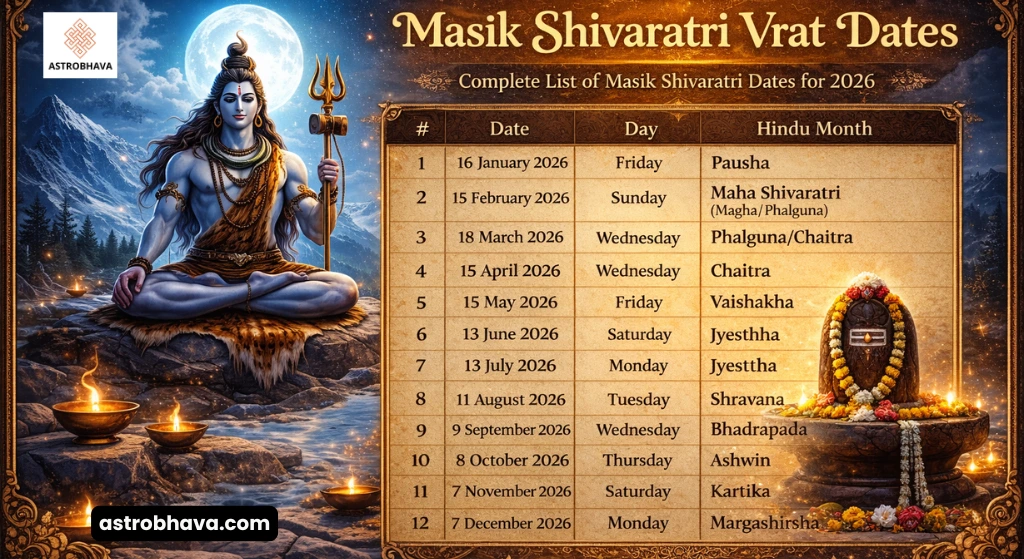
Planning to observe the vrat all year? Here are all the confirmed Masik Shivaratri dates for 2026:
| # | Date | Day | Hindu Month |
| 1 | 16 January 2026 | Friday | Pausha |
| 2 | 15 February 2026 | Sunday | Maha Shivaratri (Magha/Phalguna) |
| 3 | 18 March 2026 | Wednesday | Phalguna/Chaitra |
| 4 | 15 April 2026 | Wednesday | Chaitra |
| 5 | 15 May 2026 | Friday | Vaishakha |
| 6 | 13 June 2026 | Saturday | Jyeshtha |
| 7 | 13 July 2026 | Monday | Ashadha |
| 8 | 11 August 2026 | Tuesday | Shravana (Sawan Shivaratri) |
| 9 | 9 September 2026 | Wednesday | Bhadrapada |
| 10 | 8 October 2026 | Thursday | Ashwin |
| 11 | 7 November 2026 | Saturday | Kartika |
| 12 | 7 December 2026 | Monday | Margashirsha |
The Spiritual Significance of Masik Shivaratri
You might wonder — with Maha Shivaratri already being so grand, why bother with Masik Shivaratri every month? The answer is beautiful.
Masik Shivaratri 2026 is a monthly observance dedicated to Lord Shiva occurring on the 14th lunar day of the waning moon. This vrata enables devotees to engage in regular spiritual discipline through fasting, mantra recitation, and night vigils. This ritual is believed to balance the mind, body, and soul, strengthen devotion to Lord Shiva, and help devotees cultivate detachment and spiritual awareness.
The lunar science behind it is also fascinating. The Moon is the significator of the mind. On Krishna Paksha Chaturdashi, the Moon is in a diminished state, which can be used to step back from excessive emotional waves and examine inner patterns. Devotion to Shiva acts as a stabilising force that gives the mind support and direction.
So essentially, the monthly vrat works with the natural rhythm of the moon. When the moon is waning and mental energy is more subdued, the mind is naturally more receptive to inward focus, silence, and devotion. It’s not just a religious ritual — it’s a psycho-spiritual practice rooted in the science of the lunar cycle.
It is believed that if you chant the Shiva mantra “Om Namah Shivaya” for the entire day and night, you can keep yourself away from all worldly desires. Some of the advantages of keeping Masik Shivaratri fast include speedy recovery, good health, and happiness.
Masik Shivaratri Katha (The Sacred Story)
Every Shivaratri vrat has a Katha — a story that gives the observance its deeper meaning. The most well-known is the story of the hunter Lubdhaka.
Once there was a poor hunter named Lubdhaka who went into the forest to find food for his starving family. Unable to find any prey, he climbed a Bilva (Bael) tree to wait for animals to pass below him through the night. Unknown to him, a Shiva Lingam lay at the very base of that tree. As he waited through the dark hours, he unconsciously shed Bilva leaves down onto the Lingam — accidentally performing Shiva Puja without knowing it.
A deer came below the tree, and the hungry hunter raised his bow. But when the deer pleaded to be allowed to bid farewell to her family first, the hunter was moved by compassion and let her go. This happened three more times through the night — each time, his arrow was held back by the hunter’s own growing kindness. By the time dawn arrived, he had unknowingly stayed awake all night, dropped Bilva leaves on the Shiva Lingam in all four prahars, and performed acts of compassion.
Lord Shiva, witnessing this accidental but complete devotion, blessed the hunter and granted him liberation. This story teaches us perhaps the most profound lesson of Masik Shivaratri — that even unintentional, sincere-hearted worship of Lord Shiva brings immense grace. This story illustrates how even accidental devotion to Shiva brings immense blessings.
The Katha reminds us that the outer rituals — the fasting, the night vigil, the Bilva leaves — are meaningful because they connect the heart to the divine. It’s the bhav (feeling) that matters most.
💫 Struggling with delay in marriage or relationship conflicts?
Who Should Observe Masik Shivaratri Vrat?
Unmarried women observe this fast to get married, and married women observe this fast to maintain peace and tranquility in their married life. But this vrat is by no means limited to women or those seeking marriage.
Men, women, seekers of all ages, and anyone who wishes to deepen their connection with Lord Shiva can and should observe Masik Shivaratri. Masik Shivratri Vrat is a sacred medium to get the blessings of Lord Shiva and complete the difficult tasks of life. Whether you’re seeking clarity in career decisions, healing, peace at home, or simply a deeper spiritual life — this monthly fast creates a consistent channel of divine grace.
Devotees who want to observe Masik Shivaratri Vrat can start it from Maha Shivaratri day and continue it for a year. It is believed that even impossible and difficult tasks can be fulfilled by observing Masik Shivaratri Vrats by the grace of Lord Shiva.
Step-by-Step Rituals for Masik Shivaratri April 2026
Wondering how to actually observe the vrat this April? Here’s a practical, step-by-step guide that you can follow at home.
The Night Before (14 April 2026)
Eat a light, sattvic meal — preferably just once in the day. Avoid non-vegetarian food, alcohol, garlic, and onion. Set your intention for the vrat.
Morning of 15 April 2026
Wake up during Brahma Muhurta (before sunrise). Take a bath — ideally with sesame seeds or gangajal added to the water, which is considered purifying. Wear clean, preferably white or light-coloured clothes.
Taking the Sankalpa (Vow)
After finishing morning rituals, devotees should take Sankalpa (संकल्प) to observe a full-day fast on Shivaratri and to take food the next day. During Sankalpa, devotees pledge for self-determination throughout the fasting period and seek the blessing of Lord Shiva to finish the fast without any interference.
During the Day
Spend time in prayer, chanting “Om Namah Shivaya,” reading Shiva Purana, or simply sitting in quiet contemplation. Visit a Shiva temple if possible. Offer water and Bilva (Bael) leaves on the Shiva Lingam.
The Four Prahars of the Night
Night vigil devotees remain awake throughout the night, which is divided into four praharas: Early night (sunset to 9 PM) for chanting of Shiva Mantras; Late night (9 PM to midnight) for deep meditation and mantra repetition; Midnight or Nishita Kaal (around 12:00 to 1:00 AM) which is the most auspicious time; and Pre-dawn (1:00 to 4:00 AM) for concluding prayers and offering of prasadam.
For April 2026, the Nishita Kaal — the most powerful window — is from 12:01 AM to 12:48 AM on 16 April. This is the time to do Abhishek of the Shiva Lingam with milk, water, honey, or panchamrit, and to chant your mantras with deep focus.
Parana (Breaking the Fast)
Break your fast after sunrise on 16 April 2026, once the Chaturdashi Tithi ends. Offer thanks to Lord Shiva, have a light meal, and carry the peace of the night into your day.
 What to Offer During Masik Shivaratri Puja
Lord Shiva is famously easy to please — He is called Bholenath, the innocent and easily satisfied one. Here’s what is traditionally offered:
Bilva (Bael) leaves are the most beloved offering of Lord Shiva — always fresh, ideally three-leafed. Water or milk Abhishek on the Shiva Lingam is considered highly meritorious. White flowers — especially Dhatura and Akanda — are traditional favourites. Chandan (sandalwood paste), bhasma (sacred ash), and raw rice are also offered. Incense sticks, a ghee lamp, and camphor complete the puja. Panchamrit — a mixture of milk, curd, honey, ghee, and sugar — for a full Abhishek on auspicious days.
Avoid Ketaki (Kewda) flowers — these are never offered to Lord Shiva, as per scriptural tradition.
Harness the powerful energy of Masik Shivaratri to remove negativity and invite divine protection.
Book your Rudra Homa with Astrobhava
Masik Shivaratri Mantra for Chanting
No Shivaratri puja is complete without mantra chanting. Here are the core mantras:
Panchakshari Mantra (5-syllable Shiva mantra): ॐ नमः शिवाय | Om Namah Shivaya Chant this 108 times during Nishita Kaal for maximum benefit.
Maha Mrityunjaya Mantra: ॐ त्र्यम्बकं यजामहे सुगन्धिं पुष्टिवर्धनम् | उर्वारुकमिव बन्धनान् मृत्योर्मुक्षीय मामृतात् || Om Tryambakam Yajamahe Sugandhim Pushtivardhanam | Urvarukamiva Bandhanan Mrityor Mukshiya Maamritat || This mantra is chanted for healing, protection, and liberation from fear.
The Skanda Purana states that chanting the Panchakshari mantra on the sacred night activates the Ida, Pingala, and Sushumna nadis, making the midnight period especially powerful for awakening kundalini and higher intuition.
Fasting Rules for Masik Shivaratri — What Can You Eat?
Many first-timers wonder about the fasting rules. Here’s the good news — there’s flexibility based on your health and capacity.
A Nirjala fast (without water) is the strictest form and carries the most spiritual merit, but is physically demanding. A Phalahar fast (fruits and milk only) is the most commonly observed and is perfectly valid. A complete fast is not compulsory. It depends on health and strength. Those who are able may undertake a strict fast, while others may follow a fruit or milk-based fast and emphasise devotion and mental purity.
What you avoid on the day: grains, lentils, non-vegetarian food, alcohol, onion, garlic. What’s permitted: fruits, milk, dry fruits, sabudana (sago), sendha namak (rock salt), potatoes, and water.
Children, elderly people, pregnant women, and those with health conditions should not force themselves into a strict fast. Devotion matters more than dietary strictness.
Masik Shivaratri is your monthly gateway to connect with Lord Shiva.
Let Astrobhava perform Rudrabhishekam on your behalf.
Masik Shivaratri vs. Maha Shivaratri — What’s the Difference?
This is one of the most commonly asked questions. Let’s clear it up simply.
Masik Shivratri is observed every month, whereas Mahashivratri falls once a year. Among all the twelve Shivaratris that fall in the Hindu calendar, Mahashivratri holds the most spiritual importance. This is a day when nature pushes human beings towards their spiritual self.
In 2026, Maha Shivaratri fell on 15 February 2026 — this was the Masik Shivaratri of the Phalguna month elevated to its grandest form. The April 2026 Masik Shivaratri (Chaitra month) is the third Shivaratri of the year and carries its own beautiful energy, particularly associated with the renewal that comes with the spring season.
Think of it this way: Maha Shivaratri is the grand annual pilgrimage; every Masik Shivaratri is a monthly homecoming to the same divine presence.
Goddess Parvati and Masik Shivaratri — The Connection
Masik Shivaratri is not just about Lord Shiva alone. Shivaratri is the great festival of convergence of Shiva and Shakti. Goddess Parvati — the divine consort of Lord Shiva — is inseparable from this observance.
According to Hindu tradition, it was Goddess Parvati herself who asked Lord Shiva what vrat would most please Him, and He revealed the Shivaratri fast. Many women observe this vrat with special devotion to Goddess Parvati as well, praying for a harmonious marriage, for the well-being of their spouse, and for the blessings of the divine couple on their household.
According to scriptures, even Goddess Lakshmi, Indrani, Saraswati, Gayatri, Savitri, Sita, Parvati, and Rati observed the Shivaratri fast. So when you fast on Masik Shivaratri, you join a lineage of devotion that traces back to the goddesses themselves.
✨ Married women seeking peace, love, and longevity of their spouse?
Explore our marriage-related homas to bring peace and harmony in relationship.
Tips to Make Your April 2026 Masik Shivaratri More Meaningful
Observe the day with mindful silence — reduce unnecessary talk, social media, and entertainment. Journal your intentions before the puja — what are you releasing? What are you calling in? If you have a Shiva Lingam at home, do a simple milk or water Abhishek during Nishita Kaal. Even if you can’t stay up all night, try to be awake during the 12:01 AM – 12:48 AM window for at least a few minutes of sincere prayer. Read the Katha of Lubdhaka to children or family members — it keeps the tradition alive. Play Shiva bhajans or Rudrashtakam softly in your home through the evening.
Even those who cannot stay awake all night are advised to offer at least some worship during the Nishita Kaal span. The most important aspect is to keep inner bhav strong — that is what truly matters the most.
Conclusion
Masik Shivaratri April 2026 falls on Wednesday, 15 April, with the Chaturdashi Tithi beginning at 10:31 PM and the most auspicious Nishita Kaal window running from 12:01 AM to 12:48 AM on 16 April. Whether you’re a long-time devotee or observing this vrat for the first time, this is a deeply powerful night to connect with Lord Shiva — to fast, to pray, to stay awake, and to let the energy of the waning moon work with your inner silence.
The beauty of Masik Shivaratri is that it doesn’t demand perfection. It asks for sincerity. Like Lubdhaka the hunter who accidentally pleased Lord Shiva through an entire night of unknowing devotion, you too can find that even a few moments of genuine, heartfelt prayer during Nishita Kaal can carry immense grace.
Mark your calendar, gather your Bilva leaves, light your lamp, and let the night of Shiva do what it has always done — dissolve what no longer serves you, and fill the space with grace.
Har Har Mahadev! 🙏
Frequently Asked Questions (FAQs)
Q1. When is Masik Shivaratri in April 2026?
Masik Shivaratri April 2026 falls on Wednesday, 15 April 2026. The Chaturdashi Tithi begins at 10:31 PM on 15 April and ends at 08:11 PM on 16 April 2026 (IST).
Q2. What is the Nishita Kaal timing for Masik Shivaratri April 2026?
The Nishita Kaal — the most auspicious midnight window for Shiva puja — is from 12:01 AM to 12:48 AM on 16 April 2026 (for New Delhi/IST). Timings may vary slightly by city.
Q3. Is fasting mandatory on Masik Shivaratri?
No, a complete fast is not mandatory. You can observe a fruit and milk-based fast (Phalahar) based on your health and capacity. What matters most is sincere devotion and a pure mind.
Q4. Can unmarried girls observe Masik Shivaratri vrat?
Yes, absolutely. Unmarried women observe this fast with the prayer of finding a good life partner. Married women observe it for the well-being and longevity of their spouse and family harmony.
Q5. What should not be offered to Lord Shiva during Masik Shivaratri?
Ketaki (Kewda) flowers should never be offered to Lord Shiva as per scriptural tradition. Also avoid Tulsi leaves on the Shiva Lingam. Stick to Bilva (Bael) leaves, white flowers, water, milk, and sandalwood paste.
Q6. How many Masik Shivaratris are there in 2026?
There are twelve Masik Shivaratris in 2026 (one per lunar month), with Maha Shivaratri on 15 February 2026 being the most significant of them all.
Q7. Can I observe Masik Shivaratri at home without visiting a temple?
Yes. You can set up a Shiva Lingam or a picture of Lord Shiva at home, perform Abhishek with milk or water, offer Bilva leaves, light a lamp and incense, and chant “Om Namah Shivaya.” Home worship is completely valid.
Q8. What is the difference between Pradosh Vrat and Masik Shivaratri?
Pradosh Vrat falls on the Trayodashi Tithi (13th lunar day) of both Shukla and Krishna Paksha, while Masik Shivaratri falls on the Chaturdashi Tithi (14th day) of Krishna Paksha only. Both are dedicated to Lord Shiva, but Masik Shivaratri involves a night-long vigil and is observed once a month.
Q9. Can children and elderly people observe this fast?
Children and the elderly are not required to keep a strict fast. They can participate in prayers, listen to the Katha, and offer simple devotion. Their participation in the ritual atmosphere of the household is itself meritorious.
Q10. When should I break the Masik Shivaratri fast (Parana)?
The fast should be broken on the morning of 16 April 2026, after sunrise and once the Chaturdashi Tithi has ended. Begin with a simple prayer of gratitude before eating.