By Brahmashree Shivaaya | Head of Astrological & Spiritual Solutions, AstroBhava
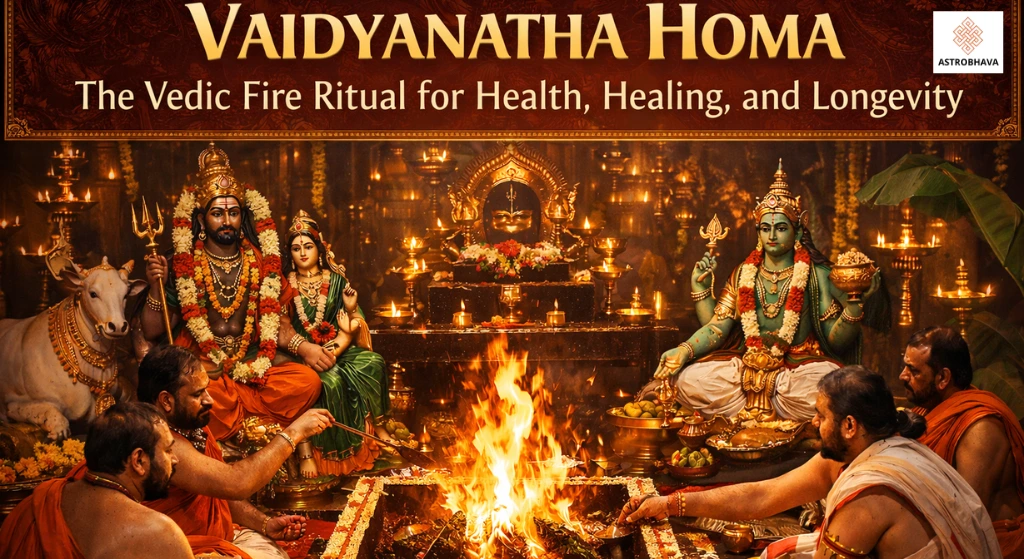
Vaidyanatha Homa is a Vedic fire ritual performed in worship of Lord Vaidyanatha — a form of Shiva revered as the supreme physician of the cosmos. The homa involves the systematic offering of medicinal herbs, ghee, and specific dravyas into consecrated fire while chanting Vedic mantras from the Shiva-related Agama and Atharva Veda traditions.
It is traditionally performed for individuals suffering from chronic or undiagnosed illness, those running Saturn or Rahu dashas with 6th or 8th house afflictions, and those seeking to extend vitality and shield against premature decline. The ritual is distinct from Mahamrityunjaya Homa in that it specifically invokes Shiva in His role as cosmic healer rather than His role as conqueror of death, making it the more targeted ritual for ongoing health support and disease recovery.
 Introduction
You may be at a point where conventional treatments have addressed the symptoms but not the root — where tests come back inconclusive, where energy refuses to return, or where one family member after another has faced similar health challenges that no physician has been able to fully explain. Many devotees who approach AstroBhava for Vaidyanatha Homa arrive with exactly this background: not as a first resort, but after exhausting other paths and recognising that their birth chart carries specific planetary signatures that Vedic tradition directly associates with health obstruction.
Vedic astrology does not separate the body from the cosmos. The 6th house governs disease. The 8th house governs chronic illness and longevity. Saturn, when afflicted or placed adversely, governs slow decay and systemic weakness. Rahu, occupying certain positions, produces mysterious, difficult-to-diagnose conditions. These are not superstitions — they are a highly structured diagnostic framework developed over centuries, refined in texts like the Brihat Parashara Hora Shastra and the Charaka Samhita’s astrological supplements. When these indicators align in a birth chart, Vedic tradition prescribes specific ritual remedies, and for health, few are more precisely calibrated than Vaidyanatha Homa.
At AstroBhava, every Vaidyanatha Homa is conducted by Padashala-certified priests with over three decades of ritual practice, strictly following Agama Shastra procedure. The muhurta is selected individually, the Sankalpa is recited with your personal details, and the dravyas — the oblation materials — include authentic medicinal herbs specified in the ritual’s Vedic source texts. What follows in this post is an honest, detailed account of what this ritual is, who genuinely needs it, how it is performed, and what the Vedic tradition says it accomplishes.
What Is Vaidyanatha Homa?
Vaidyanatha Homa is a fire oblation ritual dedicated to Lord Vaidyanatha, one of the twelve Jyotirlingas and one of Shiva’s most significant healing forms. The name breaks into three Sanskrit components: Vaidya (physician or one who knows the Vedas of medicine), Natha (lord or master), and Homa (a sacred fire ritual involving offerings made according to Vedic injunction). Together, Vaidyanatha Homa means: a ritual fire offering to the Lord who is the master physician.
The theological foundation for this form of Shiva sits primarily in the Shiva Purana, specifically the Kotirudra Samhita, which describes Lord Vaidyanatha as the one who cured Ravana’s severed heads after the latter’s act of supreme devotion, and who thus earned the title of cosmic healer. The Atharva Veda, particularly its Kanda sections dealing with healing incantations (Bheshajani Suktas), provides the mantra basis for the healing invocations used in this homa. The ritual procedure itself follows the Shaiva Agamas — specifically the Kamika Agama — which outlines the precise method for fire worship of Shiva in His healing aspect.
Unlike general Shiva homas that invoke Rudra’s fierce or transcendent forms, Vaidyanatha Homa specifically channels Shiva’s Anugraha Shakti — His grace-granting power — in the domain of physical and vital wellbeing. The oblations used are not generic; they include Bael (Bilva) leaves, Ashwagandha root, Shatavari, Guduchi (Tinospora), and specific combinations of medicated ghee (Shatavari ghrita or Mahanarayan taila-infused preparations, depending on the tradition), each of which carries both ritual significance and documented presence in Ayurvedic healing literature.
Invoke Lord Vaidyanatha’s healing grace — book your homa today.
 Who Should Perform Vaidyanatha Homa
The following astrological conditions, when present in a birth chart, indicate that Vaidyanatha Homa is a specifically appropriate remedy. This is not an exhaustive list, but these are the primary indicators our priests assess before recommending this ritual.
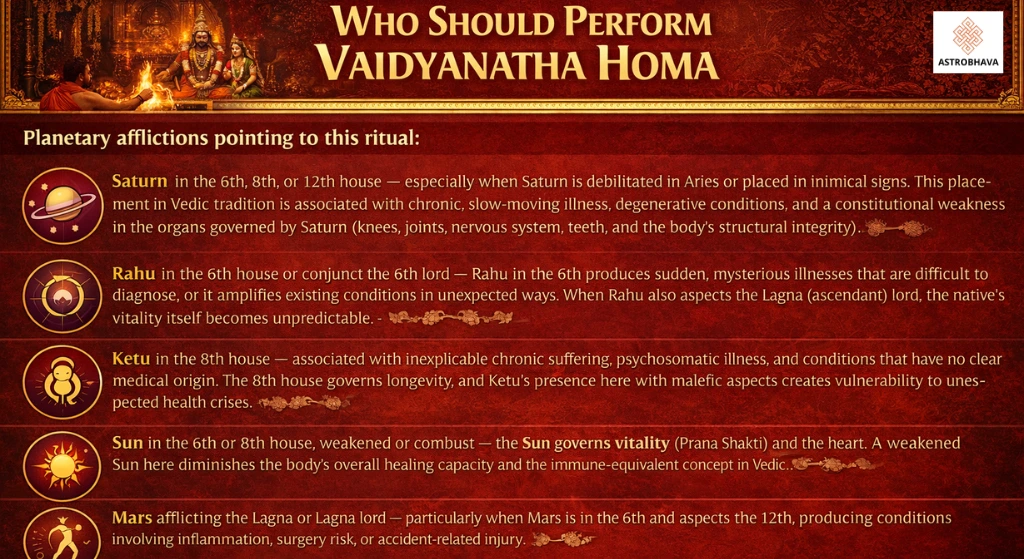
Planetary afflictions pointing to this ritual:
- Saturn in the 6th, 8th, or 12th house — especially when Saturn is debilitated in Aries or placed in inimical signs. This placement in Vedic tradition is associated with chronic, slow-moving illness, degenerative conditions, and a constitutional weakness in the organs governed by Saturn (knees, joints, nervous system, teeth, and the body’s structural integrity).
- Rahu in the 6th house or conjunct the 6th lord — Rahu in the 6th produces sudden, mysterious illnesses that are difficult to diagnose, or it amplifies existing conditions in unexpected ways. When Rahu also aspects the Lagna (ascendant) lord, the native’s vitality itself becomes unpredictable.
- Ketu in the 8th house — associated with inexplicable chronic suffering, psychosomatic illness, and conditions that have no clear medical origin. The 8th house governs longevity, and Ketu’s presence here with malefic aspects creates vulnerability to unexpected health crises.
- Sun in the 6th or 8th house, weakened or combust — the Sun governs vitality (Prana Shakti) and the heart. A weakened Sun here diminishes the body’s overall healing capacity and the immune-equivalent concept in Vedic physiology (Ojas).
- Mars afflicting the Lagna or Lagna lord — particularly when Mars is in the 6th and aspects the 12th, producing conditions involving inflammation, surgery risk, or accident-related injury.
- Sade Sati (the seven-and-a-half-year Saturn transit) — when Saturn transits the 12th, 1st, and 2nd houses from the natal Moon, and the natal chart already carries 6th or 8th house afflictions, Vaidyanatha Homa is traditionally recommended as a protective and mitigating ritual.
- Mahadasha or Antardasha of Saturn, Rahu, or the 6th/8th lords — particularly when these dasha periods coincide with an already afflicted 6th or 8th house in the natal chart.
- Nakshatra considerations — natives born in Ashlesha, Jyeshtha, or Moola nakshatras, which are ruled by Sarpa (serpent) and Nirrti deities, are traditionally considered more susceptible to health vulnerabilities and are among those for whom this homa is specifically recommended in certain regional Agamic traditions.
This ritual is also appropriate for individuals recovering from major surgery, those managing long-term conditions that Ayurveda classifies under Oja-kshaya (depletion of vital essence), and for elderly family members whose charts show significant decline indicators in the current planetary period.
Key Benefits of Vaidyanatha Homa
- Relief from Chronic, Diagnostically Elusive Illness — Vedic tradition holds that Rahu-caused illness and Ketu-caused psychosomatic conditions respond specifically to invocations of Vaidyanatha, as Lord Shiva in this form is said in the Shiva Purana to dissolve what is hidden and obstinate in the body’s suffering.
- Mitigation of Saturn’s 6th and 8th House Malefic Effects — The ritual’s fire, fuelled by Saturn-pacifying herbs including sesame (tila) and Ashwagandha, directly addresses the planetary energy responsible for degenerative and chronic systemic conditions.
- Strengthening of Ojas (Vital Essence) — The medicated ghee oblations used in this homa correspond to the Ayurvedic concept of building Ojas, the subtle essence that governs immunity, vigour, and the body’s resistance to disease. The ritual is traditionally believed to reinforce this on a subtle energetic level.
- Protection During Sade Sati for Health-Sensitive Charts — For those whose natal charts show existing 6th or 8th house vulnerabilities, performing this homa at the onset of Sade Sati is traditionally considered a protective measure against health deterioration during that seven-and-a-half-year transit period.
- Support for Post-Surgical or Post-Illness Recovery — The invocation of Vaidyanatha specifically in His healing and restorative aspect is traditionally held to aid the body’s recovery process, particularly for conditions involving long convalescence.
- Removal of Pitru Dosha-Related Health Afflictions — Certain hereditary health patterns in Vedic astrology are attributed to Pitru Dosha (ancestral karmic imbalance). When the 8th house and its lord are connected to the 9th house or Moon in an afflicted way, Vaidyanatha Homa is prescribed alongside Pitru Tarpana as a combined remedy.
- Relief from Rahu-Caused Mysterious or Rare Conditions — The Atharva Vedic mantras employed in this homa specifically address conditions that fall under what the tradition classifies as Abhichara (negative energy influence) and Graha Peedha (planetary affliction-caused suffering), both of which Rahu is the primary agent of in health contexts.
- Longevity Support for Those in Vulnerable Dasha Periods — For natives running dashas of the 8th lord or Saturn in later life stages, the homa is performed as a Ayushya Karma — a life-extending ritual action — which has roots in the Grihyasutra traditions of ritual medicine.
- Reducing the Intensity of Inflammatory and Joint Conditions — Saturn governs the skeletal and joint system in Vedic physiology. When Saturn is the afflicting planet in a health-related house, the homa’s tila (sesame) and Guduchi oblations are specifically aligned with pacifying Saturn’s harsh influence on these body systems.
- Benefit to the Entire Family in Hereditary Health Patterns — When an affliction is shown to be ancestral or karmic (9th or 4th house involvement with the 6th or 8th), the Sankalpa of this homa can be extended to cover the immediate family, and the ritual tradition holds that its protective effects extend beyond the individual performer.
⚡ What if your struggles aren’t random… but written in your stars?
Listen now to decode your doshas and discover powerful remedies.
 The Ritual Process
Stage 1: Astrological Assessment and Muhurta Selection
Before any ritual preparation begins, the presiding priest reviews the devotee’s birth chart to confirm the astrological basis for the homa and selects a muhurta — an auspicious time window — appropriate for Vaidyanatha Homa. The ideal muhurta falls on a Monday (Soma-vara, sacred to Shiva), during the waxing lunar fortnight (Shukla Paksha), under nakshatras such as Rohini, Pushya, or Hasta, and avoids Rahu Kalam and Yamagandam periods entirely. The Panchanga (Vedic almanac) is consulted to confirm that the Yoga and Karana on the selected day are conducive to health-related rituals.
Stage 2: Ritual Preparation and Mandapa Setup
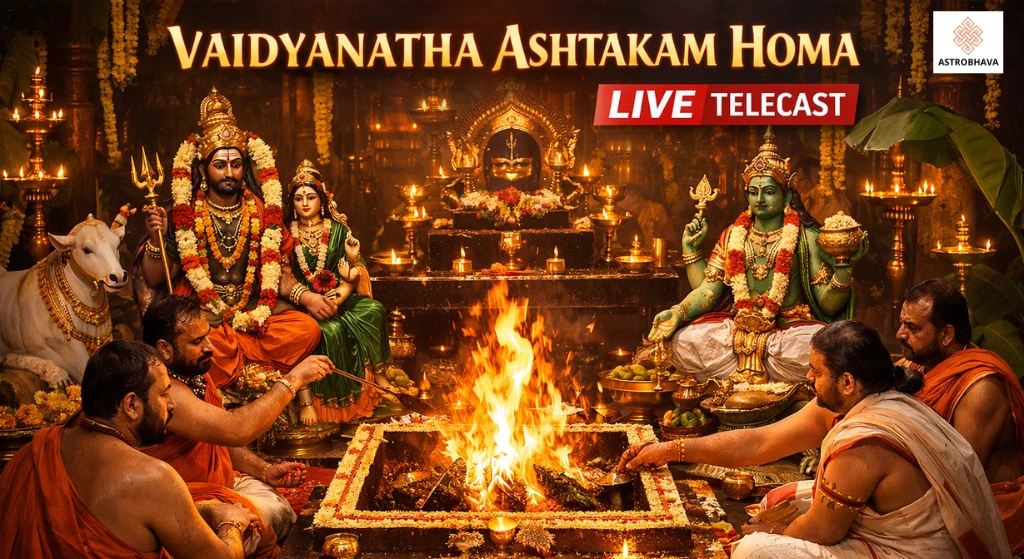
The ritual space (yajnashala) is purified using Panchagavya (the five products of the cow) and Ganga jal. The homa kunda — traditionally a square pit (chatushkona kunda) for rituals involving Shiva — is prepared and consecrated. The dravyas are arranged: Bilva leaves, sesame, Ashwagandha, Shatavari, Guduchi, white sandalwood, pure cow ghee, and medicated ghee preparations. The image or yantra of Lord Vaidyanatha is established and invoked with Pranapratishtha — the ritual installation of the deity’s presence.
Stage 3: Sankalpa
The priest recites the Sankalpa — the ritual declaration of intent — which includes the devotee’s name (nama), natal star (janma nakshatra), gotra (ancestral lineage), and the specific purpose of the ritual. For Vaidyanatha Homa, the Sankalpa explicitly states the health condition being addressed, the planetary afflictions identified in the birth chart, and the desired outcome in Vedic terms (relief from Roga Peedha, increase in Ayu and Bala). This makes the ritual’s cosmic intention precise and directional.
Stage 4: Ganesh Puja and Navagraha Invocation
Every Vedic ritual begins with the propitiation of Lord Ganesha as the remover of obstacles, followed by invocations to the Navagrahas — the nine planets. In Vaidyanatha Homa, the Navagraha invocation pays special attention to Saturn and Rahu, offering them their specific oblation materials (tila and durva grass respectively) to neutralise their malefic influence before the primary ritual proceeds.
Stage 5: Primary Homa — Vaidyanatha Invocation and Oblations
The main fire ritual begins with the chanting of the Vaidyanatha Ashtakam and selected verses from the Sri Rudram (specifically the Namakam section, which addresses Rudra’s healing and protective forms). Each oblation (ahuti) is offered with a specific mantra, and the number of ahutis follows the prescribed count from the Agamic source — typically 1,008 or 10,008 repetitions depending on the severity of the condition and the ritual’s scale. The oblations of medicinal herbs are made during the core portion, with the priest narrating their Vedic purpose as each is offered.
Stage 6: Purnahuti and Poornahuti Prasad
The ritual concludes with Poornahuti — the final complete offering — which involves offering a full coconut, betel leaves, and a compilation of all the ritual materials simultaneously into the fire as a gesture of complete surrender. This is the ritual’s culminating moment, and the fire’s response (its intensity, direction, and sound) is observed by the priest as a traditional indication of the deity’s acceptance.
Stage 7: What the Devotee Receives
Following the homa, AstroBhava dispatches to the devotee: the consecrated ash (vibhuti) from the homa kund (to be applied on the forehead as prasad), a small quantity of the medicated ghee used in oblations (traditionally consumed in small amounts as prasad with the advice of the priest), a video recording of the ritual with the Sankalpa recitation clearly audible, and the priest’s written notes on the astrological findings and any follow-up remedies recommended.
Ready to seek the divine blessings of Lord Vaidyanatha for health, healing, and longevity?
Auspicious Timings for Vaidyanatha Homa
Vara (Day): Monday is the primary day for all Vaidyanatha rituals, as Monday (Somavar) is sacred to Shiva and the Moon, and the Moon governs the mind-body connection in Vedic physiology. In cases of emergency or when Monday muhurtas are inauspicious in a given week, Saturday is used as an alternative for Saturn-related health conditions.
Tithi (Lunar Day): The Trayodashi (13th lunar day) of both fortnights is specifically sacred to Shiva and considered most powerful for Vaidyanatha invocation. Purnima (full moon) during Shukla Paksha is also highly favoured. Avoid Amavasya (new moon) for this ritual unless the intent is specifically ancestral health healing.
Nakshatra: Pushya (governed by Saturn and considered the most nourishing nakshatra), Rohini (associated with vitality and growth), and Hasta (associated with healing arts and craftsmanship, ruled by the Sun) are the three most auspicious nakshatras for this homa. Ardra nakshatra — directly ruled by Rudra — is also specifically cited in Agamic tradition as potent for Shiva healing rituals.
Yoga: Siddha Yoga and Amrita Yoga (specific combinations of vara and nakshatra) are considered particularly auspicious. Sarvartha Siddhi Yoga days are ideal for any ritual requiring long-term efficacy. Avoid Vishkambha and Vyatipata yogas.
Masa (Month): Shravan (the lunar month most sacred to Shiva, typically falling in July-August) is the highest-priority month for performing Vaidyanatha Homa. Margashirsha and Phalguna are also auspicious. Performing the ritual during Pradosh Kala (the twilight period, especially on Pradosham days) amplifies its efficacy according to Shaiva tradition.
Explore Today Panchang for Auspicious timings and Muhurat
Frequently Asked Questions
What is the difference between Vaidyanatha Homa and Mahamrityunjaya Homa?
Both are Shiva rituals associated with healing and longevity, but they invoke different aspects of Shiva with different ritual mechanisms. Mahamrityunjaya Homa invokes Shiva as Tryambaka — the three-eyed one who conquers death — and is performed primarily in situations of acute crisis, life-threatening illness, or imminent danger. Vaidyanatha Homa invokes Shiva specifically as the cosmic physician, making it better suited for chronic illness, ongoing health management, recovery support, and the removal of planetary-caused health afflictions. They can be performed together when both acute danger and planetary obstruction are present.
Can Vaidyanatha Homa be performed on behalf of someone who is ill and cannot participate in person?
Yes. The Sankalpa — the ritual declaration of intent — is recited with the name, nakshatra, and gotra of the person for whom the ritual is being performed, even if that person is not present. This is a well-established provision in Agamic ritual law, and many families perform this homa for elderly parents, hospitalised relatives, or children. The prasad and vibhuti are then dispatched to the family.
How many times should Vaidyanatha Homa be performed for serious health conditions?
For acute and recent health challenges, a single properly conducted homa with 10,008 ahutis is considered a complete remedy in many Agamic traditions. For chronic, long-standing conditions — especially those tied to Saturn Mahadasha or Sade Sati — performing the homa once per year during Shravan month is the traditional recommendation. Our priests provide a specific recommendation based on your birth chart after review.
Is Vaidyanatha Homa specifically a South Indian ritual or is it practised across India?
The Vaidyanatha Jyotirlinga is located in Deoghar, Jharkhand, making this a pan-Indian tradition. The ritual is performed across South Indian Shaiva temples following Agama Shastra, North Indian traditions following Atharva Vedic procedures, and Maharashtra-specific traditions around the Vaidyanatha form. AstroBhava’s ritual follows the Agamic procedure, which is the most widely recognised and structured of these traditions.
What should the devotee do on the day the homa is being performed?
The traditional recommendation is to observe a simple fast (or at minimum avoid non-vegetarian food), take a bath before the scheduled ritual time, light a lamp at home if possible during the ritual window, and mentally hold your intention for healing. You are not required to be present — the Sankalpa and the ritual’s mechanism function independently — but maintaining a receptive and calm state during the ritual window is considered beneficial.
Are there any contraindications — people who should not perform this homa?
There are no general contraindications. However, if you have recently performed Tarpana or a Shraadha ritual within the same lunar fortnight, the priests will adjust the timing to avoid conflicting ritual energies. In some Agamic traditions, pregnant women in their third trimester avoid proximity to homa smoke, though the ritual can still be performed on their behalf.
Can Vaidyanatha Homa address mental health conditions, not just physical illness?
Vedic tradition does not draw a sharp division between mental and physical health in the way modern medicine does. Conditions that involve anxiety, chronic fear, inexplicable depression, or mental fatigue — especially when associated with Rahu in the 6th or 12th house, or Ketu in the 4th — are considered within the domain of this ritual’s scope. The homa is not a substitute for professional mental health support, but it is traditionally held to address the planetary and karmic layer of such conditions simultaneously.
How long does the ritual take, and will I receive proof it was performed?
A standard Vaidyanatha Homa with 1,008 ahutis takes approximately two to three hours. A full 10,008 ahuti ritual can span four to six hours. AstroBhava provides every devotee with a video recording of the complete ritual, including the Sankalpa recitation (where your name is audible), and a follow-up call with the presiding priest if you have questions after viewing.
Does the planetary position at the time of performing the homa matter, or only the natal chart?
Both matter. The natal chart determines whether the ritual is indicated and what the Sankalpa should specify. The muhurta — the chosen time of performance — is selected based on current planetary transits to ensure the ritual is performed at a moment when the cosmic environment is aligned with its purpose. This is why muhurta selection is an integral and non-negotiable part of AstroBhava’s ritual preparation process.
What is the scriptural basis for believing that a fire ritual can influence health outcomes?
The connection between fire ritual and health is rooted in multiple layers of Vedic authority. The Charaka Samhita (the foundational Ayurvedic text) explicitly acknowledges the role of Daivavyapashraya Chikitsa — divine or ritual-based medicine — as one of the three pillars of Ayurvedic treatment alongside herbal medicine and rational therapy. The Atharva Veda is largely composed of healing incantations, many of which form the basis for ritual healing traditions. And the Shiva Purana’s account of Vaidyanatha specifically frames Shiva’s grace as operative in the realm of physical healing. AstroBhava does not claim that this ritual replaces medical treatment — these two systems are understood as operating on different but complementary layers of reality.
Book a Vaidyanatha Homa with AstroBhava
If you have read this far and recognise your astrological situation in what has been described — the planetary placements, the dasha periods, the health patterns — the next step is a birth chart review. AstroBhava’s priests conduct a brief astrological consultation before every Vaidyanatha Homa booking to confirm that the ritual is correctly matched to your chart, select the most auspicious muhurta for your specific planetary situation, and personalise the Sankalpa.
You can visit our Vaidyanatha Homa service page to review what is included, submit your birth details, and connect with our team. Every ritual is conducted live at our sanctified yajnashala by priests who have performed this homa hundreds of times — with the same rigour whether the devotee is in Chennai or Chicago.