Have you ever wondered why certain days on the Hindu calendar carry a spiritual charge so powerful that even a single act of devotion on that day can change the course of your life? 2026 Parashurama Dwadashi is one of those rare, electrifying occasions. Whether you’re a devoted follower of Lord Vishnu, someone seeking inner strength, or simply curious about the depth of Hindu traditions, this blog has everything you need to know — date, timings, rituals, spiritual meaning, and more.
Let’s dive in.
What Is Parashurama Dwadashi?
Parashurama Dwadashi is a sacred Vaishnava observance that falls on the Dwadashi Tithi (the twelfth lunar day) of the Shukla Paksha (the bright fortnight) in the month of Vaishakha. This day is specifically linked to Lord Parashurama, the sixth avatar of Lord Vishnu — the fierce warrior-sage who descended on Earth to restore righteousness when the world was overrun by arrogant and oppressive rulers.
Unlike other Dwadashi days that are tied to different incarnations of Vishnu (like Kurma Dwadashi or Matsya Dwadashi), Parashurama Dwadashi holds a uniquely intense energy. It is a day that blends Bhakti (devotion), Shakti (strength), and Dharma (righteousness) in one powerful spiritual package.
The word “Parashu” means axe in Sanskrit, and Parashurama literally translates to “Rama with the axe.” He is the only avatar of Vishnu who is considered a Chiranjeevi — an immortal who still walks the Earth. According to the Kalki Purana, Lord Parashurama will also serve as the martial guru of Kalki, the tenth and final avatar of Vishnu, at the end of this age (Kali Yuga). That alone tells you how significant this deity is.
2026 Parashurama Dwadashi Date and Timings
Let’s get straight to the most searched question: When is Parashurama Dwadashi in 2026?
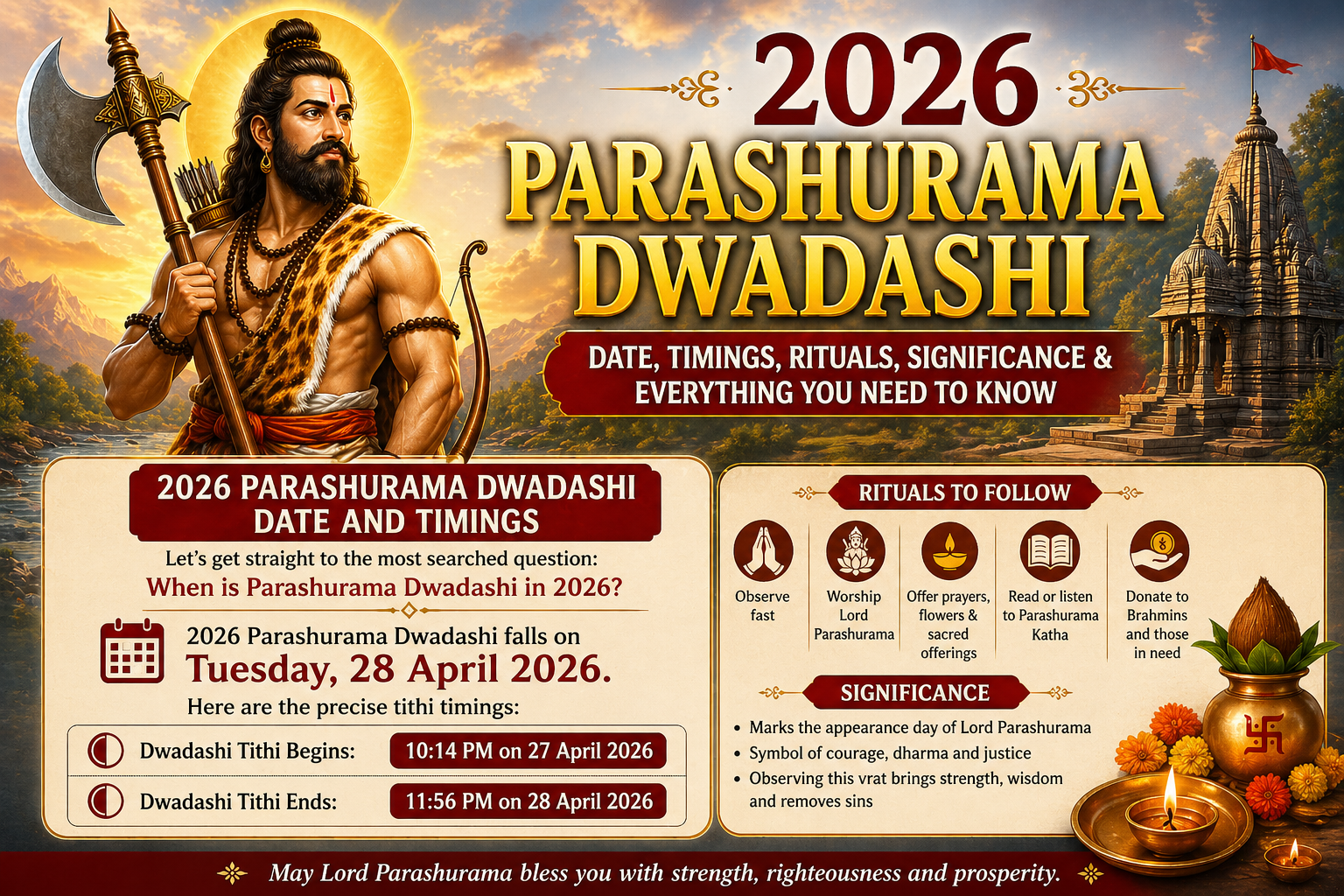
2026 Parashurama Dwadashi falls on Tuesday, 28 April 2026.
Here are the precise tithi timings:
Dwadashi Tithi Begins: 10:14 PM on 27 April 2026
Dwadashi Tithi Ends: 11:56 PM on 28 April 2026
Since the Vaishakha Shukla Dwadashi Tithi is present at sunrise on 28 April 2026, the observance of the fast and all associated rituals is done on that day — Tuesday, 28 April 2026.
Brahma Muhurta on 28 April will be the ideal time to wake up, take your bath, and begin your sankalpa (sacred vow). Morning worship between sunrise and mid-morning is considered the most auspicious window for puja and mantra recitation on this day.
The Story Behind Lord Parashurama — Why This Day Matters
To truly understand why 2026 Parashurama Dwadashi deserves your attention, you need to know the story of the deity himself.
Born to the great sage Jamadagni and his wife Renuka, Parashurama was no ordinary Brahmin. Trained directly by Lord Shiva in the art of warfare, he received a divine axe (Parashu) as a boon — a weapon that came to symbolise the destruction of ego, injustice, and moral corruption.
The pivotal event that shaped his divine mission was the injustice committed by King Kartavirya Arjuna, who forcefully took away the divine cow Kamadhenu from Sage Jamadagni’s hermitage. When Parashurama defeated the king in battle, the king’s sons retaliated by killing Sage Jamadagni — Parashurama’s own father. Consumed by grief and righteous fury, Parashurama took a vow to cleanse the Earth of oppressive rulers. He is said to have performed this act of cosmic justice twenty-one times over, dismantling the kshatriya (warrior class) power structures that had become corrupt and tyrannical.
But his story doesn’t end in violence. After fulfilling his dharmic duty, he renounced his weapons and turned to deep penance and spiritual discipline. He embodies the ultimate spiritual teaching: that strength must always be in service of truth, and that even a warrior must eventually lay down his weapons and turn inward.
Parashurama Dwadashi is the day to reflect on this teaching in your own life.
Spiritual Significance of Parashurama Dwadashi
The Dwadashi Tithi itself is one of the most spiritually potent lunar days in the Hindu Panchang. Ancient texts like the Manusmriti, Padma Purana, Skanda Purana, and Vishnu Dharmottara Purana all describe the immense merit earned by observing Dwadashi Vrat. Acts like bathing, charity, mantra chanting, havan, and fasting performed on Dwadashi are said to bestow inexhaustible spiritual merit.
When this already powerful Tithi is specifically dedicated to Lord Parashurama, the energy is amplified in the following ways:
Protection from enemies and adversity. For those facing unfair opposition, legal troubles, or hostile forces, Parashurama Dwadashi is considered especially protective. The fierce energy of Lord Parashurama acts as a divine shield.
Destruction of ego and arrogance. Just as Parashurama dismantled corrupt power, worshipping him on this day helps devotees identify and dissolve their own inner arrogance, anger, and unchecked pride.
Awakening of courage and ethical clarity. Those in leadership, defence, law, or any field that requires decisive action find this day deeply supportive for sharpening their moral compass.
Karmic cleansing. The Dwadashi Tithi is associated with expansion, sustenance, and stabilisation. Vows taken on this day are believed to carry special karmic weight, helping you break free from negative patterns.
Divine blessings for righteous effort. Any dharmic work, new venture, or ethical undertaking initiated on this day receives the blessings of Lord Vishnu through his Parashurama avatar.
How to Observe 2026 Parashurama Dwadashi — Step-by-Step Rituals
Observing 2026 Parashurama Dwadashi doesn’t require elaborate resources. What it requires is sincere intention and devotion. Here’s how to observe the day the right way:
1. Wake Up at Brahma Muhurta
Rise before sunrise — ideally during Brahma Muhurta (approximately 1.5 hours before sunrise). This is when the cosmic energies are cleansest and most receptive to prayer.
2. Take a Ritual Bath (Snan)
Bathe with clean water, ideally mixed with a pinch of sesame seeds or a few drops of Ganga Jal if available. This is the purification step that prepares your body and mind for the sacred observance.
3. Take the Sankalpa
A Sankalpa is a sacred vow — a formal declaration of your intention to observe the Vrat. Face east or north, hold water in your right palm, and declare your intention to fast and worship Lord Parashurama or Lord Vishnu for spiritual merit, protection, or the fulfilment of a specific dharmic goal.
4. Puja of Lord Parashurama or Lord Vishnu
Set up the puja space with a clean cloth. Offer Tulsi leaves, sandalwood paste, yellow or white flowers, incense, and a lamp. If you have a murti or image of Lord Parashurama, worship it directly. Otherwise, a Vishnu murti or Shaligrama is perfectly appropriate.
Offer the following in your puja:
Panchamrit (milk, curd, honey, ghee, sugar)
Tulsi (sacred basil) — especially dear to Lord Vishnu
Yellow flowers (associated with Vishnu’s auspiciousness)
Sandalwood paste
Dhoop (incense) and Deepak (lamp)
5. Mantra Recitation
The following mantras are recommended on Parashurama Dwadashi:
Vishnu Sahasranama — a powerful recitation of the thousand names of Lord Vishnu
Om Namo Bhagavate Vasudevaya — the twelve-syllable Vishnu mantra, especially potent on Dwadashi
6. The Fast (Vrat)
Depending on your health and capacity, you may observe:
A complete Nirjala fast (no food or water)
A fruit-based fast
A light Sattvic meal (excluding grains, onion, garlic)
The spirit of the fast is as important as the form. Even if a full fast isn’t possible, eating simple, clean, Sattvic food throughout the day honours the spirit of the observance.
7. Charity and Service
Donating food, clothing, books, or essential items to those in need is considered especially meritorious on this day. Feeding Brahmins, teachers, soldiers, or genuinely needy people is practised widely. The philosophy behind this is rooted in Lord Parashurama’s own teaching — that strength and resources are meant for the welfare of all, not personal accumulation alone.
8. Break the Fast on Dwadashi
The Parana (breaking of the fast) should ideally happen on the same day — on 28 April 2026 — after the puja is complete and before the Dwadashi Tithi ends at 11:56 PM.
Parashurama Dwadashi Vrat Katha (The Sacred Story)
Reciting or listening to the Vrat Katha is an integral part of the Parashurama Dwadashi observance. The story goes thus:
In ancient times, there lived a devoted Brahmin who faced relentless persecution from a powerful and arrogant landlord. Despite his righteousness, the Brahmin had no recourse to justice. On the advice of a sage, he observed the Parashurama Dwadashi fast with complete sincerity — bathing before sunrise, worshipping Lord Parashurama, reciting his names, and distributing food to the needy.
Lord Parashurama, pleased by this sincere devotion, appeared in a dream and told the Brahmin that justice would be served. Within days, the landlord’s own misdeeds caught up with him, and the Brahmin’s life was restored to peace and prosperity.
The moral of the Katha is straightforward: when human justice fails, divine justice doesn’t. And Lord Parashurama is that force of divine justice that never sleeps.
Parashurama Dwadashi and Its Connection to Vaishakha Month
The month of Vaishakha (April–May) is considered one of the holiest months in the Hindu calendar. It is the month of Parashurama Jayanti (which fell on Akshaya Tritiya, 19 April 2026), Mohini Ekadashi, Narasimha Jayanti, and Buddha Purnima. Parashurama Dwadashi arrives right at the heart of this spiritually charged month — just days after Parashurama Jayanti — making the energetic connection between these observances deeply complementary.
Devotees who worship Lord Parashurama on his Jayanti (birth anniversary) and then again observe the Dwadashi fast nine days later are said to receive the full cycle of his blessings — birth, mission, and cosmic protection.
Who Should Especially Observe 2026 Parashurama Dwadashi?
While this is a day for all devotees, certain groups of people find it especially transformative:
Those facing legal battles or unjust opposition — Lord Parashurama is the embodiment of divine justice. His blessings can create breakthroughs in situations where fairness seems impossible.
People in the military, police, law enforcement, or judiciary — The warrior-sage energy of Parashurama resonates deeply with those whose duty is to protect and uphold the law.
Students and scholars of the Vedic tradition — Parashurama was both a warrior AND a Brahmin scholar. He represents the union of knowledge and action.
Those struggling with anger and power — If you find yourself misusing authority or being consumed by rage, this is the day to seek Parashurama’s guidance on channelling those energies righteously.
People seeking protection from enemies or negative energies — The day is considered highly powerful for creating a spiritual shield around yourself and your family.
Anyone undertaking new ventures that require courage and integrity — Starting a new job, a business, a creative project, or any dharmic initiative on or around this day carries his blessings.
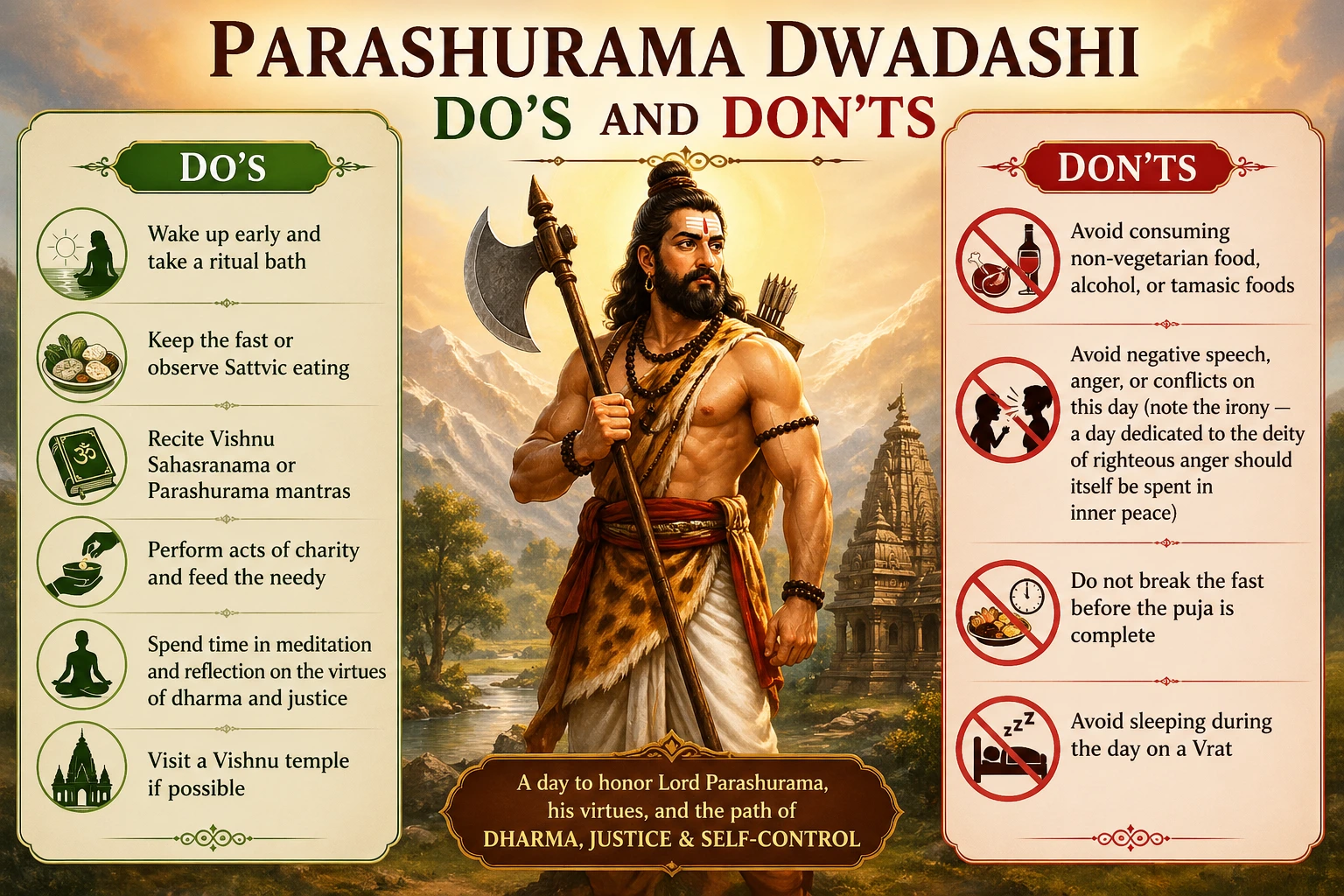
Parashurama Dwadashi Do’s and Don’ts
Do’s:
Wake up early and take a ritual bath
Keep the fast or observe Sattvic eating
Recite Vishnu Sahasranama or Parashurama mantras
Perform acts of charity and feed the needy
Spend time in meditation and reflection on the virtues of dharma and justice
Visit a Vishnu temple if possible
Don’ts:
Avoid consuming non-vegetarian food, alcohol, or tamasic foods
Avoid negative speech, anger, or conflicts on this day (note the irony — a day dedicated to the deity of righteous anger should itself be spent in inner peace)
The Deeper Spiritual Teaching of Parashurama Dwadashi
At a deeper level, 2026 Parashurama Dwadashi is not just a ritual observance — it is an invitation to a profound inner inquiry.
Lord Parashurama’s life teaches us something that is rarely spoken about openly: the right relationship between power and purpose. He was one of the most powerful beings in all of creation, yet he ultimately surrendered his weapons and turned to penance. He shows us that the highest form of strength is not the ability to defeat others — it is the discipline to conquer yourself.
This Dwadashi, ask yourself:
Where in your life are you misusing strength or authority?
Where are you failing to stand up for justice out of fear or convenience?
How can you better align your power — your time, your resources, your voice — with dharma?
These are the questions Lord Parashurama places before every devotee on this sacred day.
Conclusion
2026 Parashurama Dwadashi falls on Tuesday, 28 April 2026, with the Dwadashi Tithi beginning at 10:14 PM on 27 April and concluding at 11:56 PM on 28 April. This is a day of immense spiritual power — a day to invoke the energy of the warrior-sage who stood for justice, surrendered his ego, and walked the path of dharma even when it was the hardest road.
Whether you observe a fast, perform a puja, recite mantras, or simply spend a few moments in quiet reflection, let this day be a turning point. Let the axe of Parashurama cut through whatever in your life is unjust, misaligned, or holding you back from your truest, most dharmic self.
The divine warrior is still here. He is waiting for your call.
Frequently Asked Questions (FAQs)
Q1. When is 2026 Parashurama Dwadashi?
2026 Parashurama Dwadashi is on Tuesday, 28 April 2026. The Dwadashi Tithi begins at 10:14 PM on 27 April 2026 and ends at 11:56 PM on 28 April 2026.
Q2. What is the significance of Parashurama Dwadashi?
It is a sacred Vaishnava observance dedicated to Lord Parashurama, the sixth avatar of Lord Vishnu. The day is associated with justice, protection, inner strength, karmic cleansing, and the destruction of ego and arrogance.
Q3. How do you fast on Parashurama Dwadashi?
Depending on your health, you can observe a complete fast (Nirjala), a fruit fast, or eat a simple Sattvic meal without grains, onion, or garlic. The fast is broken on the same day — 28 April 2026 — after completing the puja.
Q4. Which mantra should be chanted on Parashurama Dwadashi?
The Parashurama Mool Mantra (Om Jaamadagnyaaya Vidmahe Mahaaviraya Dheemahi Tanno Parashu Prachodayaat), Vishnu Sahasranama, and Om Namo Bhagavate Vasudevaya are all highly recommended.
Q5. Is Parashurama Dwadashi the same as Parashurama Jayanti?
No. Parashurama Jayanti is his birth anniversary and falls on Vaishakha Shukla Tritiya — in 2026, that was on 19 April (Akshaya Tritiya). Parashurama Dwadashi falls on the Vaishakha Shukla Dwadashi, nine days later, on 28 April 2026.
Q6. Who should observe Parashurama Dwadashi?
Anyone can observe it, but it is especially beneficial for those in military or law enforcement roles, those facing legal or unjust opposition, those struggling with anger management, and devotees of Lord Vishnu seeking protection and strength.
Q7. Is Lord Parashurama still alive?
According to Hindu scriptures, yes. Lord Parashurama is one of the Sapta Chiranjivis (seven immortals) and is believed to still reside on Mahendra Parvata. He is not worshipped in the conventional temple sense like Rama or Krishna, as his mission in this world is considered ongoing.
Q8. What should be offered in puja on Parashurama Dwadashi?
Tulsi leaves, sandalwood paste, yellow or white flowers, Panchamrit, incense, and a lamp are ideal. Feeding Brahmins or the needy afterwards amplifies the merit of the worship.
Q9. Can Parashurama Dwadashi be observed at home?
Absolutely. A simple home puja with sincere intention, mantra recitation, and charitable giving is fully valid and spiritually effective.
Q10. What charity should be done on Parashurama Dwadashi?
Donating food, clothing, books, or essential items to those in need is considered highly meritorious. Feeding Brahmins, teachers, soldiers, or the genuinely poor is especially aligned with the spirit of Lord Parashurama’s teachings.



 Parashurama Dwadashi Do’s and Don’ts