Have you ever come across a goddess so fierce, so raw, and so deeply profound that just learning about her feels like a spiritual awakening? That is exactly who Maa Chinnamasta is — the self-decapitated goddess, the sixth of the ten Mahavidyas, and one of the most powerful divine forces in the entire Tantric tradition. And if you have been searching for everything about 2026 Chinnamasta Jayanti — the date, the timings, the rituals, the meaning, and how to truly honour her — you have landed in exactly the right place.
Let us walk through every detail together, with the reverence this extraordinary goddess deserves.
Who Is Goddess Chinnamasta? A Brief Introduction
Before we get into the specifics of the festival, it helps to understand who we are talking about. Goddess Chinnamasta — also known as Prachanda Chandika — is one of the ten Mahavidya goddesses in Hinduism, all of whom represent different aspects of the Supreme Divine Feminine energy (Adi Shakti). She belongs to the Kali Kula tradition and is considered the Shakti of Kabandha Shiva.
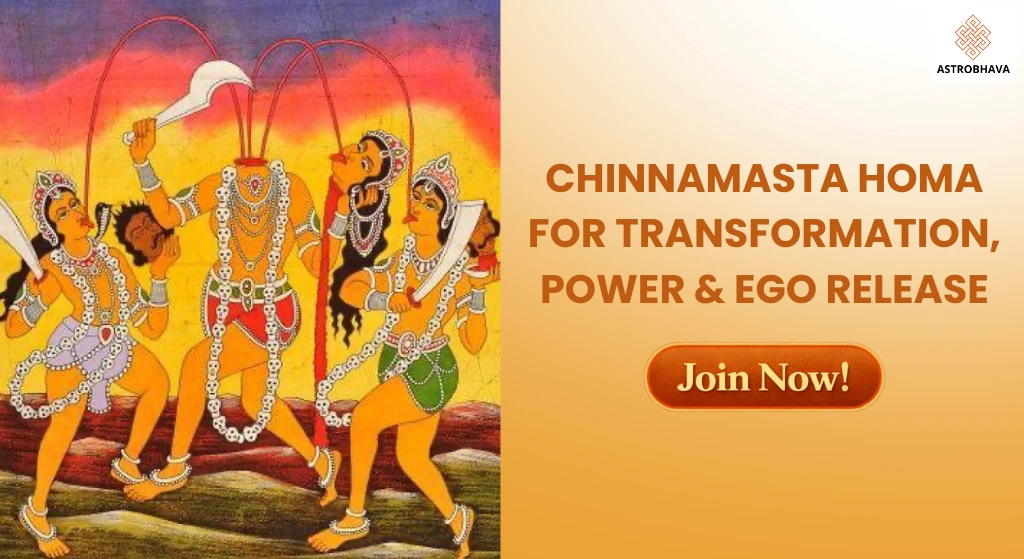
Her iconography is unlike anything else in the Hindu pantheon. She is depicted standing on the divine couple Rati and Kamadeva, holding her own severed head in one hand, with three streams of blood gushing from her neck — one entering her own severed mouth and the other two feeding her two attendants, Jaya and Vijaya. Flanking her on either side are Dakini and Varnini, her fierce companions.
This image, as shocking as it first appears, is a powerful allegory. The severed head represents the destruction of the ego. The three streams of blood symbolise the three nadis — Ida, Pingala, and Sushumna — the energy channels in the subtle body. Her act of self-sacrifice for her attendants embodies the highest form of compassion and selflessness.
In essence, Maa Chinnamasta is the goddess of self-realisation, fearlessness, transformation, and liberation (Moksha).
2026 Chinnamasta Jayanti: Date and Tithi
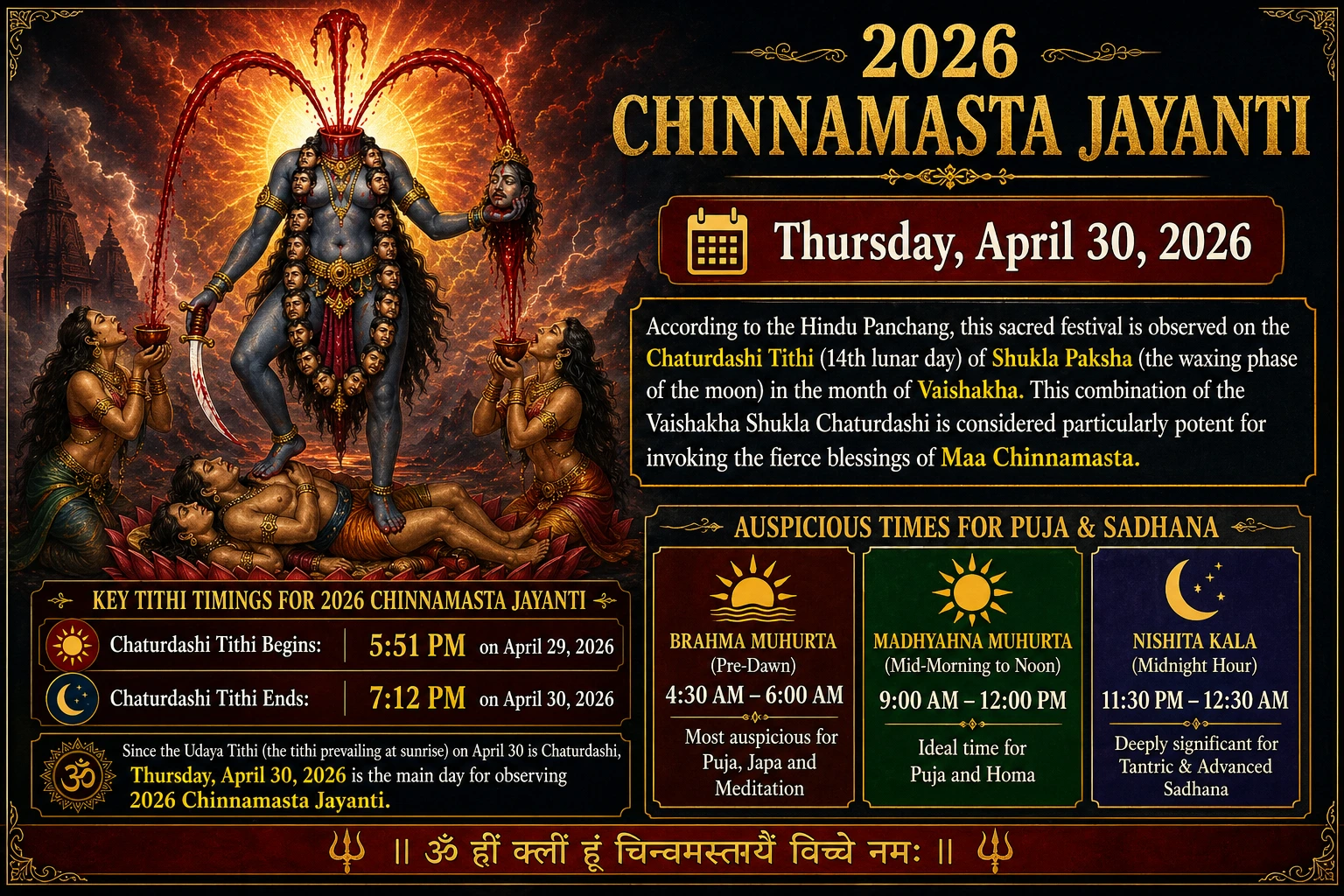
2026 Chinnamasta Jayanti falls on Thursday, April 30, 2026.
According to the Hindu Panchang, this sacred festival is observed on the Chaturdashi Tithi (14th lunar day) of Shukla Paksha (the waxing phase of the moon) in the month of Vaishakha. This combination of the Vaishakha Shukla Chaturdashi is considered particularly potent for invoking the fierce blessings of Maa Chinnamasta.
Key Tithi Timings for 2026 Chinnamasta Jayanti:
Chaturdashi Tithi Begins: 5:51 PM on April 29, 2026 Chaturdashi Tithi Ends: 7:12 PM on April 30, 2026
Since the Udaya Tithi (the tithi prevailing at sunrise) on April 30 is Chaturdashi, Thursday, April 30, 2026 is the main day for observing 2026 Chinnamasta Jayanti.
The most auspicious time for Puja on this day is during the Brahma Muhurta (approximately 4:30 AM to 6:00 AM) and the Madhyahna Muhurta (mid-morning to noon). For Tantric and advanced Sadhana practices, the Nishita Kala (midnight hour) is also deeply significant.
The Sacred Legend Behind Chinnamasta Jayanti
Every Hindu festival has a story at its heart, and Chinnamasta Jayanti is no different. In fact, it has more than one legend, each richer and more layered than the last.
The Legend of the Mandakini River
The most well-known story goes like this: One day, Goddess Parvati went to bathe in the sacred Mandakini River, accompanied by her two attendants, Jaya and Vijaya. The goddess became so absorbed in her bath that she completely lost track of time. Meanwhile, her attendants grew increasingly hungry. They reminded her again and again, but Parvati, deep in her divine state, did not notice.
When she finally realised how long she had kept them waiting, she was overcome with guilt. In an extraordinary act of love and self-sacrifice, she beheaded herself with her own hands. From her severed neck, three streams of blood sprang forth. Two nourished Jaya and Vijaya, and the third flowed into her own severed head, sustaining herself. From that day, she came to be worshipped as Chinamasta — the Severed-Head Goddess.
This story is not just mythology. It is a teaching. It says: true compassion sometimes demands the highest sacrifice. It says: the ego (the head) must be offered at the altar of love.
The Mahavidya Legend
Another legend connects Chinnamasta to the emergence of the ten Mahavidyas. When Lord Shiva wished to depart from Goddess Parvati’s home, she manifested ten fierce forms of herself in all ten directions to block his path. These ten forms became the Mahavidyas, with Chinnamasta being the sixth among them. Each Mahavidya governs a different cosmic function — Chinnamasta governs the fierce, transformative energy that breaks the cycle of ignorance.
The Demon-Slayer
A third legend describes how the gods, unable to defeat powerful demons, invoked the Supreme Shakti for help. She appeared as Prachanda Chandika — a ferocious warrior goddess. Even after destroying all the demons, her rage did not subside. It was only when she beheaded herself that her fury was contained. This is why she is also worshipped as the one who has absolute mastery over even her own divine anger.
 Why Is 2026 Chinnamasta Jayanti Spiritually Significant?
You might wonder — with so many Hindu festivals, why should this particular day hold such importance? The answer lies in the cosmic alignment.
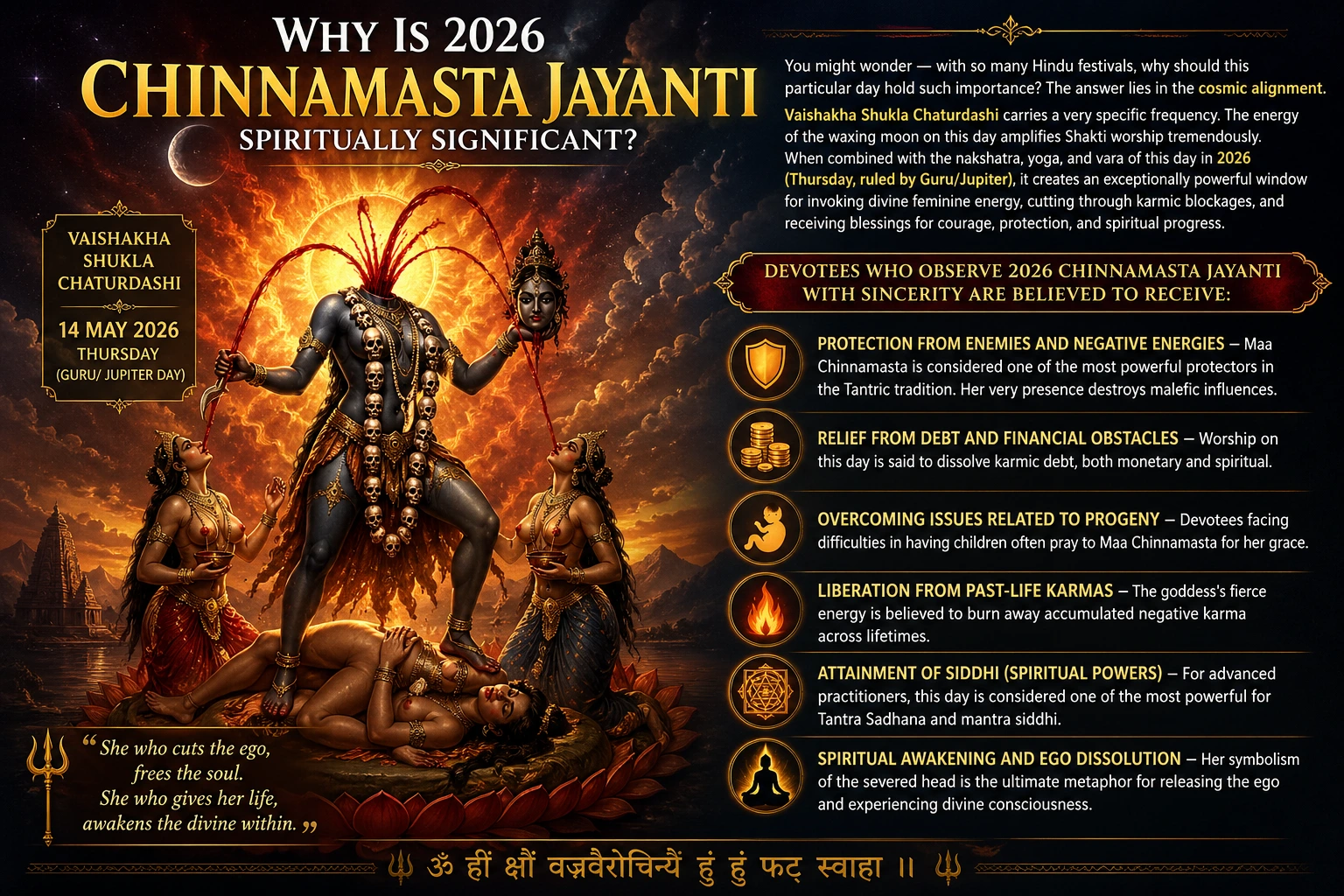
Vaishakha Shukla Chaturdashi carries a very specific frequency. The energy of the waxing moon on this day amplifies Shakti worship tremendously. When combined with the nakshatra, yoga, and vara of this day in 2026 (Thursday, ruled by Guru/Jupiter), it creates an exceptionally powerful window for invoking divine feminine energy, cutting through karmic blockages, and receiving blessings for courage, protection, and spiritual progress.
Devotees who observe 2026 Chinnamasta Jayanti with sincerity are believed to receive:
Protection from enemies and negative energies — Maa Chinnamasta is considered one of the most powerful protectors in the Tantric tradition. Her very presence destroys malefic influences.
Relief from debt and financial obstacles — Worship on this day is said to dissolve karmic debt, both monetary and spiritual.
Overcoming issues related to progeny — Devotees facing difficulties in having children often pray to Maa Chinnamasta for her grace.
Liberation from past-life karmas — The goddess’s fierce energy is believed to burn away accumulated negative karma across lifetimes.
Attainment of Siddhi (spiritual powers) — For advanced practitioners, this day is considered one of the most powerful for Tantra Sadhana and mantra siddhi.
Spiritual awakening and ego dissolution — Her symbolism of the severed head is the ultimate metaphor for releasing the ego and experiencing divine consciousness.
How to Observe 2026 Chinnamasta Jayanti: Puja Vidhi (Step-by-Step)
Whether you are a seasoned devotee or someone approaching Maa Chinnamasta for the first time, here is how to observe this sacred day with the right intent and method.
1. Wake Up Early and Purify Yourself
Begin your day during Brahma Muhurta (around 4:30 AM) with a bath. Wear clean clothes — red or black are traditionally preferred for Chinnamasta worship. Set your Sankalpa (sacred intention) clearly in your mind before beginning.
2. Set Up the Altar
Place the image or idol of Maa Chinnamasta on a clean altar facing east or north. If you have the image of Lord Shiva nearby, include it as well, since Chinnamasta is intrinsically connected to Shiva. Light a ghee lamp and incense sticks to purify the atmosphere.
3. Offer the Puja Items
Traditional offerings for Maa Chinnamasta include:
- Red flowers (especially hibiscus/Japa flowers)
- Kumkum (vermilion)
- Red cloth
- Coconut
- Fruits and Prasad (sacred food)
- Betel leaves and betel nut
4. Chant the Chinnamasta Mantra
The core mantra for Maa Chinnamasta is:
ॐ श्रीं ह्रीं क्लीं ऐं वज्र वैरोचनीयै हूं हूं फट् स्वाहा॥ Om Shreem Hreem Kleem Aim Vajra Vairochanyai Hum Hum Phat Swaha
Chant this mantra 108 times using a red sandalwood or rudraksha mala. Even those new to Tantric practices can chant this mantra with devotion and sincerity.
5. Perform Aarti
Offer aarti to the goddess with a camphor flame, moving it in a clockwise direction. Sing or play devotional hymns dedicated to Maa Chinnamasta.
6. Kanya Puja
On this day, worshipping young girls (Kanya) as manifestations of the goddess is considered especially auspicious. Offer them food, clothing, and gifts with a pure heart.
7. Dana and Charity
Donate food, clothes, or money to those in need on this day. Charity performed on Chinnamasta Jayanti is said to multiply manifold in blessings returned.
8. Observe a Fast
Many devotees observe a day-long fast on 2026 Chinnamasta Jayanti, breaking it only in the evening after puja. Fasting is considered a form of self-discipline and offering that resonates deeply with the goddess’s symbolism of sacrifice.
The Deeper Symbolism of Maa Chinamasta: What She Truly Teaches
Let us go a little deeper, because Maa Chinnamasta is not just a goddess to be worshipped on a particular day — she is a lifelong teacher.
The Severed Head — The head represents the intellect and ego. By severing it herself, the goddess teaches that true liberation comes from transcending the rational, ego-driven mind. Spiritual awakening cannot happen through thinking alone — it happens through surrender.
Standing on Rati and Kamadeva — She stands on the couple representing desire and love, symbolising her absolute mastery over sensory attachment and carnal desire. She is not anti-desire — she transcends it.
The Three Streams of Blood — These represent the three pranas (life forces) or the three gunas (Tamas, Rajas, and Sattva). In the Tantric interpretation, they are the Ida, Pingala, and Sushumna nadis — and the goddess’s self-offering activates the Kundalini energy through all three channels simultaneously.
Her Fearlessness — She does not flinch. She does not wait for permission. She acts out of pure love and total fearlessness. This is her greatest teaching: to act from a place of inner completeness, not from lack.
Chinnamasta and the Mahavidyas: Her Place in the Divine Order
Maa Chinnamasta is the sixth of the ten Mahavidyas. The ten Mahavidyas represent the ten cosmic aspects of Shakti, each corresponding to different dimensions of divine power:
- Kali — Time and transformation
- Tara — Compassion and guidance
- Tripura Sundari — Beauty and grace
- Bhuvaneshwari — Space and nurturing
- Bhairavi — Fierce discipline
- Chinnamasta — Self-sacrifice and awakening
- Dhumavati — Dissolution and detachment
- Bagalamukhi — Power over speech and enemies
- Matangi — Creative intelligence
- Kamala — Abundance and fulfilment
Among these, Chinnamasta holds a unique and challenging position. She is neither the most approachable nor the most fearsome — but she is arguably the most transformative. Reaching her requires a willingness to dissolve the self.
Do’s and Don’ts on 2026 Chinnamasta Jayanti
Do’s:
- Wake up early and maintain physical and mental cleanliness
- Observe a fast with genuine spiritual intent
- Chant her mantra with a focused, devoted mind
- Perform charity and feed those in need
- Visit a Shakti temple if possible
- Read or listen to the Devi Mahatmyam or Chinnamasta Stotra
Don’ts:
- Avoid non-vegetarian food and alcohol on this day
- Do not approach her worship with ego or selfish motivations alone
- Avoid arguments, anger, or negative speech
- Do not perform her Sadhana without proper guidance if you are a beginner in Tantric practice
Conclusion
2026 Chinnamasta Jayanti on Thursday, April 30 is not just another festival on the Hindu calendar. It is a doorway — fierce, blazing, and wide open — to one of the most profound transformations available to a sincere seeker. Maa Chinnamasta does not offer comfort in the ordinary sense. She offers something far greater: the courage to shed the ego, to give without holding back, and to realise the infinite nature of your own consciousness.
Whether you are observing a simple fast and chanting her mantra at home, or participating in an elaborate Homa and Puja ceremony, what matters most is the sincerity of your heart. Come to her honestly. Come with your burdens, your fears, your unanswered questions. She has seen it all — and she still offers herself completely.
May Maa Chinnamasta bless you on this sacred day with fearlessness, clarity, and liberation.
Jai Maa Chinnamasta! 🙏
Frequently Asked Questions (FAQs) About 2026 Chinnamasta Jayanti
Q1. When is Chinnamasta Jayanti in 2026?
2026 Chinnamasta Jayanti falls on Thursday, April 30, 2026, corresponding to the Chaturdashi Tithi of Shukla Paksha in the month of Vaishakha.
Q2. What is the Chaturdashi Tithi timing for 2026 Chinnamasta Jayanti?
The Chaturdashi Tithi begins at 5:51 PM on April 29, 2026, and ends at 7:12 PM on April 30, 2026. Since Chaturdashi prevails at sunrise on April 30, that is the main day of observance.
Q3. What is the significance of 2026 Chinnamasta Jayanti?
This day marks the divine manifestation of Goddess Chinnamasta, the sixth Mahavidya. Worshipping her on this day is believed to dissolve karma, destroy negative energies, grant courage, remove debt, and accelerate spiritual growth.
Q4. Who is Goddess Chinnamasta?
Goddess Chinnamasta, also known as Prachanda Chandika, is the sixth of the ten Mahavidyas. She is depicted as a self-decapitated goddess, representing ego dissolution, self-sacrifice, spiritual awakening, and liberation from the cycle of birth and death.
Q5. Can ordinary devotees worship Maa Chinamasta?
Absolutely. While advanced Tantric Sadhana requires guidance, ordinary devotees can worship Maa Chinnamasta with a clean heart, sincere devotion, her mantra, red flowers, and a fast. The goddess is as much a mother as she is a fierce protector.
Q6. What is the main mantra for Chinnamasta Puja?
The most widely used mantra is: ॐ श्रीं ह्रीं क्लीं ऐं वज्र वैरोचनीयै हूं हूं फट् स्वाहा॥ Chant it 108 times with a mala for best results.
Q7. What should I offer Maa Chinnamasta on Jayanti?
Offer red hibiscus flowers, kumkum, red cloth, coconut, fruits, betel leaves, and Prasad. A ghee lamp and incense are essential parts of the puja.
Q8. Is fasting mandatory on Chinnamasta Jayanti?
Fasting is highly recommended as an act of self-discipline and offering, but it is not strictly mandatory. What is most important is sincere devotion and the right intent.
Q9. What are the benefits of performing Chinnamasta Homa?
A Chinnamasta Homa is believed to remove severe obstacles, destroy enemies’ negative intentions, dissolve accumulated karma, protect from evil forces, and open pathways for spiritual siddhi.
Q10. Can I participate in Chinnamasta Puja online?
Yes. Astrobhava offers professionally conducted Chinnamasta Puja and Homa services with experienced Vedic priests who perform the rituals on your behalf with your name and Gotra, making the blessings fully personal and effective regardless of your location.