If you’ve been searching for a reliable, spiritually rooted guide to Sankashti Chaturthi 2026 — one that covers every vrat date, the significance behind each fast, how to perform the puja correctly, and the moonrise timings — you’ve arrived at exactly the right place. Whether you’re a devotee living in the USA, UK, Canada, Australia, or anywhere else abroad, this guide has been crafted with your needs in mind.
Let’s dive deep into this beautiful, monthly Vedic practice that can truly transform your life.
What Is Sankashti Chaturthi? Understanding the Meaning
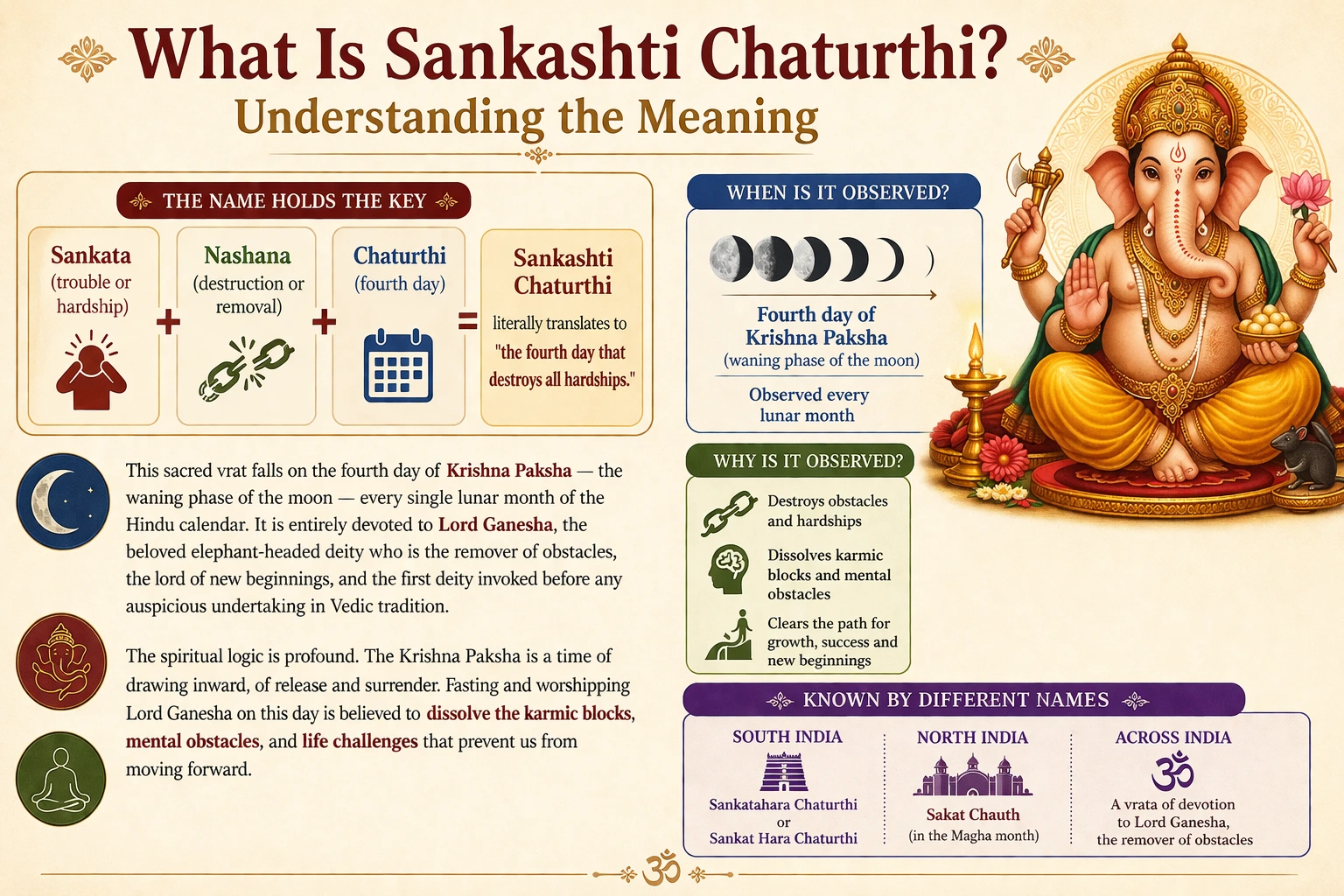
The name itself holds the key. Sankashti comes from the Sanskrit words Sankata (trouble or hardship) and Nashana (destruction or removal). Chaturthi simply means the fourth day. Put them together and Sankashti Chaturthi literally translates to “the fourth day that destroys all hardships.”
This sacred vrat falls on the fourth day of Krishna Paksha — the waning phase of the moon — every single lunar month of the Hindu calendar. It is entirely devoted to Lord Ganesha, the beloved elephant-headed deity who is the remover of obstacles, the lord of new beginnings, and the first deity invoked before any auspicious undertaking in Vedic tradition.
The spiritual logic is profound. The Krishna Paksha is a time of drawing inward, of release and surrender. Fasting and worshipping Lord Ganesha on this day is believed to dissolve the karmic blocks, mental obstacles, and life challenges that prevent us from moving forward. In South India, the same vrat is lovingly called Sankatahara Chaturthi or Sankat Hara Chaturthi, and in North India during the Magha month, it is observed as the famous Sakat Chauth.
 Why Sankashti Chaturthi Is So Powerful — The Spiritual Science
Think of the moon as a cosmic mirror of your mind. Vedic astrology holds that the mind (manas) is governed by the Moon. On Chaturthi during Krishna Paksha, the moon is in a diminishing phase — a perfect time for releasing what no longer serves you. When you fast, pray, and break your fast only after sighting the moon and offering Arghya, you are symbolically surrendering your ego and obstacles at the feet of Lord Ganesha and aligning yourself with the cosmic rhythm.
Lord Ganesha is also known as Vighnaharta (the one who destroys obstacles) and Buddhipriya (the one who loves intelligence and wisdom). Worshipping him on this potent day is said to bring:
- Removal of persistent obstacles in career, business, and relationships
- Clarity of mind and improved decision-making
- Relief from financial difficulties and debts
- Protection of children and family members
- Fulfilment of long-pending wishes and desires
- Inner peace and spiritual advancement
Angarki Chaturthi 2026 — The Most Sacred of All
Now here’s something truly remarkable about 2026. This year is exceptionally auspicious because three Sankashti Chaturthis fall on a Tuesday, making them Angarki Chaturthi — the most powerful and rare of all Sankashti observances.
When the Chaturthi Tithi of Krishna Paksha falls on a Tuesday (Mangalvar), the combined cosmic energies of Lord Ganesha and the planet Mars (Mangala) create an extraordinarily potent spiritual window. Mars governs action, courage, and perseverance, while Lord Ganesha governs wisdom and removes obstacles. Together, their energies are said to dissolve even the most deep-rooted karmic blockages. Ancient scriptures and Vedic practitioners hold that fasting on a single Angarki Chaturthi is equivalent to observing the vrat for an entire year.
In 2026, the three Angarki Chaturthi dates are:
January 6, 2026 | May 5, 2026 | September 29, 2026
If you can observe only a handful of fasts this year, these three days are the ones not to miss.
Complete Sankashti Chaturthi 2026 Dates, Timings & Moonrise (India — New Delhi)
Below is the complete, verified calendar of all 13 Sankashti Chaturthi vrat dates in 2026. Note that moonrise timings are based on New Delhi — please adjust approximately ±20 minutes for your location within India. For NRIs and devotees abroad, please use a local Hindu panchang app or Drik Panchang’s location-based tool to get the precise moonrise time for your city.
| Date | Day | Special | Month (Krishna Paksha) | Chaturthi Begins | Chaturthi Ends | Moonrise |
|---|---|---|---|---|---|---|
| January 6, 2026 | Tuesday | ⭐ Angarki Chaturthi | Magha (Purnimanta) / Paush (Amanta) | 8:01 AM (Jan 6) | 6:52 AM (Jan 7) | 9:23 PM |
| February 5, 2026 | Thursday | — | Phalguna | 12:09 AM (Feb 5) | 12:22 AM (Feb 6) | 9:50 PM |
| March 6, 2026 | Friday | — | Chaitra | 5:53 PM (Mar 6) | 7:17 PM (Mar 7) | 9:21 PM |
| April 5, 2026 | Sunday | — | Vaishakha | 11:59 AM (Apr 5) | 2:10 PM (Apr 6) | 9:50 PM |
| May 5, 2026 | Tuesday | ⭐ Angarki Chaturthi | Jyeshtha | 5:24 AM (May 5) | 7:51 AM (May 6) | 10:22 PM |
| June 3, 2026 | Wednesday | — | Ashadha | — | — | ~10:30 PM |
| July 3, 2026 | Friday | — | Shravana | — | — | ~10:15 PM |
| August 1, 2026 | Saturday | — | Bhadrapada | — | — | ~9:55 PM |
| August 31, 2026 | Monday | — | Ashwin | — | — | ~9:40 PM |
| September 29, 2026 | Tuesday | ⭐ Angarki Chaturthi | Kartika | — | — | ~8:45 PM |
| October 29, |
Important note for NRIs: The moonrise time differs for every city across the globe. A devotee in London, New York, Toronto, or Sydney must look up the moonrise time specifically for their city on each date. The fast must be broken only after sighting the moon at your location. If clouds obstruct the view, you may offer Arghya toward the east at the calculated moonrise time.
Sankashti Chaturthi 2026 Vrat Vidhi — How to Observe the Fast Correctly
Whether you are a seasoned devotee or observing this vrat for the first time, the following step-by-step puja vidhi will guide you through this sacred day.
Morning Rituals
Wake up during Brahma Muhurta, ideally before sunrise. Take a cleansing bath — this is not just physical but symbolically purifies the mind and aura. After dressing in clean, preferably yellow or orange clothing (colours sacred to Lord Ganesha), take a Sankalp — a mental vow of intention. Simply close your eyes and internally resolve: “I am observing this Sankashti Chaturthi vrat for the removal of obstacles and to receive the blessings of Lord Ganesha.”
Setting Up the Puja
Clean your altar or puja space. Place an idol or image of Lord Ganesha at the centre. If possible, face east while performing the puja. Gather the following materials:
- Durva grass (the three-bladed green grass most sacred to Ganesha)
- Fresh red or yellow flowers
- Modak or laddoo (Lord Ganesha’s most beloved sweet)
- Sesame seeds (til) and jaggery (gud)
- Sandalwood paste (chandan)
- Incense sticks and a lamp (deepa)
- Gangajal or clean water in a small pot for Arghya
Fasting Rules
The Sankashti Chaturthi fast is observed from sunrise until the sighting of the moon after sunset. During the day, you may consume fruits, roots, milk, dry fruits, sabudana (tapioca), peanuts, and potatoes. Rice, wheat, pulses, and all grains are strictly avoided. For elderly devotees or those with health conditions, consuming simple sattvic foods is permitted — the purity of intention always matters more than rigid external rules.
Evening Puja & Ganesha Mantra Chanting
In the evening, after sunset, perform the main puja. Light the lamp, offer flowers and durva grass to Lord Ganesha, and chant the following mantras with full devotion:
Vakratunda Maha-Kaya Mantra: Vakratunda Mahakaya Suryakoti Samaprabha, Nirvighnam Kuru Me Deva Sarva Karyeshu Sarvada.
Ganesha Mool Mantra: Om Gam Ganapataye Namaha
It is recommended to chant the Ganesha mool mantra 108 times after sunset or during moonrise. You may also recite the Sankashti Chaturthi Vrat Katha for the respective month — each of the 13 months has its own unique katha that narrates the glory and grace of Lord Ganesha.
Moonrise — The Sacred Moment
This is the most awaited moment of the entire day. When the moon rises, step outside or look toward the east from your window. Offer Arghya — pour clean water mixed with Gangajal, kumkum, and rice toward the moon. You may also offer red flowers. Once you have offered Arghya and prayed, the fast is broken — traditionally with modak prasad, sweetened milk, or fruits.
The Significance of the Vrat Katha on Sankashti Chaturthi 2026
One aspect that many devotees, especially those living abroad, overlook is the recitation of the Vrat Katha. Every month’s Sankashti Chaturthi has a specific story — 12 regular kathas plus one Adhika Katha that appears once every few years. These stories are not mere folklore. They are spiritually coded narratives that reinforce the devotee’s faith, describe the nature of Lord Ganesha’s grace, and remind us of how the divine responds to sincere devotion.
Reading or listening to the Vrat Katha during puja completes the ritual and is considered as important as the fast itself. Many pandits recommend that NRI families gather together over a video call and listen to the katha together — a beautiful modern adaptation of this ancient tradition.
Sankashti Chaturthi vs. Vinayaka Chaturthi — What’s the Difference?
This is one of the most frequently asked questions by devotees. Here’s a simple breakdown:
Sankashti Chaturthi falls during Krishna Paksha (after the full moon, as the moon wanes). The purpose is deliverance from hardship and obstacle removal. The fast is kept until moonrise.
Vinayaka Chaturthi falls during Shukla Paksha (after the new moon, as the moon waxes). It is observed for seeking Lord Ganesha’s blessings for new beginnings and prosperity. The most celebrated Vinayaka Chaturthi is the grand Ganesh Chaturthi in the month of Bhadrapada.
Both are sacred. Both honour the same divine lord. But the energy of each is distinct — Sankashti is about releasing and cleansing; Vinayaka is about invoking and celebrating.
How NRIs and Devotees Abroad Can Observe Sankashti Chaturthi
One of the most common concerns among the Indian diaspora in the USA, UK, Canada, Australia, and Europe is: “How do I follow this vrat properly when I live so far from India?”
The good news is that Sankashti Chaturthi 2026 is one of the most adaptable home-based vrats in the Vedic calendar. You don’t need a temple or a pandit physically present. Here’s how to make it work:
Find Your Local Moonrise Time: Use a location-based panchang app or a reliable online source like Drik Panchang, enter your city, and note the moonrise time on the specific date.
Create a Sacred Space at Home: Even a simple corner with a Ganesha idol or image, a lamp, and some flowers is sufficient.
Participate in Remote Puja Services: Platforms like Astrobhava allow you to commission expert Vedic pandits to perform the complete Sankashti Chaturthi puja in India on your behalf, with your name and gotra included in the Sankalp, and send you prasad and puja photos.
Connect Virtually: Many temple communities in the diaspora now live-stream their Sankashti Chaturthi puja on YouTube and social media. Watching devotionally while you perform your home puja counts beautifully.
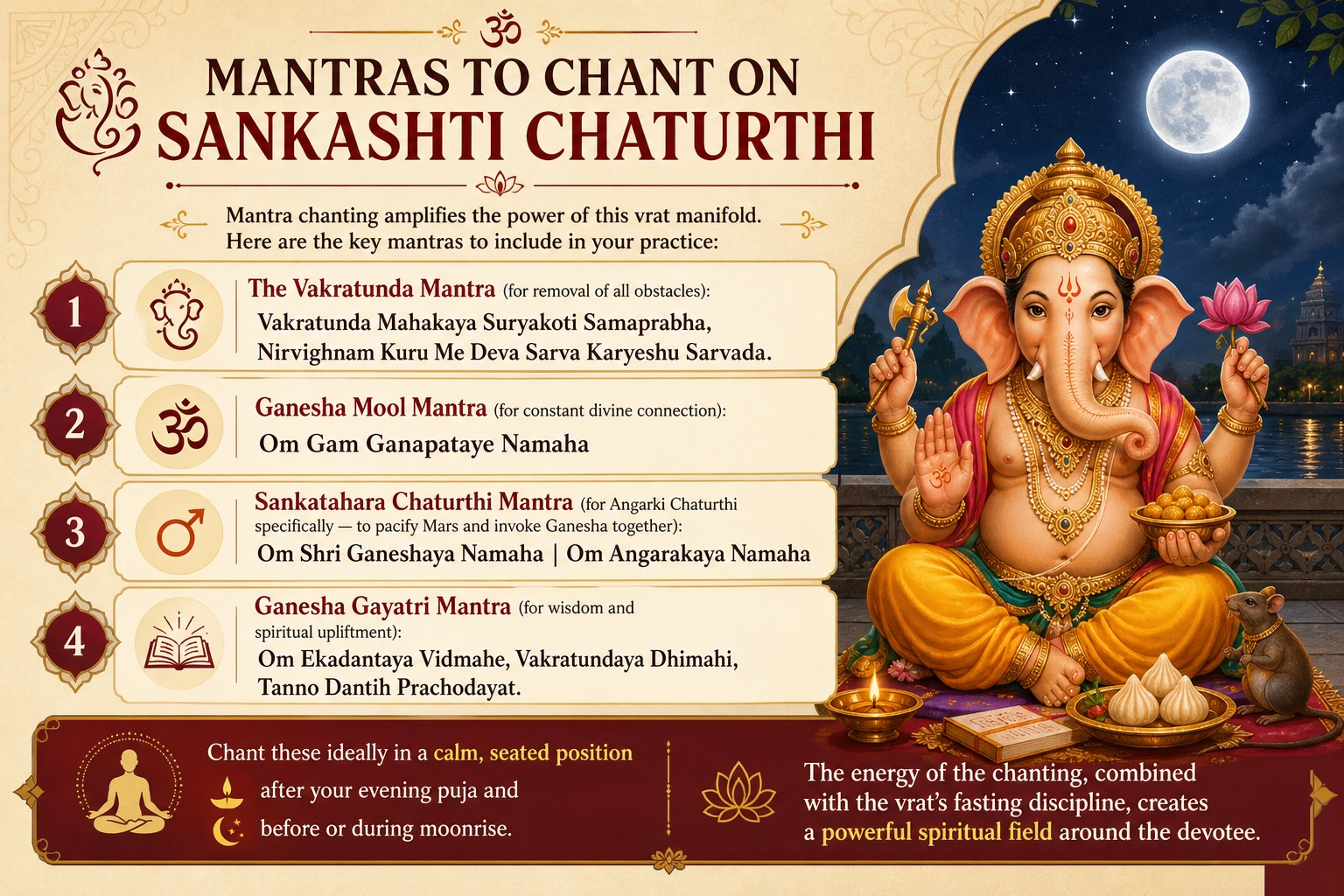 Mantras to Chant on Sankashti Chaturthi
Mantra chanting amplifies the power of this vrat manifold. Here are the key mantras to include in your practice:
- The Vakratunda Mantra (for removal of all obstacles): Vakratunda Mahakaya Suryakoti Samaprabha, Nirvighnam Kuru Me Deva Sarva Karyeshu Sarvada.
- Ganesha Mool Mantra (for constant divine connection): Om Gam Ganapataye Namaha
- Sankatahara Chaturthi Mantra (for Angarki Chaturthi specifically — to pacify Mars and invoke Ganesha together): Om Shri Ganeshaya Namaha | Om Angarakaya Namaha
- Ganesha Gayatri Mantra (for wisdom and spiritual upliftment): Om Ekadantaya Vidmahe, Vakratundaya Dhimahi, Tanno Dantih Prachodayat.
Chant these ideally in a calm, seated position after your evening puja and before or during moonrise. The energy of the chanting, combined with the vrat’s fasting discipline, creates a powerful spiritual field around the devotee.
Common Mistakes Devotees Make on Sankashti Chaturthi
Even sincere devotees sometimes unknowingly make errors. Here are a few to be mindful of:
Breaking the fast before moonrise is the most common mistake, especially when devotees are hungry or not aware of the exact local moonrise time. Always verify the time for your specific city.
Using tulsi leaves during the puja is another common error. Lord Ganesha is traditionally not offered tulsi. Durva grass is the most sacred offering for him.
Skipping the Vrat Katha entirely is a missed opportunity. The katha is an integral part of the vrat, not optional.
Not offering Arghya to the moon is technically an incomplete observance. Even if the moon is not visible due to clouds, offer the water toward the eastern direction at the calculated moonrise time.
The 21 Patras — The Most Sacred Offering for Lord Ganesha
One of the most exquisite rituals associated with Ganesh worship is the offering of 21 types of leaves (Patras), each associated with a specific name and quality of Lord Ganesha. These include maachi (biryani leaves), bringaraj, arka, vishnukrant, doob (durva), shami, keshara, devdar, and many others.
On Sankashti Chaturthi, offering even five or seven of these leaves while chanting Ganesha’s names is considered extremely auspicious. For devotees abroad, where some rare leaves may not be available, using durva grass and whatever natural leaves are locally available — offered with full devotion — is perfectly acceptable. Lord Ganesha is moved by bhakti, not mere botanical accuracy.
Conclusion — Let This Year Be the Year Ganesha Clears Your Path
The year 2026 is exceptionally blessed for devotees of Lord Ganesha. With three rare Angarki Chaturthis — on January 6, May 5, and September 29 — and a full cycle of 13 Sankashti Chaturthi vrats spread across every month, this year offers an unparalleled opportunity to deepen your connection with the divine.
Whether you are facing professional obstacles, seeking clarity in personal decisions, longing for financial stability, or simply wanting to walk through life with a little more grace and guidance — the practice of Sankashti Chaturthi can be your monthly anchor. It is not just a ritual. It is a relationship — a sacred, monthly conversation with Lord Ganesha that, when observed sincerely, has the power to reshape the very landscape of your life.
At Astrobhava, our team of expert Vedic pandits is available to support your journey — whether through remote puja services, personalised Ganesh homas, mantra japa, or Sudarshana Yantra installations. Because devotion deserves the right guidance.
Ganapati Bappa Morya. May Lord Ganesha remove every obstacle on your path and fill your 2026 with his divine grace.
Frequently Asked Questions (FAQs)
Q1. How many Sankashti Chaturthi fasts are there in 2026?
There are 13 Sankashti Chaturthi vrats in 2026, corresponding to the 13 lunar months in this particular year.
Q2. What is Angarki Chaturthi and why is it special?
Angarki Chaturthi occurs when Sankashti Chaturthi falls on a Tuesday. In 2026, this happens three times — on January 6, May 5, and September 29. It is considered the most auspicious Sankashti because the energies of Lord Ganesha and Mars combine to dissolve even deep karmic obstacles.
Q3. Can I observe Sankashti Chaturthi without a pandit?
Yes, absolutely. This is a home-based vrat that any devotee can observe independently. The key elements are: morning Sankalp, day-long fast, evening Ganesha puja, Vrat Katha recitation, and breaking the fast after moonrise with Arghya.
Q4. What can I eat during the Sankashti Chaturthi fast?
You may consume fruits, roots, milk, dry fruits, potatoes, peanuts, sabudana (tapioca), and water. All grains — rice, wheat, and pulses — are to be avoided for the day.
Q5. How do NRIs find the correct moonrise time for their city abroad?
Use location-based panchang tools or apps like Drik Panchang. Enter your specific city (e.g., London, New York, Toronto, Sydney) and check the moonrise time for the exact Sankashti Chaturthi date. Moonrise times vary by location and must be checked for your city specifically.
Q6. What is the significance of offering Durva grass to Lord Ganesha?
Durva grass is the most beloved offering of Lord Ganesha, rooted in Vedic mythology. Offering durva with devotion is said to please him immensely and grant long life, health, and removal of difficulties. Always use three-bladed or five-bladed durva.
Q7. What is the difference between Sankashti Chaturthi and Ganesh Chaturthi?
Sankashti Chaturthi is observed monthly during Krishna Paksha (waning moon) for obstacle removal. Ganesh Chaturthi (also called Vinayaka Chaturthi) is a grand annual festival in Bhadrapada month during Shukla Paksha, celebrating the birthday of Lord Ganesha.
Q8. Can I commission a Sankashti Chaturthi puja through Astrobhava if I live abroad?
Yes! Astrobhava offers remote puja services where our Vedic pandits perform the complete ritual on your behalf in India, including your name and gotra in the Sankalp. You receive puja photos, prasad, and a detailed report of the puja performed.
Q9. Is it necessary to recite the Vrat Katha every month?
Yes, reciting or listening to the Sankashti Chaturthi Vrat Katha specific to each month is an integral part of the vrat. Each month has its own katha. Skipping it is considered an incomplete observance.
Q10. Which is the most important Sankashti Chaturthi of the year?
The Sankashti Chaturthi in the month of Magha (Purnimanta calendar) or Paush (Amanta calendar) is traditionally considered the most significant. In 2026, this falls on January 6 — and it is also an Angarki Chaturthi, making it doubly powerful and exceptionally auspicious.