If you have ever felt drawn to a goddess who transcends conventional boundaries, who blesses the outcast and the artist in equal measure, who speaks in the language of music, poetry, and raw inner truth — then Maa Matangi has already called you.
Whether you are a spiritual seeker living in the USA, UK, Canada, or anywhere across the globe, and you feel the deep pull to worship Matangi Mata but don’t know where to begin — this guide is written for you. We’ll walk you through who she truly is, her divine story, how she differs from Goddess Saraswati, and the precise rituals — Matangi Homa, Puja, and Japa — that can transform your life.
Let’s begin at the beginning.
Who Is Matangi Mata?
Goddess Matangi is the ninth of the ten Dasha Mahavidyas — the ten supreme cosmic wisdom goddesses of Vedic and Tantric tradition. She is often called the Tantric form of Goddess Saraswati, yet her energy is distinctly fiercer, more unconventional, and far more accessible to sincere seekers who may feel disconnected from mainstream ritual purity.
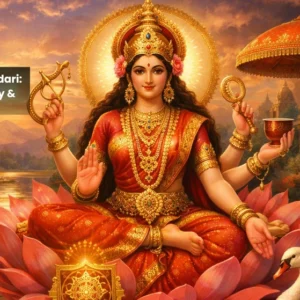
In the ancient scriptures, Matangi is described as the daughter of Sage Matanga, born from the divine union of wisdom and deep devotion. She is depicted with an emerald-green complexion, seated on a jewelled throne, adorned with a crescent moon, and holding a veena (lute) — the instrument of divine sound. Her energy governs the Vishuddha Chakra, the throat chakra, the sacred seat of truthful expression, inspired speech, and creative brilliance.
Her most exalted power is Vak Siddhi — the miraculous ability where whatever the devotee sincerely speaks with a pure heart comes true. She is the living embodiment of sound, inner knowledge, and the transformative power of the spoken word.
Matangi is also known as Ucchishtha Chandalini — the goddess who accepts offerings that are considered unconventional or leftover (ucchishtha) by orthodox ritual standards. This makes her uniquely egalitarian. She teaches that divinity does not reside only in purity by ritual rules, but in the purity of intention and devotion.
About the Dasha Mahavidyas — The Ten Wisdom Goddesses
To truly understand Matangi, you must understand her place in the sacred council of the Dasha Mahavidyas. These ten goddesses represent ten distinct cosmic energies of the Divine Mother Shakti, each governing a specific dimension of reality and liberation.
The ten Mahavidyas are: Kali (time and transformation), Tara (compassionate guidance), Tripura Sundari (beauty and grace), Bhuvaneshwari (space and creation), Bhairavi (dissolution and purification), Chinnamasta (self-sacrifice and awakening), Dhumavati (the void and wisdom of loss), Bagalamukhi (power over enemies and speech), Matangi (inner knowledge, arts, and communication), and Kamala (abundance and material grace).
Together, these ten Mahavidyas represent the full spectrum of Shakti’s power — from creation to dissolution, from abundance to renunciation. Each one is a doorway to a specific type of liberation (moksha), and Matangi specifically governs the liberation that comes through mastery of knowledge, sound, and expression.
At AstroBhava, our rituals dedicated to all ten Mahavidyas, including the Dasha Maha Vidya Homa, are performed by experienced Vedic priests trained in authentic Tantric Agama traditions.
Unlock the Secrets of the 10 Mahavidyas
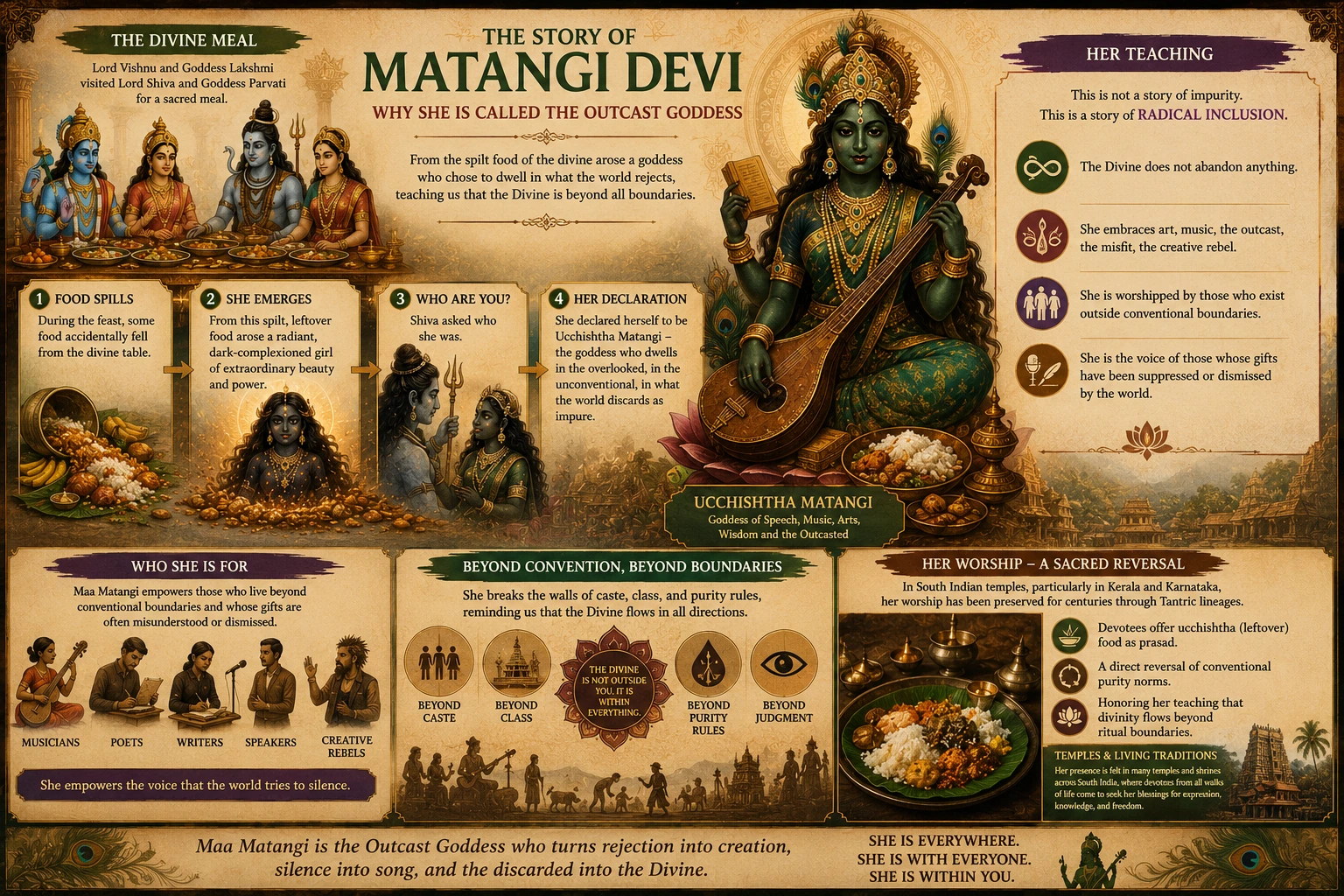 The Story of Matangi Devi — Why She Is Called the Outcast Goddess
The Matangi Devi story is as beautiful as it is profound.
In one of the most celebrated accounts from the Tantric texts, Lord Vishnu and Goddess Lakshmi visited Lord Shiva and Goddess Parvati for a sacred meal. During the feast, some food accidentally fell from the divine table. From this spilt, leftover food arose a radiant, dark-complexioned girl of extraordinary beauty and power. Shiva asked who she was, and she declared herself to be the Ucchishtha Matangi — the goddess who dwells in the overlooked, in the unconventional, in what the world discards as impure.
This is not a story of impurity. This is a story of radical inclusion. Maa Matangi teaches us that the Divine does not abandon anything — not art, not music, not the outcast, not the misfit, not the creative rebel. She is worshipped especially by those who feel they exist outside conventional boundaries — musicians, poets, writers, speakers, and those whose gifts have been suppressed or dismissed by the world.
In South Indian temples, particularly in Kerala and Karnataka, her worship has been preserved for centuries through Tantric lineages where devotees offer ucchishtha food as prasad — a direct reversal of conventional purity norms — honoring her teaching that divinity flows beyond ritual boundaries.
What Is the Difference Between Matangi and Saraswati?
This is one of the most searched questions among spiritual seekers, and it deserves a clear, specific answer.
Both Matangi and Saraswati are goddesses of knowledge, music, speech, and the arts. But the similarities end at the surface.
Saraswati operates in the realm of Sattvic (pure, gentle, orderly) energy. She presides over formal learning, Vedic knowledge, classical arts, and educational institutions. Her worship follows precise orthodox Vedic norms with strict rules of ritual purity. She is worshipped in the light, in the classroom, in the concert hall.
Matangi operates in the Tantric realm — she governs inner wisdom, intuitive knowledge, and the kind of creative genius that cannot be taught in any school. Her energy is raw, unconventional, and directly transformative. She is the goddess of the creative fire that breaks all rules to find truth. She is worshipped in the space between convention and liberation.
If Saraswati is the classical music teacher in the conservatory, Matangi is the jazz musician improvising at midnight — both are sublime expressions of divine sound, but they move through completely different energetic frequencies.
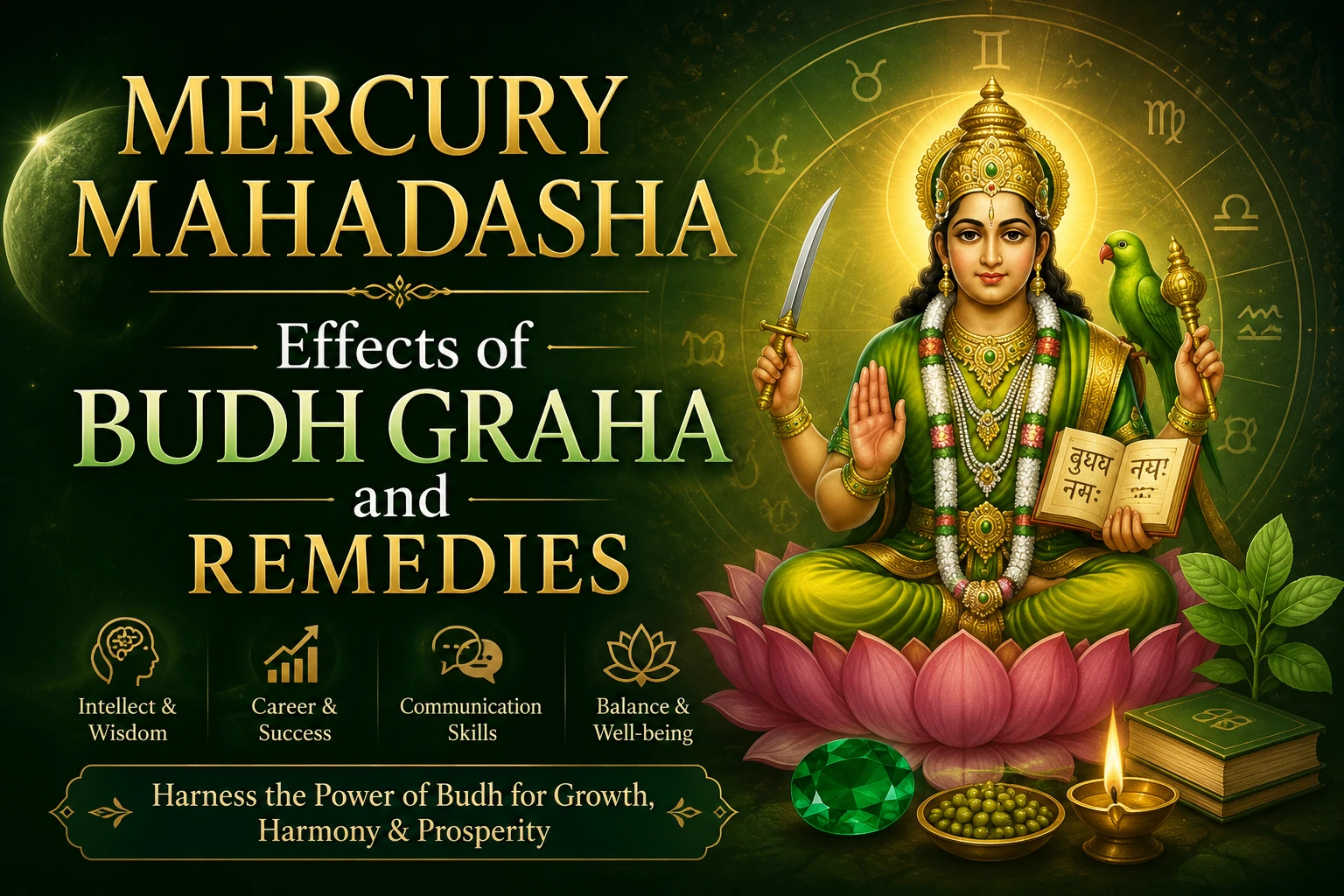
At the planetary level, while Saraswati governs the gentle and orderly blessings of Mercury (Budha), Matangi governs Mercury’s deepest and most potent expressions — especially for those whose birth chart shows Mercury afflictions, speech difficulties, or blocked creative potential.
Listen Now: Different types of dosha and their respective remedies
What Are the Benefits of Worshipping Maa Matangi?
When you sincerely worship Matangi Mata, you are not simply performing a ritual — you are aligning your entire being with the cosmic frequency of divine speech, wisdom, and creative mastery. The benefits are profound and well-documented across centuries of devotional and Tantric tradition.
Vak Siddhi and Speech Power: Her primary blessing is the power of flawless, persuasive, and truthful speech. Public speakers, lawyers, teachers, diplomats, and anyone who communicates for a living experiences a remarkable shift in the clarity and impact of their words.
Creative Awakening: Artists, musicians, writers, filmmakers, and all creative professionals experience the dissolution of blocks. Inspiration flows naturally. New ideas arrive with an almost supernatural clarity.
Academic Excellence: Students preparing for competitive exams, admissions, or professional certifications find enhanced memory, comprehension, and intellectual sharpness.
Mercury Dosha Remedy: For those with Mercury afflictions in their birth chart — including speech impediments, communication fears, or difficulty in expression — Matangi’s rituals serve as a powerful astrological remedy.
Positive Influence and Attraction: She bestows the power to attract positive people, form meaningful relationships, and exercise rightful influence in professional and social life.
Removal of Enemies Through Wisdom: Unlike Bagalamukhi who silences enemies through force, Matangi dissolves opposition through the power of wisdom and eloquent expression. This is a subtler but extraordinarily effective form of divine protection.
Spiritual Evolution: Regular worship of Matangi Mata opens the Vishuddha Chakra, enabling devotees to receive divine guidance more clearly, speak their truth fearlessly, and walk their spiritual path with confidence.
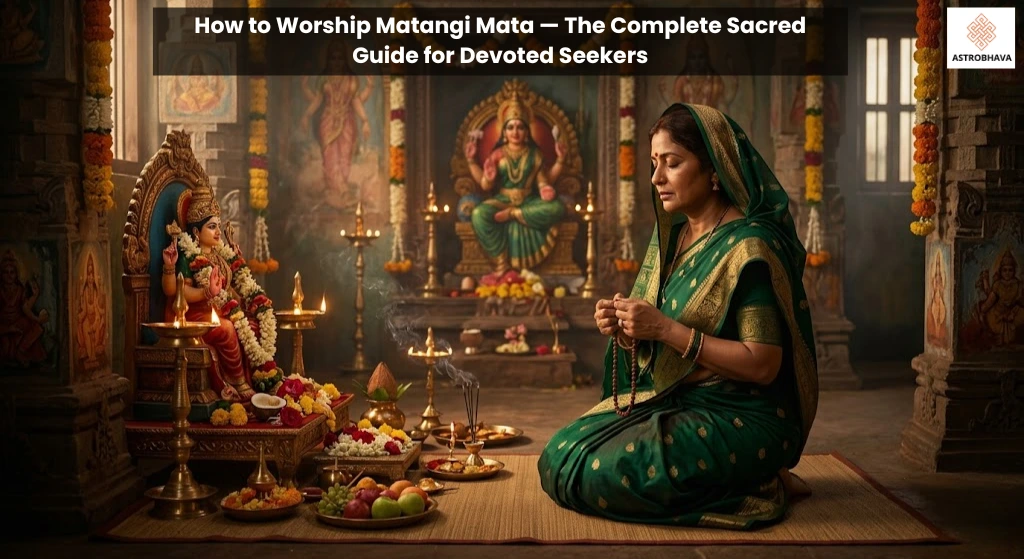 How to Worship Matangi Mata — The Three Sacred Paths
Now we arrive at the heart of this guide. To worship Matangi Mata with authentic results, there are three primary ritual pathways prescribed in the Tantric and Vedic tradition: Homa (fire ritual), Puja (divine invocation), and Japa (sacred mantra chanting). At AstroBhava, all three are available as fully personalised, authentic Vedic rituals performed by certified priests.
1. Matangi Homa — The Sacred Fire Ritual
The Matangi Homa is considered the most powerful and direct form of worship offered to Goddess Matangi. In Vedic cosmology, Agni (fire) is the divine messenger — the sacred carrier that transforms and transmits your offerings, prayers, and intentions directly to the deity.
In the Matangi Homa, oblations of ghee, specific herbs, green leaves, and grains sacred to Matangi are offered into the consecrated fire with precise Tantric mantras dedicated to the goddess. The fire ritually destroys karmic impurities connected to Mercury, releases creative blockages at the energetic level, and invokes Matangi’s grace to pour into the devotee’s life in direct, tangible ways.
What the Matangi Homa specifically grants: Vak Siddhi (speech power), removal of Mercury doshas, creative breakthroughs, success in arts and education, and alignment with Mercury’s highest blessings across career, communication, and relationships.
At AstroBhava, the Matangi Homa is performed live from our sacred Yagna Ashram by Vedic priests trained in Tantric Agama traditions. The ritual is telecast live — you can watch from your home in New York, London, Toronto, or Sydney, and feel the divine energy as it flows in real time. You receive an energised Matangi Yantra and prasad shipped free to your doorstep worldwide.
2. Matangi Puja — The Sacred Invocation Ritual
The Matangi Puja is a deeply personalised Vedic ritual dedicated to Goddess Matangi, performed inside a consecrated temple sanctum with complete focus on your individual Sankalpa (intention). Unlike group ceremonies, every Matangi Puja at AstroBhava is performed exclusively for you — your name, your birth details, your Gotra, and your specific life intention are woven into the invocation.
The Puja follows the Agama Shastra prescribed sequence: Avahana (invocation of the goddess), Shodashopachara (sixteen offerings including flowers, incense, lamp, and naivedya), Mantra recitation, and Poornahuti (completion offering). Matangi receives specific offerings that align with her Tantric nature — green bananas, green leaves, kadali (plantain) flowers, and other items sacred to her.
The Matangi Puja is especially recommended for devotees seeking improvement in communication, removal of obstacles in education or career, enhancement of artistic skills, and those who feel their voice — literal or metaphorical — has been suppressed.
Because live telecast is not offered for Puja (as Agama Vidhi strictly prohibits photography or videography inside the temple sanctum), you can be completely assured that the ritual is performed in total purity, without distraction, solely for your benefit.
3. Matangi Japa — Sacred Mantra Chanting
The Matangi Japa is the practice of systematically chanting the sacred Matangi mantra a prescribed number of times inside a consecrated Tantric temple. The primary mantra used is:
Om Hreem Aim Hreem Matangyai Namaha
Japa is not merely repetition — it is a precise science of sacred vibration. Each syllable of the Matangi mantra carries a specific energetic frequency that resonates with her cosmic domain. When chanted by trained priests in the correct sequence, at the correct pace, in a consecrated space, the accumulated power of each mantra repetition builds into a profoundly transformative spiritual force that enters the devotee’s energetic field.
AstroBhava performs Matangi Japa at the following levels: 1,001 chants (performed in 1 day, ideal for beginners or those removing minor communication blocks), 10,001 chants (10 days, for deeper Mercury remedy and creative enhancement), 28,001 chants (48 days, for significant life changes in career or artistic pursuits), 51,001 chants (48 days + live Homa, for those seeking profound transformation), and 125,001 chants (48 days + live Homa, the most powerful offering for complete creative and speech mastery).
The 48-day duration for higher Japa counts is spiritually precise — it corresponds to the 27 Nakshatras (Birth Stars), 12 Rashis (Moon Signs), and 9 Planets, ensuring the mantra vibrations permeate every dimension of your astrological and cosmic profile.
The Auspicious Days and Times to Worship Matangi Mata
Worshipping Matangi Mata on specific auspicious days amplifies the power of your devotion considerably.
Wednesday (Budhavar) is the most sacred day for Matangi worship, as Wednesday is governed by Mercury (Budha) — her ruling planet. Beginning any Matangi ritual, Japa practice, or even personal prayer on a Wednesday aligns your practice with the optimal cosmic energy channel.
Navami Tithi (the ninth lunar day) holds special significance for Matangi, being the ninth Mahavidya. Purnima (full moon) and Ashtami (eighth lunar day) are also highly auspicious for her worship.
Navaratri — particularly the autumn Sharadiya Navaratri — is a peak period for Matangi worship, as all Mahavidya energies are magnified during these nine sacred nights.
For Tantric practitioners, Pradosha Kala (the twilight hours of evening) is considered especially potent for Matangi invocation.
Offerings Sacred to Maa Matangi
When worshipping Matangi Mata at home, the following offerings are traditionally prescribed in Tantric texts:
Green-coloured offerings are paramount — green bananas, green coconuts, green leaves, green moong (mung beans), and green flowers (particularly neem leaves and green jasmine buds). Matangi’s emerald-green complexion is directly reflected in the sacred preference for green in her worship.
Sweet rice or Pongal (sweetened rice cooked with jaggery and coconut) is the most traditional naivedya (food offering). In the Ucchishtha tradition, the devotee first tastes the offering before placing it before the goddess — a radical reversal of conventional purity norms that honors her deepest teaching.
Turmeric and red vermillion (kumkuma) are used in her abhisheka (ritual bathing), along with fragrant sandalwood paste.
Incense: Guggul (Indian frankincense) and jasmine agarbatti are considered most pleasing to Matangi.
Matangi Yantra — The Sacred Geometric Body of the Goddess
The Matangi Yantra is the geometric visual representation of the goddess’s energy — a sacred diagram that serves as her energised abode. Keeping an energised Matangi Yantra in your home or workspace continuously radiates her blessings into your environment.
At AstroBhava, devotees who book Matangi Puja or higher Japa packages receive a complimentary energised Matangi Yantra shipped free worldwide. The Yantra arrives sealed and ready to be installed in your sacred space, bringing ongoing blessings of speech, wisdom, and creative mastery into your daily life.
 Who Should Worship Matangi Mata?
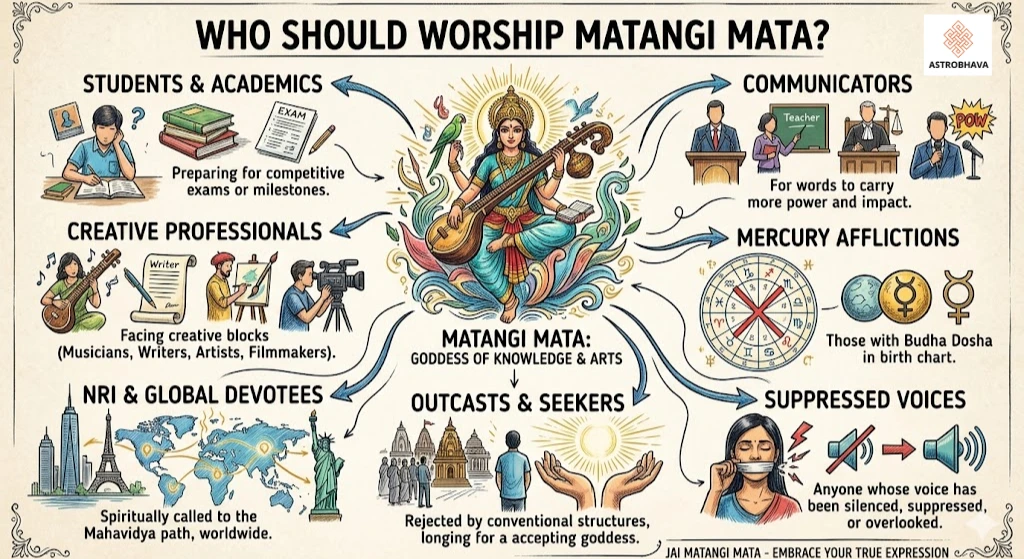
Matangi is the goddess for you if you are a student preparing for competitive exams or academic milestones, a creative professional — musician, writer, artist, designer, filmmaker — facing creative blocks, a speaker, teacher, lawyer, or communicator who wants their words to carry more power and impact, someone with Mercury afflictions (Budha dosha) in their birth chart, an NRI or global devotee who feels spiritually called to the Mahavidya path, a seeker who has felt rejected by conventional religious structures and longs for a goddess who accepts you exactly as you are, or anyone whose voice — in any form — has been silenced, suppressed, or overlooked.
Conclusion
To worship Matangi Mata is to take a profoundly personal and transformative step toward reclaiming your voice, your creativity, and your inner wisdom. She is not a distant celestial force — she is the goddess who sits at the intersection of divine sound and human expression, waiting to bless everyone who calls to her with sincerity.
Whether you choose the Matangi Homa to create a powerful cosmic breakthrough, the Matangi Puja for a deeply personal divine invocation, or the Matangi Japa to let thousands of sacred repetitions rewire your inner world — each path leads to the same radiant emerald grace.
At AstroBhava, every Matangi ritual is performed by certified Vedic and Tantric priests in consecrated temples in Tamil Nadu and Kerala, following authentic Agama Shastra procedures. Whether you are in Texas or Toronto, Manchester or Melbourne, the divine energy of Maa Matangi crosses all distances and reaches exactly where it is needed.
Your voice is sacred. Your creativity is divine. Maa Matangi has been waiting.
Explore Matangi Homa, Puja, and Japa at AstroBhava — Book your personalised ritual today and let the ninth Mahavidya transform your world.
Frequently Asked Questions (FAQs)
Q1. Who is Matangi Mata and why is she called the Tantric Saraswati?
Matangi is the ninth of the ten Dasha Mahavidyas — the supreme wisdom goddesses of Vedic-Tantric tradition. She governs speech, inner knowledge, music, and the arts. She is called the Tantric Saraswati because while Saraswati represents orderly, Sattvic learning, Matangi embodies the raw, intuitive, boundary-breaking dimension of knowledge and creative expression — the kind of wisdom that flows beyond conventional rules.
Q2. What is the most powerful mantra to worship Matangi Mata?
The primary Matangi Moola Mantra is Om Hreem Aim Hreem Matangyai Namaha. This mantra governs the Vishuddha Chakra, activates Vak Siddhi, and aligns the devotee’s Mercury energy with its highest creative and communicative potential. For maximum results, this mantra should be chanted in a prescribed, systematic Japa performed by trained priests.
Q3. Can I worship Matangi Mata if I am not initiated into Tantra?
Yes. While Matangi is a Tantric deity, her worship is accessible to sincere devotees without formal Tantric initiation, especially when performed through authorised Vedic institutions. At AstroBhava, our priests perform the rituals on your behalf with all proper initiation and procedure, so you receive the full blessings without needing personal initiation.
Q4. What is the difference between Matangi Homa, Puja, and Japa? Which one should I choose?
Matangi Homa (fire ritual) is the most intense and direct — ideal for major life changes, Mercury dosha removal, or creative breakthroughs. Matangi Puja is a deeply personalised invocation — ideal for ongoing blessings, communication enhancement, and spiritual growth. Matangi Japa is sacred mantra repetition — ideal for sustained transformation, Mercury remedies, and those who want a practice that works gradually but deeply over time. Many devotees combine all three for maximum results.
Q5. Can people living abroad (USA, UK, Canada, Australia) book Matangi rituals?
Absolutely. AstroBhava was built precisely to serve the global Hindu and spiritual community. The Matangi Homa is telecast live so you can watch from anywhere in the world. Energised Yantras and prasad are shipped free worldwide. The divine energy of Maa Matangi crosses every border and timezone.
Q6. How long does it take to see results after Matangi Puja or Japa?
Most devotees begin noticing subtle shifts within 21 to 40 days — improved clarity in communication, creative inspiration, new opportunities in career or education. Deeper, sustained changes typically manifest within 3 to 6 months, especially when combined with the 48-day Yantra Puja that follows higher Japa packages.
Q7. On which day is it most auspicious to worship Matangi Mata?
Wednesday (Budhavar) is the most sacred day for Matangi worship, as Wednesday is governed by Mercury — her ruling planet. Navami Tithi (ninth lunar day), Purnima, and Navaratri are also especially powerful times to begin or intensify her worship.
Q8. What offerings should I make to Maa Matangi at home?
Green-coloured offerings are most sacred to her — green bananas, green coconuts, green moong, green flowers, and neem leaves. Sweet rice (Pongal), sandalwood paste, turmeric, jasmine incense, and guggul are also prescribed. The intention behind the offering matters more than its grandeur.