If you have been hearing the term “Padmini Ekadashi 2026” a lot lately and wondering what makes it so special — you are not alone. Spiritual seekers from the USA, UK, Canada, Australia, and across the globe are searching for this sacred day, and for good reason. Padmini Ekadashi does not come every year. It arrives once in approximately three years, hidden inside the rare extra lunar month called Adhik Maas or Purushottam Maas. In 2026, this extraordinary Ekadashi falls right in the middle of the spiritually supercharged Adhik Jyeshtha Maas — and that combination makes it one of the most powerful fasting and worship days a Vishnu devotee can observe in a lifetime.
Let us walk through everything you need to know — the correct date and timings, the real story behind this Ekadashi, the complete puja vidhi, fasting rules, dos and don’ts, and the specific Vedic rituals that amplify your prayers manifold on this day.
What Is Padmini Ekadashi? Understanding Its Sacred Identity
Padmini Ekadashi is the Ekadashi (11th lunar day) that falls during the Shukla Paksha, or the waxing phase of the moon, in Adhik Maas — the intercalary lunar month that the Hindu calendar inserts approximately every 32 months to realign the lunar and solar cycles. Because Adhik Maas itself occurs only once every three years, Padmini Ekadashi is extraordinarily rare. Among all 25 Ekadashis that occur in a year containing Adhik Maas, Padmini is considered the most powerful for seeking Lord Vishnu’s grace.
It is also known as Kamala Ekadashi — Kamala being another name for the lotus flower (Padma in Sanskrit), which is Lord Vishnu’s most beloved offering. The name Padmini has a second, deeply human origin too, rooted in a beautiful legend from the Bhavishyottara Purana, which we will get to in a moment.
Adhik Maas itself is called Purushottam Maas because Lord Vishnu, moved by compassion for this “extra month” that carried no ruling deity, adopted it as His own. Every act of devotion performed in this month — fasting, homa, japa, charity, temple visits — is said to yield merit multiplied many times over. Padmini Ekadashi sits as the crown jewel of this already extraordinary month.
 Padmini Ekadashi 2026: Exact Date and Timings
This is the section most readers are looking for, so let us be precise.
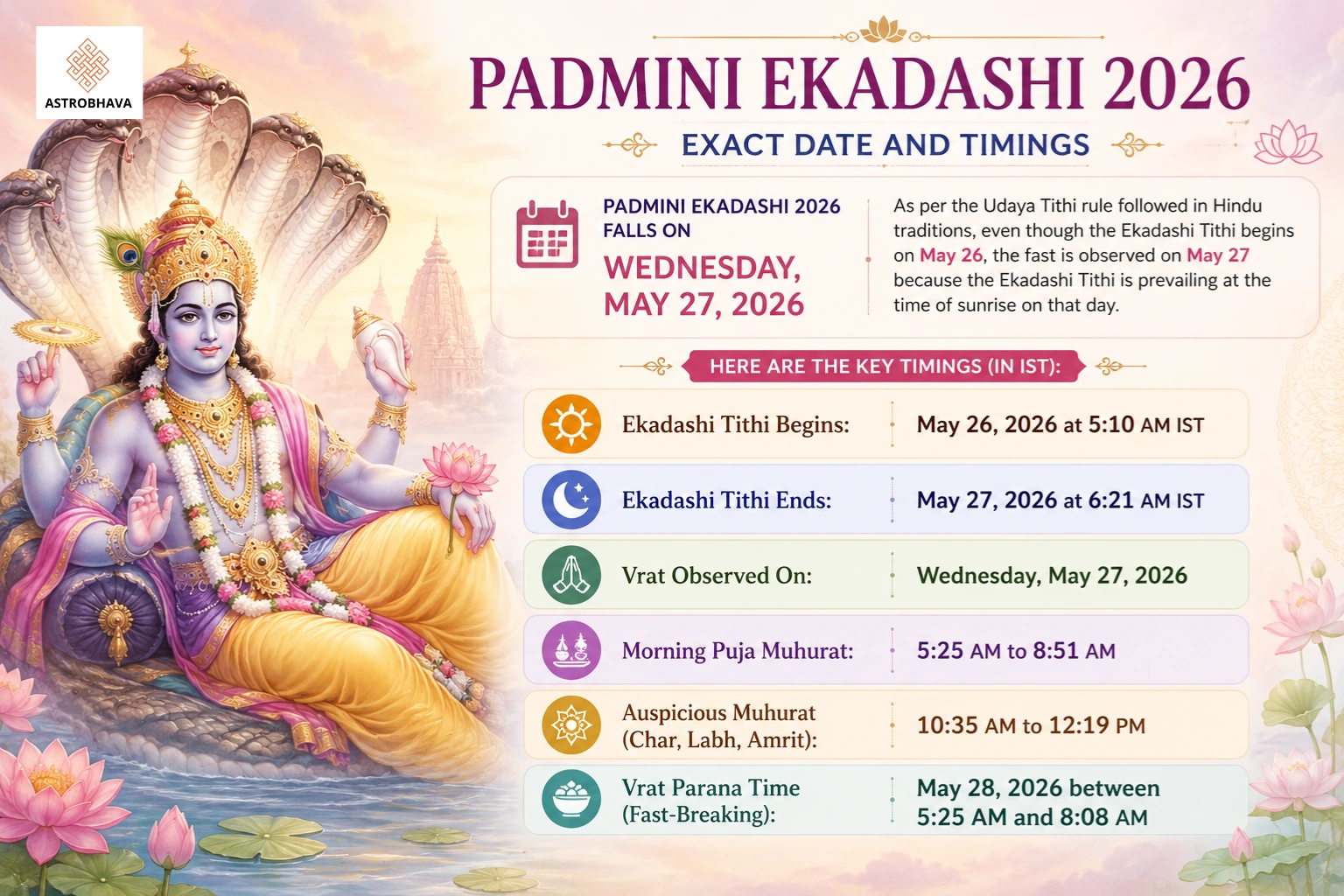
Padmini Ekadashi 2026 falls on Wednesday, May 27, 2026.
As per the Udaya Tithi rule followed in Hindu traditions, even though the Ekadashi Tithi begins on May 26, the fast is observed on May 27 because the Ekadashi Tithi is prevailing at the time of sunrise on that day.
Here are the key timings (in IST):
Ekadashi Tithi Begins: May 26, 2026 at 5:10 AM IST
Ekadashi Tithi Ends: May 27, 2026 at 6:21 AM IST
Vrat Observed On: Wednesday, May 27, 2026
Morning Puja Muhurat: 5:25 AM to 8:51 AM
Auspicious Muhurat (Char, Labh, Amrit): 10:35 AM to 12:19 PM
Vrat Parana Time (Fast-Breaking): May 28, 2026 between 5:25 AM and 8:08 AM
For devotees in the USA, UK, and other international time zones, please convert the above timings from IST to your local time zone to plan your worship accordingly. The spiritual intent matters equally with the timing — if you are unable to observe exact muhurat windows due to work schedules, focus on completing your prayers before noon.
Adhika Masa 2026: The Rare Extra Month That Can Transform Your Spiritual Life
The Story Behind Padmini Ekadashi — Why Queen Padmini’s Devotion Still Inspires Millions
The legend of Padmini Ekadashi appears in the Bhavishyottara Purana and was narrated by Lord Krishna to King Yudhishthira. It is one of those stories that speaks directly to people dealing with longing, delayed blessings, and deep grief — which is perhaps why it still resonates so powerfully with modern devotees.
King Kritavirya of the mighty Haihaya dynasty ruled the prosperous kingdom of Mahishmati. Despite his power, virtue, and righteousness, the king and his beloved queen Padmini — daughter of the noble King Harishchandra — were childless. Years passed. Prayers were offered. Pilgrimages were undertaken. Yet the royal couple remained without an heir, and the grief of this unanswered prayer cast a shadow over even their greatest accomplishments.
Unable to bear the pain any longer, the king and queen left their throne in the care of their ministers and retreated to the Gandhamadana mountains to perform intense penance. There, the revered sage Anusuiya (consort of the great sage Atri) appeared before Queen Padmini. With divine compassion, the sage revealed the secret of Adhik Maas — the extra sacred month — and instructed the queen to observe the Shukla Paksha Ekadashi of this rare month with complete devotion, night-long vigil, and wholehearted prayer to Lord Vishnu.
Queen Padmini followed every instruction with absolute faith. She fasted strictly, worshipped Lord Vishnu with lotus flowers and Tulsi leaves, chanted His names through the night, and remained in prayer until sunrise the following day. Lord Vishnu, moved by her unwavering devotion, appeared before her riding Garuda — His divine eagle — and asked her to name her boon. The queen, with the humility of a truly devoted soul, requested a son who would be invincible to gods, demons, and humans alike, yet revered by all three worlds.
Lord Vishnu granted the boon, saying: “Because you have pleased me in my own beloved month, Purushottam Maas, I grant you a son whose glory will be unmatched.”
From that sacred vow was born the legendary Kartavirya Arjuna (also called Sahasrarjuna) — the only warrior in all of existence who was powerful enough to defeat the mighty Ravana. This story is not merely mythology. It is a testament to what sincere devotion during Padmini Ekadashi can accomplish — not just for progeny, but for any deeply held prayer that has seemed beyond reach.
Spiritual Significance of Padmini Ekadashi 2026 — Why This Year Is Even More Special
Every Padmini Ekadashi is spiritually significant. But Padmini Ekadashi 2026 carries an additional layer of power because it falls within Adhik Jyeshtha Maas — a particularly auspicious configuration that amplifies the merit of every devotional act performed on this day.
Here is what the scriptures and tradition confirm about observing Padmini Ekadashi:
Fasting on this day is said to be equivalent to performing pilgrimage at all Teertha Kshetras (holy sites) simultaneously. The combined merit of visits to the Ganga, Yamuna, Godavari, Saraswati, Narmada, Sindhu, and Kaveri rivers is believed to flow into the punya (spiritual merit) of a single sincere observance of this Ekadashi.
The vrat removes sins accumulated not just in this lifetime but across multiple past lives. For devotees who carry unresolved karmic burdens — health challenges, financial stagnation, broken relationships, professional obstacles — this day offers a rare window for deep cleansing.
Observing the fast with charity, prayers, and a Vishnu Homa on this day is said to ultimately lead the soul to Vaikuntha — Lord Vishnu’s transcendental abode — ensuring liberation from the cycle of birth and death.
For NRIs and overseas devotees who cannot always attend temple rituals in person, this day is especially accessible through online puja services — the merit of your intention and the authenticity of the ritual are equally valid regardless of geography.
🔥 Invite Lord Vishnu’s Cosmic Grace Into Your Home This Padmini Ekadashi
Let the divine fire carry your Sankalpa directly to Lord Vishnu.
Padmini Ekadashi 2026 Puja Vidhi — Step-by-Step Ritual Guide
Here is the complete, authentic puja vidhi for Padmini Ekadashi 2026 as followed in Vedic tradition:
Step 1: Dashami Preparation (Evening of May 26)
The preparation for Padmini Ekadashi begins the evening before, on Dashami (the 10th lunar day). On this evening, eat a simple, sattvic meal before sunset. Avoid non-vegetarian food, alcohol, onion, garlic, and any tamasic food. Sleep early and set your intention clearly for the next day’s fast. This mental preparation is considered as important as the physical discipline.
Step 2: Brahma Muhurta Awakening (May 27, Before Sunrise)
Wake up during Brahma Muhurta — ideally between 4:00 AM and 5:25 AM. This sacred pre-dawn window is considered the most powerful time for prayer, as the atmosphere is charged with sattvic energy and divine vibrations.
Step 3: Holy Bath (Snana)
Take a bath before sunrise. If you have access to Ganga Jal, add a few drops to your bath water. Chant “Om Namo Bhagavate Vasudevaya” during your bath. This act of physical purification mirrors the internal purification that the vrat is designed to bring. Wear clean, fresh clothes — preferably white (symbolising purity) or yellow (the favourite colour of Lord Vishnu).
Step 4: Sankalpa (Sacred Vow)
Stand before your home temple or place of worship and take the Sankalpa — the formal vow to observe the Ekadashi fast with complete devotion. Mention your name, your gotra (family lineage), and the purpose of your vrat. If you are performing the vrat for a specific boon — health, prosperity, family harmony, progeny, or moksha — state it clearly in your Sankalpa.
Step 5: Purifying the Puja Space
Sprinkle Ganga Jal throughout your home and particularly in the puja room. Clean the altar thoroughly. Light a ghee diya (lamp) and incense sticks. Place a fresh idol or image of Lord Vishnu at the centre of your altar. Lord Vishnu is traditionally represented with four arms holding the Shankha (conch), Chakra (disc), Gada (mace), and Padma (lotus).
Step 6: Decoration and Offering
Adorn Lord Vishnu’s idol with yellow or golden cloth. Offer fresh lotus flowers or other flowers if lotus is unavailable. Place Tulsi (Holy Basil) leaves at His feet — Tulsi is Lord Vishnu’s most beloved plant offering and should never be omitted on this day. Important: Tulsi leaves must be plucked the day before (on Dashami). Do not pluck Tulsi leaves on Ekadashi itself — this is a strict rule.
Offer fruits, coconut, sweets (avoid grain-based items), panchamrit (milk, curd, ghee, honey, sugar), and scented water to the deity.
Step 7: Mantra Chanting and Vishnu Stotras
This is the spiritual core of the day. Chant the following with devotion:
“Om Namo Bhagavate Vasudevaya” — the Dwadasha Akshari (12-syllable) mantra of Lord Vishnu, ideal for continuous chanting throughout the day.
Recite or listen to the Vishnu Sahasranama — the thousand names of Lord Vishnu as narrated by Bhishma Pitamaha in the Mahabharata. Reciting this in full on Padmini Ekadashi is considered equivalent to performing a major yajna.
Chant the Purusha Sukta — the powerful Vedic hymn from the Rig Veda that describes Lord Vishnu as the Cosmic Being who pervades and sustains all creation.
Read or listen to the Padmini Ekadashi Vrat Katha (the story of Queen Padmini narrated above).
Step 8: Fasting Rules Through the Day
The fast on Padmini Ekadashi is observed as follows. Strictly avoid: rice, all grains (wheat, barley, lentils), urad dal, chickpeas, onion, garlic, spinach, honey, and non-vegetarian food in any form. Many devoted observers keep a Nirjala fast — complete abstinence from food and water — which is considered the highest level of observance. If you have health conditions, you may opt for a Phalahar fast — consuming only fruits, milk, nuts, and sabudana. The goal is not extreme physical hardship but the cultivation of inner purity, discipline, and single-pointed focus on Lord Vishnu.
Step 9: Night Vigil (Jagaran)
Staying awake through the night — Jagaran or Ratri Jagaran — is a key element of Padmini Ekadashi. This is not merely tradition; it is a deliberate practice of offering one’s sleep (a powerful natural desire) to the Lord. Spend the night chanting Vishnu’s names, singing devotional bhajans, listening to the Vrat Katha, or meditating on Lord Vishnu’s form. If you are in a city with an active Hindu temple community (USA, UK, Canada), try to attend or stream a night bhajan session.
Step 10: Dwadashi Parana — Breaking the Fast (May 28, 2026)
The fast must be broken on Dwadashi (May 28) within the prescribed Parana window: 5:25 AM to 8:08 AM IST. Breaking the fast outside this window reduces the spiritual merit of the vrat. Begin by offering food and water to Lord Vishnu and then feeding a Brahmin or a deserving person before eating yourself. Break your own fast with simple, sattvic food.
🛡️ Protect Your Family and Home with the Power of Lord Sudarshana
Ekadashi is one of the most auspicious days to perform this powerful protective ritual.
Fasting Do’s and Don’ts on Padmini Ekadashi 2026
Do’s: Observe a complete or partial sattvic fast with sincere intention. Chant Vishnu mantras repeatedly, especially “Om Namo Bhagavate Vasudevaya.” Offer Tulsi leaves (plucked the day before) to Lord Vishnu. Donate food, clothes, or money to the deserving on this day — charity on Adhik Maas Ekadashi carries multiplied merit. Light a ghee lamp before Lord Vishnu’s image and keep it burning throughout the day and night. Read the Padmini Ekadashi Vrat Katha. Maintain mental purity — avoid arguments, gossip, and negative thoughts.
Don’ts: Do not consume rice, grains, onion, garlic, urad dal, spinach, honey, or any non-vegetarian food. Do not pluck Tulsi leaves on Ekadashi day itself. Do not sleep during the day — this is specifically prohibited on Ekadashi. Do not engage in any acts of anger, jealousy, or deceit. Do not cut your nails or hair on this day. Do not break the fast outside the Parana muhurat window.
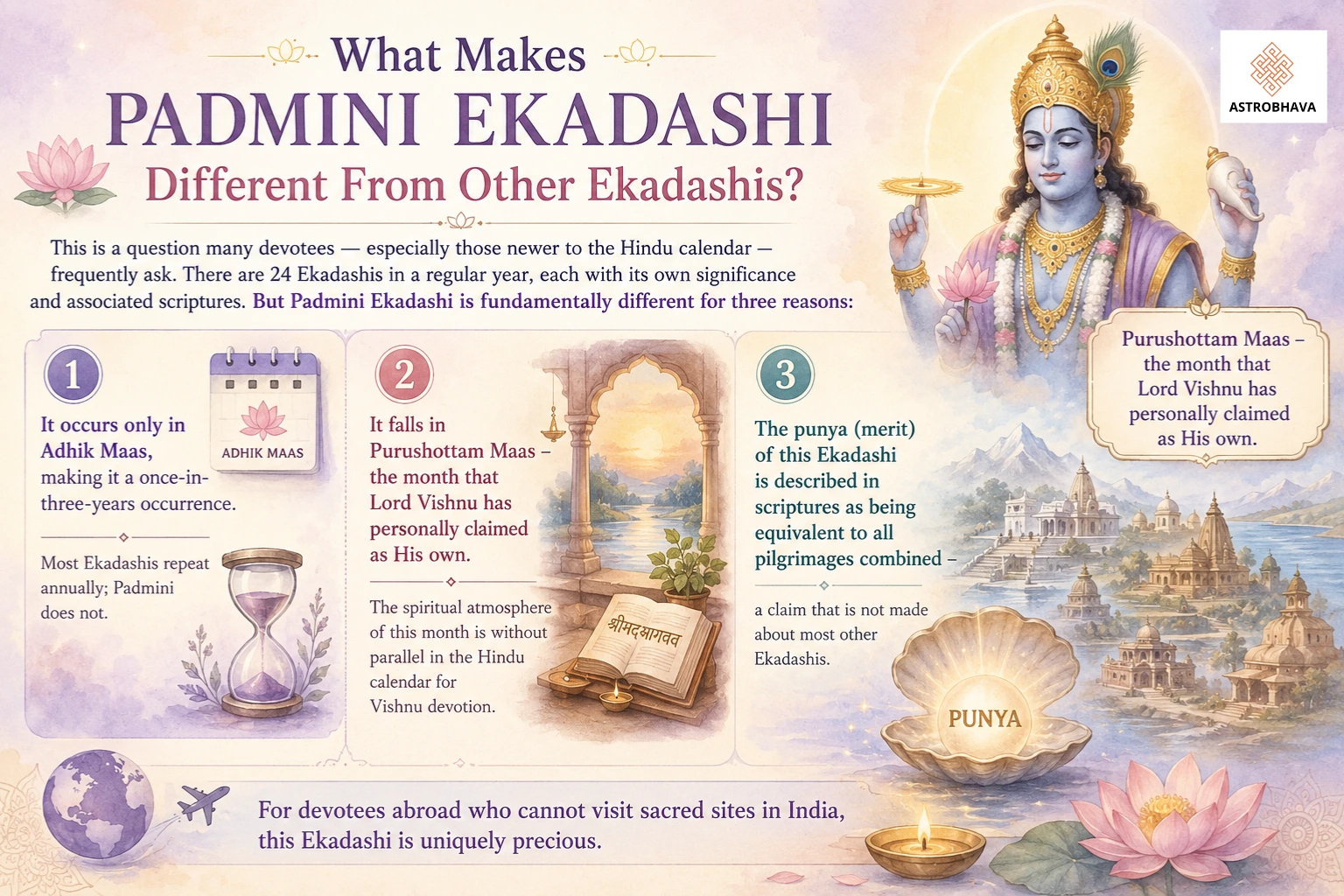 What Makes Padmini Ekadashi Different From Other Ekadashis?
This is a question many devotees — especially those newer to the Hindu calendar — frequently ask. There are 24 Ekadashis in a regular year, each with its own significance and associated scriptures. But Padmini Ekadashi is fundamentally different for three reasons:
First, it occurs only in Adhik Maas, making it a once-in-three-years occurrence. Most Ekadashis repeat annually; Padmini does not.
Second, it falls in Purushottam Maas — the month that Lord Vishnu has personally claimed as His own. The spiritual atmosphere of this month is without parallel in the Hindu calendar for Vishnu devotion.
Third, the punya (merit) of this Ekadashi is described in scriptures as being equivalent to all pilgrimages combined — a claim that is not made about most other Ekadashis. For devotees abroad who cannot visit sacred sites in India, this Ekadashi is uniquely precious.
How NRIs and Overseas Devotees Can Observe Padmini Ekadashi 2026
Living in the USA, UK, UAE, or elsewhere does not diminish the power of this Ekadashi for you — in fact, the devotees who maintain their spiritual practices far from their homeland often carry the deepest sincerity. Here is how you can honour this day fully:
Convert the IST timings for your local time zone and plan your Brahma Muhurta accordingly. Set an alarm and begin your day with a holy bath and prayer even before sunrise.
Set up a clean, dedicated altar at home with Lord Vishnu’s image, a ghee lamp, fresh flowers, Tulsi leaves (if available at Indian grocery stores), and incense. The physical space of worship matters — it creates a container for your intention.
Fast according to your health capacity — full Nirjala, fruit-only, or milk and fruit. The sincerity of your intention is the primary offering.
Book a live Padmini Ekadashi puja or Vishnu Homa through AstroBhava. Our certified Vedic priests perform every ritual from our sacred Yagna Ashram in India using your personal Sankalpa — your name, birth details, and gotra — ensuring the ritual is fully personalised to you. For Homas, you can watch the live fire ritual from anywhere in the world via our YouTube livestream.
Connect with your local temple or Hindu community for evening bhajans or a virtual Ekadashi katha session.
The geographical distance from India does not create spiritual distance from Lord Vishnu. Your sincerity is the bridge.
Astrological Significance of Padmini Ekadashi 2026
From an astrological standpoint, Padmini Ekadashi 2026 carries layered significance. Falling during Adhik Jyeshtha Maas, the planetary energies during this period are especially conducive to Vishnu-oriented remedies. The Shukla Paksha (waxing moon) enhances manifestation energy — making intentions, prayers, and homams performed on this day more potent for attracting abundance, health, and clarity.
For devotees experiencing Rahu-Ketu doshas, Saturn transits, or ongoing periods of planetary affliction, performing a Sudarshana Homa or a Vishnu-related ritual on Padmini Ekadashi 2026 is considered one of the most effective Vedic remedies available this year.
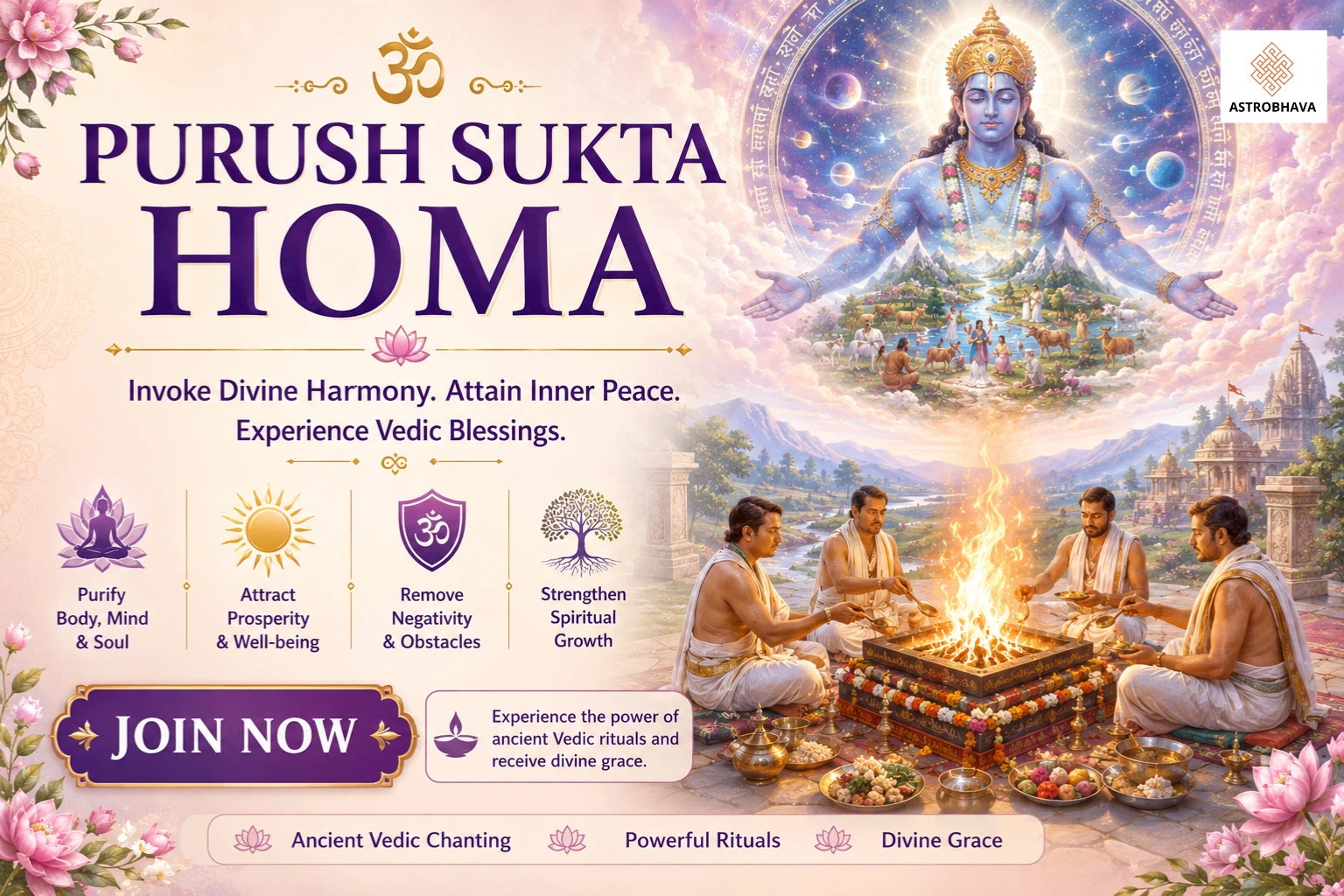
🙏 Let Your Padmini Ekadashi Sankalpa Be Heard — Book Your Personal Purush Sukta Homa
Performed by AstroBhava priests with your personalised Sankalpa, the Purush Sukta Homa honours the Universal Lord and opens the channel for your deepest prayers to be fulfilled. Live telecast available. 100% personalised — never a group ceremony.
Reserve Your Purush Sukta Homa for Padmini Ekadashi
Padmini Ekadashi and Parama Ekadashi — What Is the Difference?
Both Padmini Ekadashi and Parama Ekadashi occur within Adhik Maas. Padmini Ekadashi falls on the Shukla Paksha Ekadashi (waxing moon phase), while Parama Ekadashi falls on the Krishna Paksha Ekadashi (waning moon phase) of the same extra month. Both are rare and auspicious, but Padmini Ekadashi holds precedence in the scriptures for the scale of its spiritual benefits.
Conclusion: Why You Should Not Miss Padmini Ekadashi 2026
Padmini Ekadashi 2026 is not just another date on the Hindu calendar. It is a rare, once-in-three-years confluence of Adhik Maas, Purushottam Maas, and Shukla Paksha Ekadashi — a spiritual portal that opens briefly and invites sincere devotees into a direct encounter with Lord Vishnu’s grace.
Whether your prayer is for healing, for children, for prosperity, for freedom from a long-standing obstacle, or simply for the peace that comes from knowing you are divinely held — this Ekadashi is your opportunity. Fast with sincerity. Worship with devotion. Keep your Tulsi ready. And if you are far from the temples and pandits you grew up with, let AstroBhava’s Vedic priests carry your Sankalpa to the sacred fire on your behalf.
The grace of Lord Vishnu does not require geography. It requires only a sincere heart.
FAQs About Padmini Ekadashi 2026
Q1. When is Padmini Ekadashi 2026?
Padmini Ekadashi 2026 falls on Wednesday, May 27, 2026. The Ekadashi Tithi begins on May 26 at 5:10 AM IST and ends on May 27 at 6:21 AM IST. As per the Udaya Tithi rule, the vrat is observed on May 27.
Q2. What is the Parana time for Padmini Ekadashi 2026?
The Vrat Parana (fast-breaking) time is on May 28, 2026 between 5:25 AM and 8:08 AM IST. It is important to break the fast within this window to preserve the full merit of the vrat.
Q3. Why is Padmini Ekadashi so rare?
Padmini Ekadashi falls only during Adhik Maas — the extra lunar month that occurs approximately once every 32 months (roughly every 3 years). This makes it a once-in-three-years Ekadashi, far rarer than the 24 Ekadashis of a regular year.
Q4. What is the difference between Padmini Ekadashi and Kamala Ekadashi?
They are the same Ekadashi. Padmini Ekadashi is also called Kamala Ekadashi because Kamala (lotus) is Lord Vishnu’s favourite flower and is the primary offering on this day.
Q5. Can I observe Padmini Ekadashi if I live abroad (USA, UK, etc.)?
Absolutely. You can observe the fast and perform home puja from anywhere in the world. For those who wish to have a proper Vedic ritual performed on their behalf, AstroBhava offers personalised online puja and homa services, including Purush Sukta Homa and Sudarshana Homa, performed by certified Vedic priests in India using your personal Sankalpa.
Q6. What should I not eat on Padmini Ekadashi?
Avoid rice, all grains, urad dal, chickpeas, lentils, onion, garlic, spinach, honey, and all non-vegetarian foods. You may consume fruits, milk, nuts, sabudana, sendha namak (rock salt), and other vrat-friendly items.
Q7. Is it mandatory to stay awake all night on Padmini Ekadashi?
Night vigil (Jagaran) is a traditional and highly recommended practice on this Ekadashi, as it is believed to multiply the merit of the vrat. However, it is not compulsory for those with health limitations. Even partial night prayer and mantra chanting is spiritually beneficial.
Q8. What is the best homa to perform on Padmini Ekadashi 2026?
The Purush Sukta Homa and the Sudarshana Homa are both extremely auspicious on this day. The Purush Sukta Homa invokes Lord Vishnu as the Universal Being and is ideal for prosperity, spiritual growth, and fulfillment of desires. The Sudarshana Homa invokes Lord Vishnu’s divine discus for protection, removal of negative energies, and karma cleansing. AstroBhava performs both rituals live from our Yagna Ashram with personalised Sankalpa.
Q9. What is the significance of the Sudarshana Yantra on Padmini Ekadashi?
The Sudarshana Yantra is a sacred geometric tool that represents the energy of Lord Vishnu’s divine discus. When energised during a Sudarshana Homa — especially on an auspicious day like Padmini Ekadashi — it serves as a continuous spiritual shield for your home, protecting against negative energies, evil eye, and planetary afflictions.
Q10. How does Padmini Ekadashi 2026 differ from regular Ekadashis?
Regular Ekadashis occur twice a month throughout the year. Padmini Ekadashi occurs only once every three years in Adhik Maas (Purushottam Maas), which is dedicated entirely to Lord Vishnu. The scriptures state that the merit of this single observance equals that of all pilgrimages combined — a distinction that sets it apart from every other Ekadashi on the calendar.