If you’ve been looking for a complete and accurate guide to June Festivals 2026, you’ve landed in the right place. June 2026 is no ordinary month on the Hindu calendar. It carries the tail end of the rare Adhika Maas (Purushottam Maas), two powerful Ekadashis, the sacred Mithuna Sankranti, Vat Purnima Vrat, and the glorious Jyeshtha Purnima — all packed into a single month. Whether you’re an NRI in the USA, UK, Canada, Australia, or a devoted spiritual seeker anywhere in the world, this guide is your one-stop reference to navigate June 2026 with full awareness, the right rituals, and maximum spiritual merit.
Let’s walk through each festival and vrat, date by date.
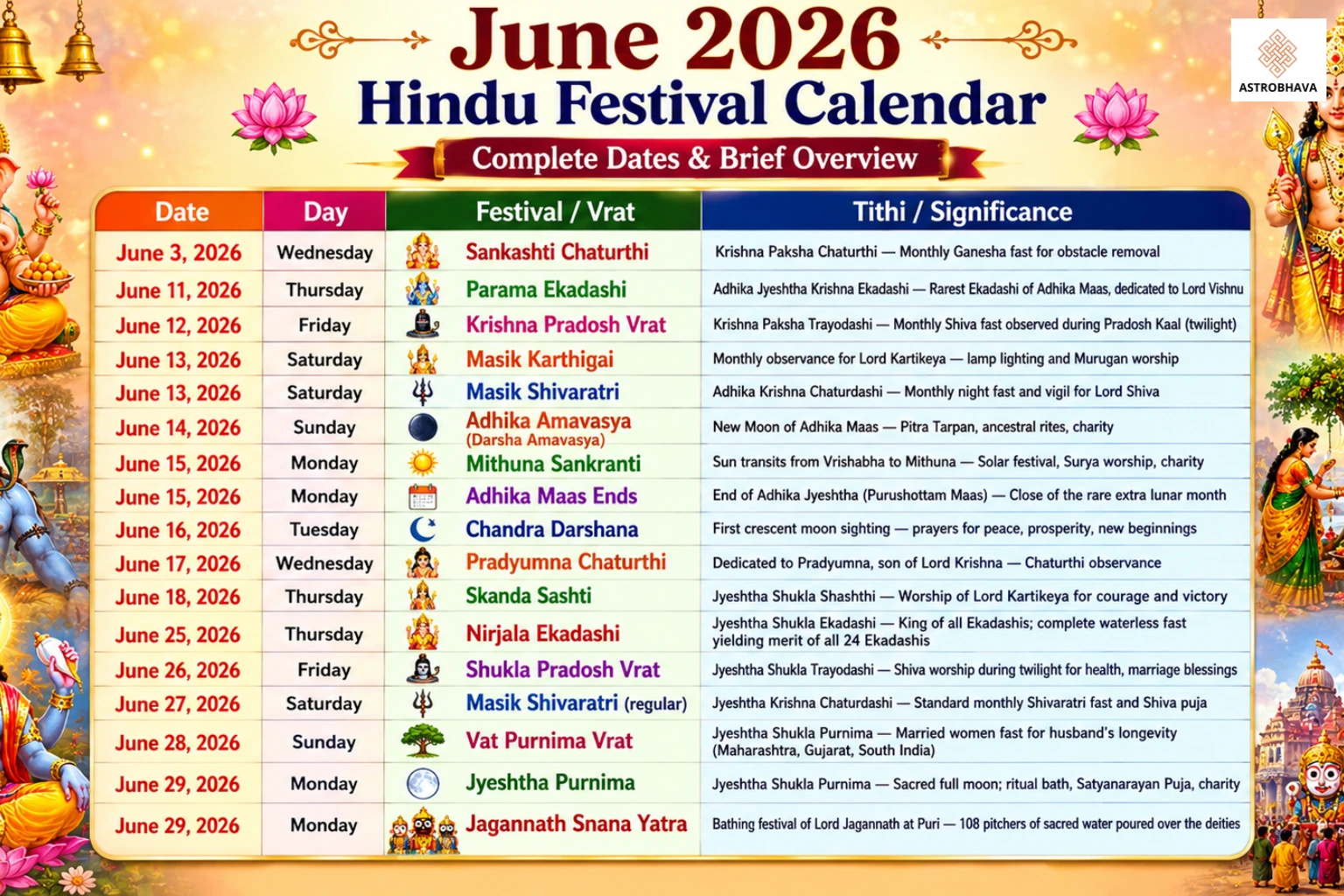 June 2026 Hindu Festival Calendar — Complete Dates & Brief Overview
| Date | Day | Festival / Vrat | Tithi / Significance |
| June 3, 2026 | Wednesday | Sankashti Chaturthi | Krishna Paksha Chaturthi — Monthly Ganesha fast for obstacle removal |
| June 11, 2026 | Thursday | Parama Ekadashi | Adhika Jyeshtha Krishna Ekadashi — Rarest Ekadashi of Adhika Maas, dedicated to Lord Vishnu |
| June 12, 2026 | Friday | Krishna Pradosh Vrat | Krishna Paksha Trayodashi — Monthly Shiva fast observed during Pradosh Kaal (twilight) |
| June 13, 2026 | Saturday | Masik Karthigai | Monthly observance for Lord Kartikeya — lamp lighting and Murugan worship |
| June 13, 2026 | Saturday | Masik Shivaratri | Adhika Krishna Chaturdashi — Monthly night fast and vigil for Lord Shiva |
| June 14, 2026 | Sunday | Adhika Amavasya (Darsha Amavasya) | New Moon of Adhika Maas — Pitra Tarpan, ancestral rites, charity |
| June 15, 2026 | Monday | Mithuna Sankranti | Sun transits from Vrishabha to Mithuna — Solar festival, Surya worship, charity |
| June 15, 2026 | Monday | Adhika Maas Ends | End of Adhika Jyeshtha (Purushottam Maas) — Close of the rare extra lunar month |
| June 16, 2026 | Tuesday | Chandra Darshana | First crescent moon sighting — prayers for peace, prosperity, new beginnings |
| June 17, 2026 | Wednesday | Pradyumna Chaturthi | Dedicated to Pradyumna, son of Lord Krishna — Chaturthi observance |
| June 18, 2026 | Thursday | Skanda Sashti | Jyeshtha Shukla Shashthi — Worship of Lord Kartikeya for courage and victory |
| June 25, 2026 | Thursday | Nirjala Ekadashi | Jyeshtha Shukla Ekadashi — King of all Ekadashis; complete waterless fast yielding merit of all 24 Ekadashis |
| June 26, 2026 | Friday | Shukla Pradosh Vrat | Jyeshtha Shukla Trayodashi — Shiva worship during twilight for health, marriage blessings |
| June 27, 2026 | Saturday | Masik Shivaratri (regular) | Jyeshtha Krishna Chaturdashi — Standard monthly Shivaratri fast and Shiva puja |
| June 28, 2026 | Sunday | Vat Purnima Vrat | Jyeshtha Shukla Purnima — Married women fast for husband’s longevity (Maharashtra, Gujarat, South India) |
| June 29, 2026 | Monday | Jyeshtha Purnima | Jyeshtha Shukla Purnima — Sacred full moon; ritual bath, Satyanarayan Puja, charity |
| June 29, 2026 | Monday | Jagannath Snana Yatra | Bathing festival of Lord Jagannath at Puri — 108 pitchers of sacred water poured over the deities |
The Big Backdrop: Adhika Maas Concludes in June 2026
Before diving into individual festivals, it’s important to understand the sacred energy surrounding June 2026. The month opens still inside Adhika Maas — the rare extra lunar month that occurs once every 2–3 years to align the lunar and solar calendars. In 2026, Adhika Jyeshtha began on May 17 and concludes on June 15. This is the first Adhika Maas since 2023, and the next won’t arrive until approximately 2029.
Why does this matter? Because scriptures declare that spiritual acts performed during Adhika Maas — japa, homa, puja, fasting, dana (charity), and Vishnu worship — yield Akshaya Phala, meaning everlasting, multiplied spiritual merit. The Puranas specifically name this month as dedicated to Purushottama, the Supreme Lord Vishnu. If you have ever considered starting a spiritual practice or seeking divine intervention for health, marriage, career, or family wellbeing, the early days of June 2026 carry immense amplification for those intentions.
Brief explanation of each festival
Sankashti Chaturthi — June 3, 2026
Sankashti Chaturthi is the monthly fast observed on the Krishna Paksha Chaturthi (fourth day of the waning lunar fortnight) dedicated entirely to Lord Ganesha. The word “Sankashti” means deliverance from troubles, and devotees observe this vrat to overcome obstacles in career, marriage, education, and health. The fast is maintained throughout the day and broken only after sighting the moon in the evening. Offerings of durva grass, red flowers, and modak are made to Ganesha, and the Sankashti Vrat Katha is recited. The evening moonrise is the pivotal moment — devotees offer water (arghya) to the moon and seek Ganesha’s blessings before breaking the fast.
Parama Ekadashi — June 11, 2026
Parama Ekadashi is one of the rarest Ekadashis in the Hindu calendar because it occurs only during the Krishna Paksha of Adhika Maas — a month that itself arrives only once every 2–3 years. Dedicated to Lord Vishnu as Purushottama (the Supreme Being), this Ekadashi carries far greater merit than a regular monthly Ekadashi. Scriptures state that observing it grants forgiveness of accumulated karmas and spiritual benefit equivalent to thousands of yajnas. The fast is observed with Tulsi puja, Vishnu Sahasranama chanting, and the reading of the Ekadashi Katha. Devotees who cannot observe every Ekadashi through the year especially benefit from this rare occurrence.
Krishna Pradosh Vrat — June 12, 2026
Pradosh Vrat falls on the Trayodashi (thirteenth lunar day) of both fortnights each month and is one of the most effective monthly observances for Lord Shiva’s grace. The Krishna Pradosh, falling in the dark fortnight, is considered particularly powerful for healing ailments, removing misfortune, and resolving long-standing family or marital issues. The primary ritual is performed during Pradosh Kaal — the 90-minute window around sunset — when the Shivalinga is bathed with Panchamrit and bilva leaves are offered while chanting “Om Namah Shivaya.” Devotees observe a day-long fast and break it after the evening puja.
Masik Karthigai — June 13, 2026
Masik Karthigai is the monthly observance of the Karthigai Nakshatra day, deeply beloved in Tamil Nadu, Karnataka, and South Indian communities worldwide. It is dedicated to Lord Kartikeya (Murugan / Skanda), the son of Lord Shiva and Goddess Parvati and the Commander of the Divine Army. Devotees light rows of lamps (deepams) at home and in temples, offer red flowers and coconut, and chant the Kanda Shashti Kavacham or “Om Saravanabhavaya Namaha.” This observance is considered especially powerful for students, those seeking career breakthroughs, and anyone overcoming enemies or inner weaknesses.
Masik Shivaratri — June 13, 2026 (Adhika) & June 27, 2026 (Regular)
Every month carries a Masik Shivaratri on the Krishna Paksha Chaturdashi — the 14th day of the waning fortnight. June 2026 is unusual in having two such dates: June 13 falls in the Adhika (extra) lunar month, and June 27 falls in the regular Jyeshtha month. Both are dedicated to Lord Shiva. Devotees fast through the day, perform Shiva Puja with Panchamrit abhisheka (ritual bathing of the Shivalinga with milk, honey, curd, ghee, and sugar) and bilva leaf offerings, maintain a night vigil chanting the Maha Mrityunjaya Mantra, and break the fast at sunrise the following day. June 13’s Masik Shivaratri carries the added merit of Adhika Maas, making it especially powerful for Shiva worship this year.
Adhika Amavasya (Darsha Amavasya) — June 14, 2026
The New Moon (Amavasya) of Adhika Maas is one of the most powerful days in June 2026 for ancestral rituals. Scriptures declare that performing Pitra Tarpan — the ritual offering of water mixed with sesame seeds to one’s departed ancestors — during Adhika Amavasya removes Pitra Dosha and brings ancestral blessings for the entire family. Beyond Tarpan, this day calls for introspection, fasting, and charitable giving (Dana). Feeding Brahmins, donating food and clothing, and lighting sesame oil lamps in the name of ancestors are all highly meritorious acts on this day. Auspicious new beginnings are traditionally avoided on Amavasya.
Mithuna Sankranti — June 15, 2026
Mithuna Sankranti marks the solar transition of the Sun from the zodiac sign Vrishabha (Taurus) into Mithuna (Gemini). All Sankranti days are considered highly auspicious in Vedic tradition for ritual baths, Surya (Sun) worship, Pitra Tarpan, and charitable giving. On Mithuna Sankranti, taking a bath at sunrise while chanting Surya mantras such as the Gayatri Mantra or the Aditya Hridayam is the primary ritual.
Adhika Maas Ends — June 15, 2026
The conclusion of Adhika Jyeshtha (the rare extra lunar month also called Purushottam Maas or Mal Maas) falls on June 15, 2026. This marks the end of a 30-day window of amplified spiritual merit that began on May 17. For devotees who undertook any special vrata, japa, or homa during Adhika Maas, June 15 is the day to complete these practices with a proper Udyapan — a formal ritual conclusion involving prayers, charity, and offerings to Lord Vishnu. The Puranas hold that spiritual acts performed in Adhika Maas yield Akshaya Phala — undying, compounding spiritual rewards — making this closure an important moment.
Chandra Darshana — June 16, 2026
Chandra Darshana (literally “sight of the moon”) marks the first sighting of the thin crescent moon after the new moon (Amavasya). In Vedic tradition, the first appearance of the new moon is a moment of beauty, auspiciousness, and renewal. Devotees offer Arghya — a ritual water offering — to the crescent moon while standing outdoors, reciting “Om Som Somaya Namaha” or the Chandra Stotra. It is believed that sighting the new moon on this day and offering prayers brings peace, mental clarity, emotional healing, and new blessings into the home. Children are traditionally shown the new moon as a blessing ritual.
Pradyumna Chaturthi — June 17, 2026
Pradyumna Chaturthi is observed on the Shukla Paksha Chaturthi of Jyeshtha and is dedicated to Lord Pradyumna — the eldest son of Lord Krishna and Rukmini, considered one of the Chatur Vyuha (four divine emanations of Vishnu). Pradyumna is associated with the Manas (mind) aspect of the divine and is worshipped for intelligence, creative power, and blessings in matters of love and relationships. The puja involves offerings of yellow flowers, sweets, and incense, with chanting of Pradyumna’s names from the Vishnu Sahasranama.
 Skanda Sashti — June 18, 2026
Skanda Sashti falls on the Sashti Tithi (sixth lunar day) of Jyeshtha Shukla Paksha and is one of the most sacred monthly observances for Lord Kartikeya (also called Skanda, Murugan, or Subrahmanya). As the divine commander who defeated the demon Tarakasura, Lord Kartikeya is worshipped for courage, clarity of purpose, career victory, and overcoming enemies both external and internal. Devotees observe a partial or full fast, visit Murugan temples, offer red flowers and vel (Kartikeya’s divine spear), and chant the Kanda Shashti Kavacham. This day holds especially deep significance for Tamil, Telugu, and South Indian devotees worldwide.
Nirjala Ekadashi — June 25, 2026
Nirjala Ekadashi is the supreme Ekadashi of the year — the one day when even those who cannot observe every monthly Ekadashi commit to a total fast. “Nirjala” literally means “without water,” and this is perhaps the most demanding spiritual fast in the Hindu calendar: from sunrise on June 25 to sunrise on June 26, no food and no water are consumed.
The Mahabharata recounts how Bhima, one of the five Pandavas, who could not control his hunger enough to fast regularly, was advised by sage Vyasa to observe this single Ekadashi each year in place of all 24. Lord Vishnu is worshipped with Tulsi, yellow flowers, incense, and the chanting of the Vishnu Sahasranama. Donating water pots, fans, and food to the poor on this day carries immense merit, as the summer heat makes water donation particularly sacred.
Shukla Pradosh Vrat — June 26, 2026
The Shukla Pradosh Vrat falls on the Trayodashi of the Shukla (waxing) fortnight and is considered particularly auspicious for Shiva worship because the growing moon amplifies devotion and positive intention. Lord Shiva and Goddess Parvati are together on Mount Kailash during Pradosh Kaal (twilight window), and prayers offered at this time are believed to reach them directly. Married couples especially observe Shukla Pradosh for marital harmony, fertility, and family wellbeing. The Shivalinga is bathed, bilva leaves are offered, and the Pradosh Vrat Katha is recited during the twilight hour.
Vat Purnima Vrat — June 28, 2026
Vat Purnima Vrat is the full-moon version of the Vat Savitri Vrat, observed primarily in Maharashtra, Gujarat, Goa, and South Indian communities. Married women fast through the day and worship the sacred banyan tree (Vat Vriksha) — considered a symbol of immortality, fertility, and divine protection — by tying threads around its trunk and reciting the story of Savitri, the devoted wife who outwitted Yama (the God of Death) to bring her husband Satyavan back to life.
Jyeshtha Purnima — June 29, 2026
Jyeshtha Purnima is one of the most auspicious full moons of the year, marking the completion of the Jyeshtha lunar month. A ritual bath at dawn — ideally in a sacred river like the Ganga, Godavari, or Kaveri, or at home with Ganga Jal — is the central act of this Purnima. The evening is traditionally reserved for the Satya Narayana Puja, a beloved household ceremony invoking Lord Vishnu’s blessings for the family’s health, prosperity, and protection. Charity (Anna Daan, Vastra Daan) and Chandra Arghya (offering water to the full moon) round out the day’s observances. This Purnima also closes the Jyeshtha month, paving the way for Ashadha — the month of Rath Yatra, Guru Purnima, and Devshayani Ekadashi.
 Why June 2026 Is Exceptionally Special for Spiritual Seekers
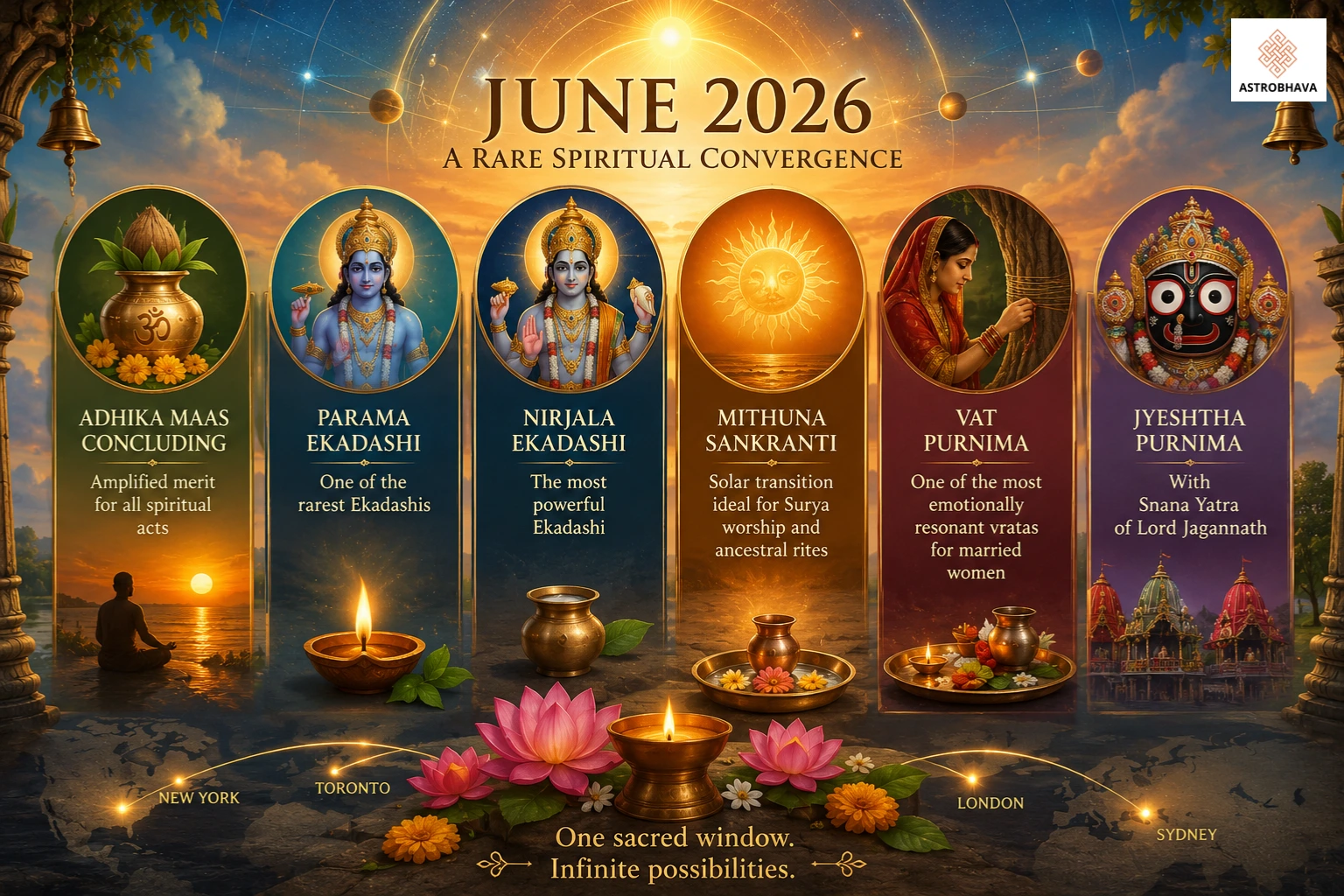
The convergence happening in June 2026 is genuinely rare. You have:
- Adhika Maas concluding — carrying amplified merit for all spiritual acts performed in its final days
- Two powerful Ekadashis — Parama Ekadashi (one of the rarest) and Nirjala Ekadashi (the most powerful)
- Mithuna Sankranti — a solar transition day ideal for Surya worship and ancestral rites
- Vat Purnima — one of the most emotionally resonant vratas for married women
- Jyeshtha Purnima with Snana Yatra — the sacred bathing festival of Lord Jagannath
In Vedic spirituality, the coming together of multiple auspicious events within a short window is called a “Yoga Kaal” — a convergence that amplifies the effectiveness of any ritual, fast, prayer, or spiritual intention. June 2026 is that window. Wherever you are in the world — New York, London, Toronto, Sydney — these tithis and cosmic energies are active. All you need is the right intention, the right ritual, and the right Vedic support.
Tips for NRIs and Devotees Abroad: Celebrating June Festivals 2026 Remotely
Many of our devotees from the USA, UK, UAE, Canada, and Australia often wonder: “How do I observe these festivals when I don’t have access to temples, pundits, or the right puja materials?” Here are some practical, spiritually effective ways:
- Sankalpa is everything. Before any vrat or puja, take a clear mental Sankalpa — state your name, your city, and your intention. The Vedas teach that divine energy follows intention.
- Create a simple altar at home with a Vishnu idol or image, a Shivalinga, and a Ganesha murti. Even a printed image in a clean space with a ghee diya is sufficient.
- Use YouTube for Vrat Kathas and bhajans to maintain the devotional atmosphere during fasts.
- Book professional online puja services — this is where AstroBhava’s certified priests fill an irreplaceable gap. They perform your rituals at an authentic temple in South India using your exact birth details and Sankalpa, following strict Agama Shastra, and ship prasad and energised Yantras directly to your home.
Conclusion
June Festivals 2026 offer one of the richest spiritual landscapes of the entire year. From the rare Parama Ekadashi within Adhika Maas to the mighty Nirjala Ekadashi, from the loving Vat Purnima Vrat to the majestic Snana Yatra of Lord Jagannath — every day of this month is an invitation. An invitation to slow down, turn inward, offer something sacred, and receive something transformative in return.
Whether you observe all these days or simply focus on one or two with full sincerity, the divine energy of June 2026 responds to genuine devotion. And for those who wish to go deeper — with personalised Homas, Pujas, Japas, and energised Yantras performed by trained Vedic priests in authentic South Indian temples — AstroBhava is your trusted partner, wherever in the world you may be.
Har Har Mahadev. Jai Shri Vishnu. Jai Jagannath. 🙏
Frequently Asked Questions (FAQs) About June Festivals 2026
Q1. What is the most important Hindu festival in June 2026?
Nirjala Ekadashi on June 25, 2026 is widely considered the most important. It is called the King of Ekadashis, and observing it is said to grant the spiritual merit of all 24 Ekadashis of the year combined. Parama Ekadashi on June 11 is also extremely rare and powerful, as it falls during the special Adhika Maas.
Q2. When does Adhika Maas end in 2026?
Adhika Maas (Adhika Jyeshtha) ends on June 15, 2026, coinciding with Mithuna Sankranti. The sacred extra month begins on May 17 and concludes on June 15.
Q3. Is Vat Savitri Vrat in May or June 2026?
It depends on regional tradition. In North India, Vat Savitri Vrat was observed on May 16, 2026 (Jyeshtha Amavasya). In Maharashtra, Gujarat, and South India, it is observed on Jyeshtha Purnima — which falls on June 28, 2026, and is called Vat Purnima Vrat.
Q4. Can women observe Nirjala Ekadashi during pregnancy?
Pregnant women, elderly individuals, or those with health conditions are advised not to observe a complete waterless fast. A simple fruit-and-milk fast (Phalahar), regular Vishnu Puja, mantra chanting, and charity on this day are considered spiritually equivalent for those with physical limitations. Always consult your physician.
Q5. What mantra should I chant throughout June 2026?
For Adhika Maas observance: “Om Namo Bhagavate Vasudevaya” — the 12-syllable Vishnu Mantra is the most recommended mantra for the entire Adhika Maas period and carries deep merit through June 15. Post-Adhika Maas, continue with this mantra or shift to the Maha Mrityunjaya Mantra for health protection or the Gayatri Mantra for overall spiritual merit.
Q6. How can NRIs perform June festival rituals from abroad?
NRIs can observe fasts, create home altars, take ritual baths with Ganga Jal, and chant mantras for each festival. For a complete Vedic ritual experience — including personalised Pujas, Homas, and Japas performed at South Indian temples by certified priests — AstroBhava offers fully authenticated remote services with live-streamed Homas, real-time participation, and worldwide prasad delivery.
Q7. What is Parama Ekadashi and why is it rare?
Parama Ekadashi falls only during the Krishna Paksha of Adhika Maas — which itself occurs only once every 2–3 years. It is dedicated to Lord Vishnu and is considered exceptionally meritorious for forgiveness of karmas and spiritual elevation. In 2026, it falls on June 11.
Q8. Which June 2026 festival is best for removing Pitra Dosha?
Adhika Amavasya on June 14, 2026 is the most powerful day for Pitra Tarpan and ancestral rites in June. Mithuna Sankranti on June 15 is also auspicious for Pitra Tarpan. Both these days during Adhika Maas carry amplified merit for ancestral offerings.
Q9. Is June 2026 auspicious for starting a new business or venture?
The early fortnight of June is still in Adhika Maas, during which major new beginnings and auspicious activities like marriage and Griha Pravesh are traditionally avoided. However, from June 16 onwards, the regular Jyeshtha Shukla Paksha resumes, and days with auspicious Yogas and Nakshatras can be identified in your local panchang for new beginnings.