There is a hymn in the Vedic devotional tradition so exquisitely tender, so soaked in love and surrender, that the great sage-philosopher Shrimad Vallabhacharya is said to have composed it the very night Lord Krishna himself appeared before him. That hymn is the Madhurashtakam — eight luminous verses where every line ends with the word madhuram, meaning sweet or blissful — and it remains, after five centuries, the most intimate celebration of Krishna’s all-pervading sweetness ever set to Sanskrit verse.
The Madhurashtakam Homa takes this devotional masterpiece a step further. By consecrating the recitation of the Madhurashtakam within a sacred Vedic fire ritual (homa), the potency of each verse is amplified through Agni, the divine intermediary, and carried directly into the cosmic realm. If you are seeking relief from mental turbulence, a deeper bond with Lord Krishna, restoration of harmony in relationships, or simply the nectar of true bhakti — the benefits of Madhurashtakam Homa offer all of this and more.
This guide walks you through everything you need to know: the stotra’s origins, the structure of the homa, what it heals, who should perform it, the ideal muhurta, and how devotees across the USA, UK, Canada, and the NRI diaspora worldwide are accessing this powerful ritual from the comfort of their homes.
What Is the Madhurashtakam? Origins and Sacred Context
The Madhurashtakam (Sanskrit: मधुराष्टकम्) was composed by Shrimad Vallabhacharya around 1478–1479 CE, the founder of the Pushtimarga — the Path of Grace in Vaishnava philosophy. Tradition records that on the midnight of Shravana Shukla Ekadashi, Lord Krishna manifested before Vallabhacharya in Vrindavan. In ecstatic response to this divine darshan, the saint composed this ashtakam — eight verses, each containing the word madhuram seven times — as a spontaneous outpouring of love.
Each verse of the Madhurashtakam praises a different facet of Lord Krishna:
- Verse 1: His lips, face, eyes, smile, heart, and gait — adharam madhuram, vadanam madhuram
- Verse 2: His hands, feet, dance, flute, and movements
- Verse 3: His ornaments, clothing, and celestial form
- Verse 4: His words, companions, and associations
- Verse 5: His pastimes (leelas) in Vrindavan
- Verse 6: His divine glances and compassion
- Verse 7: His divine love toward the gopis and devotees
- Verse 8: Everything that belongs to Madhuradhipati — the Lord of Sweetness — is sweet
This is not merely a literary hymn. In the Pushtimarga tradition, the Madhurashtakam is classified as a seva stotra — a hymn of sacred service. It creates a living bridge between the devotee’s consciousness and Krishna’s svarupa (true divine essence). When this stotra is chanted continuously into the Vedic fire during a homa, it saturates the ritual space, the participants, and the cosmos itself with divine madhurya — sweetness, grace, and bliss.
What Is a Madhurashtakam Homa?
A Madhurashtakam Homa is a structured Vedic fire ritual (agnihotra) in which the eight verses of the Madhurashtakam are recited as the primary mantra offering into the consecrated fire (homa kunda). Conducted by certified Vedic priests trained in classical Padashala traditions, the homa follows the precise Agamic framework:
Sankalpa → Ganapati Puja → Kalasha Sthapana → Agni Pratishtha → Madhurashtakam Japa and Ahutis → Abhisheka → Purnahuti → Prasad distribution
Each verse is chanted a prescribed number of times — typically 108 repetitions per verse across the eight verses — with simultaneous offerings of ghee (clarified butter), panchamrita, tulsi leaves, panchagavya, honey, fresh yellow flowers (especially kadamba and marigold beloved of Krishna), butter (the Lord’s own cherished offering), yellow sandalwood paste, sesame seeds, havan samagri, and sacred wood.
The number 108 is deeply significant: it represents the 108 gopis of Vrindavan, the 108 divine names of Krishna, and the 108 Upanishads — making each cycle of recitation a complete act of cosmic devotion.
✨ Ready to experience the divine sweetness of Krishna’s grace?
 Core Benefits of Madhurashtakam Homa
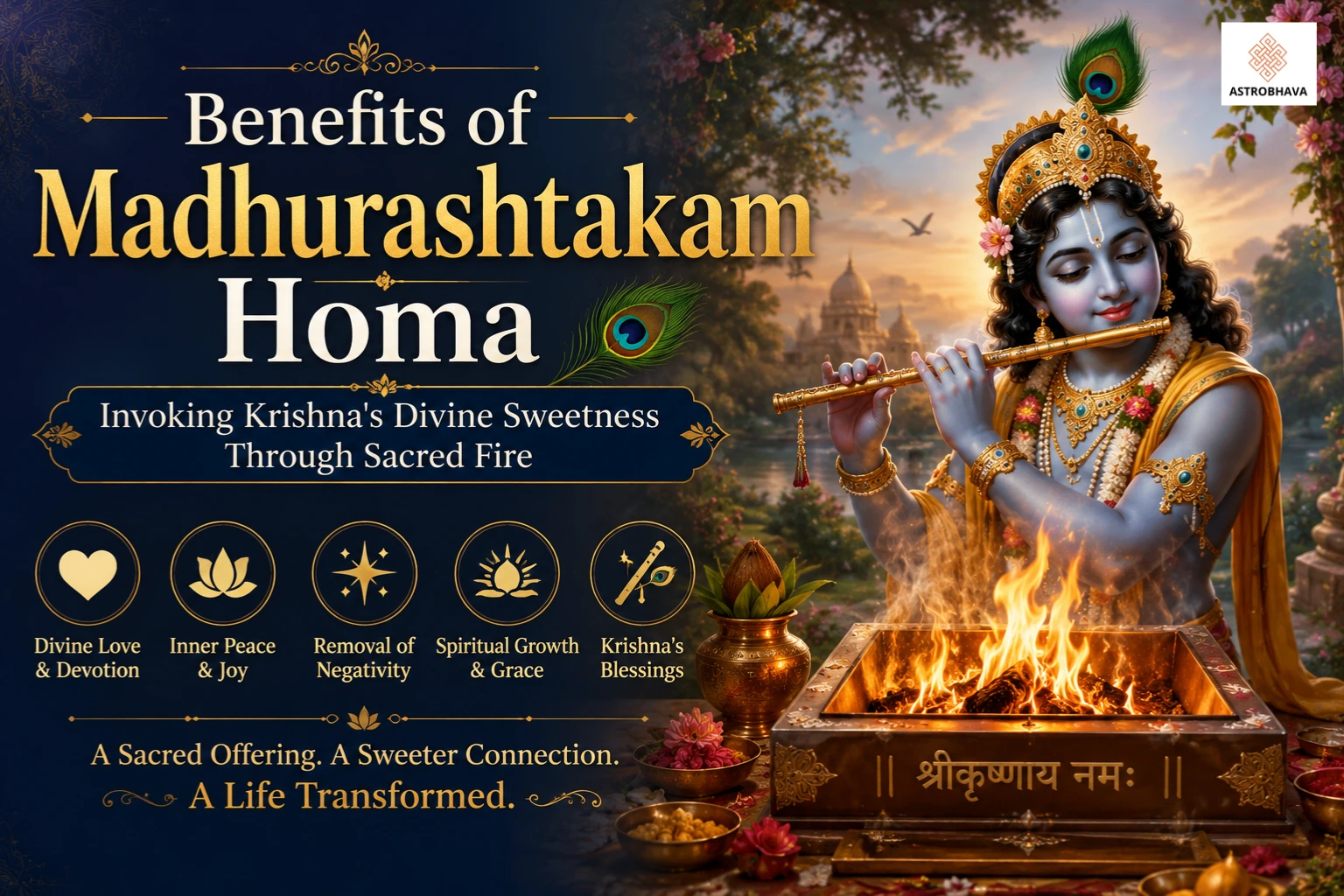
The benefits of Madhurashtakam Homa are both spiritual and material, rooted in centuries of classical Vedic understanding and devotional experience. Here is a detailed breakdown:
1. Deep Spiritual Connection with Lord Krishna
The primary and most profound benefit of the Madhurashtakam Homa is the direct invocation of Lord Krishna’s madhurya — his sweetness and divine essence. The combined power of fire, mantra, and devotional intent creates a portal through which Krishna’s grace descends into the devotee’s life with remarkable clarity. Those who have performed this homa often describe a profound shift in their inner life — a softening of hardness in the heart, an inexplicable joy that persists beyond the ritual, and a felt sense of being in Krishna’s presence.
2. Healing of Broken or Strained Relationships
The Madhurashtakam’s verses meditate on Krishna’s role as the embodiment of love and harmony. Vedic tradition specifically recommends this stotra — and by extension, the Madhurashtakam Homa — for households experiencing conflict, estranged family relationships, marital discord, or workplace hostility. The fire ritual transforms the rajas (restlessness) and tamas (inertia) at the root of conflict into sattva (pure harmony). Couples experiencing emotional distance, parents and children navigating difficult phases, and business partners in disagreement all benefit from the peace-infusing energy this homa generates.
3. Relief from Mental Anxiety, Stress, and Emotional Turbulence
Modern life — particularly for NRIs navigating dual cultures, long work hours, family separation, and social pressures — generates a unique kind of psychological exhaustion. The benefits of Madhurashtakam Homa include a measurable calming of the nervous system and mental field. The repetitive chanting of madhuram during the ritual acts as a sonic meditation — dissolving fear, anxiety, grief, and mental restlessness. Classical texts describe this as the mantra’s sannidhya (divine proximity) being established within the devotee’s mind, replacing turbulence with the natural sweetness of bhakti.
4. Removal of Negativity, Evil Eye, and Inauspicious Energies
The purifying power of Agni (fire) combined with Krishna’s protective grace makes the Madhurashtakam Homa highly effective for those suffering from drishti dosha (evil eye), graha pida (planetary afflictions causing emotional suffering), vastu dosha in the home, or generalized negativity that refuses to lift. The fire consumes all inauspicious energies, while the Madhurashtakam’s vibrations sanctify the atmosphere at every level — physical, subtle, and causal.
5. Enhancement of Creativity, Beauty, and Artistic Gifts
Lord Krishna is Murali Manohar — the enchanting flute player whose very being represents divine artistry. The Madhurashtakam Homa invokes this aspect of Krishna, making it especially beneficial for artists, musicians, dancers, writers, teachers, and all those whose livelihood or purpose depends on creative expression. Those seeking to refine their artistic sensibility, overcome creative blocks, or infuse their work with genuine rasa (aesthetic essence) find remarkable results after performing this homa.
6. Marital Bliss and Harmonious Family Life
In the Pushti Marga tradition, the Madhurashtakam is central to sringarika bhakti — devotion through the appreciation of divine beauty and love. This makes the homa especially auspicious for couples seeking deeper intimacy, newlyweds wishing to begin their union under Krishna’s blessing, or families praying for unity and sweetness in their household. The panchamrita abhisheka of the Krishna murti performed as part of the homa seals the intention for harmonious relationships.
7. Attraction of Prosperity and Positive Circumstances
When the devotee’s inner life is purified and aligned with divine sweetness, outer circumstances naturally begin to reflect that alignment. Many devotees who have performed the Madhurashtakam Homa report an increase in opportunities, unexpected blessings, improvements in financial situations, and a general upliftment in their life circumstances. This is not incidental — it is consistent with the Vedic principle that when the inner landscape is purified through ritual and mantra, the outer world responds accordingly.
8. Purification of Ancestral Karma and Karmic Relief
The Madhurashtakam Homa performed on specific tithis — particularly Ekadashi and the Krishna Paksha Ashtami — carries special potency for releasing karmic burdens accumulated across lifetimes. The fire transmutes subtle karmic imprints, and Krishna’s compassion, invoked through the stotra, extends its grace to the entire lineage. NRI families who have experienced generational patterns of difficulty, health issues, or strained relationships often find tangible shifts after this homa is performed with proper sankalpa (intention setting) for the family.
🙏 For NRIs in the USA, UK, Canada, and UAE — Don’t let geography separate you from Krishna’s blessings.
Ritual Procedure: How the Madhurashtakam Homa Is Performed
Understanding the vidhi (procedure) deepens your appreciation of the ritual and helps you participate meaningfully, even when joining via live telecast.
Step 1 — Punyahavachanam and Deeksham: The priests and participants undergo ritual purification through sacred water sprinkling, pranayama, and the chanting of purification mantras.
Step 2 — Sankalpa: The patron’s name, gotra, nakshatra, and specific intention (sankalpa) are formally declared, anchoring the ritual’s purpose to the individual’s life situation.
Step 3 — Ganapati Puja: Lord Ganesha is invoked first as the remover of obstacles, ensuring the ritual proceeds without interruption.
Step 4 — Kalasha Sthapana: A sacred pot (kalasha) filled with water, mango leaves, and a coconut is consecrated, representing the divine presence of all the gods.
Step 5 — Agni Pratishtha: The sacred fire is kindled using specific Vedic mantras and pure aranis (fire sticks), invoking Agni as the divine witness and messenger.
Step 6 — Krishna Avahana: Lord Krishna is formally invited and installed in the ritual space through the Madhurashtakam’s first verse and relevant Vishnu/Krishna Ashtottara recitation.
Step 7 — Madhurashtakam Japa and Ahutis: This is the core of the homa. Each verse of the Madhurashtakam is chanted 108 times, with simultaneous offerings after each round — cow’s ghee, butter, honey, panchamrita (five sacred liquids), tulsi, kadamba flowers, sesame, barley, and havan samagri. The number of rounds and priests determines the ritual’s intensity and breadth.
Step 8 — Abhisheka of Krishna Murti: The Krishna murti is bathed in panchamrita (milk, curd, honey, ghee, and sugar) while the Madhurashtakam is chanted continuously — a moment of extraordinary beauty in the ritual.
Step 9 — Purnahuti: The final and most sacred offering — a coconut wrapped in cloth soaked in ghee — is placed into the fire as the crescendo of the entire ritual, sealing all intentions and releasing them into the divine.
Step 10 — Aarti, Prasad, and Blessing: The ritual closes with the full Aarti of Lord Krishna, distribution of prasad (sacred food), and the priests’ blessings delivered to all participants, including those joining via live telecast.
Sacred Offerings (Homa Samagri) Used in Madhurashtakam Homa
The specific samagri used in the Madhurashtakam Homa is carefully chosen to resonate with Krishna’s divine attributes:
- Cow’s Ghee — the most sacred offering, purifying all that it touches
- Fresh Butter (Makhan) — Krishna’s cherished food, deepening the personal devotional dimension
- Honey — representing madhurya, the sweetness this entire ritual celebrates
- Tulsi (Holy Basil) — the most dear plant to Lord Vishnu-Krishna; no Vaishnava ritual is complete without it
- Kadamba Flowers — the sacred flower of Vrindavan, beloved of Radha and Krishna
- Yellow Marigold and Lotus — auspicious for Vishnu/Krishna worship
- Panchamrita — the five sacred liquids for abhisheka
- Sesame Seeds — for ancestral blessing and karmic purification
- Barley and Rice — for prosperity and abundance
- Yellow Sandalwood Paste — to sanctify and cool the ritual space
- Camphor — for purification and illumination
- Havan Samagri (mixed aromatic herbs) — for atmospheric sanctification
Who Should Perform the Madhurashtakam Homa?
The benefits of Madhurashtakam Homa are universal, but it is especially recommended for:
- Devotees of Lord Krishna and those on the Vaishnava path who wish to deepen their bhakti
- Individuals experiencing emotional pain, heartbreak, grief, or prolonged anxiety
- Couples struggling with discord, distance, or seeking to strengthen their bond
- Families plagued by frequent arguments, negative atmospheres, or unresolved conflict
- Artists, musicians, teachers, and creative professionals seeking divine inspiration
- Those experiencing graha dosha affecting emotional wellbeing or relationships (especially Venus/Shukra afflictions)
- NRIs and diaspora devotees who feel spiritually disconnected from their roots and seek a reconnection with the divine through authentic Vedic ritual
- Anyone seeking relief from drishti dosha, negativity, or the effects of hostile environments
- Parents who wish to instill bhakti and sattvic energy in their children’s lives
- Devotees who specifically wish to observe the ritual on Ekadashi, Janmashtami, or other Krishna-centric festivals
🌸 Enhance your Krishna devotion with a personalized Madhurashtakam Japa service — our certified priests chant the Madhurashtakam 108 times on your behalf with your sankalpa, sending you the blessed audio and prasad.
Explore Japa services at AstroBhava
 Auspicious Dates and Muhurta for Madhurashtakam Homa
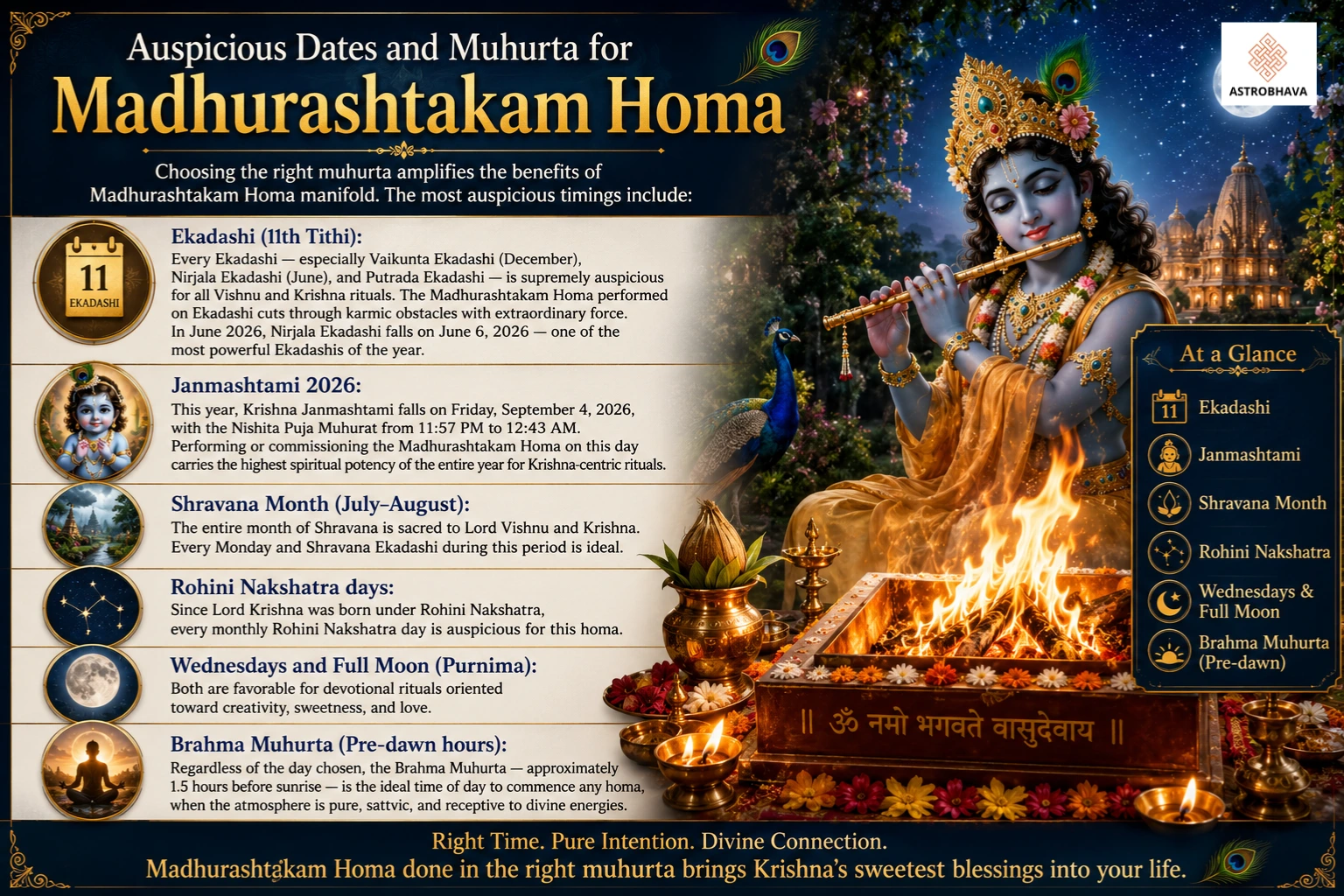
Choosing the right muhurta amplifies the benefits of Madhurashtakam Homa manifold. The most auspicious timings include:
Ekadashi (11th Tithi): Every Ekadashi — especially Vaikunta Ekadashi (December), Nirjala Ekadashi (June), and Putrada Ekadashi — is supremely auspicious for all Vishnu and Krishna rituals. The Madhurashtakam Homa performed on Ekadashi cuts through karmic obstacles with extraordinary force. In June 2026, Nirjala Ekadashi falls on June 6, 2026 — one of the most powerful Ekadashis of the year.
Janmashtami 2026: This year, Krishna Janmashtami falls on Friday, September 4, 2026, with the Nishita Puja Muhurat from 11:57 PM to 12:43 AM. Performing or commissioning the Madhurashtakam Homa on this day carries the highest spiritual potency of the entire year for Krishna-centric rituals.
Shravana Month (July–August): The entire month of Shravana is sacred to Lord Vishnu and Krishna. Every Monday and Shravana Ekadashi during this period is ideal.
Rohini Nakshatra days: Since Lord Krishna was born under Rohini Nakshatra, every monthly Rohini Nakshatra day is auspicious for this homa.
Wednesdays and Full Moon (Purnima): Both are favorable for devotional rituals oriented toward creativity, sweetness, and love.
Brahma Muhurta (Pre-dawn hours): Regardless of the day chosen, the Brahma Muhurta — approximately 1.5 hours before sunrise — is the ideal time of day to commence any homa, when the atmosphere is pure, sattvic, and receptive to divine energies.
How NRIs Worldwide Can Participate in Madhurashtakam Homa
One of the most significant developments in contemporary Vedic ritual practice is the ability of the global Indian diaspora to participate in authentic homa rituals without traveling to India. AstroBhava has made this seamless, maintaining complete ritual authenticity while enabling participation from anywhere in the world.
How it works at AstroBhava:
- Book your homa online with your name, gotra, and sankalpa (specific intention)
- Receive a Muhurta confirmation via email within 24–48 hours — your ritual is scheduled at the most auspicious time based on your birth details
- Join the LIVE telecast on AstroBhava’s YouTube channel as certified Vedic priests perform the complete Madhurashtakam Homa at their sacred Yagna Ashram in Tamil Nadu
- Receive your complimentary energized Krishna Yantra — sealed in a sacred silver amulet and shipped worldwide, free of charge
- Receive prasad delivered to your door — blessed vibhuti (sacred ash), kumkum, and sanctified offerings from the homa
All rituals at AstroBhava are strictly 100% individual — your homa is never combined into a group ceremony. Your sankalpa is specific, your ritual is personal, and the blessings are unambiguously directed toward you and your family.
Devotees in the USA, UK, Canada, Australia, UAE, Singapore, and across Europe have experienced the transformative benefits of Madhurashtakam Homa through this live-streamed format. The live telecast is not a compromise — it is a continuation of the ancient tradition of participating in temple rituals from a distance, where the devotee’s intent and the priest’s recitation together form the complete ritual circuit.
Explore powerful homas to perform in 2026
Madhurashtakam Puja vs. Madhurashtakam Homa: What’s the Difference?
Devotees often ask whether a Madhurashtakam Puja is sufficient or whether the full homa is necessary. Here is a clear comparison:
Madhurashtakam Puja involves the ceremonial worship of Lord Krishna’s murti with flowers, lamp, incense, panchamrita abhisheka, and the chanting of the Madhurashtakam. It is deeply devotional, purifying, and accessible for daily or weekly practice. The focus is on darshana and seva — seeing and serving the Lord.
Madhurashtakam Homa incorporates all elements of the puja AND adds the consecrated fire, which amplifies the mantra’s potency through Agni. The fire acts as a cosmic transmitter — carrying the vibrations of the Madhurashtakam beyond the physical realm and into the subtle planes where karma operates. For deep healing, karmic relief, or significant life changes, the Homa is substantially more powerful.
For maximum results, AstroBhava recommends commissioning the full Homa combined with a subsequent 48-day Yantra Puja, where the energized Krishna Yantra is worshipped daily across 27 Nakshatras and 12 Rashis, sustaining the homa’s blessings over an extended period.
💛 Deepen your connection with a personalized Krishna Puja — offered individually for you with your sankalpa, using traditional Vaishnava puja vidhi.
Explore Krishna Puja at AstroBhava
Conclusion
The benefits of Madhurashtakam Homa reach into every dimension of human life — healing the heart, calming the mind, restoring relationships, and opening the devotee to the infinite sweetness (madhurya) that is Lord Krishna’s most essential gift to the world. This is not a ritual that asks for grand sacrifices. It asks only for sincerity — a genuine turning of the heart toward the Lord of Sweetness, conducted through the ancient, proven medium of sacred fire, mantric sound, and Vedic priest-craft.
For those of us living far from India’s temples — in the busy cities of America, the UK, Canada, or the UAE — the Madhurashtakam Homa available through AstroBhava bridges that distance completely. Your sankalpa travels on the smoke of the homa fire; your name is spoken by priests trained in the oldest living ritual traditions; your prasad arrives at your door. The divine sweetness of Krishna is not limited by geography.
Choose the most auspicious muhurta. Set your sankalpa with a pure heart. Let the Madhurashtakam Homa do what five centuries of devotional tradition confirm it does — fill every corner of your life with the sweetness of Krishna’s grace.
ॐ मधुराधिपतेरखिलं मधुरम्। Everything about the Lord of Sweetness is sweet.
Frequently Asked Questions (FAQs)
Q1. What is the main purpose of the Madhurashtakam Homa?
The primary purpose of the Madhurashtakam Homa is to invoke Lord Krishna’s divine grace, sweetness, and love through the combined power of sacred fire and the Madhurashtakam stotra. It is performed for spiritual upliftment, healing of relationships, removal of negativity, emotional peace, and deepening of bhakti.
Q2. Who composed the Madhurashtakam and when?
The Madhurashtakam was composed by Shrimad Vallabhacharya around 1478–1479 CE. According to tradition, he composed it on the midnight of Shravana Shukla Ekadashi after receiving a divine darshan of Lord Krishna in Vrindavan. Vallabhacharya was the founder of the Pushtimarga (Path of Grace) school of Vaishnavism.
Q3. On which days is the Madhurashtakam Homa most auspicious?
The most auspicious days are Ekadashi tithis, Janmashtami (September 4, 2026), Rohini Nakshatra days, the full Shravana month (July–August), Wednesdays, and Purnima (full moon). The Brahma Muhurta is the ideal time of day regardless of which date is chosen.
Q4. Can I perform the Madhurashtakam Homa if I live outside India?
Absolutely. AstroBhava specializes in live-streamed individual Homa services for devotees in the USA, UK, Canada, Australia, UAE, and across the global NRI diaspora. You join via YouTube live telecast, your sankalpa is individually set, and your prasad and energized yantra are shipped to your home worldwide at no extra cost.
Q5. What is the difference between performing the homa with 1 priest versus 3 or 5 priests?
The number of priests multiplies the intensity and breadth of the mantra recitation. A 1-priest homa is deeply personal and effective for individual-focused intentions. A 3-priest homa amplifies the energy for family-level healing. A 5-priest homa creates the most powerful ritual environment, recommended for significant life transitions, severe distress, or broad sankalpa intentions covering health, wealth, and relationships simultaneously.
Q6. What materials (samagri) are used in the Madhurashtakam Homa?
Key offerings include cow’s ghee, fresh butter (makhan), honey, tulsi leaves, kadamba and marigold flowers, panchamrita, sesame seeds, barley, yellow sandalwood paste, camphor, and havan samagri. All materials are sourced fresh by AstroBhava’s Yagna Ashram for each individual ritual.
Q7. Is there a japa alternative to the full homa?
Yes. If you wish to begin your Krishna devotional practice or complement an upcoming homa, AstroBhava offers a dedicated Madhurashtakam Japa service, where certified priests chant the stotra 108 or 1008 times with your specific sankalpa. This is an excellent ongoing practice for daily blessings and can be booked alongside the homa for sustained results.
Q8. How long does the Madhurashtakam Homa take?
A standard Madhurashtakam Homa with one priest takes approximately 2 to 2.5 hours from Sankalpa through Purnahuti. A 3-priest or 5-priest homa may extend to 3–4 hours due to the fuller recitation cycles.
Q9. Do I need to fast before the homa?
Fasting is not mandatory, but consuming sattvic (pure vegetarian) food on the day of the homa and avoiding tamasic foods (meat, onion, garlic, alcohol) is strongly recommended. This purifies the body and aligns the devotee’s energy with the ritual’s intention.
Q10. What happens after the homa — do I receive anything?
AstroBhava sends you a complimentary energized Krishna Yantra sealed in a sacred silver amulet, along with sanctified prasad (vibhuti, kumkum, and blessed items from the homa) shipped free of charge to your address worldwide. A follow-up 48-day Yantra Puja can be added to sustain the homa’s blessings over the following six weeks.