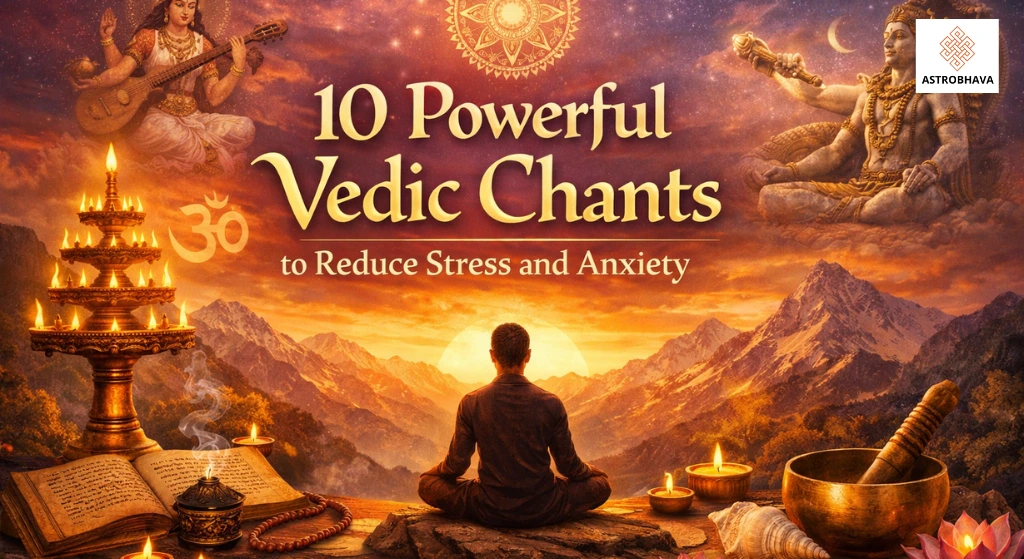
Let’s be honest — life these days can feel like a never-ending to-do list. Between work pressures, relationship stress, health worries, and the constant noise of the digital world, it’s no wonder so many of us feel anxious, overwhelmed, and mentally drained. If you’ve been searching for a natural, holistic way to find calm, you’re in the right place.
Vedic Chants — ancient Sanskrit mantras rooted in India’s 5,000-year-old Vedic tradition — are one of the most powerful yet underrated tools for mental and emotional healing. These aren’t just religious rituals. Science is now catching up to what sages knew millennia ago: sound vibration has a direct, measurable effect on the nervous system, brain chemistry, and emotional well-being.
In this guide, we’re going to walk you through 10 incredibly effective Vedic Chants that can help you melt away stress, quiet a racing mind, and restore that deep inner peace you deserve. Whether you’re new to mantras or have been chanting for years, there’s something here for you.
Why Do Vedic Chants Work for Stress and Anxiety?
Before we dive into the actual mantras, let’s quickly understand why Vedic Chants are so remarkably effective. When you chant a Sanskrit mantra, a few powerful things happen simultaneously.
First, the rhythmic repetition of sound activates the vagus nerve — the body’s built-in “calm down” switch — which directly lowers your heart rate and blood pressure. Second, focusing on a mantra gives your anxious mind something constructive to hold onto, breaking the exhausting loop of worry and rumination. Third, Sanskrit syllables are specifically designed to create resonant vibrations in the chest, throat, and skull that stimulate calming neurological pathways.
And finally — and this is the part that often surprises people — the intention and spiritual energy embedded in these Vedic Chants connects you to something larger than your immediate worries, giving you perspective and peace that modern techniques alone simply can’t replicate.
How to Chant Effectively: Find a quiet space, sit comfortably with your spine straight, close your eyes, and breathe deeply for a minute before starting. You can chant aloud, in a whisper, or silently in your mind — all three methods work. Traditionally, 108 repetitions (one mala) is recommended.
The 10 Best Vedic Chants for Stress Relief
1. Om Mantra — The Primordial Sound
Mantra: “Om” (or “Aum”)
If there’s one Vedic chant that almost every person on earth has heard, it’s Om. And there’s a very good reason it’s so universally practised — it works.
Om is considered the original sound of the universe, the vibration from which all of creation arose. When you chant it slowly and steadily, the sound naturally elongates into three syllables — “A,” “U,” and “M” — each representing a different state of consciousness (waking, dreaming, and deep sleep). The humming resonance at the end activates the parasympathetic nervous system almost immediately.
Even 5 minutes of Om chanting has been shown in studies to reduce activity in the limbic system — the brain’s emotional stress-processing centre. It’s the simplest starting point for anyone new to Vedic Chants, and it never stops being deeply effective even for seasoned practitioners.
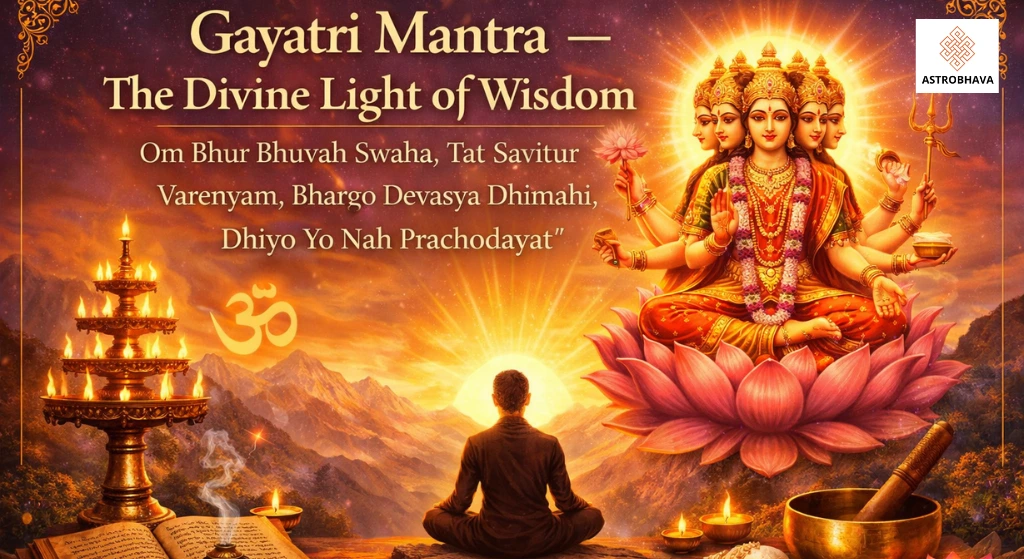
2. Gayatri Mantra — The Divine Light of Wisdom
Mantra: “Om Bhur Bhuvah Swaha, Tat Savitur Varenyam, Bhargo Devasya Dhimahi, Dhiyo Yo Nah Prachodayat”
The Gayatri Mantra is arguably the most revered of all Vedic Chants. Found in the Rigveda, this mantra is a prayer to the divine solar energy — asking it to illuminate our intellect and guide our understanding.
For stress and anxiety, the Gayatri Mantra is particularly powerful because it works on mental clarity. When you’re anxious, your thinking becomes foggy, distorted, and catastrophic. This chant helps cut through that fog. Many practitioners report a profound sense of calm and mental sharpness after just a few minutes of Gayatri chanting. Best chanted at sunrise, noon, and sunset — though any time of day is beneficial for anxiety relief.
3. Mahamrityunjaya Mantra — The Great Healer
Mantra: “Om Tryambakam Yajamahe, Sugandhim Pushtivardhanam, Urvarukamiva Bandhanan, Mrityor Mukshiya Maamritat”
This is one of the most potent healing mantras in the Vedic tradition. Dedicated to Lord Shiva in his aspect as the conqueror of death and disease, the Mahamrityunjaya Mantra is often called the “Great Liberating Mantra.”
For those dealing with chronic stress, anxiety, or fear — especially anxiety related to health, mortality, or major life upheavals — this is the chant to reach for. It’s deeply grounding. The mantra literally means a prayer to be liberated from the cycle of fear and attachment, which is essentially the root of all anxiety. Traditionally chanted 108 times during periods of illness, grief, or extreme fear, this is one of those Vedic Chants that never fails to bring a sense of protection and calm.
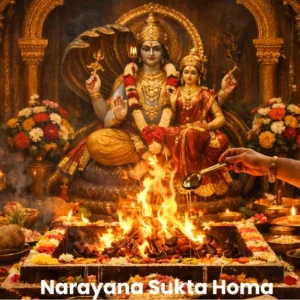
🔥 Amplify Your Practice with a Sacred Homa. Sometimes personal chanting needs a boost. Book a Live Online Homa at AstroBhava →
4. Shanti Mantra — The Peace Invocation
Mantra: “Om Shanti Shanti Shanti”
Simple, beautiful, and incredibly effective — the Shanti Mantra is exactly what it sounds like: a pure invocation of peace. The threefold repetition of “Shanti” addresses the three sources of suffering in Vedic philosophy: cosmic disturbances, worldly disturbances, and internal disturbances.
In plain language? When you chant “Om Shanti Shanti Shanti,” you’re asking for peace at every level of your existence — your outer circumstances, your relationships, and your inner world. It’s a beautiful way to close a meditation session or simply to press pause in the middle of a stressful day. One of the quickest Vedic Chants to practise — even three slow repetitions can noticeably shift your emotional state.
5. Hanuman Chalisa — Courage Against Fear
Mantra: “Jai Hanuman Gyan Gun Sagar, Jai Kapis Tihun Lok Ujagar…” (40-verse hymn)
The Hanuman Chalisa is a 40-verse devotional hymn dedicated to Lord Hanuman — the symbol of fearless devotion, strength, and complete surrender to the divine. While technically more of a hymn than a brief mantra, it holds immense power as a Vedic chant for anxiety and fear.
Hanuman is the archetype of someone who faces every obstacle with complete calm because his mind rests entirely in the divine. Chanting the Chalisa aloud — it typically takes 10–15 minutes — creates a deeply protective, calming energy field. Many people who struggle with panic attacks or social anxiety swear by this practice. Especially powerful for anxiety that stems from fear of failure or dark intrusive thoughts — chant it daily for 21 consecutive days for best results.
Ready to seek the blessings of Lord Hanuman? Book Your Japa Here
6. Ganesh Mantra — Removing Obstacles and Worry
Mantra: “Om Gam Ganapataye Namaha”
A huge portion of our anxiety comes from worrying about obstacles — things going wrong, plans falling apart, paths being blocked. The Ganesh Mantra addresses this directly. Lord Ganesha is the remover of obstacles and the lord of new beginnings, and this short, punchy mantra is one of the most widely used Vedic Chants across all traditions.
The seed syllable “Gam” carries a specific vibrational quality that activates the Mooladhara (root) chakra — the energy centre associated with stability, security, and groundedness. When anxiety makes you feel unmoored and unsafe, chanting this mantra can quite literally ground you. Perfect to chant before starting something new — a meeting, a journey, a challenging conversation — to release worry about what could go wrong.
7. Lakshmi Mantra — Releasing Anxiety About Finances
Mantra: “Om Shreem Maha Lakshmiyei Namaha”
Financial stress is one of the most common and corrosive forms of anxiety in modern life. If money worries keep you up at night, the Lakshmi Mantra is specifically attuned to this kind of suffering. Goddess Lakshmi governs abundance, prosperity, and well-being — but she also represents the inner richness of contentment and gratitude.
The seed syllable “Shreem” is considered one of the most powerful bija (seed) mantras in the Vedic tradition. Its vibration is said to open channels of abundance while simultaneously soothing the scarcity mindset that feeds financial anxiety. Chanting this mantra doesn’t just attract prosperity — it shifts your entire relationship with lack and fear. Chant 108 times on Fridays (Lakshmi’s sacred day) for amplified results.
8. Saraswati Mantra — Calming a Restless, Overthinking Mind
Mantra: “Om Aim Saraswatyai Namaha”
Anxiety very often lives in the intellect — the part of us that overanalyses, catastrophises, and goes in endless mental loops of “what if.” The Saraswati Mantra is the perfect antidote for this kind of restlessness. Goddess Saraswati governs knowledge, wisdom, and clear, focused thinking.
The seed syllable “Aim” (pronounced “I’m”) is the bija mantra of the Ajna chakra — the third eye, the seat of intuition and discernment. Regular chanting of this Vedic mantra helps transform the anxious, scattered mind into a focused, calm, and creative one. Students, artists, and professionals under cognitive pressure will find this particularly powerful. It’s also excellent for exam anxiety and performance anxiety before high-stakes situations.
9. Navagraha Mantra — Balancing Planetary Energies
Mantra: “Om Suryaya Namah, Om Chandraya Namah, Om Mangalaya Namah…” (one mantra for each of the nine planets)
This is a more advanced practice, and it addresses stress from a uniquely Vedic angle. In Vedic astrology, much of the chronic stress and anxiety we experience has roots in our birth chart. Malefic planetary periods — particularly Saturn’s Sade Sati or Rahu-Ketu transits — can create sustained periods of anxiety, confusion, and suffering that seem to have no obvious worldly cause.
The Navagraha Vedic Chants are nine individual mantras, each dedicated to one of the nine planets. Chanting all nine daily — or focusing on the mantra of the planet currently causing difficulty — is a traditional and highly effective remedy. This practice works best when combined with proper astrological guidance so you know which planet most needs your attention right now.
🪐 Is a Planetary Period Behind Your Stress? Persistent anxiety that doesn’t respond to conventional approaches may have a deeper astrological cause. AstroBhava’s Navagraha Homa — performed by experienced Vedic priests — invokes all nine planets to harmonise their energies and remove the cosmic blockages creating turbulence in your daily life. Book a Navagraha Homa at AstroBhava →
10. So Hum Mantra — The Meditation of Pure Being
Mantra: “So Hum” — “So” on the inhale, “Hum” on the exhale
We’re saving one of the most profoundly beautiful Vedic Chants for last. “So Hum” literally translates to “I am That” — a gentle reminder that your true identity is not your anxious thoughts, your worried mind, or your fearful ego. You are pure awareness. You are the eternal self that witnesses all experience without being consumed by it.
What makes So Hum unique is that it’s a breath-synchronised mantra — you silently chant “So” on each inhale and “Hum” on each exhale. This makes it incredibly accessible both as a formal meditation and as an on-the-spot anxiety tool. The moment you feel panic rising — close your eyes, take a breath, and begin. So… Hum… So… Hum. Within minutes, you’ll notice a shift. Arguably the most versatile anxiety tool in the Vedic arsenal — you can practise it anywhere, anytime, in any posture, completely silently.
 How to Build a Daily Vedic Chanting Practice
Reading about these Vedic Chants is a great start, but the real magic happens when you commit to a regular practice. Here’s a simple approach that works beautifully even for complete beginners.
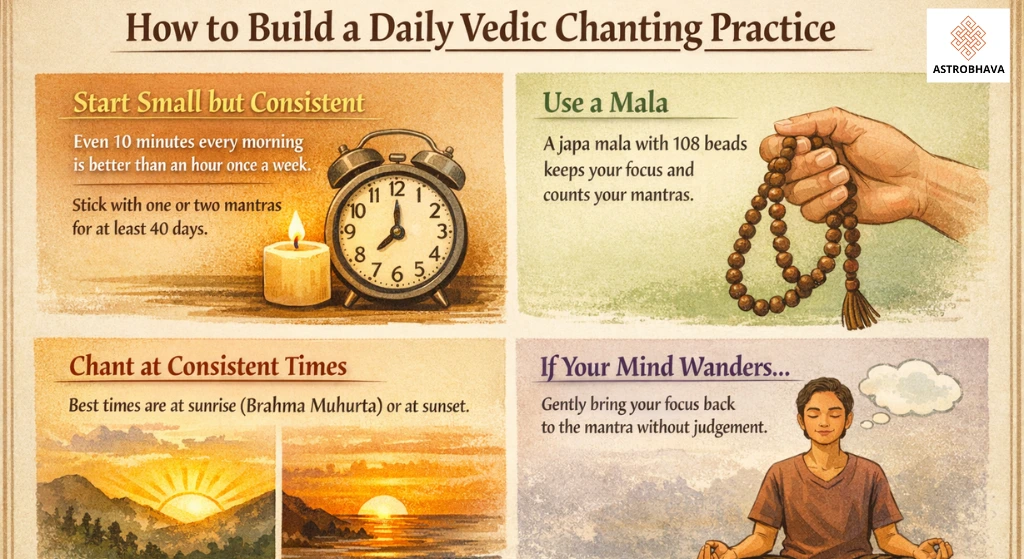
Start small but consistent. Even 10 minutes of chanting every morning is infinitely more valuable than an hour once a week. Pick one or two mantras from this list that genuinely resonate with you and stick with them for at least 40 days — this is the traditional minimum period to establish a new energetic pattern (called a sadhana).
Use a mala. A japa mala (prayer beads) with 108 beads is a fantastic tool for mantra counting. It keeps your hands engaged, your focus anchored, and ensures you complete a full cycle of 108 repetitions without distraction.
Chant at consistent times. The period around sunrise — called Brahma Muhurta (roughly 4:30–6:00 AM) — and sunset are considered the most powerful times for Vedic Chants. Morning chanting also sets a calm, intentional tone for the entire day ahead.
If your mind wanders — that’s okay. The act of gently bringing your attention back to the mantra IS the practice. Each return strengthens your mental discipline and deepens the stress-relieving benefits over time. Don’t judge yourself; just return.
Listen to our latest podcast to learn the 5 powerful Durga mantras
Conclusion
Stress and anxiety are very real, and they deserve real solutions. What’s remarkable about Vedic Chants is that they offer both immediate relief and long-term transformation — two things most modern stress-management techniques struggle to deliver simultaneously.
Whether you start with the simple Om, the healing Mahamrityunjaya, or the breath-synced So Hum, you’re tapping into a tradition that has comforted and healed millions of people across thousands of years. That’s not blind faith — that’s a track record no pharmaceutical can match.
Give these Vedic Chants a genuine 40-day try. Be patient with yourself. And if you feel called to deepen your practice with personalised guidance, sacred fire rituals, or astrological insight into the cosmic roots of your stress, the team at AstroBhava is ready to walk that path with you.
🕉 Begin Your Vedic Journey at AstroBhava.com →
Frequently Asked Questions
Do I need to be Hindu or religious to benefit from Vedic Chants? Absolutely not. Vedic Chants work through the physics of sound and vibration — they are not dependent on religious belief. People of all faiths and none regularly practise mantra chanting and experience profound benefits. Think of them as acoustic medicine: they work regardless of whether you “believe” in them, just as a tuning fork vibrates regardless of your opinion of it.
How quickly will I notice results from chanting Vedic mantras? Many people notice an immediate calming effect — even in their very first session. However, deeper, more sustained relief from chronic stress and anxiety typically develops over 21–40 days of consistent practice. Think of it like exercise: one session helps, but the real transformation comes from showing up daily.
Does my pronunciation need to be perfect? Perfect Sanskrit pronunciation is ideal but absolutely not required, especially when you’re starting out. What matters most is sincere intention and consistent practice. Many teachers say that the divine energy within these Vedic Chants meets you where you are, not where you think you should be.
Can children and elderly people practise these Vedic Chants? Yes! Vedic Chants are suitable for all ages. Children often take to mantra chanting very naturally, and for elderly individuals, the breathing regulation and calming effects are particularly beneficial. The So Hum breath mantra is especially accessible as it requires no memorisation and no physical effort.
Which Vedic Chant is best for panic attacks? For acute panic, the So Hum mantra (chant #10) is your best immediate tool because it directly synchronises with your breath and activates the parasympathetic nervous system within minutes. Om and Om Shanti are also excellent rapid-response chants. For those prone to recurrent panic attacks, practising the Mahamrityunjaya Mantra daily can gradually reduce the frequency and intensity of episodes over time.
What is a Homa, and how does it relate to Vedic Chants? A Homa (also called Yajna or fire ritual) is a sacred Vedic ceremony where specific mantras and chants are performed while offerings are made into a consecrated fire. The fire acts as a powerful amplifier of the mantras’ energy. While personal chanting is highly effective, a Homa performed by trained priests provides a much more intense energetic intervention — especially for deep-rooted or persistent anxiety. AstroBhava offers live online Homa ceremonies performed in their sacred Vedic Yagna Ashram with real-time streaming, so you can participate and receive blessings from anywhere in the world.
How is AstroBhava’s Japa service different from chanting myself? When you chant yourself, the benefits are personal and cumulative — wonderful for daily maintenance. AstroBhava’s Japa services involve trained Vedic priests performing thousands of mantra repetitions on your behalf (up to 125,001 chants in a single ceremony), with your specific name and intention set at the outset through a personalised sankalpa. The spiritual energy generated is concentrated, pure, and directed specifically at your situation — making it a powerful complement to your personal chanting practice.