As the vibrant colors of Holi fade into the gentle embrace of spring, Hindus across India turn their hearts toward a festival that whispers of healing, protection, and renewal. Sheetala Ashtami 2026, falling on Wednesday, March 11, marks the auspicious Basoda, a day dedicated to Goddess Sheetala—the divine healer who cools the fires of affliction. In a world still grappling with health uncertainties, celebrating Sheetala Ashtami 2026 isn’t just a ritual; it’s a profound reminder of resilience and faith. Imagine starting your day with a cold bath at dawn, offering prayers that ward off diseases, and sharing stale delicacies with loved ones—no fire touched that day, symbolizing purity and surrender.
But what makes Sheetala Ashtami 2026 so special? It’s more than a date on the calendar; it’s a call to invoke Maa Sheetala’s blessings for the year ahead. Whether you’re in the bustling streets of Delhi or the serene villages of Rajasthan, Basoda brings communities together in devotion. In this comprehensive guide, we’ll dive deep into the essence of Sheetala Ashtami 2026, from its ancient roots to practical rituals you can perform at home. And if you’re seeking expert guidance, why not book a personalized Ashtami Homam with Astrobhava? Their astrologer-led pujas ensure your intentions align with cosmic energies for maximum blessings. Ready to explore? Let’s journey into the cool, soothing world of Maa Sheetala.
 About Sheetala Ashtami and Basoda: A Festival of Coolth and Protection
Sheetala Ashtami 2026 is one of those festivals that bridges the gap between the exuberance of Holi and the solemnity of Navratri, observed on the eighth day (Ashtami) of the Krishna Paksha in the Hindu month of Chaitra. This year, it graces us on March 11, 2026, just eight days after Holi, making it a natural extension of the spring festivities. Known interchangeably as Basoda—especially in Rajasthan and among Marwari communities—Sheetala Ashtami 2026 embodies the principle of “cooling” in a season when the summer heat begins to intensify.
At its core, Sheetala Ashtami or Basoda is a vow to honor Goddess Sheetala, the deity who safeguards against epidemics, fevers, and skin ailments like smallpox and chickenpox. The word “Sheetala” itself derives from Sanskrit, meaning “the cool one,” reflecting the festival’s emphasis on moderation—no cooking fires are lit on this day, and meals are prepared the night before using leftover or “stale” food. This unique tradition isn’t about frugality but symbolism: it teaches humility, gratitude for what we have, and a break from the “heat” of daily routines.
In northern India, from Punjab to Uttar Pradesh, Sheetala Ashtami 2026 will see temples adorned with marigold garlands and devotees flocking for darshan. In Rajasthan, Basoda takes on a familial hue, with women leading the household rituals, singing folk songs in praise of Maa Sheetala. Regionally, it varies: in Bengal, she’s revered as Oladevi, while in Gujarat, the focus is on community feasts post-puja.
Why does Sheetala Ashtami 2026 matter today? In an era of global health challenges, this festival reaffirms our connection to nature’s healing rhythms. Devotees believe that observing Basoda with sincerity can prevent illnesses and promote overall well-being. Have you felt the subtle shift in energy during past Basoda celebrations? It’s like a collective sigh of relief, cooling the soul. As we approach Sheetala Ashtami 2026, let’s reflect: How can this day inspire us to prioritize health in our modern lives?
About Maa Sheetala: The Divine Healer and Her Eternal Symbols
No discussion of Sheetala Ashtami 2026 is complete without delving into the heart of the festival: Maa Sheetala herself. Often depicted as a serene mother figure, Goddess Sheetala is an incarnation of Parvati, the consort of Lord Shiva, embodying the nurturing yet formidable aspect of the Divine Feminine. Her name, “Sheetala,” evokes coolness, contrasting the fiery energies of other deities, and she is revered as the ultimate protector against “hot” afflictions—diseases born of imbalance and excess.
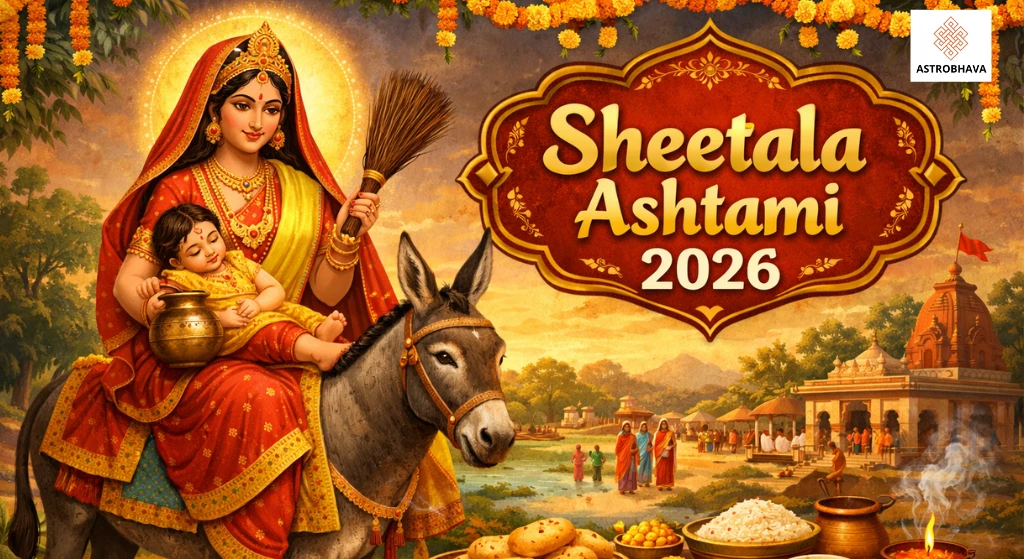
Visually, Maa Sheetala is a study in gentle power. She rides a humble donkey, symbolizing humility and the earth’s grounded energy. In one hand, she holds a broom (jhadu), representing the sweeping away of impurities and illnesses; in another, a fan (pankha) to soothe fevers; and often, a kalash (pot) of cool water or a winnowing basket (supari) filled with grains for prosperity. Her complexion is fair, adorned in simple red or white attire, with a crown of peacock feathers nodding to her royal yet accessible nature. Temples dedicated to her, like the famous one in Chandaun (Uttar Pradesh) or Mangal Mahadeva in Rajasthan, depict her flanked by Jwarasur (the demon of fever) at her feet, subdued by her grace.
Maa Sheetala’s lore spans ancient texts like the Skanda Purana and Markandeya Purana, where she’s invoked as Shitala Devi, the cooler of cosmic fires. In folk traditions, she’s the village guardian, invoked during outbreaks to restore harmony. For Sheetala Ashtami 2026, devotees see her as a beacon of hope—imagine her cool gaze upon your home, warding off the summer’s first sweltering waves.
But Maa Sheetala is more than mythology; she’s a life lesson. Her worship encourages hygiene, moderation in diet, and community care—timeless wisdom for 2026’s fast-paced world. Picture this: As you prepare for Sheetala Ashtami 2026, light a diya before her image and whisper your health intentions. Feel that chill of divine intervention? That’s her presence.
Legends and Stories: The Timeless Tales Behind Sheetala Ashtami 2026
The magic of Sheetala Ashtami 2026 lies in its stories—narratives passed down through generations that blend devotion with moral insight. These legends not only explain Basoda’s rituals but also deepen our emotional bond with Maa Sheetala. Let’s unravel a few, each a thread in the tapestry of this sacred day.
One of the most beloved tales from the Skanda Purana recounts how Goddess Parvati, distressed by the rampant spread of diseases caused by the demon Jvarasur (fever demon), transformed into Sheetala to restore balance. Riding her donkey, she descended to earth, her mere touch cooling the afflicted. Villages erupted in poxes until she swept them away with her broom, fanning relief with her pankha. A poor farmer, whose family lay dying, offered her a humble meal of cold rice—the first “Basoda” offering. In gratitude, she blessed him with eternal health. This story underscores Sheetala Ashtami 2026‘s essence: simple devotion trumps grandeur.
In Rajasthan’s Marwari folklore, another legend ties Basoda to a king’s hubris. King Bhoj, blinded by pride, ignored sanitation, leading to a plague. Maa Sheetala appeared in a dream, instructing him to observe Ashtami with cold baths and stale foods. He complied, and the kingdom was healed. Today, during Sheetala Ashtami 2026, Rajasthani families reenact this by sharing “basoda bhoj”—a no-cook feast—reminding us that humility cools the ego’s fever.
Bengali traditions offer the Oladevi story, where Sheetala emerges from Ganga’s waters to cure a child’s measles, teaching that purity (cold water rituals) dissolves impurity. Across India, these tales converge on themes of surrender: No fire on Basoda symbolizes quenching inner turmoil.
The Cosmic Significance of Sheetala Ashtami 2026: Aligning with the Stars
Every Sheetala Ashtami carries unique astrological vibes, but Sheetala Ashtami 2026 promises amplified healing energies. Falling on a Wednesday (Budhvar), ruled by Mercury—the planet of intellect and communication—this day enhances mental clarity alongside physical wellness. The muhurat from 6:36 AM to 6:27 PM aligns with the moon’s waning phase, ideal for releasing toxins and inviting Sheetala’s cool prana.
Astrologically, 2026’s Chaitra Ashtami sees Jupiter’s benevolent gaze from Taurus, fostering growth in health sectors. For those with afflicted health houses in their charts, Sheetala Ashtami 2026 is a remedial powerhouse—performing puja can mitigate Rahu-Ketu doshas linked to sudden illnesses. In Vedic terms, it’s a time when Sheetala’s energy neutralizes Pitta imbalances, perfect for summer prep.
Sheetala Saptami vs. Sheetala Ashtami: Key Differences for 2026
Here’s a sharpened take on these back-to-back festivals honoring Maa Sheetala. Both fall in Chaitra Krishna Paksha, post-Holi, with overlapping rituals (no cooking, cold baths, stale-food offerings). But Saptami (7th tithi) is the gentle opener, while Ashtami (8th) is the full Basoda crescendo. Confirmed for 2026: Saptami on Tuesday, March 10; Ashtami on Wednesday, March 11.
Concise Comparison Table
| Aspect | Sheetala Saptami (March 10, 2026) | Sheetala Ashtami/Basoda (March 11, 2026) |
| Lunar Day | 7th (Saptami) – Prep for cooling inner heat | 8th (Ashtami) – Peak protection from epidemics |
| Muhurat | 6:37 AM–6:26 PM (11h 50m) | 6:36 AM–6:27 PM (11h 51m) |
| Focus | Personal detox; mild fast, home sweep, simple naivedya (curd rice) | Community healing; strict no-fire, family feasts (mathri, lassi), jhoola swings in Rajasthan |
| Legend Tie | Initial defeat of Jwarasura (fever demon) | Full manifestation to cool Shiva’s fiery drop |
Why the Distinction Matters
Saptami builds subtle energy—like a pre-Basoda neem bath to ease Pitta before summer hits our deserts—ideal for solo intentions. Ashtami amps it up with Marwari flair: Share “basoda bhoj” with neighbors, reenact legends via folk tunes. Observing both? Double the grace for health, humility, and harmony.
Preparing for Sheetala Ashtami 2026: Setting the Stage for Devotion
As Sheetala Ashtami 2026 approaches, preparation is key to a fulfilling Basoda. Start a week early: Cleanse your home thoroughly, as Maa Sheetala favors purity. Stock up on puja essentials—cold water, flowers, incense—and prepare the previous night’s meal: kachoris, mathris, or curd-based dishes, stored coolly.
Mentally, attune with daily chants of “Om Sheetala Devyai Namah.” For families, involve kids by crafting donkey motifs from clay— a fun way to teach legends. Regionally, Gujaratis add swing rituals (jhoola), while Punjabis incorporate bhangra-inspired dances post-puja.
This groundwork transforms Sheetala Ashtami 2026 from routine to revelation. Ever wondered how a simple cleanup ritual shifted your home’s vibe? Try it and tell us!
Sacred Chants: Sheetala Saptami Aarti
Here’s the full lyrics of Jai Sheetala Mata Aarti, transliterated in English:
Jai Sheetala Mata, Maiya Jai Sheetala Mata.
Aadi Jyoti Maharani, Sab Phal Ki Daata.
Om Jai Sheetala Mata…
Ratan Singhासन Shobhit, Shwet Chhatra Bhaata.
Riddhi-Siddhi Chavar Dolaaven, Jagmag Chhavi Chaata.
Om Jai Sheetala Mata…
Vishnu Sevat Charan Kamal, Brahma Bed Gaaven.
Shankar Dhyaavat Dhyaan Se, Ganesh Gauri Paaven.
Om Jai Sheetala Mata…
Kanak Kalash Sohe Haath, Sheetala Jal Bhari.
Kalpavruksh Adhirajni, Sab Kaamna Puri.
Om Jai Sheetala Mata…
Singhासन Gajendra Par, Virajat Sati Mata.
Singh Sahit Gauri Roopa, Sheetala Naam Dhaata.
Om Jai Sheetala Mata…
Mor Pankh Chavar Doli, Hiy Harshaavan Kare.
Bhakt Jan Man Harshit, Suman Maalya Barse.
Om Jai Sheetala Mata…
Jai Mata Di, Jai Mata Di.
Jai Sheetala Mata, Jai Mata Di.
Performing Rituals for Sheetala Ashtami 2026 with Astrobhava: Step-by-Step Guidance
The rituals of Sheetala Ashtami 2026 are a symphony of simplicity and sanctity, best performed with astrological insight from Astrobhava. Here’s a guide to Basoda observance, infused with cosmic timing for profound results:
- Pre-Dawn Awakening and Snan (Bath): Rise before sunrise on March 11, 2026. Take a cold-water bath using neem leaves or tulsi—symbolizing purification. Astrobhava tip: Align with Mercury’s hora (planetary hour) for mental detox. Chant “Om Hreem Sheetalaayai Namah” 108 times. Why it works: This cools Pitta dosha, inviting Maa’s immediate grace.
- Ghar Ki Safai (Home Cleansing): Sweep your space with a besom broom dipped in Gangajal. Discard clutter to “sweep away” negativities. With Astrobhava’s astro-guidance, visualize Rahu’s shadows dissolving—ideal for 2026’s Jupiter transit.
- Idol Sthapana (Installation): Set up Maa Sheetala’s image or kalash on a clean altar facing east. Adorn with white flowers, apply chandan tilak, and light a ghee diya (no fire for cooking). Pointer: Offer a fan and pot of cool water. Astrobhava enhancement: Personalize with your sankalpa (vow) for health-specific remedies.
- Puja Vidhi (Worship Sequence): Recite the Sheetala Ashtami Stotra while offering fruits, curd, and stale sweets (no hot prasad). Circle the altar seven times, fanning gently. For Sheetala Ashtami 2026, time it within muhurat for amplified vibrations. Interactive twist: Play devotional bhajans—pause and reflect: What “fever” in your life needs cooling?
- Vrat and Bhojan (Fasting and Feast): Observe a light fast till sunset; break with cold foods like lassi and pakoras from the night before. Share with neighbors to spread blessings.
- Visarjan and Aarti (Immersion and Closing): Conclude with evening aarti using a hand fan instead of flames. Immerse intentions in flowing water. Post-ritual, journal gratitudes—Astrobhava journals available for deeper tracking.
Regional Flavors of Basoda: Celebrating Sheetala Ashtami 2026 Across India
Sheetala Ashtami 2026 isn’t monolithic; it’s a mosaic of traditions. In Rajasthan, Basoda means elaborate swings for Maa’s idol, with women in ghagra-cholis singing “Sheetala Mata ki Aarti.” Punjab adds langar-style community meals, emphasizing equality in healing.
Uttar Pradesh’s Mathura temples host midnight processions, while Bengal’s Olabibi Mela features terracotta idols. In Gujarat, it’s “Sheetala Saptami” extended, with garba under moonlight. These variations highlight universality—Sheetala Ashtami 2026 unites us in coolth.
Which regional ritual excites you for 2026? Comment your heritage’s twist—we’d love to feature reader stories!
Conclusion: Cooling into a Blessed 2026 with Sheetala Ashtami
As we wrap up this exploration of Sheetala Ashtami 2026 and Basoda, remember: This festival isn’t just about warding off diseases; it’s a portal to holistic harmony. From Maa Sheetala’s legends to the broom-swept rituals, every element invites us to cool our inner fires—ego, stress, imbalance—and emerge renewed. On March 11, 2026, let her grace envelop you, promising a year of vibrant health and serene joy.
Whether through home pujas or Astrobhava’s cosmic homams, your devotion matters. Step forward with faith; the cooling winds of Basoda await. Jai Maa Sheetala!
FAQs: Your Sheetala Ashtami 2026 Queries Answered
Q: When is Sheetala Ashtami 2026?
A: It falls on Wednesday, March 11, 2026, with puja muhurat from 6:36 AM to 6:27 PM.
Q: What is the difference between Sheetala Ashtami and Basoda?
A: They’re the same festival! Basoda is the Rajasthani/Marwari name, emphasizing family feasts.
Q: Can I perform Sheetala Ashtami rituals at home for 2026?
A: Absolutely! Follow the pointers above. For astro-aligned guidance, book with Astrobhava.
Q: Why no cooking on Sheetala Ashtami 2026?
A: It symbolizes cooling energies, preventing “hot” diseases. Prepare meals the night before.
Q: What if I miss the muhurat on March 11?
A: Evening observances still hold merit. Astrobhava offers remedial pujas post-festival.
Q: Are there benefits for children during Basoda 2026?
A: Yes—protection from seasonal illnesses. Include them in idol decoration for engagement.
Q: How do I book a Sheetala Homam?
A: Visit Astrobhava for seamless scheduling tailored to 2026.