“Ramo vigrahavan dharmah” — Rama is dharma personified.
He is not merely a king or warrior; he is the ideal that humanity reaches toward.
— Valmiki Ramayana
In the vast tapestry of Hindu dharma, few names resonate with the same depth, devotion, and cultural resonance as Lord Rama. For millions of Hindus across the world, Rama is not a mythological figure confined to ancient texts — he is a living presence, a spiritual ideal, and the very embodiment of righteousness, compassion, and moral perfection. But who exactly is Lord Rama? Why is he revered as the 7th avatar of Lord Vishnu? And what does his timeless story teach us about life, duty, and devotion?
This blog takes you through everything you need to know — from Rama’s divine origins and his extraordinary story in the Ramayana, to the spiritual significance of his fourteen virtues and the power of Rama worship in your own life.
 Who is Lord Rama? — The Divine Identity
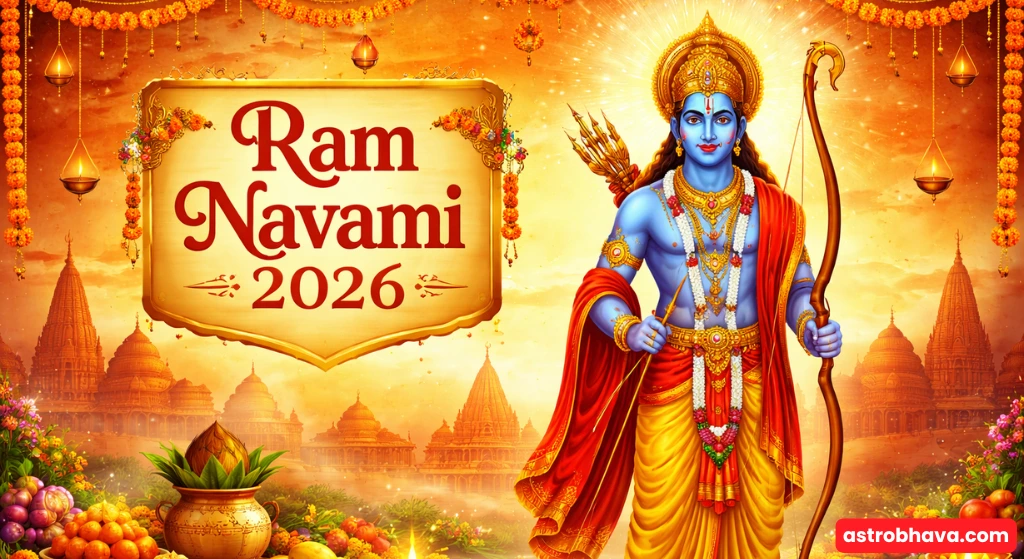
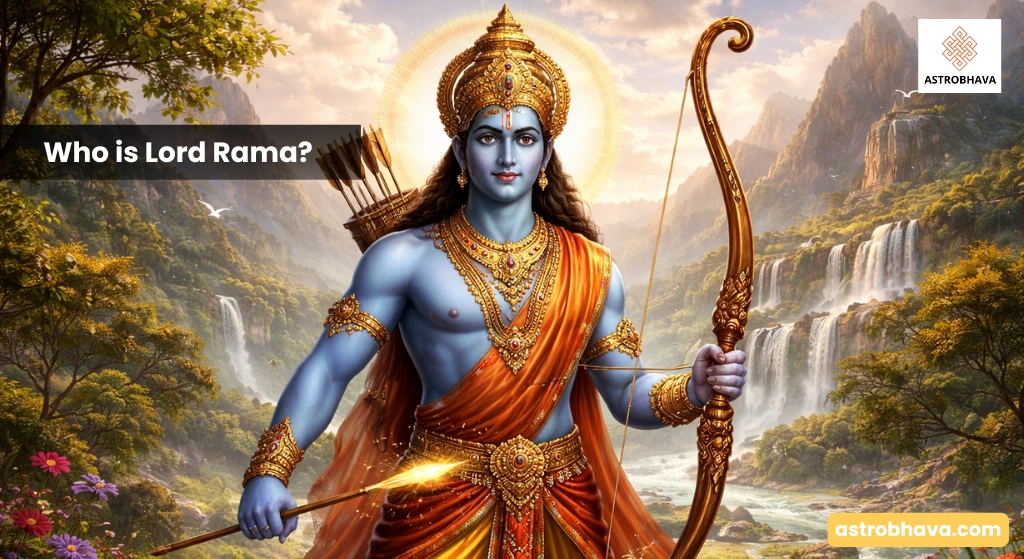
Lord Rama, also written as Ram or Shri Ram, is the seventh incarnation (avatar) of Lord Vishnu — the supreme preserver deity of the Hindu Trinity. Unlike many divine incarnations, Rama descended to earth not as an omnipotent being flexing cosmic power, but as a fully human king, bound by human limitations, love, grief, and duty. This is the profound beauty of Rama’s avatar: he shows humanity how to live — not how gods transcend it.
Rama was born in Treta Yuga, the second of the four cosmic ages, in the ancient kingdom of Ayodhya (present-day Uttar Pradesh, India) to King Dasharatha and Queen Kaushalya. He is revered in the Hindu tradition as Maryada Purushottam — literally, “the best among men who upholds all limits and boundaries.” His life, as narrated in the epic Ramayana composed by sage Valmiki, is the gold standard of ethical and righteous living.
🌟 Lord Rama — At a Glance
| Attribute | Details |
| Full Name | Rama (Ramachandra) |
| Divine Identity | 7th Avatar of Vishnu |
| Birthplace | Ayodhya, Kosala Kingdom |
| Era / Yuga | Treta Yuga |
| Parents | King Dasharatha & Queen Kaushalya |
| Consort | Sita (Daughter of Janaka) |
| Brothers | Lakshmana, Bharata, Shatrughna |
| Key Allies | Hanuman, Sugriva, Vibhishana |
| Symbols | Blue lotus, bow & arrow |
| Birth Tithi | Chaitra Navami (Ram Navami) |
Listen to the latest podcast on 3 Rama Rituals that can change your life.
Why Did Vishnu Take the Rama Avatar?
According to the Valmiki Ramayana and the Bhagavata Purana, the demon king Ravana had performed intense penances and obtained a boon from Lord Brahma that made him virtually invincible to gods, demons, and celestial beings. However, in his arrogance, Ravana had not asked for protection from humans — considering them too weak to be a threat.
Ravana’s tyranny had thrown the three worlds into chaos. The gods, celestial sages, and rishis cried out to Lord Vishnu for deliverance. Vishnu, the compassionate preserver, pledged to incarnate as a human — Rama, son of King Dasharatha — and use that very human vulnerability to destroy the demon king. Thus the purpose of the Rama avatar was twofold: to eliminate the evil of Ravana, and to demonstrate to all of humanity how to live a life of perfect righteousness.
The Full Story of Lord Rama — Key Chapters of the Ramayana
The Ramayana is composed of approximately 24,000 verses spread across seven Kandas (chapters). Here is the complete arc of Rama’s journey, covering all the most significant episodes:
Birth & Childhood in Ayodhya (Bala Kanda)
Born on the auspicious Chaitra Navami to King Dasharatha through the Putrakameshti Yajna performed by sage Rishyashringa, Rama and his three brothers — Lakshmana, Bharata, and Shatrughna — grew up in the royal court of Ayodhya. From childhood, Rama displayed extraordinary virtue, calm intellect, and archery skills. He was educated under sage Vasishtha, one of the Saptarishis.
Defeating Demons & Winning Sita (Bala Kanda continued)
At the request of sage Vishwamitra, young Rama and Lakshmana protected the yajna forest from demonesses Tadaka and Subahu. Vishwamitra then took them to Mithila, the kingdom of King Janaka. There, Rama effortlessly lifted and strung the divine bow of Lord Shiva — Pinaka — which no king or warrior had been able to even move. By breaking this bow, Rama won the hand of the virtuous Sita in a swayamvara.
Exile to the Forest — 14 Years (Ayodhya Kanda)
Just as Rama was about to be crowned king of Ayodhya, his stepmother Kaikeyi invoked two boons granted by Dasharatha long ago: the throne for her son Bharata, and 14 years of forest exile for Rama. Without hesitation, Rama accepted his exile with a smile — the image of perfect filial obedience and acceptance of fate. Sita and Lakshmana voluntarily accompanied him. King Dasharatha, heartbroken, died of grief in Rama’s absence.
Life in the Forest & Abduction of Sita (Aranya Kanda)
Living as forest ascetics, Rama, Sita, and Lakshmana encountered sages, demons, and celestial beings. The demoness Shurpanakha, Ravana’s sister, fell for Rama and was disfigured by Lakshmana after she threatened Sita. Enraged, Ravana plotted revenge. He sent the demon Maricha disguised as a golden deer to lure Rama away, then abducted Sita and carried her to his island-kingdom of Lanka. The vulture king Jatayu tried to stop Ravana and was mortally wounded.
Search for Sita & Alliance with Sugriva (Kishkindha Kanda)
Rama and Lakshmana searched desperately through the forests, meeting the dying Jatayu, and eventually reaching Kishkindha — the kingdom of the Vanaras (monkey people). Here, Rama helped the exiled Vanara king Sugriva defeat his brother Vali (who had wrongfully exiled him) in exchange for Sugriva’s army to help find Sita. It was through Sugriva’s general, the great Hanuman, that Rama’s search found its direction.
Hanuman’s Leap to Lanka — Sundara Kanda
The most beloved section of the Ramayana, Sundara Kanda narrates Hanuman’s extraordinary journey. He leapt across the ocean to Lanka, found Sita imprisoned in the Ashoka grove, delivered Rama’s ring as a token, and set Lanka ablaze with his burning tail. He returned with the proof that Sita was alive and faithful, filling Rama’s heart with hope and determination.
The Great War & Defeat of Ravana (Yuddha Kanda)
Rama’s Vanara army built a miraculous bridge — Ram Setu — across the ocean to Lanka. An epic 10-day battle followed, where Rama and Lakshmana faced Ravana’s finest warriors including Kumbhakarna and Indrajit (Meghanada). Finally, Rama confronted Ravana directly. With the divine Brahmastra arrow, Rama pierced Ravana’s navel — the secret of his immortality — and slew him. Sita was reunited with Rama after passing the test of fire (Agni Pariksha). The triumphant army returned to Ayodhya on the Pushpaka Vimana as the 14-year exile ended.
Coronation & Ram Rajya (Uttara Kanda)
Rama’s return to Ayodhya on the new moon night of Kartika was celebrated with millions of lamps — the origin of Diwali. Rama was crowned king and the era of Ram Rajya — a golden age of justice, prosperity, and dharma — began. His reign became the archetype of ideal governance: where no subject suffered, and dharma reigned supreme.
Book a sacred Rama Nama Japa performed by expert pandits — purify your karma & invite peace.→
The 14 Virtues of Lord Rama — Why He is Maryada Purushottam
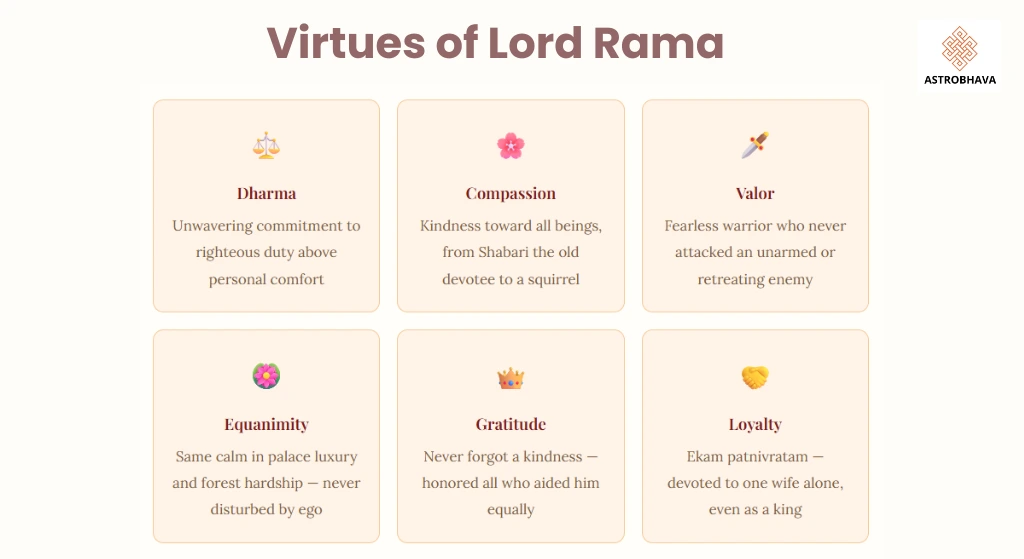 The 14 Virtues of Lord Rama — Why He is Maryada Purushottam
When sage Narada asked Valmiki who on earth possessed all sixteen noble virtues, Valmiki described Rama as the only being who combined all of them. The Valmiki Ramayana opens with a list of Rama’s supreme qualities that make him the “best among those who uphold dharma.” Among the most celebrated:
⚖️
Dharma
Unwavering commitment to righteous duty above personal comfort
🌸
Compassion
Kindness toward all beings, from Shabari the old devotee to a squirrel
🗡️
Valor
Fearless warrior who never attacked an unarmed or retreating enemy
🪷
Equanimity
Same calm in palace luxury and forest hardship — never disturbed by ego
👑
Gratitude
Never forgot a kindness — honored all who aided him equally
🤝
Loyalty
Ekam patnivratam — devoted to one wife alone, even as a king
Rama and Sita — The Ideal of Sacred Partnership
Perhaps the most spiritually significant relationship in the Ramayana is that of Rama and Sita. Sita is not merely Rama’s queen — she is his Shakti, his divine feminine counterpart. Born from the earth itself (she was discovered in a ploughed furrow by King Janaka), Sita embodies the qualities of purity, patience, and fierce devotion.
Together, Rama and Sita represent the divine masculine and feminine principles in perfect harmony — Purusha and Prakriti. Their love story is not just romantic; it is a cosmic pairing where neither is complete without the other. Hindu tradition holds that worshipping Rama without invoking Sita’s name is incomplete — the salutation “Jai Siya Ram” always pairs them together.
Hanuman — The Greatest Devotee of Lord Rama
No discussion of Lord Rama is complete without acknowledging Hanuman — the vanara warrior son of the wind god Vayu, and the supreme devotee of Rama. Hanuman is often described as the ideal bhakta (devotee), whose entire existence was dedicated to the service of Rama.
Hanuman is said to remain present wherever the name of Rama is chanted. The Hanuman Chalisa by Tulsidas remains one of the most recited devotional texts in the world, and devotees believe that chanting Rama’s name in Hanuman’s presence multiplies the blessings manifold. Hanuman demonstrated that pure, selfless devotion to Rama can grant a mortal being attributes exceeding even the gods.
Seek the divine blessings of Lord Hanuman- Book Hanuman Homa Now
Ram Navami — The Sacred Birthday of Lord Rama
Ram Navami falls on the ninth day (Navami) of Chaitra month in the Hindu calendar — typically in March or April. It is observed with fasting, singing of devotional hymns (bhajans), recitation of the Ramayana, and grand temple celebrations across India and the world. The day marks not just Rama’s physical birth but the descent of divine righteousness into the world.
In South India, Ram Navami coincides with the auspicious period of Chaitra Navaratri. Thousands of temples — from the grand Ram temple of Ayodhya to small shrines in villages — mark this day with abhishekam, processions, and communal feasting.
Diwali and the Return of Lord Rama
The most celebrated Hindu festival, Diwali (the Festival of Lights), commemorates the return of Lord Rama to Ayodhya after 14 years of exile and his victory over Ravana. According to tradition, the people of Ayodhya lit rows of oil lamps (diyas) to welcome their beloved king home in the dark new moon night of Kartika month. This tradition continues every year — millions of lights symbolizing the victory of truth over falsehood, light over darkness, and good over evil — themes that Rama’s life embodies completely.
Ram Setu — The Bridge That Changed the Ocean
Ram Setu (also called Adam’s Bridge) is a chain of limestone shoals between India and Sri Lanka, which Hindu tradition identifies as the bridge built by Rama’s Vanara army to cross to Lanka. The Valmiki Ramayana describes how the Vanara engineers Nala and Nila used their divine boon to make stones float on water. This bridge, built in a miraculous five days, remains one of the most debated archaeological and mythological topics in South Asian scholarship.
The Spiritual Significance of Lord Rama’s Name
In the devotional tradition, especially within the Bhakti movement of medieval India, the very name “Rama” is considered a bija mantra (seed mantra) of extraordinary power. Saint Tulsidas composed the celebrated Ramcharitmanas in the 16th century, making Rama’s story accessible to everyday people in vernacular Hindi.
The word “Rama” is sometimes analyzed as composed of the seed sounds of two powerful mantras: Ra from Om Namah Shivaya and Ma from Om Namo Narayanaya. This is why the Ramanama is considered a bridge between the Shaiva and Vaishnava traditions of Hinduism. Mahatma Gandhi’s last words were said to be “Hey Ram” — a testament to Rama’s place at the very center of India’s spiritual identity.
How to Worship Lord Rama — Rituals & Practices
Worshipping Lord Rama is accessible to everyone, regardless of circumstance. Here are the most common devotional practices associated with Rama bhakti:
Daily Chanting: Recite the Rama Raksha Stotra, Rama Ashtakam, or simply “Jai Shri Ram” or “Sri Rama Jaya Rama Jaya Jaya Rama” 108 times with a tulsi mala.
Reading the Ramayana: Reading or listening to the Valmiki Ramayana or Tulsidas’s Ramcharitmanas, especially on Tuesdays, Saturdays, and Ram Navami, is considered highly auspicious.
Rama Puja: A formal puja to Rama involves offering blue lotus flowers, tulsi leaves, yellow sandal paste, fruits, and lighting a ghee lamp while chanting the Rama Ashtottara (108 names of Rama).
Rama Homa: A sacred fire ritual (yajna) performed by trained priests, invoking Rama’s divine presence to bless specific intentions — overcoming obstacles, seeking protection, or purifying negative karma.
Rama Japa: The systematic recitation of Rama’s name — either personally or through priests — often performed in multiples of 108, 1008, or even a crore (10 million) repetitions for specific blessings.
Conclusion
Lord Rama is far more than a character in an ancient epic. He is the living ideal of what a human being can aspire to be — a perfect son, devoted husband, compassionate king, and fearless warrior in the service of dharma. His story has shaped the moral imagination of an entire civilization for thousands of years. Whether you encounter Rama in a temple, in the words of a bhajan, or in the quiet lighting of a lamp on Diwali night, you are touching a spiritual current that runs to the very heart of human longing for goodness. Chant his name. Seek his blessings. And discover the Rama that lives within you.
🙏 Jai Shri Ram
Frequently Asked Questions
Why is Rama called seventh Avatar of Vishnu?
According to the Dashavatara (ten principal avatars of Vishnu), Rama is the seventh: Matsya, Kurma, Varaha, Narasimha, Vamana, Parashurama, then Rama. He descended in the Treta Yuga specifically to defeat the demon king Ravana who had obtained a boon of invincibility against gods and celestials but had not sought protection from humans — making Rama’s human incarnation the perfect solution.
Are Lord Ram and Lord Krishna the same?
Both Rama (7th avatar) and Krishna (8th avatar) are incarnations of Vishnu, but they represent different aspects of the divine. Rama is Maryada Purushottam — the upholder of boundaries, dharma, and perfect conduct. He follows all societal and ethical rules even at personal cost. Krishna, on the other hand, is Leela Purushottam — the divine player, who sometimes transcends conventional dharma to serve a higher purpose. Rama’s story is primarily about duty; Krishna’s is about ultimate surrender and devotion (bhakti).
When is Rama Navami Celebrated and why?
Ram Navami falls on the ninth day (Navami tithi) of the bright fortnight of Chaitra month — usually in March or April. It marks the birth anniversary of Lord Rama. Celebrations include fasting, reading of the Ramayana, bhajans, abhishekam of Rama’s idol, and grand processions. It falls during Chaitra Navaratri and is one of the most important Vaishnava festivals of the year.
What is the significance of chanting Jai Shri Ram?
The name “Rama” is considered a Taraka mantra — a mantra that carries one across the ocean of worldly existence. Saint Tulsidas declared that the name of Rama is greater than even Brahman himself because the name, accessible to all, contains the essence of all spiritual practice. Chanting “Jai Shri Ram” is believed to purify the mind, ward off negative energies, and invoke Rama’s protective grace. It is also a traditional greeting and affirmation of divine presence in everyday life.
What are the benefits of Rama Puja or Homa?
Devotional tradition holds that Rama Puja, Homa (fire ritual), and Japa are performed to seek Rama’s blessings for specific life intentions: overcoming long-standing obstacles or enemies, restoring harmony in family relationships, seeking justice in legal matters, purifying karmic debts, and obtaining the general grace of dharma in one’s life. These rituals are especially recommended during Ram Navami, Tuesdays, and Saturdays when Rama’s energy is considered most accessible.
Is Lord Hanuman connected to Lord Rama?
Absolutely. Hanuman is inseparable from Rama in devotional practice. Hindu tradition holds that wherever Rama’s name is chanted, Hanuman is present. Many devotees first pray to Hanuman before approaching Rama, as Hanuman is considered the ideal intermediary — the devotee’s devotee. The Hanuman Chalisa, Ramacharitmanas readings, and most Rama temples feature Hanuman prominently. Worshipping Hanuman is itself considered a direct way to reach Rama.