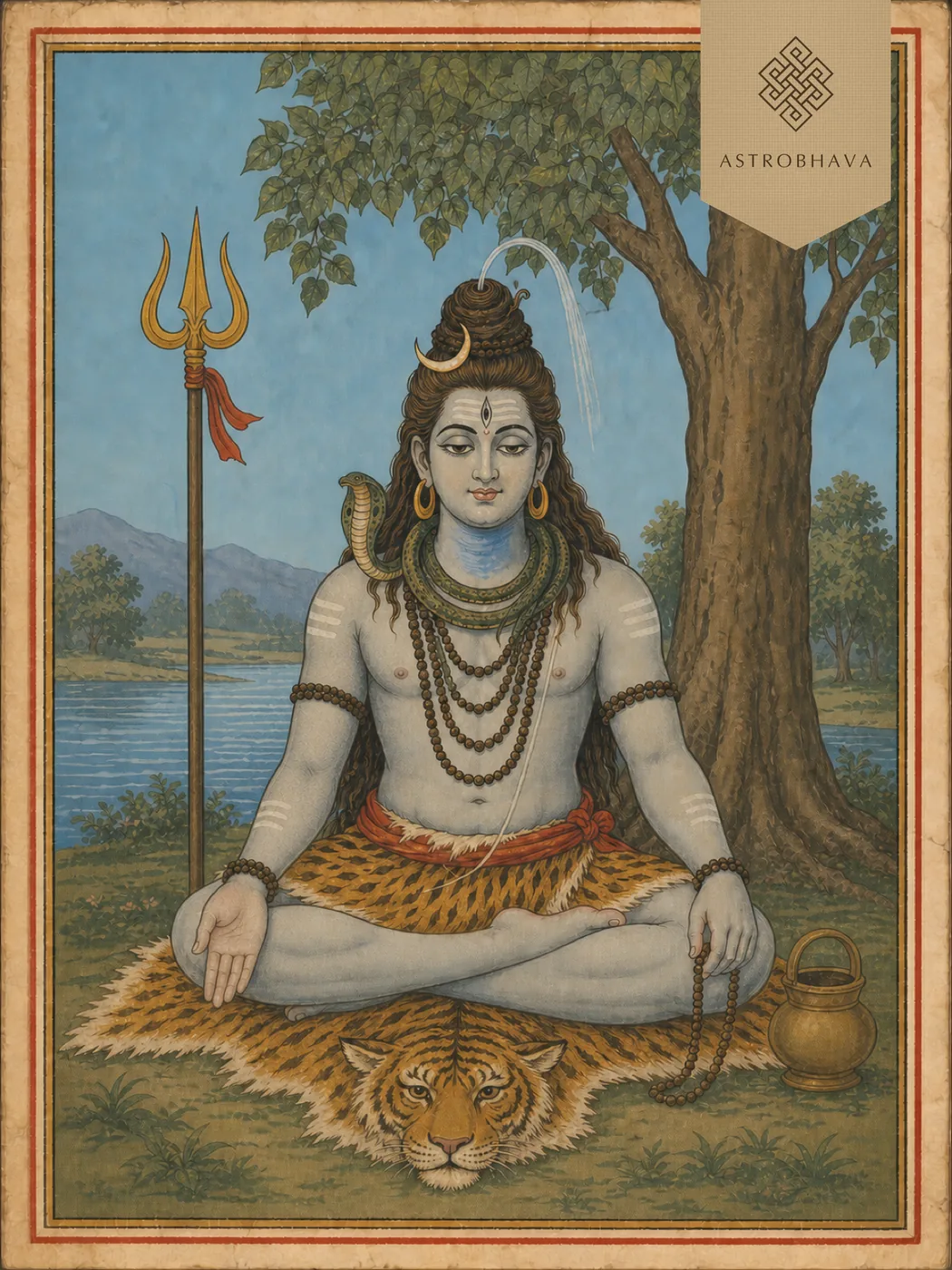
Mrityunjaya Trayambakam Mantra
ॐ त्र्यम्बकं यजामहे सुगन्धिं पुष्टिवर्धनम् उर्वारुकमिव बन्धनान्मृत्योर्मुक्षीय माऽमृतात्In Devanagari, Tamil, Telugu, Kannada, Malayalam and English — with the meaning of every word, and the one syllable most people pronounce wrongly.
Who Mrityunjaya Trayambakam is
Mrityunjaya is the specific epithet of Śiva as conqueror of death, addressed through the ancient Tryambaka formula preserved in the Ṛgveda. He is the three-eyed lord whose single upward-turned eye is said to survey the three times, the three worlds and the three guṇas simultaneously. In classical Śaiva literature this form is distinguished from Naṭarāja, Dakṣiṇāmūrti or Ardhanārīśvara by its exclusive association with the release from the noose of Yama. Iconographically Mrityunjaya may appear seated in a posture of serene defiance, one hand raised in abhaya while the other holds the vessel of amṛta, or simply as the liṅga continuously bathed during the recitation of the three-eyed verse. The name itself fuses mṛtyu and jaya, yet the deity is never presented as a mere banisher of physical end; rather he is the presence that reorders the devotee’s standing before mortality. Tradition places him at the heart of the Markaṇḍeya episode and of every later Śaiva meditation on the boundary between the finite and the deathless.
Markaṇḍeya and the noose
The narrative most closely bound to Mrityunjaya appears in the Skanda Purāṇa and the Śiva Purāṇa. The boy sage Markaṇḍeya, destined to die at sixteen, continues his worship of the Śiva-liṅga even as Yama’s noose settles around his neck. When the lord of death attempts to drag both boy and liṅga together, Śiva emerges from the liṅga in the fierce yet protective form later called Mrityunjaya, strikes Yama unconscious and declares that the devotee’s life is henceforth measureless. The same episode is alluded to in the Mahābhārata’s Anuśāsana Parvan, where the three-eyed lord is praised as the one who loosened the bonds of time for the young ṛṣi. The Ṛgvedic mantra itself (7.59.12) is older than these Purāṇic tellings; it was already known to the Śākala school as a verse addressed to Tryambaka, the three-eyed one, and later Śaiva commentators simply identified that Vedic deity with the Mrityunjaya who rescued Markaṇḍeya. Thus the myth and the mantra converge upon a single figure: the lord who stands between the cucumber slipping from its vine and the soul slipping from its mortal frame.
The mantra, in six scripts
The seed mantra, and the form most devotees chant daily. No initiation is required — it is open to anyone, including a parent chanting for a child.
- ॐ
- oṃ — the sacred syllable
- त्र्यम्बकं
- tryambakaṃ — the three-eyed one
- यजामहे
- yajāmahe — we worship
- सुगन्धिं
- sugandhiṃ — the fragrant
- पुष्टिवर्धनम्
- puṣṭivardhanam — increaser of nourishment
- उर्वारुकम्
- urvārukam — a cucumber
- इव
- iva — like
- बन्धनान्
- bandhanān — from the stalk / bondage
- मृत्योः
- mṛtyoḥ — from death
- मुक्षीय
- mukṣīya — may I be released
- मा
- mā — not
- अमृतात्
- amṛtāt — from the deathless
The syllable people get wrong
In tryambakaṃ the opening conjunct trya compresses t, r and y before the vowel a; speakers commonly insert an epenthetic i and pronounce triyambakaṃ, splitting the compact Vedic cluster into an extra syllable that the original ṛgvedic metre cannot accommodate and that obscures the deity’s very name.
When Mrityunjaya Trayambakam is chanted
Festival. Mahāśivarātri
Questions
Have your chart read before you decide
Chanting is yours to do, and free. But which deity your situation calls for — and whether a mantra alone is the right response — depends on your chart. Sometimes it is; sometimes it is not.
- Over 30 years in the Guru–Sishya Parampara, from the age of five
- He reads every chart himself — 60 minutes, one to one, never delegated
- Charts are read only between sunrise and sunset, following tradition
Related
Chanting is yours to do. Some things are performed for you.
Where a matter carries real weight — an examination that decides a course, a performance, a child whose studies have stalled — devotees sponsor the homa alongside their own practice. Performed for you and any family members you name, at our Yagna Ashram, in your name and gotra, on a muhurta calculated from your chart, and telecast live so you can watch it done for you.