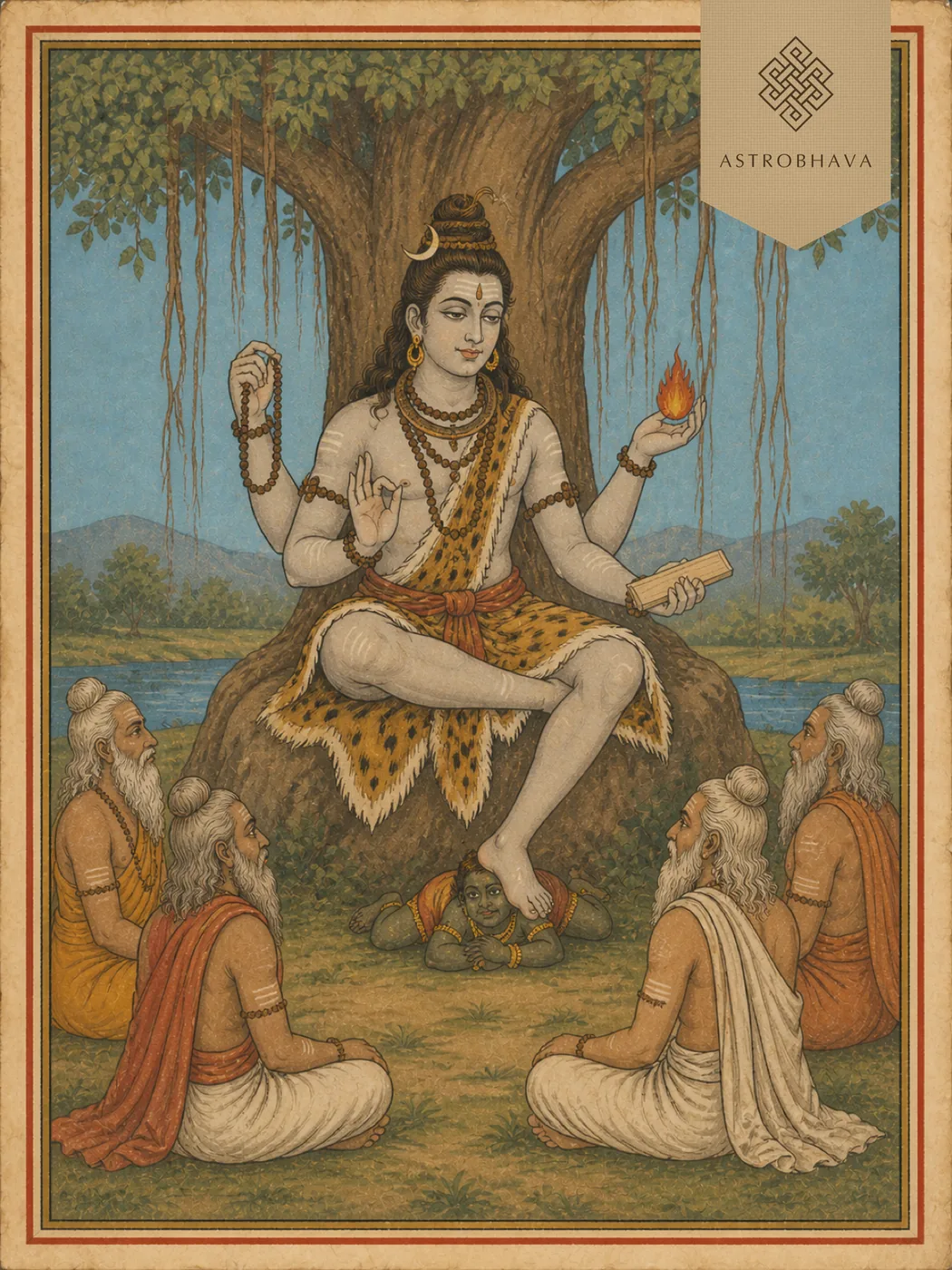
Guru Mantra
गुरुर्ब्रह्मा गुरुर्विष्णुर्गुरुर्देवो महेश्वरः । गुरुः साक्षात्परं ब्रह्म तस्मै श्रीगुरवे नमः ॥In Devanagari, Tamil, Telugu, Kannada, Malayalam and English — with the meaning of every word, and the one syllable most people pronounce wrongly.
Who Guru Mantra is
The Guru is the living conduit through whom the formless Brahman becomes audible and visible to the disciple. Neither a mere instructor nor a distant deity, the Guru is regarded as the condensed presence of the trimurti—Brahma who generates knowledge, Vishnu who preserves it, and Shiva who dissolves ignorance. In the Guru Gita and the traditional stotras the Guru is declared identical with the supreme reality yet remains approachable in human form. The relationship is therefore one of direct transmission: the disciple’s mind is refined in the presence of the teacher exactly as metal is purified in fire. Reverence offered to the Guru is understood as reverence offered to the entire lineage that stretches back to the primordial seers.
The Guru as Trimurti
The Guru Gita, presented as a dialogue between Shiva and Parvati in the Skanda Purana, establishes the theological ground of this mantra. Parvati asks how the supreme reality can be known. Shiva replies that the Guru alone reveals it, for the Guru is none other than Brahma, Vishnu, and Maheshvara in a single embodied grace. The text continues that the syllable gu denotes darkness and ru its dispersal; thus the Guru is the very act of removing obscurity. Later verses equate the dust of the Guru’s feet with the waters of all sacred rivers and the sight of the Guru with the vision of the twelve Jyotirlingas. The mantra itself crystallises this teaching into a compact salutation, affirming that the teacher is not a representative of the gods but their simultaneous presence, and finally the unqualified Brahman itself. The tradition therefore places the living Guru at the centre of spiritual life without diminishing the transcendent absolute.
The mantra, in six scripts
The seed mantra, and the form most devotees chant daily. No initiation is required — it is open to anyone, including a parent chanting for a child.
- गुरुर्
- gurur — the Guru (is)
- ब्रह्मा
- brahmā — Brahma
- गुरुर्
- gurur — the Guru (is)
- विष्णुर्
- viṣṇur — Vishnu
- गुरुर्
- gurur — the Guru (is)
- देवो
- devo — the divine
- महेश्वरः
- maheśvaraḥ — Maheshvara
- गुरुः
- guruḥ — the Guru
- साक्षात्
- sākṣāt — in direct presence
- परं
- paraṃ — the supreme
- ब्रह्म
- brahma — Brahman
- तस्मै
- tasmai — to that
- श्रीगुरवे
- śrīgurave — radiant Guru
- नमः
- namaḥ — salutation
The syllable people get wrong
In sākṣāt the conjunct kṣā must be a single retroflex-palatal burst followed by long ā. It is commonly split into “sak-shaat” or softened to “saaksaat,” losing both the compact cluster and the proper length of the vowel that carries the sense of immediacy.
When Guru Mantra is chanted
Festival. Guru Purnima
Questions
Have your chart read before you decide
Chanting is yours to do, and free. But which deity your situation calls for — and whether a mantra alone is the right response — depends on your chart. Sometimes it is; sometimes it is not.
- Over 30 years in the Guru–Sishya Parampara, from the age of five
- He reads every chart himself — 60 minutes, one to one, never delegated
- Charts are read only between sunrise and sunset, following tradition
Related
Chanting is yours to do. Some things are performed for you.
Where a matter carries real weight — an examination that decides a course, a performance, a child whose studies have stalled — devotees sponsor the homa alongside their own practice. Performed for you and any family members you name, at our Yagna Ashram, in your name and gotra, on a muhurta calculated from your chart, and telecast live so you can watch it done for you.