Sahasra Chandra Darshan: the day of your thousand full moons
The date of the thousandth full moon since birth — the day of Sahasra Chandra Darshan — with the age it falls at, and the dates of Shashtipoorthi, Bhimaratha Shanti and Sathabhishekam on the way.
Enter the date of birth
Your own, or a parent’s or grandparent’s, to plan the celebration.
Registered before? Your saved profiles fill this form in one tap. New here? Your details can be saved for all 32 tools.
What is Sahasra Chandra Darshan?
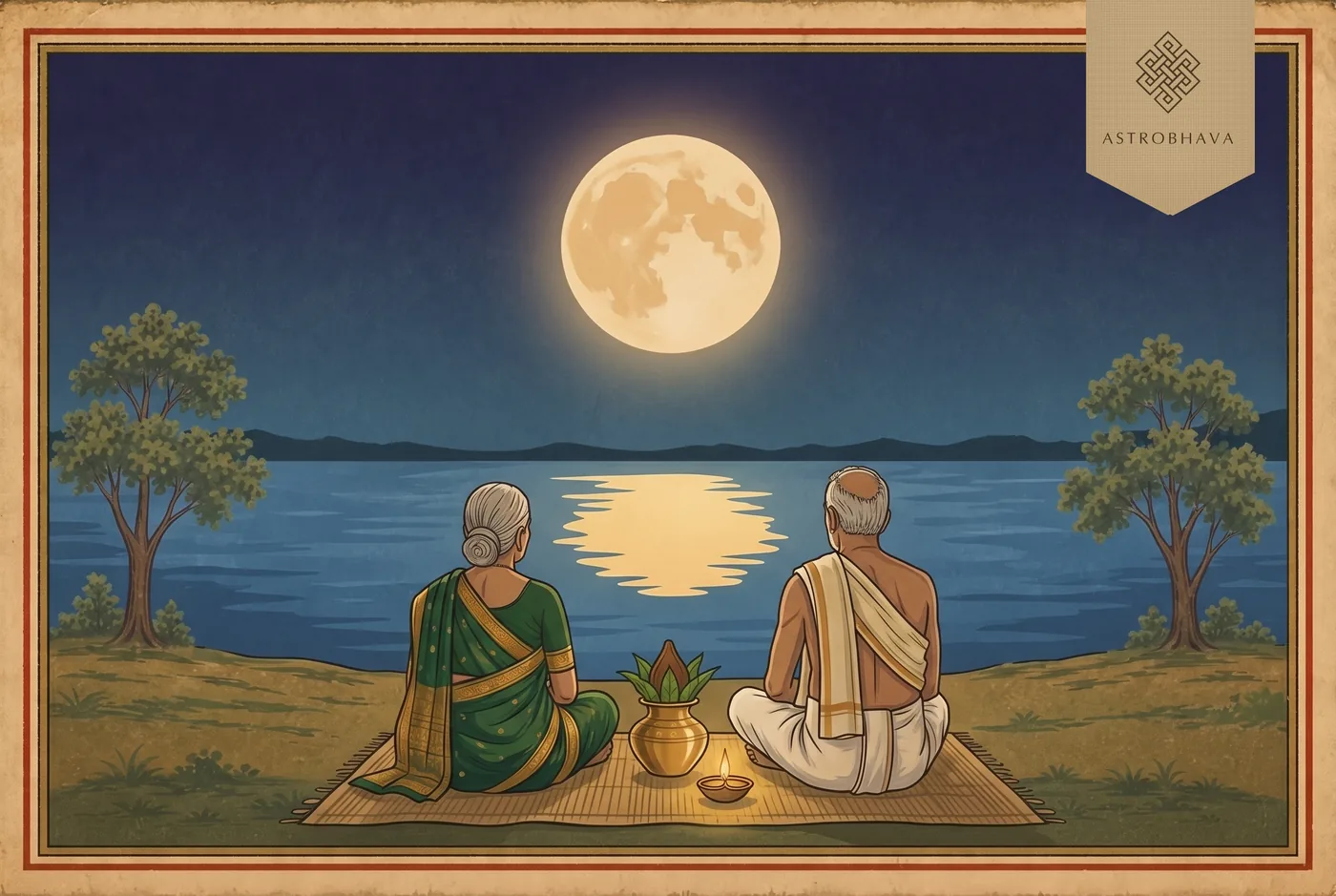
Sahasra Chandra Darshan — also called Sahasra Purna Chandrodaya Shanti — is the shanti held when a person has seen a thousand full moons: a thousand lunar months, about 80 years and 9 to 10 months of life. It gives thanks for a long life and asks for health and peace in the years that remain, and it is usually arranged by the children and grandchildren, for the couple together.
How the thousand full moons are counted
The count begins with the first full moon after the day of birth and takes every full moon — the instant the Moon stands opposite the Sun — to the thousandth. Because the lunar month varies by a few hours, the date is found exactly, not by adding years.
An example: born on 6 October 1945, the first full moon came on 21 October 1945, and the thousandth falls on 29 July 2026, at 9:36 AM — at 80 years and 9 months.
Shashtipoorthi, Bhimaratha Shanti, Sathabhishekam and Sahasra Chandra Darshan
The milestone shantis, and when tradition keeps each. Regions differ, and where they do the table says so; the calculator gives every date.
| Shanti | When | What it marks |
|---|---|---|
| Ugraratha Shanti | 59 years completed | The threshold of the sixtieth year. |
| ShashtiabdapoorthiShashtipoorthi | 60 years completed | One full cycle of sixty years, kept in the birth month on the birth star of the sixty-first year. |
| Bhimaratha Shanti | 70 years77 years, 7 months, 7 days in Karnataka | The seventieth year of a long life. |
| Sathabhishekam | 80 years completed | The eightieth birthday, on the birth star. |
| Sahasra Chandra Darshan | The thousandth full moonabout 80 years and 10 months | A thousand full moons seen. |
How Sahasra Chandra Darshan is performed
The rites
- Ganapati puja and kalasha sthapana.
- Ayush Homa, Mrityunjaya Homa, Navagraha Homa — for long life, protection and the grahas’ grace.
- The abhishekam of the couple with the consecrated kalasha waters.
- The blessings of the family, and a meal for those who attend.
Planning it
- Hold it on or soon after the thousandth full moon, on a muhurat for the person’s birth star. Find a muhurat.
- Where both are living, the couple sit together; it is performed for one when the other has passed.
- Many families keep Sathabhishekam and Sahasra Chandra Darshan as one celebration.
- A date a little after the full moon is kept without fault; the day need not be missed for travel or health.
Sahasra Chandra Darshan
When a person has seen a thousand full moons since birth: about 80 years and 9 to 10 months, because a thousand lunar months are 29,530 days. The exact date depends on the full moons after the day of birth, which is what the calculator finds.
Sathabhishekam marks the completion of 80 years, on the birth star; Sahasra Chandra Darshan comes some ten months later, at the thousandth full moon. Many families celebrate the two together, on the Sathabhishekam day or on the full moon itself.
From the first full moon after the day of birth, counting every full moon — the instant the Moon stands opposite the Sun — to the thousandth. A person born within a day of a full moon should have the count confirmed with the birth time, as the first full moon may fall either side of the birth.
Traditionally Ganapati puja and kalasha sthapana, the Ayush Homa for long life, the Mrityunjaya Homa and the Navagraha Homa, followed by the abhishekam of the couple with the consecrated kalasha waters and the blessings of the family.
Yes. The ceremony is held on or soon after the thousandth full moon, on a muhurat chosen for the person's birth star; a date a little later is kept without any fault.