Monthly horoscope
September 2026
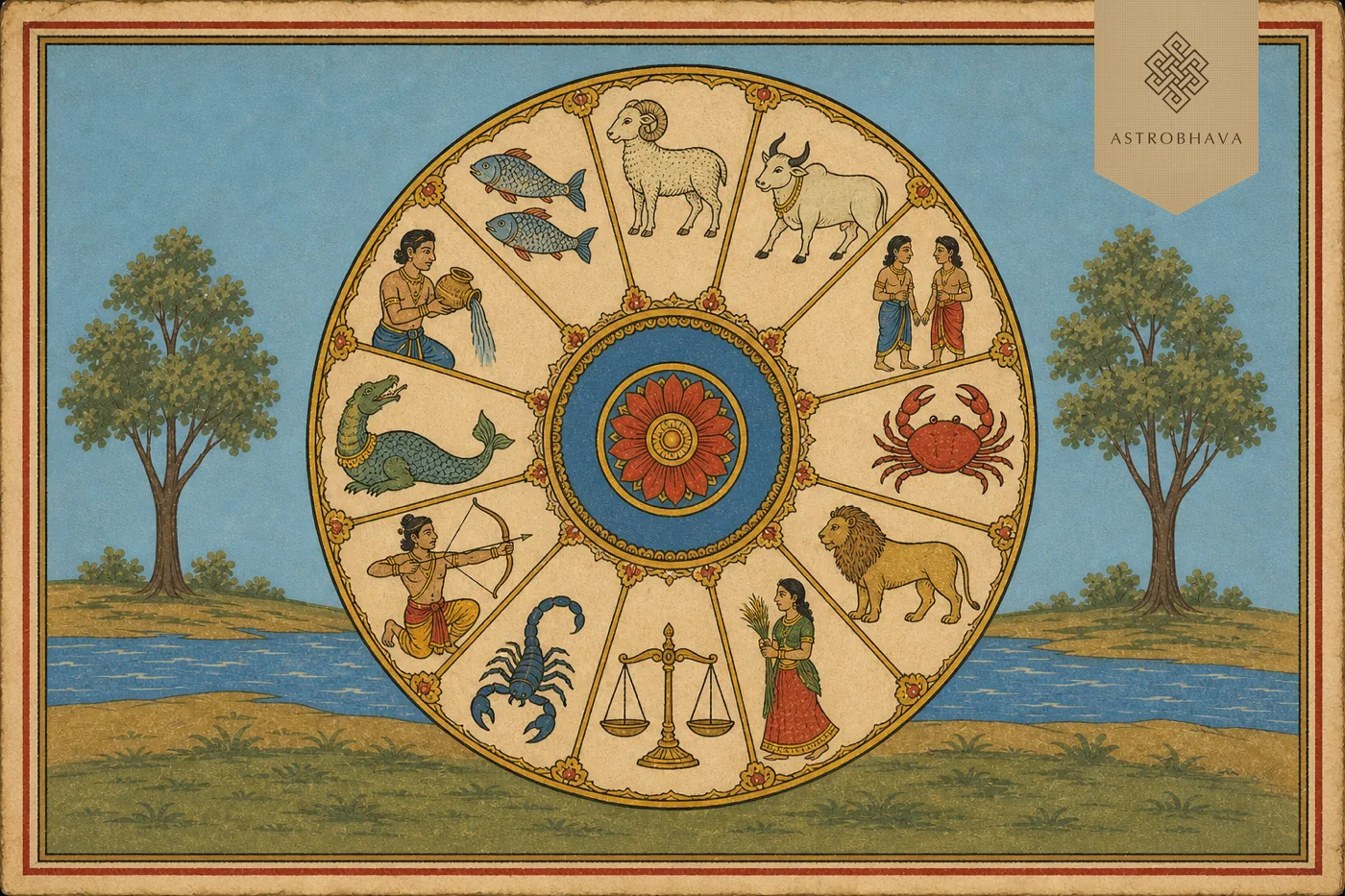
The Sun moves from Simha into Kanya on 17 September 2026, changing the solar month. Venus enters Tula on 2 September 2026; Mercury enters Kanya on 7 September 2026; Mars enters Karka on 18 September 2026. Choose your rashi.
Readings load here. Today’s panchang →
Vedic readings go by the Moon sign. If you know “Aries” or “Scorpio” from a birth date, that is usually a Western Sun sign. There is no reliable shortcut from that sign to your rashi, so enter your birth details below and we will take you straight to the right reading.
Find your rashi
Date and place are required. Nothing is stored unless you sign in and save it.
Registered before? Your saved profiles fill this in one tap. New here? One tap creates your account — no password — and your details carry across all 25 tools.
The month these are written from
These are the calculated facts behind all twelve readings for Coimbatore, Tamil Nadu, India. We publish the basis so it can be checked rather than taken on trust.
| Movement | This month | Bears on |
|---|---|---|
| Sankranti — Sun’s sign change | Simha → Kanya, 17 September 2026 at 7:45 AM | The month’s anchor. The Sun’s house from each rashi changes at this dated ingress |
| Mercury | enters Kanya on 7 September 2026 at 1:22 PM · enters Tula on 26 September 2026 at 12:29 PM | Communication, accounts, negotiation and short travel |
| Venus | enters Tula on 2 September 2026 at 1:41 PM | Relationships, comfort and purchases, by house from each rashi |
| Mars | enters Karka on 18 September 2026 at 4:22 PM | Energy, conflict and property, by house from each rashi |
| Saturn | Meena throughout September · retrograde | The slow background and named Saturn conditions by rashi |
| Jupiter | Karka throughout September · direct | Guru Bala and the longer yearly background |
| Rahu — Ketu | Kumbha — Simha at month start | The nodal axis across two houses from each rashi |
| Tithis of note | Amavasya 11 September 2026 (local sunrise) · Pournami 26 September 2026 (local sunrise) | The Pournami and Amavasya tithi present at local sunrise; observance rules can use other reference moments |
The Sankranti is the anchor of this monthly reading. It changes the Sun’s house from every rashi; the other dated movements and the slow grahas provide the surrounding context. Calculated with the LAHIRI ayanamsa. Sankranti calendar →
What a monthly horoscope can and cannot tell you
Read it by Moon sign, not Sun sign
Vedic readings are counted from the Moon. If you know “Leo” or “Scorpio” from a birth date, that is a Western Sun sign — a different measure entirely, and the two systems also differ by about twenty-four degrees.
There is no reliable shortcut from a Western Sun sign to a Vedic Moon sign. The check above resolves your rashi from the Moon at your birth.
Its real use is the shape of the month
A month contains a Sankranti and usually two or three planetary sign changes, each falling on a known date. So a monthly reading can say which part of the month favours what — the fortnight before the Sun moves and the fortnight after are genuinely different.
That is what it is for. It is not a forecast of events, and anything claiming to be one is inventing.
Where it sits among the four
Second only to the yearly. A day rests on a single Moon position and a week on its circuit — both fast and light. A month rests on the Sun’s sign change and the movements of Mercury, Venus and Mars, which are slow enough to describe a period rather than a mood.
Only the yearly reading, built on Saturn, Jupiter and the nodes, carries more weight. Yearly predictions →
Where it stops, a chart begins
Everything on this page is one twelfth of the picture. Your lagna, the houses your planets occupy, and above all the dasha you are running decide what a transit actually does to you.
Two people with the same rashi in different dashas can experience the same month very differently. Generate your kundli →
Why we say a monthly horoscope is limited
Because it is, and because most sites will not say so. A reading for Mesha this month applies to roughly a hundred million people. Whatever it says will fit some of them well, some badly, and most somewhere in between. That is arithmetic, not modesty.
What we can do honestly is write from the actual sky. The movements above are real and dated, and the readings follow from them — so a month carrying a Sankranti mid-way reads differently from one that does not. A great deal of monthly horoscope content is generated without reference to any of this, and it reads the same in every month of the year.
And we will keep pointing you past it. If something specific is worrying you, a monthly reading is the wrong instrument — the chart and the running dasha are where the answer is. That is a strange thing for a horoscope page to say, and we would rather say it than not. Have the chart read →
The other views
The further out you read, the more the reading is genuinely about your rashi.
Why the month is the useful middle
Indian timekeeping actually runs two months at once. The solar month begins when the Sun enters a new rashi at Sankranti, and it governs the Tamil and Malayalam calendars; the lunar month is measured in tithis and governs the observances. A monthly reading has to take account of both, which is why the readings here name the Sankranti date rather than treating the first of the calendar month as a beginning.
What makes the month worth reading is the Sun’s dated sign change. It holds one house from your rashi before the Sankranti and the next house afterwards, long enough for the two parts of the month to have a visible structure. The Moon cannot do this; it moves on before anything settles.
Mercury, Venus and Mars also change sign at roughly this interval, so a month usually carries two or three dated events. Naming those dates is the most honest thing a monthly reading can offer: not a prediction, but a calendar of when the conditions shift.
About monthly readings
Moon sign — your rashi. Vedic astrology counts these transits from the Moon, while the familiar Western sign is usually a Sun sign in a different zodiac. There is no reliable one-sign shortcut; the check above resolves it from your birth details.
As a description of the month’s shape for a rashi — where the Sankranti falls and which dates the conditions change — useful as general context. As a prediction about you specifically, it remains limited because it applies to a twelfth of everyone alive. We derive ours from dated transits rather than drawing from stock sentences.
Two reasons worth knowing. Many sites publish Western Sun-sign readings, which are a different system answering a different question. And a good deal of monthly horoscope content is drawn from stock sentences that could appear in any month. Ours are derived from the dated transits shown above, which you can check against an ephemeris.
Yearly first, monthly second. Both rest on planets slow enough to describe a period rather than a mood — Saturn, Jupiter and the nodes for the year; the Sun, Mercury, Venus and Mars for the month. Daily and weekly readings rest mostly on the Moon, which touches everything lightly. Yearly predictions →
Most likely because your chart and your running dasha are doing something a rashi reading cannot see. A supportive month for Mesha means little to a Mesha native in a difficult mahadasha. This is the honest limit of the format, and if the mismatch is persistent it is a sign the chart is worth reading properly. Check your dasha →
At the start of each calendar month, though the readings are organised around the Sankranti — the Sun’s sign change — which usually falls mid-month rather than on the first. That date is named in every reading, because it is where the character of the month actually turns. Sankranti calendar →
Reading twelve horoscopes to find yours?
That is the sign a general reading is not answering your question. An astrologer reads your own chart — the lagna, the houses, the dasha you are running — and tells you what the transits actually mean for you.