Sarva Mangala Mantra
सर्वमङ्गलमाङ्गल्ये शिवे सर्वार्थसाधिके शरण्ये त्र्यम्बके गौरि नारायणि नमोऽस्तु तेIn Devanagari, Tamil, Telugu, Kannada, Malayalam and English — with the meaning of every word, and the one syllable most people pronounce wrongly.
Who Sarva Mangala is
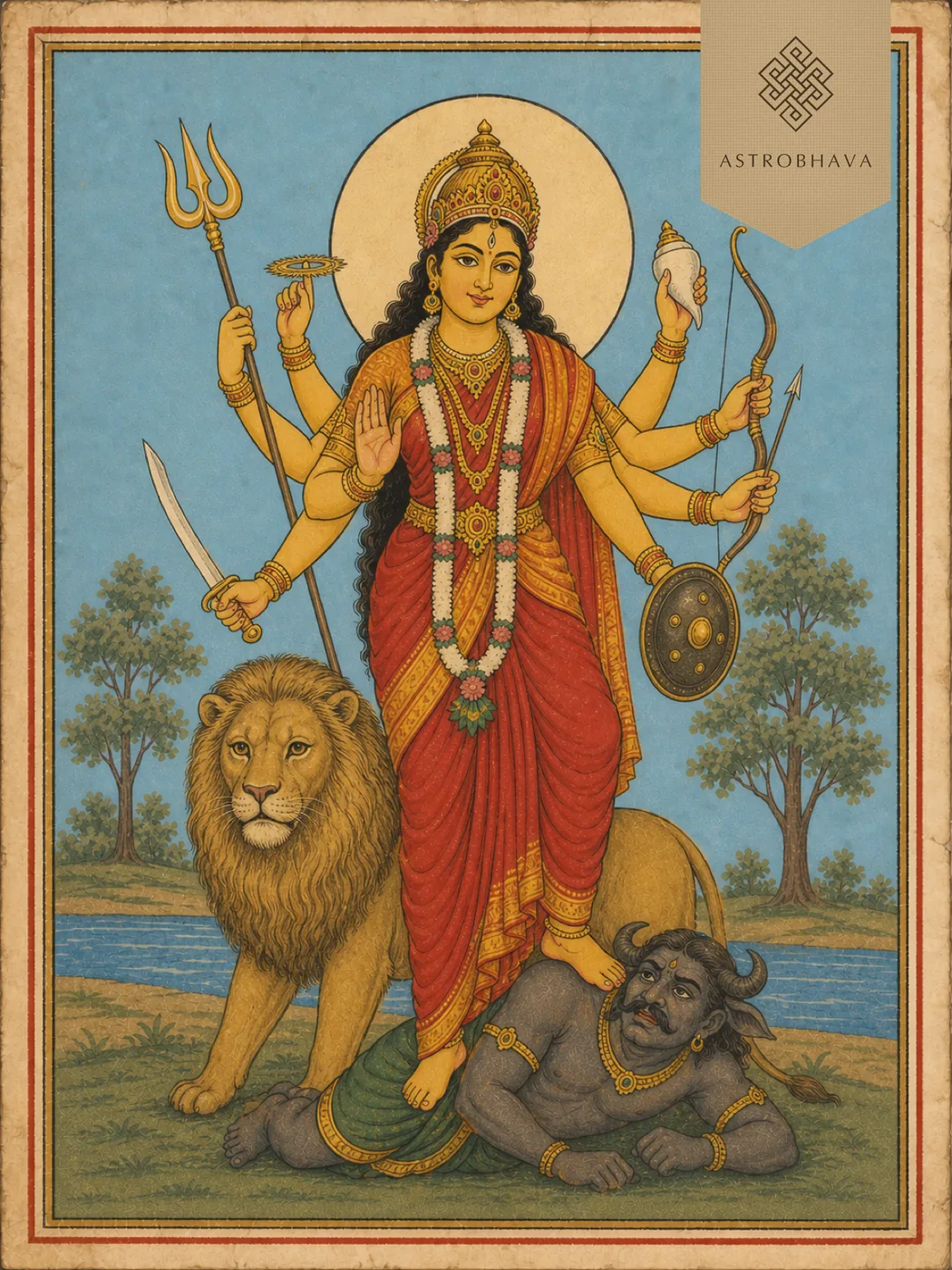
Sarvamaṅgalā is the particular designation of the Goddess as the auspiciousness that resides inside every auspicious thing, the inner core of all that is maṅgala. She is addressed in the Devī Māhātmya as the one who is both Śivā and the refuge of those who seek shelter, the three-eyed Gaurī who is also Nārāyaṇī. Unlike forms defined by martial victory or cosmic dissolution, Sarvamaṅgalā is defined by the quiet radiance that makes any enterprise or moment whole. In the liturgical imagination she stands at the centre of the Caṇḍī Pāṭha, where the famous verse beginning sarvamaṅgalamāṅgalye is recited as the very heart of the Devī’s self-revelation. Her identity is therefore inseparable from the compound that names her: she is not merely the giver of auspiciousness but the auspiciousness of auspiciousness itself, the maṅgala that underlies every lesser maṅgala. Iconographically she may be visualised as the gentle yet sovereign Gaurī whose glance alone constitutes the blessing the verse invokes.
The heart of the Caṇḍī
The verse that names Sarvamaṅgalā is embedded in the Devī Māhātmya, the core of the Mārkaṇḍeya Purāṇa. After the Goddess has slain Śumbha and Niśumbha, the gods praise her with a hymn that moves through her many names until it reaches the stanza sarvamaṅgalamāṅgalye śive sarvārthasādhike. In that moment the text presents her not as a warrior but as the quiet ground of every successful aim and every protected refuge. The same stanza is later extracted by the Śākta tradition and treated as an independent mantra, yet its original setting remains the triumphal yet contemplative close of the third carita. Commentators such as Bhāskararāya note that the verse gathers four epithets—Sarvamaṅgalā, Śivā, Sarvārthasādhikā and Śaraṇyā—before naming her Tryambakā and Gaurī and finally Nārāyaṇī, thereby weaving the gentle and the sovereign aspects into a single address. The myth, therefore, is less an external episode than the Goddess’s own self-disclosure inside the hymn that the gods offer after the battle has ended.
The mantra, in six scripts
The name mantra, and the form most devotees chant daily. No initiation is required — it is open to anyone, including a parent chanting for a child.
- सर्वमङ्गलमाङ्गल्ये
- sarvamaṅgalamāṅgalye — O auspiciousness of all auspiciousness
- शिवे
- śive — O auspicious one / O Śivā
- सर्वार्थसाधिके
- sarvārthasādhike — O fulfiller of all aims
- शरण्ये
- śaraṇye — O refuge
- त्र्यम्बके
- tryambake — O three-eyed one
- गौरि
- gauri — O Gaurī
- नारायणि
- nārāyaṇi — O Nārāyaṇī
- नमोऽस्तु
- namo'stu — let there be salutation
- ते
- te — to you
More Sarva Mangala mantras
Narayani Stuti: Srishti-sthiti-vinashanam
The verse of salutation, recited before or after japa.
- सृष्टिस्थितिविनाशानां
- sṛṣṭisthitivināśānāṃ — of creation, preservation and dissolution
- शक्तिभूते
- śaktibhūte — O you who are the power
- सनातनि
- sanātani — O eternal one
- गुणाश्रये
- guṇāśraye — O support of the gunas (sattva, rajas, tamas)
- गुणमये
- guṇamaye — O you who are made of the gunas
- नारायणि
- nārāyaṇi — O Narayani
- नमोऽस्तु
- namo'stu — let there be salutation (namaḥ + astu)
- ते
- te — to you
Source: Devi Mahatmya (Markandeya Purana), chapter 11, the Narayani Stuti: the verse right after Sarvamangala-mangalye. It is numbered 11.10 or 11.11 depending on the edition (Markandeya Purana 91.10).
Narayani Stuti: Sharanagata-dinarta
The verse of salutation, recited before or after japa.
- शरणागतदीनार्तपरित्राणपरायणे
- śaraṇāgatadīnārtaparitrāṇaparāyaṇe — O you who are intent on rescuing the helpless and afflicted who come for refuge
- सर्वस्य
- sarvasya — of all, of everyone
- आर्तिहरे
- ārtihare — O remover of distress
- देवि
- devi — O Goddess
- नारायणि
- nārāyaṇi — O Narayani
- नमोऽस्तु
- namo'stu — let there be salutation (namaḥ + astu)
- ते
- te — to you
Source: Devi Mahatmya (Markandeya Purana), chapter 11, the Narayani Stuti: the second verse after Sarvamangala-mangalye. It is numbered 11.11 or 11.12 depending on the edition (Markandeya Purana 91.11).
The syllable people get wrong
Inside māṅgalye the long ā that follows m must be held fully open; speakers often shorten it to a mid-level a, producing mangalye and thereby flattening the elongated vowel that gives the compound sarva-maṅgala-māṅgalye its characteristic rhythmic weight and its precise theological claim.
When Sarva Mangala is chanted
Festival. Navarātri
Questions
Have your chart read before you decide
Chanting is yours to do, and free. But which deity your situation calls for — and whether a mantra alone is the right response — depends on your chart. Sometimes it is; sometimes it is not.
- Over 30 years in the Guru–Sishya Parampara, from the age of five
- He reads every chart himself — 60 minutes, one to one, never delegated
- Charts are read only between sunrise and sunset, following tradition
Related
Chanting is yours to do. Some things are performed for you.
Where a matter carries real weight, devotees sponsor the homa alongside their own practice. Performed for you and any family members you name, at our Yagna Ashram, in your name and gotra, on a muhurta calculated from your chart, and telecast live so you can watch it done for you.