Have you ever wondered why Sita Navami is considered one of the most powerful days in the Hindu calendar for invoking divine feminine energy — not just for marital bliss, but for abundance and wealth? If you’re looking for the exact date, muhurat, and rituals to observe Sita Navami 2026 with full devotion, you’ve landed on the right page. This detailed guide covers everything from the tithi timings and puja vidhi to the sacred MahaLakshmi connection that makes this day extraordinary for wealth manifestation.
 What Is Sita Navami? A Quick Overview
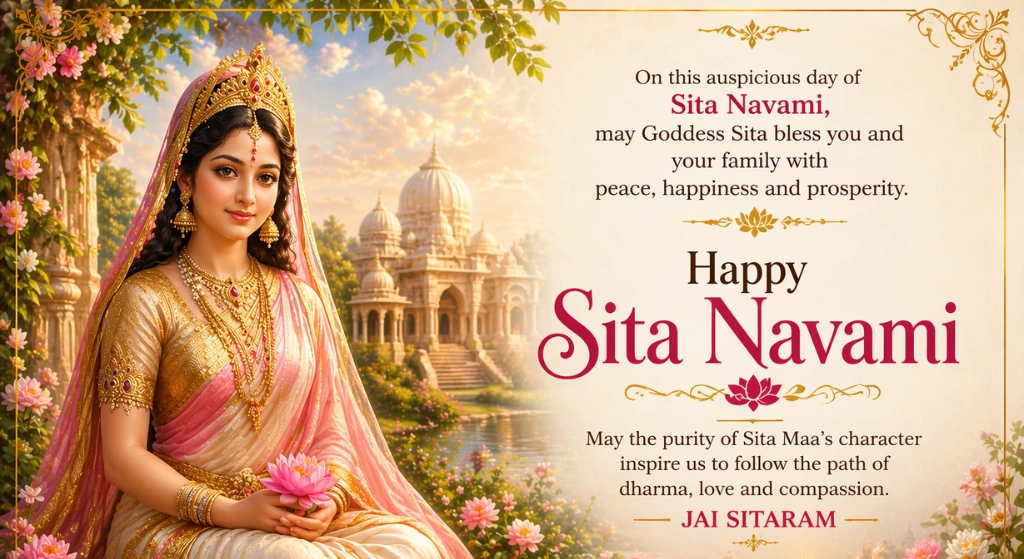
Sita Navami, also known as Sita Jayanti or Janaki Navami, is the sacred birth anniversary of Goddess Sita — the divine consort of Lord Rama and an avatar of Goddess Lakshmi herself. The festival falls on Navami Tithi (the ninth day) during Shukla Paksha in the month of Vaishakha, typically in April or May.
What makes this festival especially meaningful is the extraordinary cosmic alignment it represents. Lord Rama was born on Navami Tithi of Chaitra month, and Sita Navami falls exactly one month after Rama Navami. The same sacred tithi — Navami — connects both divine personalities, reinforcing the idea that their union was written into the very fabric of the universe.
Goddess Sita is celebrated as the embodiment of Goddess Lakshmi, and is also revered by the names Janaki, Bhoomija, and Maithili. She is the ultimate symbol of purity, patience, devotion, and inner strength. Worshipping her on this day is believed to open the doors to both spiritual grace and material prosperity.
Sita Navami 2026: Date, Tithi, and Muhurat
Let’s get straight to the most searched question — when is Sita Navami 2026?
Sita Navami 2026 Date: Saturday, April 25, 2026
Here are the key Panchang details for India:
Navami Tithi Begins: April 24, 2026 at 7:21 PM Navami Tithi Ends: April 25, 2026 at 6:27 PM
Sita Navami Madhyahna Muhurat (Most Auspicious Window): 11:06 AM to 1:44 PM (Duration: approximately 2 hours 38 minutes)
Madhyahna Moment (Peak Auspicious Time): 12:25 PM
Tradition associates the appearance of Goddess Sita with the Madhyahna or midday period. For this reason, the midday phase is considered especially suitable for the main Sita Navami puja. Those who wish to perform an elaborate worship may choose this window for special aarti, mantra japa, and reading of sacred stories.
If you’re planning to perform a full puja with homa or abhishekam, the window between 11:06 AM and 1:44 PM is your golden time.
Why Is Sita Navami 2026 Especially Important for Wealth?
Here’s the connection most people miss. Goddess Sita is regarded as the incarnated form of Goddess Lakshmi, born in Mithila. This means worshipping Sita on her birthday is equivalent to worshipping Maha Lakshmi at the peak of her divine manifestation. The prayers, homas, and rituals performed on this day carry the combined blessings of both Sita Mata and Maha Lakshmi — making it one of the most powerful opportunities in the year to invite wealth, harmony, and abundance into your home.
Observing Sita Navami ceremonies with dedication is believed to bring well-being, riches, and joy. Married women are likely to attract characteristics like sacrifice, humility, and devoted energy.
The auspicious Nakshatra of Pushya, under which Goddess Sita is believed to have been born, is ruled by Jupiter — the planet of wisdom, growth, and abundance. Performing Lakshmi-centric rituals on this day under this influence is considered exceptionally potent.
The Birth Story of Goddess Sita: Born from the Earth
Understanding Sita’s origin story adds a beautiful dimension to the rituals you perform on this day. According to Hindu mythology, when King Janaka was ploughing the land to conduct a Yajna, he found a baby girl in a golden casket inside the field. A ploughed land is called “Sita” in Sanskrit, and hence King Janaka named the baby girl Sita.
It is said that Goddess Sita emerged in front of King Janaka, who rescued the child and looked after her as his daughter. She is thus also called Bhoomija — daughter of the Earth — which makes her deeply connected to abundance, fertility, and the nurturing energy of nature. This earth connection is why offerings of seeds, grains, and flowers are considered especially appropriate in her puja.
Sita Navami and Its Deep Connection to Pushya Nakshatra
It is said that Goddess Sita took birth during Pushya Nakshatra. Lord Rama had also taken birth in the same propitious period in the Hindu Chaitra month. Pushya Nakshatra is traditionally associated with nourishment, prosperity, and Jupiter’s divine guidance. Devotees born under Pushya Nakshatra are encouraged to perform Sita puja on this day with extra dedication, as the blessings are said to be multiplied manifold.
In the event that Pushya is your birth Nakshatra, you are ruled by Jupiter, the lord of heavenly knowledge. As Goddess Sita took birth during this time, she was sensible, modest, genuine, and stayed devoted to Lord Rama.
Sita Navami 2026 Puja Vidhi: Step-by-Step Guide
Here is a detailed puja vidhi you can follow at home to observe Sita Navami 2026 with full devotion and authenticity.
Step 1 — Sankalpa (Sacred Resolve) Begin your day with a bath before sunrise. Light a diya and take a sankalpa (vow) to observe the fast and puja with a pure heart.
Step 2 — Set Up the Puja Mandap On the day of Sita Navami, married women need to worship Sita Devi alongside Lord Rama and Lakshman. It is one of the significant Sita Jayanti customs to build a small puja mandap with four pillars and decorate it with bright flowers.
Step 3 — Idol or Image Placement Place idols or framed images of Goddess Sita, Lord Rama, and Lakshman on the mandap. You may also include an image of Goddess Lakshmi since Sita is her avatar.
Step 4 — Invocation and Abhishekam Invoke the deity with the mantra Om Shri Sitaye Namah. Perform a simple abhishekam with milk, honey, and Gangajal if possible.
Step 5 — Offerings Along with puja, devotees offer fruits, sesame seeds, barley, and rice to the deities. Yellow flowers (especially marigolds), tulsi leaves, and yellow cloth are also considered auspicious.
Step 6 — Mantra Japa Recite Om Shri Sitaye Namah at least 108 times during the Madhyahna muhurat between 11:06 AM and 1:44 PM.
Step 7 — Vrat Katha Read or listen to the Sita Navami Vrat Katha and recite verses from the Ramayana.
Step 8 — Aarti and Parikrama Perform aarti of Goddess Sita and Lord Rama with devotion, ring a bell, and do parikrama (circumambulation) of the puja place three or seven times. Offer final prayers.
Step 9 — Break the Fast Devotees prepare satvik food, which is first offered to the deities and then distributed among family members or invitees after completion of the aarti. Women observe a strict fast through the day, refraining from food and water. The fast is traditionally broken in the evening after sunset.
Who Should Observe Sita Navami Fast and Why
Married women, couples facing challenges in their relationship, and those who wish to strengthen qualities like patience, sacrifice, and self-control can especially benefit from this fast.
But it’s not limited to women alone. Men and families seeking abundance, harmony, and divine blessings can also observe the day through prayer, charity, and meditation. Those going through financial difficulties can perform MahaLakshmi-centric rituals on this day to invoke the wealth-bestowing grace of the Goddess.
It is believed that women who observe the Sita Navami fast are bestowed with the divine blessings of the Goddess and a blissful married life.
 The MahaLakshmi Ritual for Wealth on Sita Navami 2026
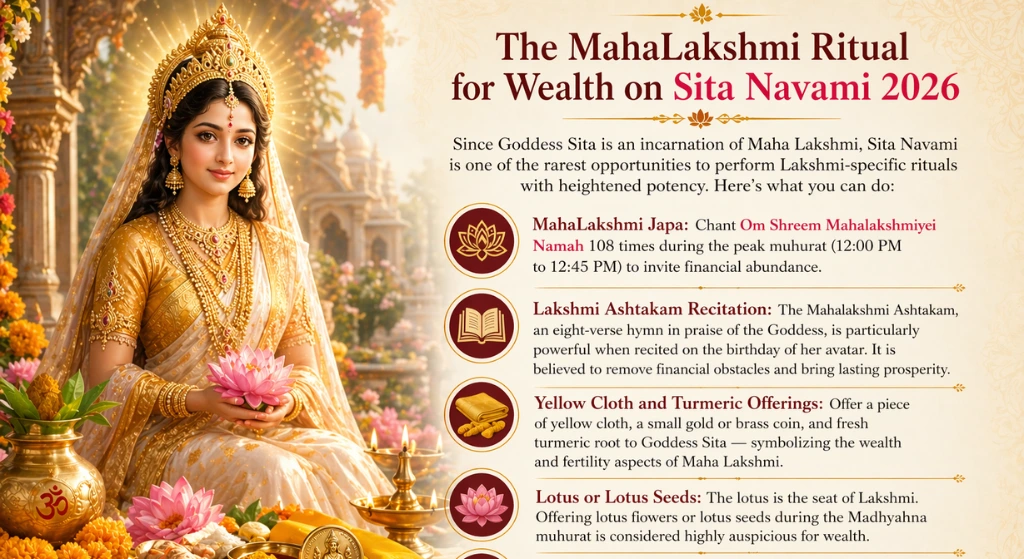
Since Goddess Sita is an incarnation of Maha Lakshmi, Sita Navami is one of the rarest opportunities to perform Lakshmi-specific rituals with heightened potency. Here’s what you can do:
MahaLakshmi Japa: Chant Om Shreem Mahalakshmiyei Namah 108 times during the peak muhurat (12:00 PM to 12:45 PM) to invite financial abundance.
Lakshmi Ashtakam Recitation: The Mahalakshmi Ashtakam, an eight-verse hymn in praise of the Goddess, is particularly powerful when recited on the birthday of her avatar. It is believed to remove financial obstacles and bring lasting prosperity.
Yellow Cloth and Turmeric Offerings: Offer a piece of yellow cloth, a small gold or brass coin, and fresh turmeric root to Goddess Sita — symbolizing the wealth and fertility aspects of Maha Lakshmi.
Lotus or Lotus Seeds: The lotus is the seat of Lakshmi. Offering lotus flowers or lotus seeds during the Madhyahna muhurat is considered highly auspicious for wealth.
Akshata and Coins: Place raw rice grains (akshata) mixed with turmeric and a few coins at the feet of the deity. This symbolises sowing the seeds of abundance.
Sita Navami vs Rama Navami: What’s the Difference?
Many people ask this, and the answer is both simple and profound. Ram Navami celebrates the birth of Lord Rama, who symbolises dharma, truth, and ideal leadership, and is observed in the month of Chaitra. Sita Navami celebrates the birth of Goddess Sita, who represents purity, devotion, sacrifice, and the ideal woman, and is observed in the month of Vaishakh. While Ram Navami is widely celebrated by all devotees, Sita Navami is especially significant for married women who observe fasts for marital happiness and family well-being. Together, both festivals highlight the divine union of Lord Rama and Goddess Sita and their teachings for a balanced and righteous life.
In terms of ritual focus, Rama Navami is more about dharma and righteousness, while Sita Navami leans toward the Shakti aspect — abundance, devotion, and feminine divine energy. This makes Sita Navami the more potent day specifically for wealth and prosperity rituals connected to Maha Lakshmi.
What to Avoid on Sita Navami 2026
To maintain the sanctity and effectiveness of your puja and fast, keep these points in mind:
Avoid non-vegetarian food, onion, and garlic throughout the day. Do not engage in arguments or harsh speech. Avoid wasteful spending or unnecessary activity during the muhurat window. Refrain from consuming food before breaking the fast in the evening. Keep your mind peaceful and focused on devotion throughout the day.
The Spiritual Lesson of Sita Navami 2026
Sita Navami 2026 is not just a date on the festival calendar. It is an invitation to look within. The day quietly teaches that endurance and sacrifice are not signs of weakness but expressions of inner strength and stability. Marital relationships stand not only on rights and expectations but also on respect, communication, and patience.
In a world that celebrates speed and acquisition, Sita Mata’s life is a gentle but powerful reminder that true wealth is found in integrity, patience, and unwavering faith. When you combine this inner wealth with the outer abundance of Lakshmi’s blessings, you create a life that is genuinely prosperous — in every dimension.
Conclusion
Sita Navami 2026 falls on Saturday, April 25, with the most auspicious Madhyahna Muhurat from 11:06 AM to 1:44 PM. This is not just a festival — it’s a rare cosmic window where the energies of Goddess Sita, the divine Maha Lakshmi, and the auspicious Pushya Nakshatra converge to create an extraordinary opportunity for spiritual and material blessings.
Whether you observe a full vrat, perform a simple home puja, chant the Mahalakshmi Ashtakam, or commission a professional homa, the key is sincerity and devotion. Goddess Sita — who emerged from the very earth itself — responds to pure-hearted prayers with abundant grace. Mark your calendar, set your intention, and make Sita Navami 2026 a truly transformative day for your family and your future.
Frequently Asked Questions (FAQs)
Q1: When is Sita Navami 2026?
Sita Navami 2026 falls on Saturday, April 25, 2026. The Navami Tithi begins on April 24 at 7:21 PM and ends on April 25 at 6:27 PM.
Q2: What is the best muhurat for Sita Navami 2026 puja?
The Madhyahna Muhurat from 11:06 AM to 1:44 PM on April 25, 2026 is the most auspicious window for Sita Navami puja. The peak moment is around 12:25 PM.
Q3: Why is Sita Navami important for wealth?
Goddess Sita is an avatar of Maha Lakshmi, the goddess of wealth. Performing puja, homa, or japa on her birthday is believed to carry the combined blessings of both Sita Mata and Lakshmi, making it one of the most powerful days for invoking prosperity.
Q4: Who should observe the Sita Navami fast?
Married women traditionally observe this fast for the longevity and well-being of their husbands. However, anyone seeking marital harmony, spiritual growth, and abundance can benefit from observing this fast.
Q5: What is the significance of Pushya Nakshatra on Sita Navami?
Goddess Sita is believed to have been born under Pushya Nakshatra, which is ruled by Jupiter and associated with nourishment and prosperity. Rituals performed under this energy are considered especially powerful for growth and abundance.
Q6: Can I perform Mahalakshmi rituals on Sita Navami?
Absolutely, yes. Since Sita is the avatar of Maha Lakshmi, Sita Navami is an ideal day to recite the MahaLakshmi Ashtakam, perform Lakshmi japa, and commission a Mahalakshmi Homa for wealth and prosperity.
Q7: What is the difference between Sita Navami and Janaki Navami?
They are the same festival. Sita Navami is also called Janaki Navami (as Sita is known as Janaki, the daughter of King Janaka) and Sita Jayanti. All three names refer to the birth anniversary of Goddess Sita.
Q8: What food can be eaten during Sita Navami vrat?
Fruits, milk, dry fruits, and satvik foods like sabudana (sago) are generally permitted. Non-vegetarian food, onion, garlic, and grains are typically avoided during the fast.