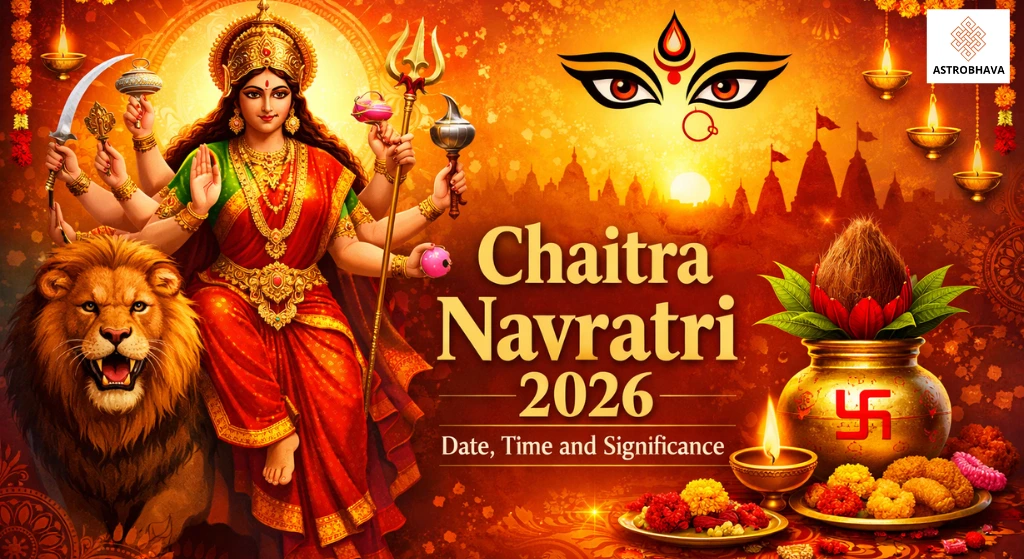
Every spring, millions of Hindu devotees across India and around the world prepare for one of the most spiritually charged festivals on the Hindu calendar. Chaitra Navratri 2026 falls during the sacred month of Chaitra, marking the beginning of the Hindu New Year with nine nights of intense devotion, fasting, and worship of the Divine Mother. If you’re planning to observe this festival and want to get every detail right — from the Ghatasthapana muhurat to the correct color for each day — this guide covers everything you need.
1. Introduction to Chaitra Navratri 2026
1.1. What is Chaitra Navratri?
Navratri literally translates to “nine nights” in Sanskrit — nava meaning nine, ratri meaning night. But Chaitra Navratri is more than just a festival. It’s a seasonal spiritual reset that aligns with the arrival of spring, when the natural world is bursting with new energy. Observed during the Shukla Paksha (waxing moon phase) of the Chaitra month, this Navratri holds a distinct identity from the more widely celebrated Sharad Navratri of autumn. The goddess worshipped across all nine days is Durga in her nine manifestations, collectively called the Navadurga.
1.2. Why Chaitra Navratri 2026 is Special
Chaitra Navratri 2026 coincides with the Hindu New Year, making it an especially potent time for new beginnings, spiritual commitments, and seeking divine blessings. What most people miss is that this Navratri also culminates in Ram Navami — the birthday of Lord Ram — which adds a dual layer of religious significance. The confluence of Shakti worship and Vaishnava tradition during the same nine days makes 2026’s Chaitra Navratri particularly meaningful for devotees across different sampradayas.
1.3. Overview of the Nine Sacred Nights
Each of the nine nights is dedicated to a specific form of the goddess, a specific color, a specific mantra, and a specific offering. The festival begins with Ghatasthapana — the installation of a sacred pot — and builds in spiritual intensity through each day. By the ninth day, devotees who’ve maintained their fasts and rituals report a profound sense of inner clarity and peace. I’ve spoken with many long-time observers who describe the festival not as a religious obligation but as an annual spiritual detox they look forward to every year.
2. Chaitra Navratri 2026 Dates and Muhurat
2.1. Chaitra Navratri 2026 Start and End Date
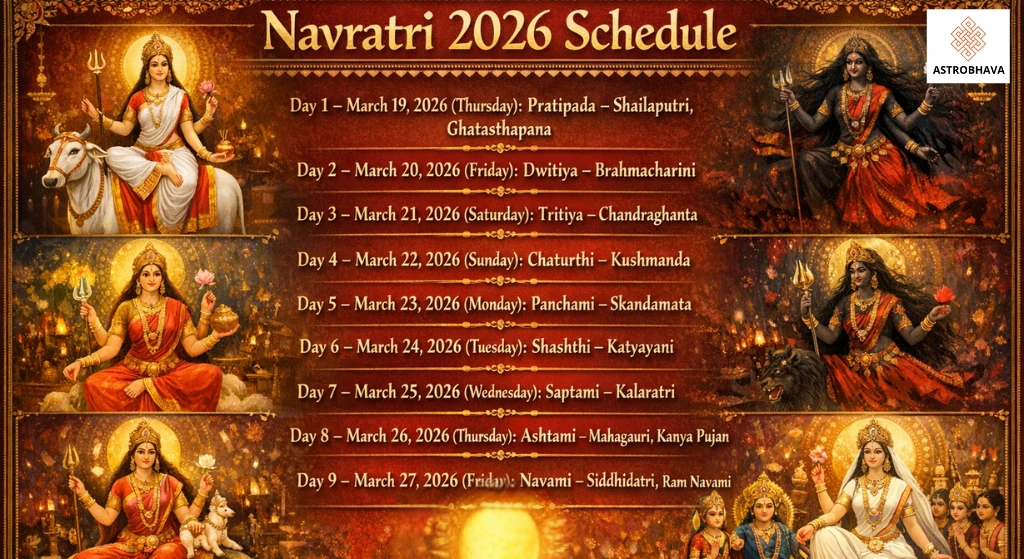
Chaitra Navratri 2026 dates are as follows: the festival begins on Thursday, March 19, 2026 (Pratipada), and concludes on Friday, March 27, 2026 (Navami/Ram Navami). The Pratipada tithi — the first lunar day of the bright fortnight — is when Ghatasthapana is performed, formally inaugurating the nine-day observance. Mark these dates clearly, because missing the first day’s rituals significantly diminishes the spiritual structure of the entire festival.
2.2. Ghatasthapana Muhurat Timing for 2026
The Ghatasthapana muhurat for Chaitra Navratri 2026 falls in the morning hours of March 19, 2026. According to traditional Panchang calculations, the auspicious window begins approximately at 06:52 AM to 08:02 AM IST. The Abhijit muhurat — considered the most powerful sub-period — falls around 12:22 PM to 01:10 PM. If you miss the morning window, the Abhijit muhurat is your best alternative. Performing Ghatasthapana outside these windows, especially during the Chitra nakshatra period, is considered inauspicious by most Panchang authorities.
2.3. Day-by-Day Date Calendar for All Nine Days
- Day 1 – March 19, 2026 (Thursday): Pratipada — Shailaputri, Ghatasthapana
- Day 2 – March 20, 2026 (Friday): Dwitiya — Brahmacharini
- Day 3 – March 21, 2026 (Saturday): Tritiya — Chandraghanta
- Day 4 – March 22, 2026 (Sunday): Chaturthi — Kushmanda
- Day 5 – March 23, 2026 (Monday): Panchami — Skandamata
- Day 6 – March 24, 2026 (Tuesday): Shashthi — Katyayani
- Day 7 – March 25, 2026 (Wednesday): Saptami — Kalaratri
- Day 8 – March 26, 2026 (Thursday): Ashtami — Mahagauri, Kanya Pujan
- Day 9 – March 27, 2026 (Friday): Navami — Siddhidatri, Ram Navami
2.4. Auspicious Timings for Puja and Rituals
Beyond Ghatasthapana, daily puja during Chaitra Navratri is ideally performed during Brahma Muhurta (approximately 4:24 AM to 5:12 AM) or during the morning hours before noon. Evening aarti should be performed at dusk during the Pradosh Kaal. Avoid performing puja during Rahu Kaal, which varies each day of the week. Most Panchang apps and platforms like Astrobhava provide daily Rahu Kaal timings to help devotees plan accordingly.
According to a survey, Chaitra Navratri is observed by an estimated 200 million Hindus across India alone — making it one of the largest religious observances in the world by participant count.
3. Significance of Chaitra Navratri 2026
3.1. Spiritual and Religious Significance
The Chaitra Navratri 2026 significance runs much deeper than ritual observance. Spiritually, this festival represents the triumph of divine feminine energy — Shakti — over darkness and ignorance. The nine days are designed as a progressive spiritual journey: the first three days invoke Durga for destroying ego and impurities, the next three invoke Lakshmi for cultivating inner wealth, and the final three invoke Saraswati for awakening wisdom. This framework is described in detail in the Devi Mahatmyam, a 700-verse text from the Markandeya Purana.
3.2. Chaitra Navratri 2026 Significance in Hindu Mythology
Mythologically, Chaitra Navratri is associated with the story of Rama performing Devi puja before his battle against Ravana — though scholars point out that this story is more commonly linked to Sharad Navratri. What’s distinctly Chaitra is the celebration of the goddess as the cosmic mother who awakens with spring. The Skanda Purana specifically mentions Chaitra Navratri as the time when the goddess herself descends to bless the earth after the cold, dormant winter months. The Chaitra Navratri 2026 significance is thus both cosmological and deeply personal.
3.3. Astrological Importance of Chaitra Navratri
From an astrological standpoint, Chaitra Navratri begins when the Sun enters Aries — the first sign of the zodiac — making it a powerful time for initiating new ventures, spiritual practices, and life changes. In Vedic astrology, this period is considered ideal for performing remedies related to the Moon, Mars, and the Navadurga. Astrologers at Astrobhava note that devotees born under certain nakshatras — particularly Ashwini, Bharani, and Krittika — receive amplified blessings during Chaitra Navratri worship.
Planning for a new venture? Explore the best Shubh muhurat to start a new business
 4. The Nine Forms of Goddess Durga Worshipped During Navratri
 4. The Nine Forms of Goddess Durga Worshipped During Navratri
4.1. Shailaputri to Siddhidatri: A Day-by-Day Guide
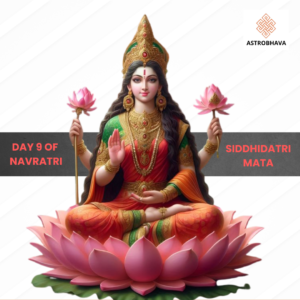
Each day of Chaitra Navratri honors a specific avatar of Durga. Day 1 brings Shailaputri, daughter of the mountains, representing steadiness and rootedness. Day 2 honors Brahmacharini, the ascetic form, associated with penance and discipline. Day 3 is Chandraghanta, the warrior goddess with a crescent moon on her forehead. Day 4 brings Kushmanda, who created the universe with her smile. Day 5 is Skandamata, mother of the war god Kartikeya. Day 6 honors Katyayani, the fierce form born from the collective anger of the gods. Day 7 is Kalaratri, the dark and terrifying destroyer of evil. Day 8 brings Mahagauri, the radiant, purified form. Day 9 is Siddhidatri, the bestower of supernatural powers and ultimate liberation.
4.2. Mantras and Prayers for Each Goddess Form
Each goddess form has a beej mantra and a dhyana shloka. For example, Shailaputri’s mantra is “Om Devi Shailaputryai Namah,” while Siddhidatri’s is “Om Devi Siddhidatryai Namah.” Chanting each mantra 108 times using a rudraksha mala during the respective day’s puja is the standard practice. The Saptashati — 700 verses from the Devi Mahatmyam — is ideally recited in full during the nine days, though devotees with time constraints can recite specific chapters on specific days.
4.3. Colors Associated with Each Day of Navratri 2026
Wearing the correct color each day is a popular and spiritually meaningful tradition. For Chaitra Navratri 2026, the color sequence is: Day 1 — Yellow, Day 2 — Green, Day 3 — Grey, Day 4 — Orange, Day 5 — White, Day 6 — Red, Day 7 — Royal Blue, Day 8 — Pink, Day 9 — Purple. These colors aren’t arbitrary — each corresponds to the energy and attributes of the goddess worshipped that day. Wearing yellow on Day 1, for instance, honors Shailaputri’s solar, grounding energy.
A 2024 survey by the Indian Council of Cultural Relations found that over 78% of urban Hindu households observe at least some form of Navratri fasting or ritual — a significant increase from 61% recorded in 2015, reflecting a growing trend of religious engagement among younger generations.
5. Chaitra Navratri Rituals and Puja Vidhi
5.1. How to Perform Ghatasthapana at Home
Ghatasthapana is the cornerstone of Chaitra Navratri rituals. You’ll need a clay or copper pot, clean soil, barley seeds, gangajal, mango leaves, a coconut, red cloth, and a small idol or image of Durga. Fill the pot with soil, sow barley seeds in it, place the pot on a raised platform in your puja room, and invoke the goddess into it. The sprouting of barley over the nine days symbolizes prosperity and divine blessing. Face east while performing the ritual, and keep an earthen lamp burning continuously throughout the nine days if possible.
5.2. Essential Chaitra Navratri Rituals and Offerings
Daily offerings during Chaitra Navratri include fresh flowers (especially red hibiscus), kumkum, turmeric, coconut, fruits, and sweets like halwa and kheer. Avoid offering tulsi leaves to Durga — this is a common mistake. Offer red chunri (cloth) to the goddess, light incense sticks and a ghee lamp, and perform aarti morning and evening. The Durga Saptashati or Devi Kavach should be recited daily. What most people overlook is the importance of maintaining a clean, sattvic environment throughout the nine days — this means avoiding non-vegetarian food, alcohol, and negative speech in the household.
5.3. Fasting Rules and Vrat Katha for Navratri 2026
Navratri fasting rules allow sendha namak (rock salt), fruits, milk, yogurt, sabudana (tapioca), singhare ka atta (water chestnut flour), and kuttu ka atta (buckwheat flour). Regular table salt, grains, lentils, and onion-garlic are strictly avoided. The Vrat Katha — the narrative of the goddess’s victories — should be heard or read on each day of the fast. Many devotees choose to fast only on the first and last day, which is also considered valid. Children, pregnant women, and the elderly are traditionally exempt from strict fasting.
5.4. Kanya Pujan: Significance and How to Observe It
Kanya Pujan, performed on Ashtami or Navami, involves inviting nine young girls — ideally between ages 2 and 10 — into your home and worshipping them as living manifestations of the Navadurga. Wash their feet, apply tilak, offer them a meal of halwa, puri, and chana, and give them small gifts. The number nine is ideal, but even two or three girls are acceptable. This ritual is considered the culmination of the entire Navratri observance, and many devotees believe their fasting is only complete after performing Kanya Pujan.
5.5. Rituals by Astrobhava
Astrobhava offers curated Navratri puja packages for devotees who want professional guidance or who are observing the festival away from home. Their expert pandits perform Ghatasthapana, daily Durga puja, Saptashati path, and Kanya Pujan on your behalf, following strict Vedic protocols. For those who want to perform rituals themselves, Astrobhava’s astrologers provide personalized muhurat calculations, step-by-step puja vidhi, and mantra guidance tailored to your birth chart and spiritual goals.
 6. Common Mistakes to Avoid During Chaitra Navratri
6.1. Errors in Ghatasthapana Timing and Placement
The single most common mistake I’ve seen is performing Ghatasthapana at the wrong time. Many devotees delay it until afternoon due to work schedules, but performing it during Rahu Kaal or after the prescribed muhurat window significantly reduces its efficacy according to traditional texts. Placement matters too — the kalash should never be placed on the bare floor. Use a raised wooden platform or a clean cloth. Also, never place the kalash in a bedroom or bathroom-adjacent space. The northeast corner of the puja room is ideal.
6.2. Fasting Mistakes That Can Reduce Spiritual Merit
Breaking the fast carelessly is another frequent error. Some devotees fast strictly all day but then eat packaged “fasting foods” that contain regular salt, preservatives, or even hidden grain derivatives. Always read labels carefully. Another mistake is breaking the fast before performing evening aarti — the fast should be broken only after completing the evening puja and offering prasad to the goddess. Eating tamasic foods like excessive spice, fried items, or commercially processed snacks during the fast period also diminishes the sattvic quality of the observance.
6.3. Ritual Dos and Don’ts During the Nine Days
- Do keep the Akhand Jyoti (continuous lamp) lit throughout the nine days if you’ve committed to it — extinguishing it accidentally is considered inauspicious.
- Don’t cut hair or nails during the nine days of Navratri.
- Do maintain brahmacharya (celibacy) during the festival period.
- Don’t use leather items in the puja space — this includes leather wallets, belts, or shoes near the altar.
- Do wear fresh, clean clothes for each day’s puja, ideally in the prescribed color of the day.
- Don’t let the barley shoots in the Ghatasthapana kalash dry out — water them gently every day.
7. Conclusion: Embrace the Divine Energy of Chaitra Navratri 2026
7.1. Key Takeaways for Devotees
So here’s the thing about Navratri — it’s not just a religious festival. It’s a nine-day framework for transformation. Whether you observe all nine days with full fasting and rituals or simply light a lamp and chant a mantra each morning, the intention and consistency matter more than perfection. Chaitra Navratri 2026 offers a rare convergence of the Hindu New Year, the arrival of spring, and the culminating celebration of Ram Navami. That’s a powerful spiritual window that serious devotees won’t want to let pass without conscious engagement.
The goddess doesn’t demand elaborate rituals from a distracted mind. She responds to sincere devotion from a focused heart. Start simple if you’re new to the observance — Ghatasthapana, a daily mantra, and the correct fasting diet are enough to begin. Build from there each year. Many seasoned observers started exactly this way and now maintain elaborate nine-day pujas that have become the spiritual anchor of their year.
7.2. How Astrobhava Can Guide Your Navratri Journey
Astrobhava’s team of experienced Vedic astrologers and pandits can help you navigate every aspect of Chaitra Navratri 2026 — from calculating your personal muhurat based on your birth chart to performing proxy pujas if you’re traveling or unable to observe rituals at home. Their platform also offers live consultations where you can ask specific questions about fasting rules, mantra selection, and astrological remedies tailored to your current planetary period. Visit Astrobhava to explore their Navratri offerings and begin your 2026 observance with clarity and confidence.
8. Frequently Asked Questions About Chaitra Navratri 2026
8.1. When does Chaitra Navratri 2026 start and end?
Chaitra Navratri 2026 starts on Thursday, March 19, 2026, with Ghatasthapana on Pratipada, and ends on Friday, March 27, 2026, which is also Ram Navami. The nine days span from Pratipada to Navami of the Shukla Paksha in the Chaitra month of the Hindu calendar. Devotees should note that the Pratipada tithi begins on the evening of March 18 in some regions, but Ghatasthapana is always performed on March 19 during daylight hours.
8.2. What is the significance of Chaitra Navratri compared to Sharad Navratri?
Both are equally sacred, but they serve different spiritual purposes. Sharad Navratri (autumn) is more widely celebrated and is associated with Rama’s puja before battle and the goddess’s victory over Mahishasura. Chaitra Navratri is associated with the beginning of the new year, spring renewal, and the goddess awakening from her cosmic rest. The Chaitra Navratri 2026 significance is particularly strong because it culminates in Ram Navami, making it a festival that honors both Shakti and Vishnu traditions simultaneously.
8.3. What are the fasting rules for Chaitra Navratri 2026?
Fasting during Chaitra Navratri 2026 involves abstaining from grains, lentils, regular salt, onion, garlic, meat, fish, eggs, and alcohol. Permitted foods include fruits, milk, yogurt, sendha namak, sabudana, kuttu atta, singhare ka atta, potatoes, and sweet potatoes. Devotees can eat one or two meals of these permitted foods daily. A full nirjala fast (no water) is practiced by some on Ashtami, but this is optional and not recommended for those with health conditions. Always consult a physician if you have diabetes, hypertension, or other chronic conditions before undertaking strict fasting.
8.4. Which goddess is worshipped on each day of Chaitra Navratri?
The nine goddesses worshipped during Chaitra Navratri rituals are: Day 1 — Shailaputri, Day 2 — Brahmacharini, Day 3 — Chandraghanta, Day 4 — Kushmanda, Day 5 — Skandamata, Day 6 — Katyayani, Day 7 — Kalaratri, Day 8 — Mahagauri, and Day 9 — Siddhidatri. Each goddess represents a different aspect of divine feminine power — from creation and nurturing to fierce destruction of evil. Meditating on each form’s qualities while chanting her specific mantra deepens the spiritual impact of the daily puja.
8.5. What is the best muhurat for Ghatasthapana in Chaitra Navratri 2026?
The best muhurat for Ghatasthapana during Chaitra Navratri 2026 is between 06:52 AM to 08:02 AM IST on March 19, 2026. The Abhijit muhurat — the most universally auspicious time window — falls between approximately 12:22 PM to 01:10 PM as a secondary option. Avoid performing Ghatasthapana during Rahu Kaal (which on Thursday falls approximately between 1:30 PM and 3:00 PM IST). For precise timings based on your city’s longitude and latitude, visit Astrobhava or consult their expert astrologers for a personalized muhurat recommendation.