Introduction: The Goddess Who Defies All Limits
Have you ever heard of a goddess who holds her own severed head in her hand and yet remains radiant, powerful, and complete? That is Chinnamasta — one of the ten Mahavidyas, the supreme wisdom goddesses of the Tantric tradition. She is terrifying to behold, yet deeply compassionate at her core. And when you invoke her through Chinnamasta Homam, what happens is nothing short of a complete spiritual and material transformation.
In this guide, we’re going to walk you through everything you need to know about Chinnamasta Homam — what it is, why it matters, who should do it, what benefits it brings, and how the ritual is performed. Whether you’re a spiritual seeker, someone going through intense challenges in life, or simply curious about the deeper dimensions of Vedic and Tantric worship, this blog is for you.
Let’s dive in.
Who Is Goddess Chinnamasta?
Before we talk about the homam, let’s understand the goddess herself — because in Vedic and Tantric tradition, understanding the deity is the first step toward truly connecting with her energy.
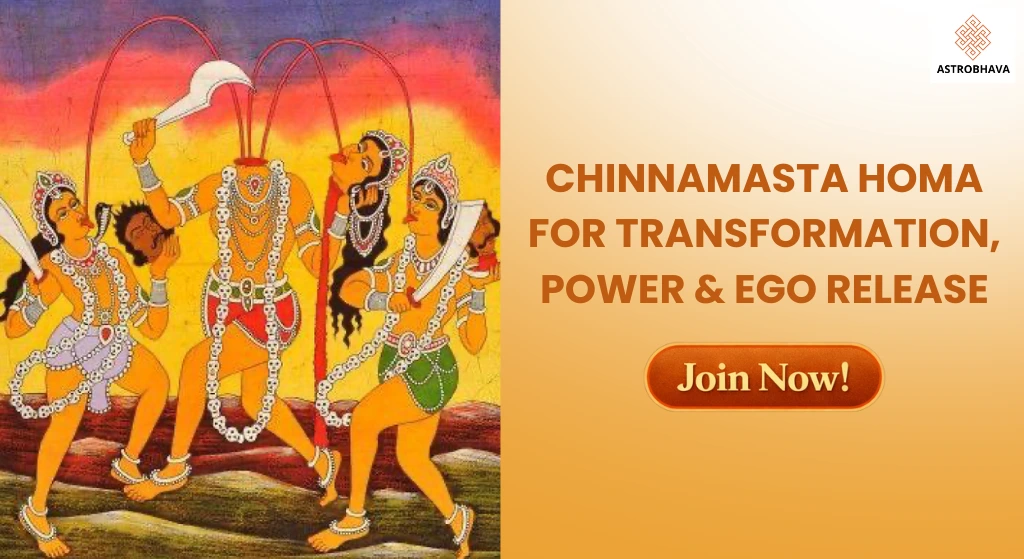
Chinnamasta (also spelled Chhinnamasta) is the sixth of the ten Mahavidyas. Her name literally means “she whose head is severed.” She is depicted standing on the copulating bodies of Rati and Kama (desire and love), holding her own severed head in one hand and a scimitar in the other. Three streams of blood flow from her neck — one into her own severed mouth, and the other two into the mouths of her two attendants, Dakini and Varnini.
Shocking? Yes. But deeply symbolic.
She represents the dissolution of ego, the transcendence of desire, the cycle of creation, preservation, and destruction — and above all, the supreme sacrifice of self for the nourishment of others and the cosmos. She is the goddess of radical self-transformation.
In tantric philosophy, Chinnamasta is also associated with the awakening of the Kundalini Shakti — the coiled serpent energy that lies dormant at the base of the spine. Worshipping her is believed to activate this energy, leading to spiritual awakening and liberation (moksha).
What Is Chinnamasta Homam?
Chinnamasta Homam is a Tantric fire ritual (yajna) performed in honor of Goddess Chinnamasta. In this ritual, a sacred fire is consecrated and specific offerings — including ghee, herbs, grains, flowers, and other prescribed materials — are made into the fire while chanting the Chinnamasta mantra and related Vedic hymns.
Homam, in general, is one of the most potent forms of worship in the Hindu tradition. The fire (Agni) acts as a divine medium — it transforms your offerings and transmits your intentions directly to the deity. When performed with proper Tantric procedures, Chinnamasta Homam carries an especially high vibrational potency because it works at the level of deep transformation, not just surface-level prayers.
This homam is typically performed by experienced Tantric priests or Vedic pandits who have been initiated into the Chinnamasta mantra tradition. The ritual can be done on your behalf (by proxy) or, in some advanced cases, with your participation.
Why Is Chinnamasta Homam So Rare and Powerful?
Among the Mahavidya homams, Chinnamasta Homam stands out as one of the most powerful — and most rarely performed. Here’s why:
Most temple rituals and household pujas deal with benevolent, sattvic forms of the deity. Chinnamasta belongs to the rajasic-tamasic energy spectrum, which means her power operates in the realms of intense desire, ego dissolution, karmic obstacles, and the breaking of deep-rooted patterns.
Her energy doesn’t gently nudge you — it cuts through illusion. Like a sword, she severs what no longer serves you. This is why Chinnamasta Homam is recommended for people facing situations that feel impossible to break free from — be it financial stagnation, health crises, relationship blocks, or deep spiritual obstacles.
It is also powerful because it works on multiple levels simultaneously: the physical (health, wealth, relationships), the psychological (overcoming fears, breaking ego patterns), and the spiritual (kundalini awakening, karmic clearing, liberation).
Who Should Perform Chinnamasta Homam?
This is a question we get asked very often, and the answer is: almost anyone who is going through deep struggle or who is seeking rapid spiritual evolution.
More specifically, Chinnamasta Homam is highly recommended for:
People facing chronic financial problems or repeated business failures — her energy cuts through the energetic blocks that keep prosperity away.
Individuals suffering from unexplained illnesses or health conditions that haven’t responded to conventional treatment — especially conditions related to blood, nervous system, or energy imbalances.
Those dealing with black magic, evil eye (nazar), or negative energies — Chinnamasta is one of the most potent deities for protection and removal of dark energies.
People with severe Rahu or Ketu afflictions in their horoscope — Chinnamasta is strongly associated with these shadow planets, and her homam can significantly pacify their malefic effects.
Spiritual seekers who want to awaken their Kundalini Shakti or accelerate their sadhana (spiritual practice).
Individuals going through a major life crisis or transformation — divorce, grief, career collapse — who need powerful divine intervention.
Anyone who feels spiritually stuck and unable to progress on the path despite regular practice.
 Benefits of Chinnamasta Homam
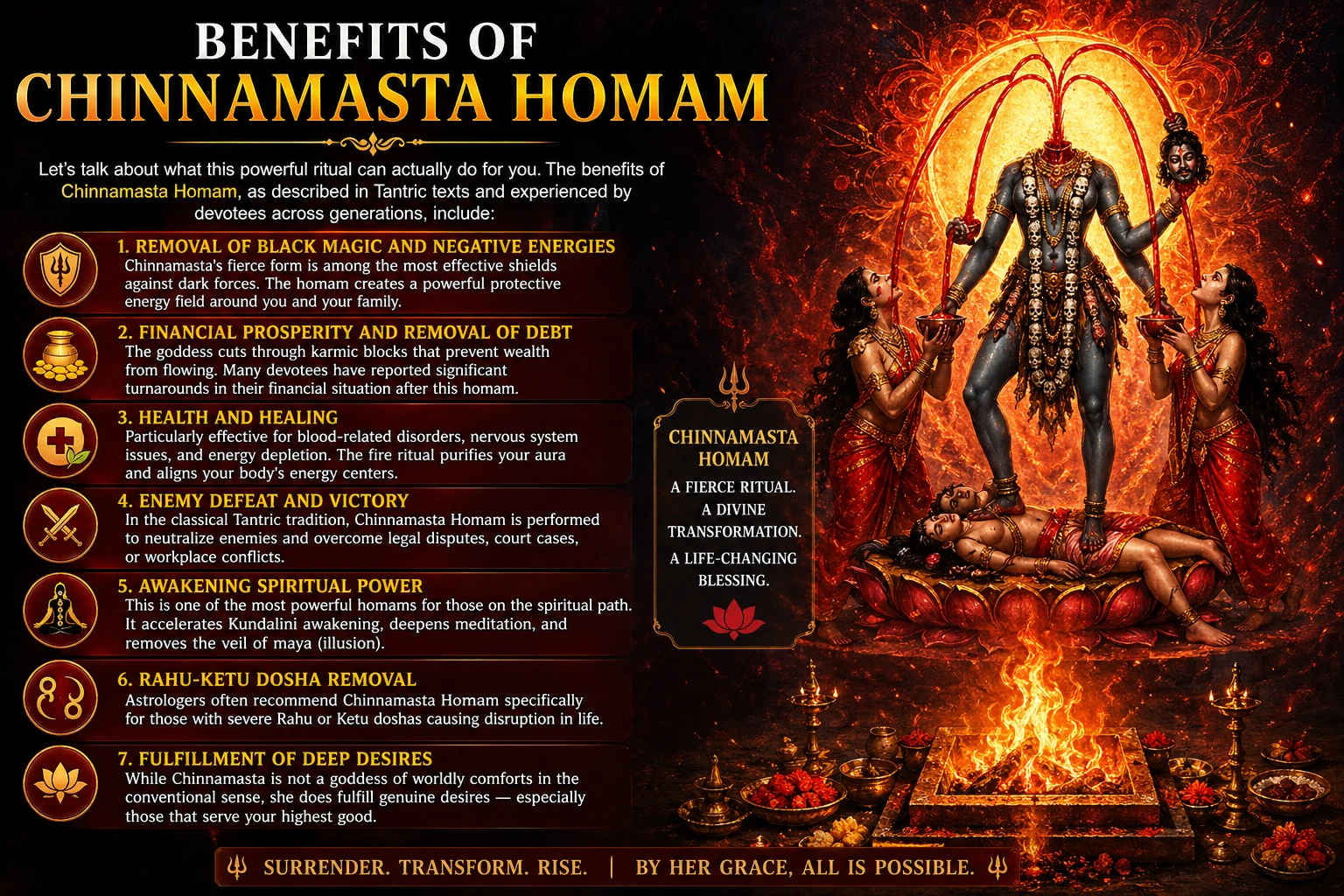
Let’s talk about what this powerful ritual can actually do for you. The benefits of Chinnamasta Homam, as described in Tantric texts and experienced by devotees across generations, include:
Removal of Black Magic and Negative Energies Chinnamasta’s fierce form is among the most effective shields against dark forces. The homam creates a powerful protective energy field around you and your family.
Financial Prosperity and Removal of Debt The goddess cuts through karmic blocks that prevent wealth from flowing. Many devotees have reported significant turnarounds in their financial situation after this homam.
Health and Healing Particularly effective for blood-related disorders, nervous system issues, and energy depletion. The fire ritual purifies your aura and aligns your body’s energy centers.
Enemy Defeat and Victory In the classical Tantric tradition, Chinnamasta Homam is performed to neutralize enemies and overcome legal disputes, court cases, or workplace conflicts.
Awakening Spiritual Power This is one of the most powerful homams for those on the spiritual path. It accelerates Kundalini awakening, deepens meditation, and removes the veil of maya (illusion).
Rahu-Ketu Dosha Removal Astrologers often recommend Chinnamasta Homam specifically for those with severe Rahu or Ketu doshas causing disruption in life.
Fulfillment of Deep Desires While Chinnamasta is not a goddess of worldly comforts in the conventional sense, she does fulfill genuine desires — especially those that serve your highest good.
The Chinnamasta Mantra: The Sound Body of the Goddess
The Chinnamasta Homam is centered around specific Tantric mantras. The primary mantra of Goddess Chinnamasta is:
Shreem Hreem Aim Vajra Vairochaniye Hreem Hreem Phat Svaha
This is the Mool (root) mantra of Chinnamasta. It is charged with powerful vibrational energy that, when chanted with proper pronunciation and intent during the fire ritual, creates a direct channel to the goddess’s energy.
There is also the Chinnamasta Gayatri Mantra and various other stotra (hymns) that are incorporated into the full homam procedure.
A critical note: Chinnamasta mantras are Tantric mantras with high potency. They should ideally be chanted by initiated priests who have undergone a proper mantra diksha (initiation). This is not a mantra to experiment with casually — the energy it invokes is real and intense. This is one reason why having a qualified Tantric priest perform the homam on your behalf is always the recommended approach.
 How Is Chinnamasta Homam Performed? The Step-by-Step Procedure
While the full procedure involves hundreds of detailed steps that only trained priests can execute correctly, here is an overview of how Chinnamasta Homam is performed:
Sankalpa (Setting the Intention) The officiating priest, together with the devotee (or on their behalf), makes a formal declaration of intention — stating who is performing the ritual, for what purpose, and invoking the blessings of the deity.
Kalasha Sthapana (Consecration of Sacred Pot) A copper or silver pot filled with sacred water, mango leaves, and a coconut is consecrated. This Kalasha represents the goddess’s presence.
Ganapati Puja No Vedic or Tantric ritual begins without invoking Lord Ganesha to remove obstacles.
Devi Avahana (Inviting the Goddess) Through specific mantras and ritual gestures (mudras), the goddess is formally invited into the ritual space.
Homam Procedure The sacred fire is lit. The priest offers ghee, sesame seeds, red flowers, special herbs, and other prescribed items into the fire while chanting the Chinnamasta mantras — typically 108 times the Mool mantra, followed by related stotras.
Purnahuti (Final Offering) The concluding grand offering into the fire, which completes the invocation and seals the ritual’s energy.
Prasad Distribution The blessed offerings are distributed as prasad to the devotees.
The entire ritual can take 3 to 6 hours depending on the scale — whether it’s performed for an individual, a family, or a large group.
Chinnamasta Japa: Can You Practice at Home?
Many people ask whether they can do Chinnamasta worship at home through Japa (mantra repetition). The answer is yes — but with important caveats.
Chinnamasta Japa is traditionally recommended only for those who have received a proper mantra diksha from a qualified Tantric guru. If you haven’t been initiated, it is safer and more effective to participate in the homam performed by expert priests, which gives you access to the full power of the goddess’s energy without the risks associated with uninitiated Tantric practice.
If you have been initiated, the Chinnamasta Japa sadhana typically involves chanting the mantra 108 times daily, ideally on a red asana (seat), facing the deity’s yantra, with red flowers and red sandalwood as offerings.
Chinnamasta Yantra: The Geometric Seat of the Goddess
In Tantric tradition, every deity has a yantra — a sacred geometric diagram that represents their energy in a visual, mathematical form. The Chinnamasta Yantra is used alongside the homam and japa for amplified results.
The yantra is typically drawn or engraved on copper and energized during the homam. Installing the energized Chinnamasta Yantra in your home or place of business is believed to create a continuous field of the goddess’s protective and transformative energy.
Best Day and Time to Perform Chinnamasta Homam
Timing matters enormously in Vedic and Tantric rituals. Chinnamasta Homam is ideally performed on:
Tuesdays and Fridays — especially during the dark fortnight (Krishna Paksha), as Chinnamasta’s energy is strongest during the waning moon.
Ashtami (8th day of the lunar fortnight) and Navami (9th day) — these tithi are considered most auspicious for Devi worship in the Tantric tradition.
During Navratri — the nine nights of the goddess are a highly potent window for any Devi-related homam.
On the nakshatra of Shatabhisha or Ashlesha — which are associated with Rahu and Ketu respectively, deities closely linked to Chinnamasta.
Aslo especially during Chinnamasta Jayanti
Our priests at Astrobhava calculate the most auspicious muhurta (time) for your Chinnamasta Homam based on your personal horoscope, ensuring maximum effectiveness.
Common Questions About Chinnamasta Homam
Is Chinnamasta Homam dangerous?
This question comes up often, and the honest answer is: only if performed incorrectly. Chinnamasta is an intense Tantric deity, and her energy is not something to take lightly. When performed by experienced, trained Tantric priests with proper protocols, the homam is safe and deeply beneficial. The danger arises only from improper practice — incorrect mantras, wrong procedure, or unqualified priests.
Can women perform Chinnamasta Homam?
Yes. In fact, Chinnamasta is a feminine energy, and women who seek her blessings — especially for health, protection, and spiritual growth — are warmly welcomed. There are no restrictions on women participating in or commissioning this homam.
How many times should the homam be performed?
For serious issues — chronic illness, strong black magic, severe Rahu-Ketu affliction — it is recommended to perform the homam 3, 9, or 11 times in succession for compounding effect. For general blessings and spiritual progress, a single properly performed homam can be sufficient.
Conclusion: Surrender to the Goddess and Let Transformation Begin
Chinnamasta Homam is not for the faint of heart — and that’s precisely what makes it so extraordinary. It is a ritual for those who are ready to go beyond surface-level prayers and engage with the raw, real, transformative power of the divine feminine.
Whether you are battling financial ruin, chronic illness, dark energies, spiritual stagnation, or the afflictions of Rahu and Ketu — Goddess Chinnamasta stands ready to cut through every obstacle that stands between you and your highest life.
At Astrobhava, our team of experienced Tantric priests and Vedic pandits perform Chinnamasta Homam with complete authenticity — using traditional materials, proper mantras, correct muhurta, and deep devotion. You can commission the homam from anywhere in the world and receive the full benefit.
Don’t wait for things to get worse. The goddess is already reaching out — are you ready to receive her grace?
Frequently Asked Questions (FAQs)
Q1. What is Chinnamasta Homam?
Chinnamasta Homam is a Tantric fire ritual performed to invoke Goddess Chinnamasta, the sixth Mahavidya, for removing obstacles, negative energies, Rahu-Ketu doshas, and to accelerate spiritual growth and transformation.
Q2. Who is Goddess Chinnamasta?
Chinnamasta is one of the ten Mahavidyas in the Hindu Tantric tradition. She is depicted with her own severed head, symbolizing the dissolution of ego and the transcendence of desire. She is associated with Kundalini Shakti and radical self-transformation.
Q3. What are the main benefits of Chinnamasta Homam?
Key benefits include removal of black magic, financial prosperity, healing from illness, protection from enemies, Rahu-Ketu dosha pacification, and Kundalini awakening.
Q4. Can I perform Chinnamasta Homam at home?
The homam requires trained Tantric priests and specific ritual materials. Chinnamasta Japa can be done at home only after receiving proper mantra initiation from a qualified guru.
Q5. How long does Chinnamasta Homam take? Depending on the scale, it takes between 3 to 6 hours to complete the full ritual procedure.
Q6. On which day should Chinnamasta Homam be performed?
Tuesdays and Fridays during the dark fortnight of the lunar calendar are most auspicious, especially on Ashtami and Navami tithi.
Q7. Is Chinnamasta Homam safe?
Yes, when performed by experienced and initiated Tantric priests following correct procedures. Astrobhava’s priests are fully trained and initiated for this specific ritual.
Q8. What is the Chinnamasta Mantra used in the homam?
The primary mantra is: Shreem Hreem Aim Vajra Vairochaniye Hreem Hreem Phat Svaha. This is a Tantric mantra and should only be chanted by initiated practitioners.
Q9. Can Chinnamasta Homam be performed online or by proxy?
Yes. You can commission the homam to be performed on your behalf by Astrobhava priests. You will receive prasad, the homam video, and a post-ritual consultation.
Q10. How many times should the homam be performed for best results?
For serious afflictions, it is recommended to perform the homam 3, 9, or 11 times. For general blessings, once is sufficient when done correctly.