If you have been exploring the world of Vedic fire rituals to seek Lord Shiva’s blessings, chances are you have come across two names that sound similar but are vastly different in scale, intensity, and purpose — Laghu Rudra Homa and Maha Rudra Homa. Both are extraordinarily powerful. Both are rooted in the sacred Sri Rudram of the Yajur Veda. Yet choosing the wrong one — or not understanding what you are committing to — can leave you confused or underprepared.
This guide breaks down everything you need to know about Laghu Rudra and Maha Rudra: the mantras chanted, the number of priests involved, the duration, the rituals performed step by step, the benefits, who should perform which, and the ideal times to schedule them. Whether you are an NRI in the USA, UK, Canada, or Australia looking to book a homa remotely, or a devotee seeking deeper clarity before making a decision, read this all the way through.
First, Let’s Understand the Root: What Is Rudra Homa?
Before diving into the difference between Laghu Rudra and Maha Rudra, it helps to understand the foundation they both stand on.
A Rudra Homa is a sacred Vedic fire ritual in which trained priests invoke Lord Rudra — the fierce, transformative, and compassionate aspect of Lord Shiva — through the chanting of Sri Rudram (also called Namakam) and Chamakam, both from the Krishna Yajur Veda. The sacred fire (Agni) in the Homa Kunda acts as the divine messenger, carrying your prayers, offerings, and intentions directly to Lord Rudra.
One recitation of Sri Rudram (Namakam) followed by one recitation of Chamakam is called a Rudram or Roopam. Eleven such recitations of Namakam paired with one recitation of Chamakam at the end of each constitute one Ekadasa Rudram. This is where the mathematical ladder of Rudra homas begins.
- Ekadasa Rudram = 11 Namakams + 1 Chamakam (repeated after each)
- Laghu Rudram = 11 rounds of Ekadasa Rudram = 121 recitations of Namakam
- Maha Rudram = 11 rounds of Laghu Rudram = 1331 recitations of Namakam
This is the precise Vedic arithmetic that separates the two. Laghu Rudra is the foundational form; Maha Rudra is eleven times more powerful.
 What Is Laghu Rudra Homa?
The word “Laghu” in Sanskrit means small or concise — but do not let that mislead you. Laghu Rudra Homa is anything but ordinary. It is one of the most powerful Shiva rituals available to an individual devotee and is described in the Shiva Purana as the foremost practice for invoking the divine aura of Lord Rudra.
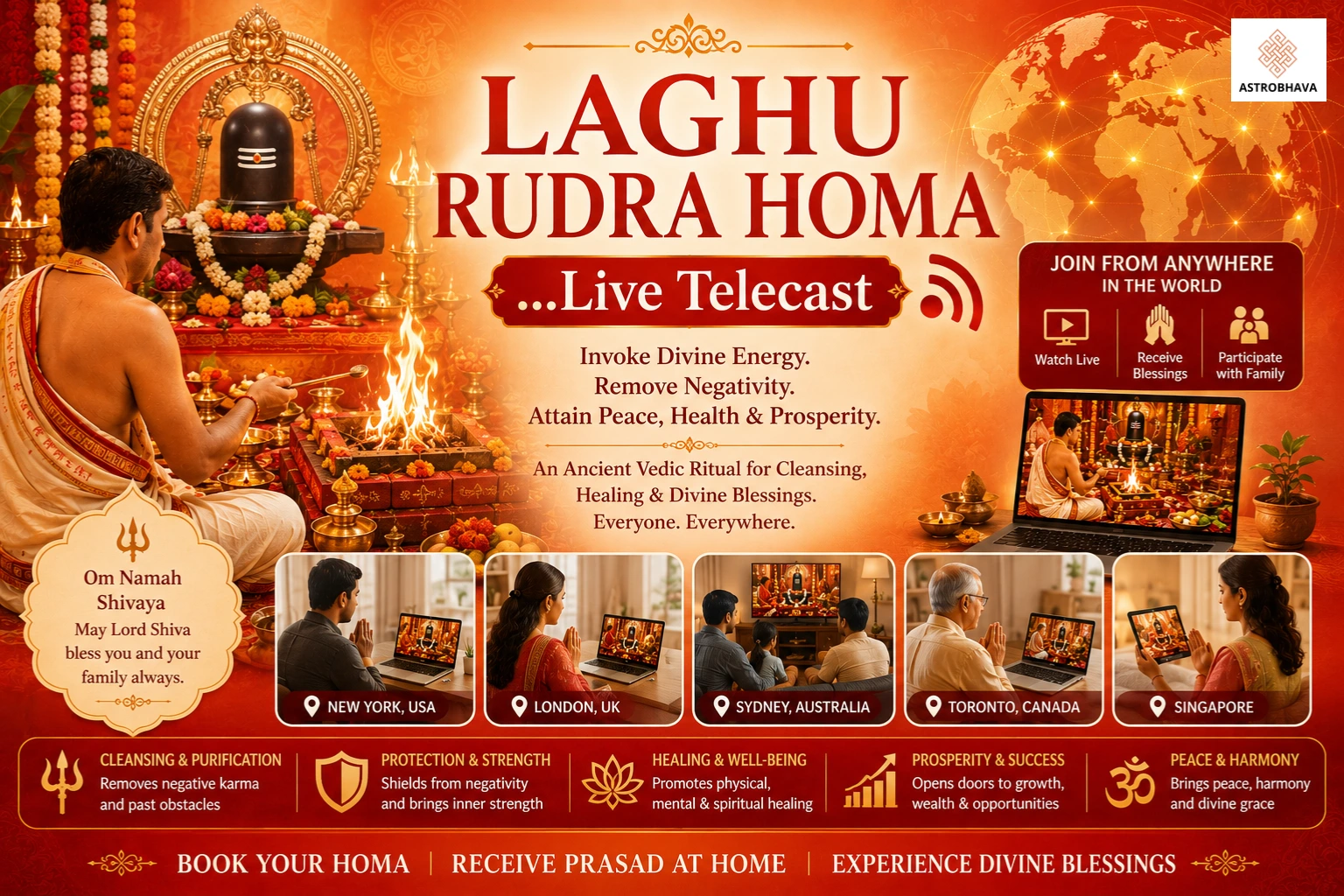
At AstroBhava, the Laghu Rudra Homa is performed by 4 expert Vedic priests over a duration of 3+ hours. During the ritual, each priest chants 3 rounds of Maha Rudram, completing a total of 12 rounds — along with the prescribed counts of Chamakam after each Rudram recitation.
✨ Ready to invite Lord Rudra’s blessings into your life?
Book Your Laghu Rudra Homa at AstroBhava — Performed Live Worldwide with a Free Energized Rudra Yantra.
What Is Maha Rudra Homa?
“Maha” means great or grand. The Maha Rudra Homa is a monumental Vedic ritual that invokes not just one but all eleven forms of Lord Rudra simultaneously. It is the highest form of individual Rudra worship performed to address deeply rooted life challenges, severe karmic burdens, chronic ailments, and major spiritual transformations.
At AstroBhava, the Maha Rudra Homa is performed by 12 expert Vedic priests over 6 full days, with each day running for 12 hours — making it a total of 72 hours of uninterrupted sacred ritual. The total chant count reaches a staggering 1,584 rounds of Maha Rudram — each priest completing 132 rounds across the six days — along with the Chamakam chanted in prescribed counts after each Rudram.
This is not just a homa. This is a complete spiritual transformation event.
🔥 Seeking a life-altering shift? Book the Maha Rudra Homa at AstroBhava — 12 Priests, 6 Days, 72 Hours of Sacred Fire. Live. Worldwide.
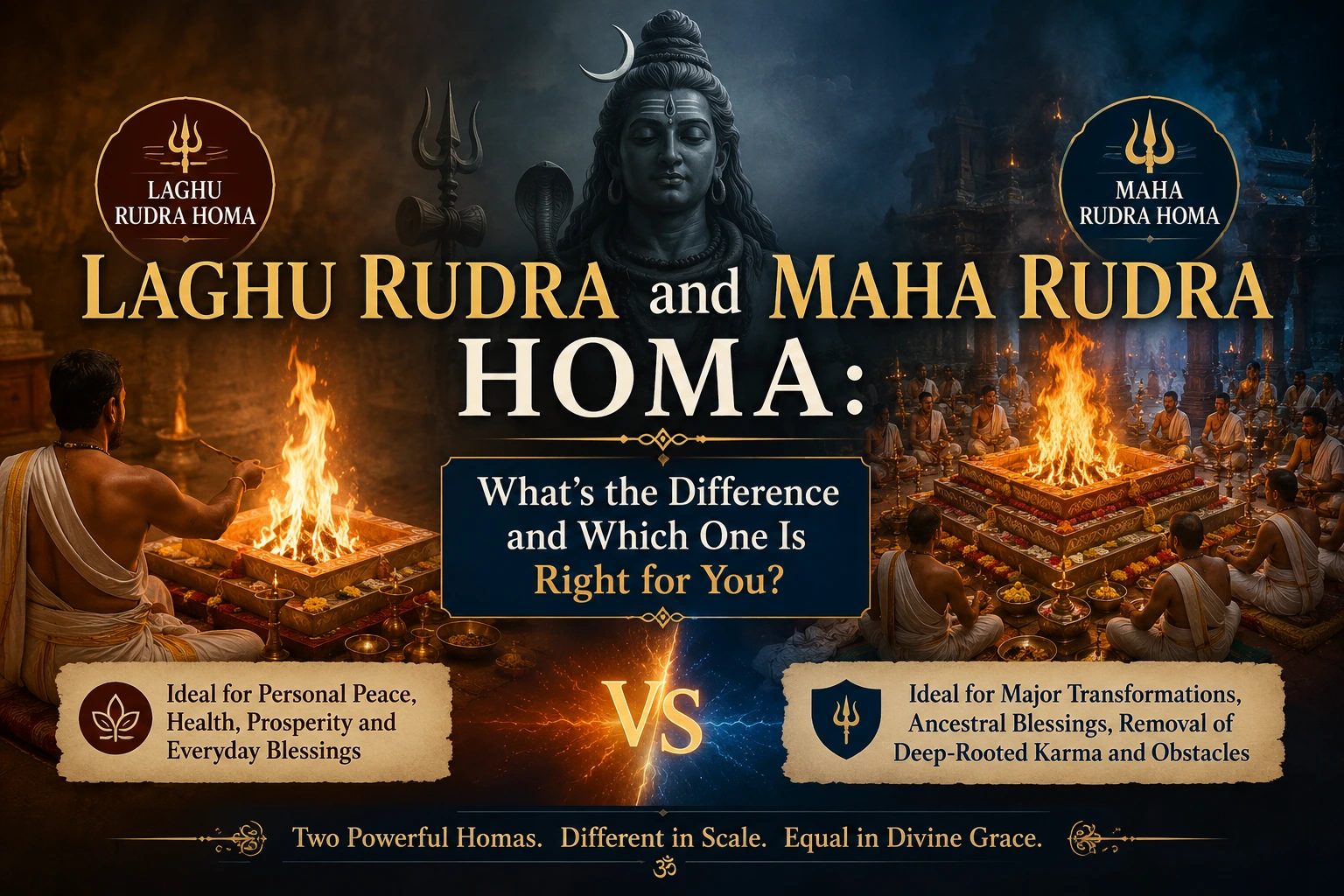
Laghu Rudra and Maha Rudra: Side-by-Side Comparison
Here is a clear breakdown of the key differences between Laghu Rudra and Maha Rudra so you can make an informed decision at a glance.
Namakam Recitations Laghu Rudra Homa: 121 times | Maha Rudra Homa: 1,331 times
Chamakam Recitations Laghu Rudra Homa: 11 times (once after each Ekadasa Rudram set) | Maha Rudra Homa: 121 times
Number of Priests (AstroBhava) Laghu Rudra Homa: 4 priests | Maha Rudra Homa: 12 priests
Total Chant Rounds Laghu Rudra Homa: 12 rounds of Maha Rudram | Maha Rudra Homa: 1,584 rounds of Maha Rudram
Duration Laghu Rudra Homa: 3+ hours | Maha Rudra Homa: 6 days, 12 hours/day (72 hours total)
Scale Laghu Rudra Homa: Concise, focused, individual | Maha Rudra Homa: Grand, multi-day, all-encompassing
Ideal For Laghu Rudra Homa: Obstacles, health, karma cleansing, protection, general prosperity | Maha Rudra Homa: Severe doshas, chronic illness, major life transformations, deep karmic removal, universal peace
Intensity Laghu Rudra Homa: Highly powerful | Maha Rudra Homa: Supreme — 11x the intensity of Laghu Rudra
 Step-by-Step Ritual Procedure: Laghu Rudra Homa
Both homas follow a structured Vedic procedure, though the Maha Rudra Homa is naturally more elaborate. Here is how the Laghu Rudra Homa unfolds:
- Preparation and Purification Participants bathe and dress in clean, traditional attire. The Homa Kunda (sacred fire pit) is prepared and decorated with sacred symbols, flowers, and auspicious items. The entire space is consecrated to create a divine ambiance.
- Kalash Sthapana and Panchang Sthapana The Kalash (sacred pot) is installed along with the Panchang Sthapana, which includes invoking Gauri-Ganesh, Punyavachan, Shodash Matrika, Navgraha, and Sarvotabhadra. This establishes the sacred cosmic framework of the ritual.
- Ganesh Puja and Abhishek The ritual begins with a Ganesh Puja — the invocation of Lord Ganesha to remove all obstacles and ensure the homa proceeds without interruption. This is non-negotiable in any Vedic ceremony.
- Navgraha Puja and Mantra Japa The nine planetary deities are honored with their respective mantras — 108 chants each — seeking their harmony and blessings before the main ritual begins.
- Sankalpa The most personal and powerful step: the presiding priest takes the Sankalpa on behalf of the devotee — stating the devotee’s name, birth details, gotra, and specific intention (wish or prayer). This formally dedicates the entire homa to the devotee’s cause.
- Invocation of Lord Rudra — Sri Rudram Chanting The sacred fire is lit in the Homa Kunda. The 4 priests then begin the systematic chanting of Sri Rudram (Namakam), completing 12 total rounds of Maha Rudram, with Chamakam recited in the prescribed sequence after each set. Bilva leaves, ghee, sesame seeds, sacred herbs, and other prescribed offerings are made into the fire with each mantra recitation.
- Purnahuti (Final Offering) The culminating offering is made into the sacred fire, symbolizing the complete surrender of the devotee’s ego, burdens, and prayers to Lord Rudra.
- Aarti, Pushpanjali, and Brahmin Bhojan The ceremony closes with Aarti (lamp worship), Pushpanjali (flower offering), and a donation/meal for Brahmins — completing the ritual with gratitude and generosity.
Step-by-Step Ritual Procedure: Maha Rudra Homa
The Maha Rudra Homa follows the same foundational steps but is vastly amplified in scope, detail, and duration across 6 days.
Day 1 — Invocation and Sacred Installation The opening day begins with Ganapathi Puja, Kalash Sthapana, Navgraha Puja, and the detailed Panchang Sthapana. All eleven forms of Lord Rudra are formally invoked and welcomed. The Homa Kunda is consecrated for multi-day use. The Sankalpa is taken for the devotee in an elaborate ceremony.
Days 1 through 6 — Continuous Sri Rudram Chanting and Homa Across all six days, the 12 priests work in disciplined shifts, each completing 132 rounds of Maha Rudram over the course of the ritual. The daily 12-hour schedule includes sustained Sri Rudram chanting, rhythmic Chamakam recitations, and thousands of sacred offerings — including ghee, herbs, bilva leaves, rice, sesame, and other Vedic samidhas — poured into the fire to the accompaniment of powerful Vedic hymns.
Abhisheka of All Eleven Rudras One of the unique features of the Maha Rudra Homa is the Rudrabhishekam offered to all 11 Rudras using the prescribed 11 dravyas (sacred liquids), including milk, honey, curd, ghee, sugarcane juice, rose water, sandalwood paste, and panchamrit. This is performed as per the prescription of the Shiva Purana.
Purnahuti on Day 6 The final day culminates with the grand Purnahuti — a massive, collective final offering made by all 12 priests together — followed by an elaborate Aarti, Pushpanjali, and charity to Brahmins.
Post-Ritual Prasad Dispatch At AstroBhava, the energized Rudra Yantra and Prasad are shipped internationally to the devotee, so even if you are watching live from New York, London, or Toronto, the sacred blessings reach you physically.
Benefits: How They Differ
Both Laghu Rudra and Maha Rudra deliver life-transforming blessings of Lord Rudra. The difference lies in depth and intensity.
Benefits of Laghu Rudra Homa are focused and immediate: purification of deep-seated karma, enhanced inner peace and emotional balance, strong divine protection from negative forces, excellent health and vitality, removal of obstacles in career and personal life, neutralization of malefic planetary effects and doshas, attraction of prosperity, and strengthening of family harmony. It is also especially beneficial for those experiencing Kaal Sarp Dosha, Pitra Dosha, or Shani-related challenges.
Benefits of Maha Rudra Homa operate at a supreme and universal level: complete removal of major life obstacles and long-standing delays, powerful relief from chronic and debilitating health issues, deep cleansing of heavy past karma and severe planetary doshas, decisive victory in career, business, and legal matters, restoration of peace in turbulent families, attraction of significant wealth and financial stability, and overall life-transforming auspiciousness. Those performing Maha Rudra Homa are invoking the combined power of all 11 Rudras — a force that is believed in Vedic tradition to purify not just the individual but the entire environment around them.
💫 Not sure which ritual is right for your situation?
WhatsApp AstroBhava Now for free, personalized guidance from expert Vedic priests.
Who Should Choose Laghu Rudra Homa?
The Laghu Rudra Homa is ideal for you if you are facing recurring obstacles in career or personal life, dealing with moderate health concerns, experiencing stress, anxiety, or emotional turbulence, seeking to remove specific doshas from your horoscope, looking to attract general prosperity and family harmony, or if you are new to Rudra homas and want a powerful yet contained ritual to begin your devotional journey. It is also a meaningful annual practice for regular Shiva devotees.
The Laghu Rudra Homa is especially recommended during auspicious months such as Shravan (July–August), Mahashivaratri periods, Pradosham days, and during one’s Janma Nakshatra or birthday month. These timings amplify the ritual’s potency significantly.
Who Should Choose Maha Rudra Homa?
The Maha Rudra Homa is for those navigating the deepest challenges life can throw. Choose this if you are dealing with a life-threatening or chronic illness that has not responded to other remedies, experiencing severe and long-standing financial ruin or business failure.
You can also perform it if you are going through extreme family conflict or marital breakdown, suffering the effects of serious doshas like Kaal Sarp, Pitra Dosha, or Guru Chandal Yoga in an intense form, seeking spiritual enlightenment and a total reset of your karmic slate, or undertaking a major endeavor that requires supreme divine support — a new business, a critical legal case, or a health crisis. Businesses, communities, and families who wish to invoke peace and transformation on a collective scale also find the Maha Rudra Homa to be an extraordinary recourse.
Can NRIs Abroad Book These Homas?
Absolutely — and this is one of the most common questions from our global devotees. At AstroBhava, both Laghu Rudra Homa and Maha Rudra Homa are performed live worldwide. You can watch the ritual unfold in real time via a live stream, participate in the Sankalpa from wherever you are, and have the energized Rudra Yantra and Prasad shipped directly to your home in the USA, UK, Canada, Australia, or anywhere else globally.
The process is simple: book your homa, provide your name, date of birth, place of birth, and Sankalpa (your specific wish), and AstroBhava’s priests schedule the ritual on a Vedically auspicious date and time selected through traditional Muhurta analysis.
🌍 Joining from abroad? Book Your Rudra Homa at AstroBhava — Live Worldwide, Fully Personalized, Prasad Shipped to You.
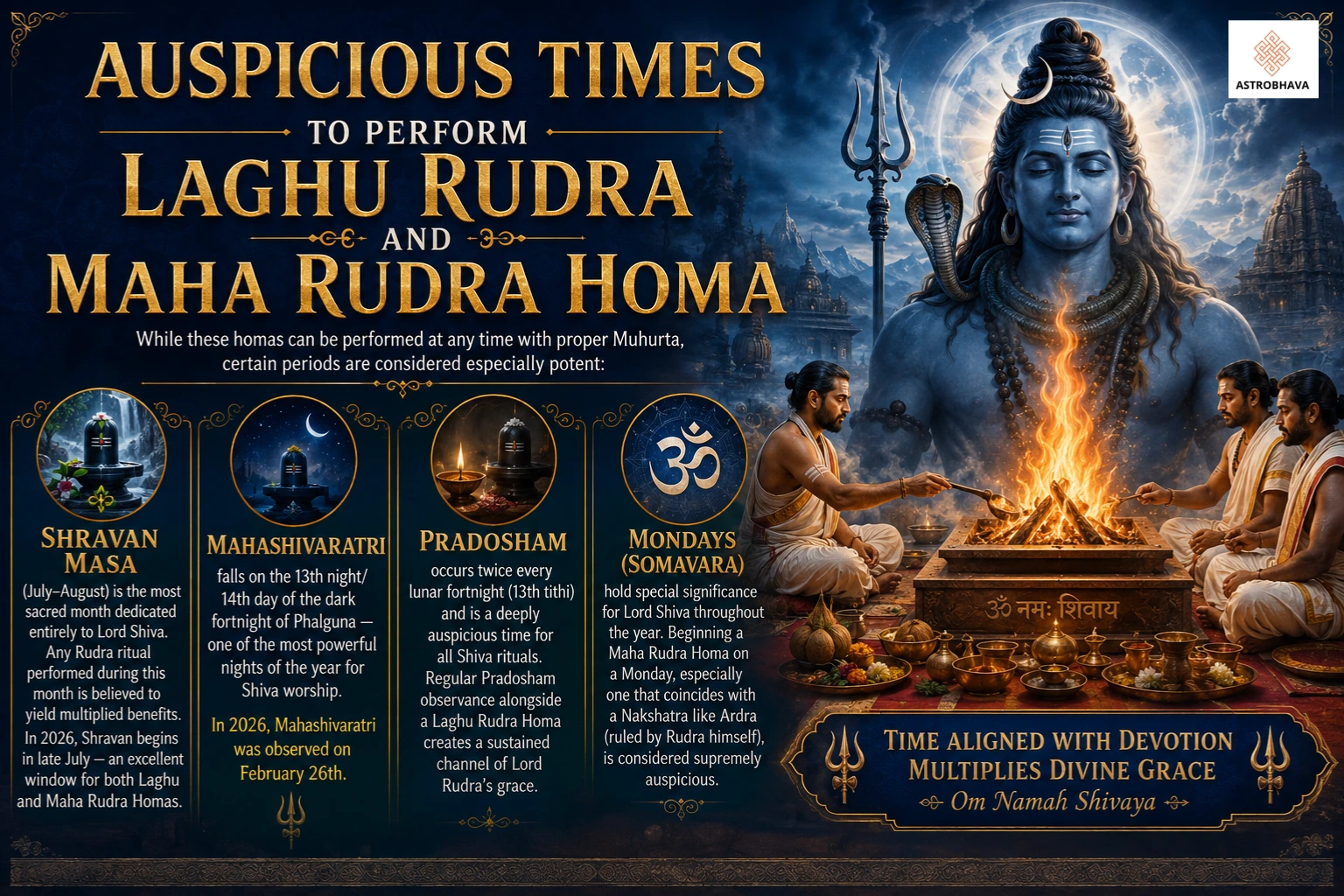 Auspicious Times to Perform Laghu Rudra and Maha Rudra Homa
While these homas can be performed at any time with proper Muhurta, certain periods are considered especially potent:
Shravan Masa (July–August) is the most sacred month dedicated entirely to Lord Shiva. Any Rudra ritual performed during this month is believed to yield multiplied benefits. In 2026, Shravan begins in late July — an excellent window for both Laghu and Maha Rudra Homas.
Mahashivaratri falls on the 13th night/14th day of the dark fortnight of Phalguna — one of the most powerful nights of the year for Shiva worship. In 2026, Mahashivaratri was observed on February 26th.
Pradosham occurs twice every lunar fortnight (13th tithi) and is a deeply auspicious time for all Shiva rituals. Regular Pradosham observance alongside a Laghu Rudra Homa creates a sustained channel of Lord Rudra’s grace.
Mondays (Somavara) hold special significance for Lord Shiva throughout the year. Beginning a Maha Rudra Homa on a Monday, especially one that coincides with a Nakshatra like Ardra (ruled by Rudra himself), is considered supremely auspicious.
A Quick Note on the Rudra Homa Hierarchy
It helps to know where Laghu Rudra and Maha Rudra fit within the complete spectrum of Rudra worship. The full hierarchy from the Vedic tradition is:
Roopam (1 Rudram) → Ekadasa Rudram (11 Rudrams) → Laghu Rudram (121 Rudrams) → Maha Rudram (1,331 Rudrams) → Ati Rudram (14,641 Rudrams)
Laghu and Maha Rudra are the two most commonly accessible forms of elevated Rudra worship for individual devotees, with Ati Rudram being a rare, once-in-a-generation universal event requiring 121 priests over 11+ days.
Conclusion
The difference between Laghu Rudra and Maha Rudra is not merely one of size — it is one of intention, depth, and divine reach. The Laghu Rudra Homa is a powerfully focused ritual for individual purification, protection, and prosperity, performed in 3+ hours by 4 priests with 12 rounds of Maha Rudram chanting. The Maha Rudra Homa is an all-encompassing, multi-day sacred event spanning 72 hours, 12 priests, and 1,584 rounds of Maha Rudram — invoking all 11 forms of Lord Rudra for supreme transformation.
If you are navigating life’s everyday challenges and seeking Lord Rudra’s grace, Laghu Rudra Homa is your answer. If life has brought you to your knees and you are seeking a complete divine intervention, Maha Rudra Homa is the path.
Either way, when performed with sincerity, proper Vedic procedure, and genuine devotion, both homas have the extraordinary power to transform your life, clear your karma, and bring you into alignment with the grace of Lord Rudra — the great destroyer of suffering and the bestower of ultimate liberation.
🙏 Ready to take the next step? Explore both homas at AstroBhava and book with confidence — Laghu Rudra Homa | Maha Rudra Homa
Frequently Asked Questions (FAQs)
Q1. What is the main difference between Laghu Rudra and Maha Rudra Homa?
The core difference lies in the scale and intensity of mantra recitation. Laghu Rudra Homa involves 121 recitations of the Namakam (Sri Rudram) performed in approximately 3+ hours by 4 priests. Maha Rudra Homa involves 1,331 recitations spread across 6 days by 12 priests, totaling 72 hours of sacred ritual. Maha Rudra is eleven times more powerful than Laghu Rudra.
Q2. Can Laghu Rudra and Maha Rudra Homa be performed online or remotely?
Yes. At AstroBhava, both homas are performed live online with worldwide streaming. Devotees from the USA, UK, Canada, Australia, and beyond can watch the ritual live, participate in the Sankalpa virtually, and receive the energized Rudra Yantra and Prasad shipped to their address.
Q3. Who is eligible to have Laghu Rudra or Maha Rudra Homa performed?
Anyone can have these homas performed on their behalf, regardless of caste, gender, or location. You do not need to be physically present. You simply need to provide your name, date of birth, place of birth, and your Sankalpa (specific prayer or intention).
Q4. How many priests perform the Laghu Rudra and Maha Rudra Homa at AstroBhava?
At AstroBhava, the Laghu Rudra Homa is performed by 4 expert Vedic priests and the Maha Rudra Homa is performed by 12 expert Vedic priests over 6 days.
Q5. What is the best time of year to perform Laghu Rudra or Maha Rudra Homa?
The most auspicious periods are Shravan Masa (July–August), Mahashivaratri, Pradosham days (the 13th tithi of each fortnight), and Mondays. The month of Shravan is entirely dedicated to Lord Shiva and is considered the highest potency window for any Rudra ritual.
Q6. What offerings are made in Laghu Rudra and Maha Rudra Homa?
Traditional Vedic offerings include pure cow’s ghee, bilva leaves, sesame seeds, rice, sacred herbs, coconut, honey, sugarcane, and other prescribed Vedic samidhas (fire offerings). In the Maha Rudra Homa, Rudrabhishekam is additionally performed with 11 sacred liquids including milk, curd, honey, panchamrit, and sandalwood water.
Q7. What are the key benefits of Laghu Rudra Homa?
Key benefits include karma purification, obstacle removal, divine protection, improved health and vitality, neutralization of malefic planetary doshas, and attraction of prosperity and family harmony.
Q8. What are the key benefits of Maha Rudra Homa?
The Maha Rudra Homa delivers supreme divine protection, relief from chronic illness, deep karmic cleansing, victory in career and legal matters, financial restoration, and a profound life-transforming shift that touches every aspect of the devotee’s existence.
Q9. Is Maha Rudra Homa more powerful than Laghu Rudra Homa?
Yes, significantly so. The Maha Rudra Homa is 11 times more powerful than the Laghu Rudra Homa by Vedic count. While both are extraordinary in their own right, the Maha Rudra Homa is reserved for those facing deep-rooted and severe life challenges or those seeking the highest level of divine grace and spiritual transformation.
Q10. What is the cost of Laghu Rudra Homa and Maha Rudra Homa at AstroBhava?
At AstroBhava, the Laghu Rudra Homa is priced at $702.4 USD and the Maha Rudra Homa is priced at $20450 USD. Both include a free energized Rudra Yantra shipped globally. The investment reflects the scale, number of expert priests involved, and the duration of the sacred ritual. Contact AstroBhava via WhatsApp at +91 96295 55442 for guidance on the right ritual for your situation.