Have you ever sat before an exam, a major presentation, or an important life decision and felt your mind go completely blank — like wisdom itself had stepped out of the room? If so, you are not alone. The ancient Vedic rishis understood this struggle intimately, and they left behind a profound gift to address it: the Medha Sukta Homam.
This is not just another fire ritual. This is one of the most precisely constructed Vedic remedies for the human mind — a sacred invocation drawn directly from the Taittiriya Aranyaka of the Krishna Yajurveda, offered into consecrated fire to awaken the divine faculty of Medha — the power to receive, retain, and radiate knowledge. Whether you are a student preparing for competitive exams, a professional seeking clarity, a parent wanting the best for your children, or a spiritual seeker longing for deeper wisdom, the Medha Sukta Homam has the power to transform your inner world.
Let’s explore this extraordinary ritual in depth — its origins, its mechanics, its benefits, and how you can perform or commission it with the authenticity it deserves.
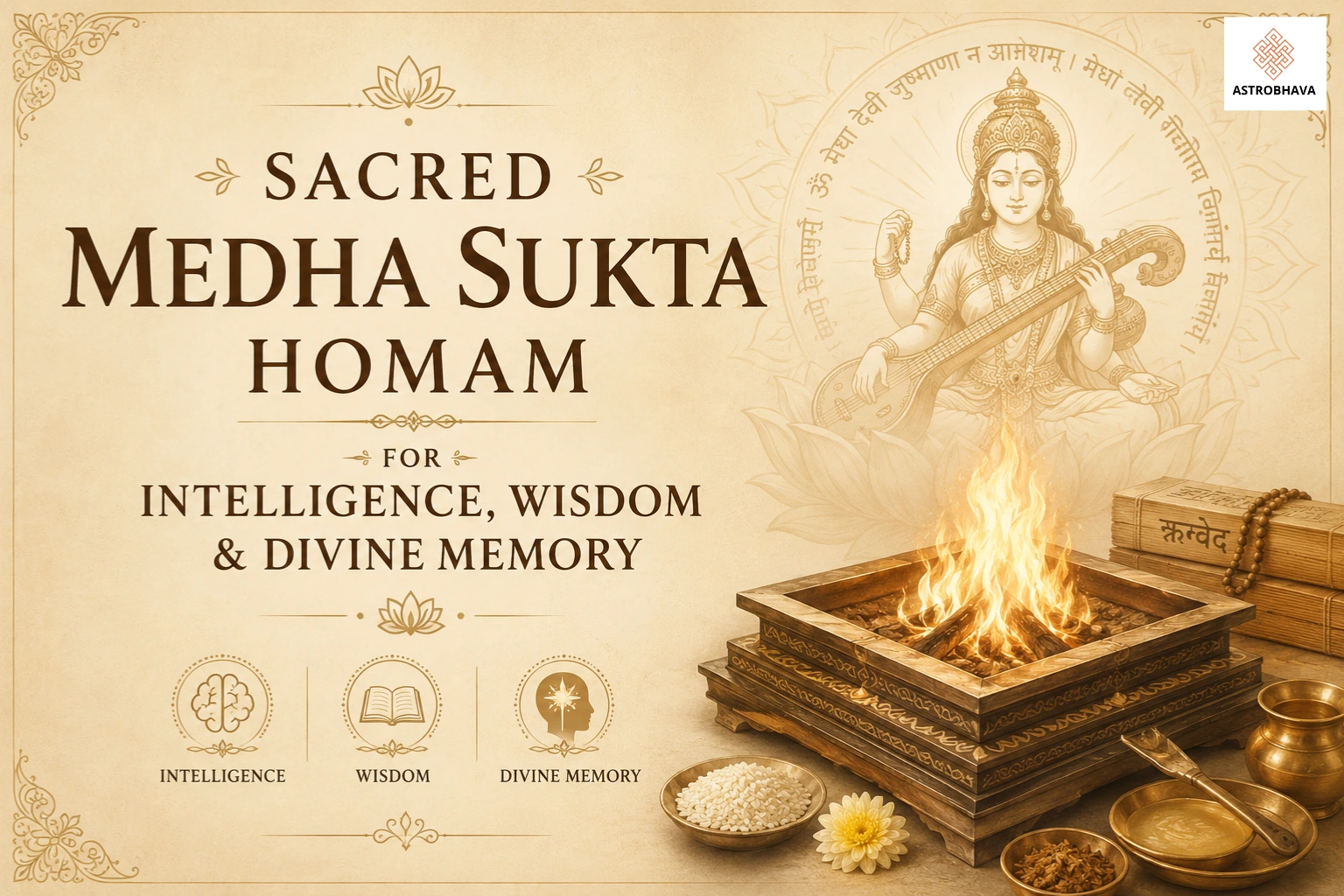 What Is Medha Sukta Homam?
At its heart, the Medha Sukta Homam is a sacred Vedic fire sacrifice performed with the systematic recitation of the Medha Suktam — a cluster of six powerful hymns drawn from the Mahanarayana Upanishad (also called Narayanavalli), which forms part of the Taittiriya Aranyaka of the Krishna Yajurveda. The word Medha in Sanskrit refers specifically to “the power of understanding endowed with consciousness” — not just memory or intelligence in the ordinary sense, but the divine cognitive faculty that allows a being to truly comprehend, retain, and apply wisdom. Suktam means “that which is well-said” — a perfectly composed sacred verse. And Homam refers to the ritual of offering into sacred fire.
When these three elements unite — the pristine mantra, the sacred fire (Agni), and devoted intention — the result is a Vedic ceremony of extraordinary potency.
It is important to understand that the Medha Sukta Homam is not merely a prayer to one deity. These six verses invoke a constellation of divine powers: Indra (the king of the gods, representing inner strength and leadership), Surya (the sun god, bestowing brilliance and radiance of mind), Agni (the fire deity, granting vital vigor and inner light), Goddess Medha Devi (the embodiment of pure intellect and divine memory), Goddess Saraswati (the goddess of knowledge, speech, and the arts), and the twin Ashvins (the divine physicians who bestow sharpness of perception). Each deity is called upon to contribute a specific dimension of intelligence — making this one of the most comprehensive Vedic rituals for cognitive and spiritual elevation.
There is also a nine-mantra version of the Medha Suktam appearing as a Khila Sukta to the Rigveda. Both versions carry profound shakti; the Taittiriya Aranyaka version is the most widely performed in the context of formal Homam.
The Scriptural Roots: Why This Homam Carries Such Depth
The Taittiriya Aranyaka belongs to the class of texts traditionally studied deep in forest hermitages — aranya means forest — by Vedic students who had undergone rigorous preparation. These were not texts composed casually. They contain the deepest esoteric teachings of the Krishna Yajurveda tradition, and the Medha Suktam sits within this sacred matrix.
The Mahanarayana Upanishad, which houses the Medha Suktam, also contains other celebrated hymns like the Durga Suktam and the Narayana Suktam — placing the Medha Suktam in extremely elevated scriptural company. This lineage is why the Medha Sukta Homam is not a popular folk ritual but a high-caliber Vedic ceremony, typically performed by learned Vedic priests who are specifically trained in Taittiriya recitation.
The Six Verses of the Medha Suktam and What They Invoke
Each of the six verses of the Medha Suktam targets a specific dimension of intelligence. Together, they form a complete map of the human mind seeking divine illumination.
Verse 1 opens by invoking Indra to bestow intelligence, Saraswati to grant wisdom, and the twin Ashvins adorned with lotus garlands to bless the devotee with sharp intellect. This is the foundational invocation — setting the stage for all that follows.
Verse 2 expands the invocation to Agni (seeking vigor and inner fire), Indra (requesting bodily strength and leadership capacity), and Surya (asking for mental brilliance and radiance). The triad of fire, sovereignty, and solar light together represent the full spectrum of intellectual vitality.
Verse 3 through Verse 6 continue to deepen this invocation — calling upon Medha Devi directly, seeking the ability to understand and retain sacred learning, asking for clarity of speech and thought, and culminating in a prayer for divine memory that does not waver even under pressure.
What makes the Medha Suktam remarkable is that it addresses intelligence not as a single faculty but in its many dimensions: instinctual wisdom, scholarly acumen, creative talent, ethical discernment, and spiritual insight — all simultaneously.
Key Benefits of Medha Sukta Homam
The Medha Sukta Homam is one of the most specifically targeted Vedic rituals in the tradition, and its benefits are correspondingly precise:
Enhanced Memory and Retention — The ritual directly invokes Medha Devi, the personification of retentive memory. Devotees who have performed this Homam regularly report a noticeable improvement in their ability to absorb and recall information — particularly in academic and professional contexts.
Sharpened Concentration and Focus — One of the most immediate effects reported is relief from mental fog. The vibratory energy of the Medha Suktam chanted in fire ceremony creates a purified energy field that supports sustained attention and deep focus.
Removal of Mental Obstacles and Confusion — Just as obstacles in Ganesha’s realm are cleared before any ritual begins, the Medha Sukta Homam specifically targets the mental barriers — self-doubt, confusion, intellectual laziness, and anxiety — that prevent a person from accessing their full potential.
Strengthened Academic and Professional Performance — This Homam is especially recommended before major examinations, interviews, research presentations, creative projects, or any endeavor requiring peak intellectual performance.
Awakening of Creative Intelligence — Medha is not limited to rote memory. She governs the deeper creative intelligence — the capacity to connect ideas, innovate, compose, and envision. Artists, writers, musicians, and researchers benefit immensely.
Spiritual Wisdom and Self-Knowledge — Beyond worldly intelligence, the Medha Suktam seeks prajna — the wisdom that penetrates the nature of reality itself. Regular connection with this ritual deepens one’s spiritual understanding over time.
Improved Speech and Communication — The invocation of Saraswati in the Homam specifically blesses the devotee with clarity and power of speech — invaluable for teachers, lawyers, speakers, and writers.
Positive Aura and Inner Confidence — Fire ceremonies generate a purified pranic environment. Participants and beneficiaries of the Medha Sukta Homam frequently report a renewed sense of inner confidence and mental calm.
Who Should Perform Medha Sukta Homam?
The Medha Sukta Homam is genuinely one of the most universally applicable Vedic rituals. It is specifically recommended for:
Students at any level — school, college, competitive examinations (UPSC, GATE, SAT, LSAT, MCAT, bar exams, board certifications), and professional certifications. The ritual is traditionally performed before a new academic year begins or before high-stakes examinations.
Researchers and Academics who need the sustained capacity for original thought, retention of vast bodies of knowledge, and clear articulation of complex ideas.
Children showing learning difficulties — parents across traditions have commissioned this Homam for children who struggle with concentration, reading, or academic performance. The results, when performed with authentic Vedic precision, can be remarkable.
Professionals in knowledge-intensive fields — lawyers, doctors, engineers, consultants, and financial analysts who need sharp analytical minds under high pressure.
Spiritual seekers who wish to deepen their understanding of sacred texts, accelerate their contemplative practice, or develop the discernment needed for genuine spiritual growth.
Artists and Creatives — since Medha governs creative intelligence as much as analytical intelligence, musicians, writers, filmmakers, and designers find deep resonance with this ritual.
Anyone experiencing mental fatigue, brain fog, or intellectual stagnation — sometimes the mind simply needs a divine reset.
The Full Procedure of Medha Sukta Homam: Step by Step
The Medha Sukta Homam follows the classical Vedic Homam structure with specific modifications that honor Medha Devi and the Taittiriya tradition. Here is the authentic procedure:
Step 1: Purification and Preparation (Shuddhi)
The ritual space is thoroughly cleansed, and the Havan Kund — the sacred fire altar — is set up in a clean, well-ventilated space. The altar area is purified by sprinkling Gangajal (holy Ganga water). All participants bathe, wear clean traditional clothing, and sit facing east or north. The priests who conduct the ceremony must observe brahmacharya (purity of body and mind) on the day of the ritual.
Step 2: Sankalpa (Sacred Intention)
The officiating Vedic priest leads the beneficiary in making the Sankalpa — a formal declaration of sacred intention. The devotee holds water and sacred darbha (kusha) grass in their right hand and states their name, gotra (lineage), nakshatra (birth star), the specific purpose of the ritual, and the benediction they seek. This aligns the cosmic support of the ceremony precisely with the individual’s need.
Step 3: Ganapati Puja and Navagraha Invocation
No Vedic ritual begins without first invoking Lord Ganesha, the remover of obstacles. The priest performs a brief Ganapati Puja with the mantra “Om Gan Ganapataye Namah Svaha” into the fire. This is followed by offerings to the nine planets (Navagrahas) with “Om Navagrahaya Namah Svaha” to neutralize any planetary resistance to the ceremony.
Step 4: Kalasha Sthapana (Sacred Vessel Consecration)
A copper or brass Kalasha (pot) is filled with pure water, mango leaves, and a coconut, and consecrated as the divine vessel of Goddess Medha Devi and Saraswati. This Kalasha becomes the living presence of the goddess throughout the ceremony.
Step 5: Saraswati and Medha Devi Avahana (Divine Invocation)
The main deities — Medha Devi (as the presiding deity of the ceremony), Goddess Saraswati, Indra, Surya, and Agni — are formally invoked through specific Vedic nyasa and avahana mantras. The fire is lit using mango wood (the preferred wood for knowledge-related homams) and stabilized with pure cow’s ghee.
Step 6: The Medha Suktam Homam (Main Fire Offerings)
This is the heart of the ceremony. The six verses of the Medha Suktam are chanted in the traditional Taittiriya style, and with each verse and each “Svaha”, specific offerings (ahutis) are made into the sacred fire. The primary offerings include:
- Pure cow’s ghee — the primary carrier of mantra shakti into the fire
- White sesame seeds (til) — for clearing karma and purifying the mind
- Saraswati Samagri — a specially prepared mixture of sacred herbs known to activate the buddhi (intellect)
- Lotus flowers or petals — sacred to both Saraswati and Medha Devi
- White rice — symbolizing clarity and purity of thought
- Sandalwood powder — for purification and divine cooling of the mind
- Dry fruits — almonds, raisins, and lotus seeds, which are themselves associated with memory and brain nourishment in Ayurveda
- Durva grass — for longevity and stability of learning
The central mantra “Om Saraswatyai Namah Svaha” is offered 108 times with devotion and concentration. The six verses of the Medha Suktam are also offered as separate formal ahutis, often repeated in multiple rounds (avartis) depending on the scale of the ceremony.
Step 7: Purnahuti (Final Sacred Offering)
A coconut smeared with ghee and wrapped in red cloth is offered as the Purnahuti — the culminating offering that seals the blessings of the ceremony. This is a moment of deep spiritual concentration, where all the accumulated mantra shakti of the ceremony is symbolically consolidated and offered to the divine.
Step 8: Aarti, Prasad, and Brahmin Bhojanam
The ceremony concludes with the aarti of Goddess Saraswati and Medha Devi. The sacred ash (vibhuti) from the havan kund is applied to the forehead of all participants — this is considered especially beneficial for the intellect. Prasad is distributed. If possible, learned Brahmins are fed and offered Dakshina, which multiplies the merit of the ceremony many-fold.
Auspicious Dates and Timings for Medha Sukta Homam in 2026
Timing is a sacred science in the Vedic tradition, and the Medha Sukta Homam carries amplified results when performed on days with specific astrological and calendrical significance:
Vasant Panchami (January 23, 2026) — This is the single most powerful day of the year for any Saraswati or Medha Sukta ritual. It is the Panchami Tithi of Shukla Paksha in the month of Magha — the birthday of Goddess Saraswati herself. Many Vedic authorities consider this an Abujha Muhurta — a day so inherently auspicious that no further astrological calculation is needed for timing. The Purvahna Kala (the period between sunrise and midday) is the most effective window for performing the Homam on this day.
Shukla Panchami (Fifth lunar day of the bright fortnight) — The Panchami Tithi in any month is inherently favorable for Saraswati and Medha worship, as the goddess is believed to be especially receptive on this day.
Purnima (Full Moon) — Every full moon amplifies the potency of any Vedic ritual, but particularly those connected with mind and wisdom. The full moon of Sharad Purnima (in autumn) and Kartik Purnima are especially powerful.
Thursday (Brihaspativar) — Thursday is governed by Brihaspati (Jupiter), the planet of wisdom, knowledge, and sacred learning in Vedic astrology. Performing the Medha Sukta Homam on a Thursday gives it a natural Jupiterian amplification.
Saraswati Puja during Navaratri — In South Indian tradition, the Saraswati Puja during the Sharada Navaratri (typically in September-October) is another exceptional window for the Medha Sukta Homam.
Nakshatra considerations — Hasta Nakshatra, Pushya Nakshatra, and Sravana Nakshatra are particularly auspicious nakshatras for rituals connected with learning and intellectual development.
For NRIs and devotees abroad, Astrobhava can calculate the most favorable Muhurta based on your personal Janma Nakshatra and the current planetary positions — ensuring maximum cosmic alignment for your ceremony.
How NRIs Abroad Can Participate in Medha Sukta Homam
One of the most beautiful aspects of Vedic tradition is that the benefits of a sacred fire ceremony are not geographically limited. The Vedic understanding is that Sankalpa — intention — bridges all distances. When a qualified Vedic priest performs the Medha Sukta Homam on your behalf with your name, gotra, and intention formally declared in the Sankalpa, the blessings reach you wherever you are in the world.
Astrobhava makes this accessible to devotees in the USA, UK, Canada, Australia, Singapore, UAE, and across the globe through:
- Live video streaming of the entire ceremony via WhatsApp, Zoom, or any preferred platform, so you can witness and participate in real time
- Sankalpa on your behalf — your full details are formally included in the ritual opening so the ceremony is cosmically connected to you specifically
- Vibhuti (sacred ash) and Prasad can be shipped to your address after the ceremony
- Personalized Muhurta selection based on your birth chart and current needs
- Multi-language consultation before and after the ceremony to help you understand the ritual and integrate its blessings
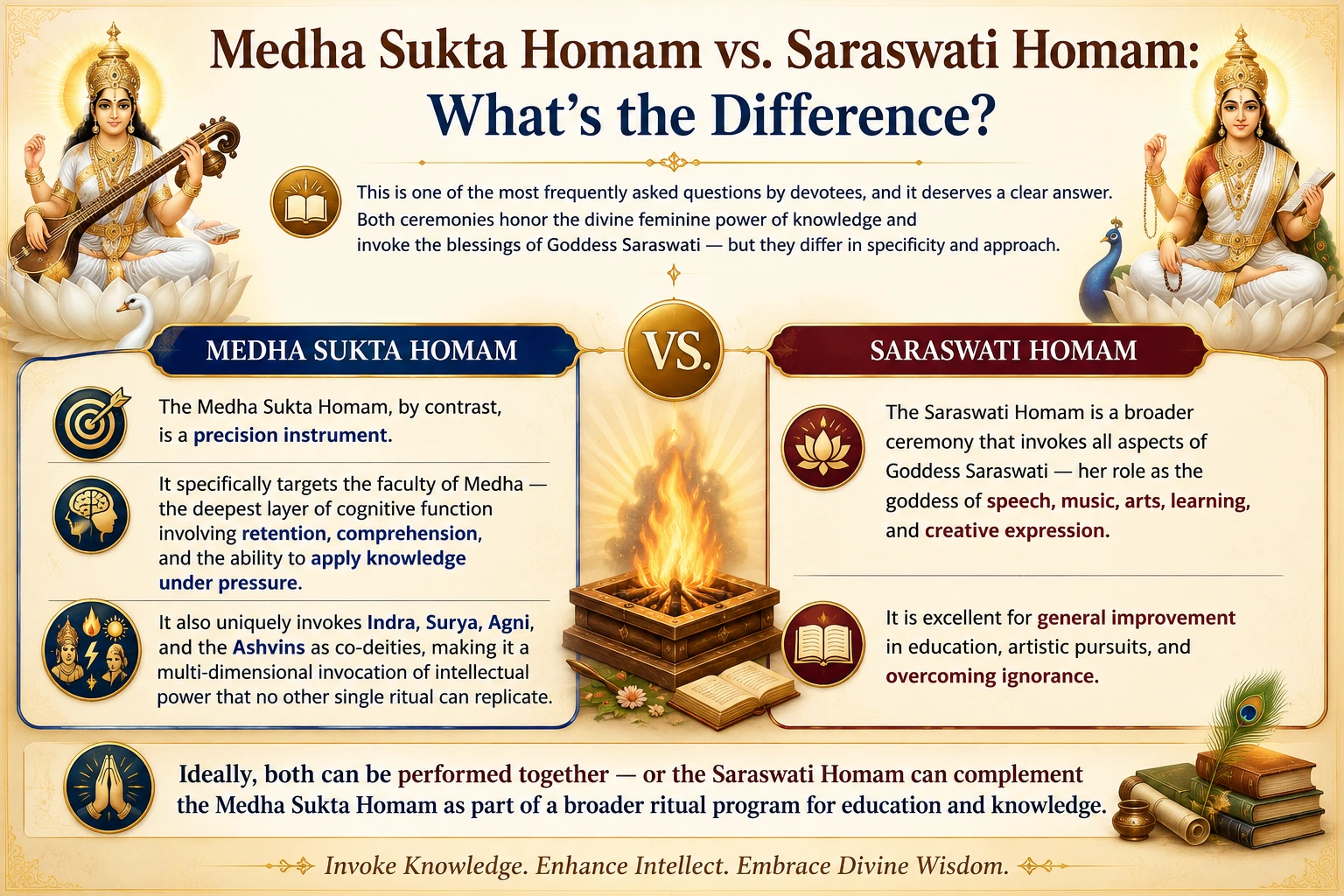 Medha Sukta Homam vs. Saraswati Homam: What’s the Difference?
This is one of the most frequently asked questions by devotees, and it deserves a clear answer. Both ceremonies honor the divine feminine power of knowledge and invoke the blessings of Goddess Saraswati — but they differ in specificity and approach.
The Saraswati Homam is a broader ceremony that invokes all aspects of Goddess Saraswati — her role as the goddess of speech, music, arts, learning, and creative expression. It is excellent for general improvement in education, artistic pursuits, and overcoming ignorance.
The Medha Sukta Homam, by contrast, is a precision instrument. It specifically targets the faculty of Medha — the deepest layer of cognitive function involving retention, comprehension, and the ability to apply knowledge under pressure. It also uniquely invokes Indra, Surya, Agni, and the Ashvins as co-deities, making it a multi-dimensional invocation of intellectual power that no other single ritual can replicate.
Ideally, both can be performed together — or the Saraswati Homam can complement the Medha Sukta Homam as part of a broader ritual program for education and knowledge.
The Saraswati Yantra: Your Daily Connection to Medha Devi
While the Medha Sukta Homam is a periodic, high-energy ritual event, the Saraswati Yantra serves as a permanent anchor of Saraswati’s energy in your home, study room, or workspace. A yantra is a precise geometric sacred diagram that represents the energy field of a specific deity in material form.
A properly energized Saraswati Yantra — consecrated during or after a Medha Sukta Homam — becomes a living spiritual tool. Placing it on your study desk, in your child’s room, or in your office creates a continuous field of Saraswati’s blessing in that space. The daily practice of lighting a diya before the yantra and chanting even a single round of the Medha Suktam significantly amplifies the long-term benefits of the Homam.
Post-Homam Practices for Lasting Results
The Medha Sukta Homam opens a divine channel — but maintaining that channel requires a few simple ongoing practices:
Daily Medha Suktam Chanting — Even 10 minutes of chanting the Medha Suktam each morning, before your study or work session, continuously invites Medha Devi’s presence into your intellectual activities.
Saraswati Mantra Japa — The seed mantra “Om Aim Saraswatyai Namah” chanted 108 times daily keeps the mind receptive to divine wisdom and maintains the clarity opened by the Homam.
Satvik Diet and Brahmacharya — Vedic tradition consistently links mental sharpness with dietary purity. Reducing tamasic foods (heavy, processed, non-vegetarian items) and increasing satvik foods (fruits, nuts, dairy, legumes) supports the enhanced cognitive state that the Homam initiates.
Study before sunrise (Brahma Muhurta) — The period from roughly 4:00 AM to 6:00 AM is traditionally considered the time when the mind is most receptive to learning and when Medha Devi’s influence is strongest.
Avoid mental pollution — Excessive social media, negative news, meaningless entertainment, and angry conversations dissipate the pranic clarity that the Homam generates.
A Note for Skeptics: The Science Behind the Sacred
For those who approach these rituals with a questioning mind — which is itself a sign of the very Medha we seek — it is worth considering that modern cognitive science increasingly recognizes the impact of sound, intention, and ritual on neurological functioning. Specific sound frequencies have measurable effects on brainwave states.
The Sanskrit mantras of the Medha Suktam, composed by rishis who spent lifetimes perfecting the science of sound, operate on the same principle — but with a precision that modern science is only beginning to appreciate. The fire of the Homam simultaneously purifies the physical environment (the combustion of medicinal herbs produces antimicrobial compounds that have been measured by Agnihotra researchers) and creates a shift in the pranic atmosphere of the space.
Whether you approach the Medha Sukta Homam from pure devotion or from a place of spiritual curiosity, the tradition asks only one thing of you: sincere intent. The rest is in the hands of the divine.
Conclusion
In a world that demands our best thinking — our sharpest analysis, our most creative problem-solving, our most retentive memory — the Medha Sukta Homam stands as one of the most directly useful gifts the Vedic tradition has to offer modern humanity. It is ancient, but it is anything but outdated. Drawn from the deepest strata of the Taittiriya Aranyaka, invoking the combined power of Medha Devi, Saraswati, Indra, Surya, Agni, and the Ashvins, this sacred fire ritual operates on the deepest layers of human consciousness — purifying, illuminating, and strengthening the very faculty through which we experience the world.
If you have been feeling mentally scattered, intellectually blocked, or simply want to consecrate your mind and your learning to something divine — this is your ritual. Whether you attend in person or connect from across the world through Astrobhava’s live-streamed ceremony, the Vedas assure you: the fire bridges all distances, and Medha Devi’s blessings know no borders.
Let the sacred fire of the Medha Sukta Homam light the flame of wisdom within you.
Frequently Asked Questions (FAQs)
Q1. What is Medha Sukta Homam and who should perform it?
The Medha Sukta Homam is a Vedic fire ritual based on the Medha Suktam — six sacred hymns from the Taittiriya Aranyaka of Krishna Yajurveda — performed to invoke divine intelligence, memory, and wisdom. It is ideal for students, professionals, children with learning difficulties, researchers, artists, and spiritual seekers of all ages.
Q2. How many times should the Medha Suktam be chanted during the Homam?
The Medha Suktam is typically chanted in multiple avartis (rounds) during the Homam. In a standard ceremony, the central Saraswati mantra is offered 108 times with ahutis, while the six verses of the Suktam are formally offered as complete rounds. The scale can be expanded to 1,008 repetitions for a Maha Homam on especially auspicious occasions.
Q3. What are the most auspicious days to perform Medha Sukta Homam?
Vasant Panchami (January 23, 2026 — the birthday of Goddess Saraswati), Shukla Panchami of any month, Purnima (full moon days), and Thursdays (governed by Jupiter, the planet of wisdom) are the most powerful days for this ritual.
Q4. Can the Medha Sukta Homam be performed online or on behalf of someone abroad?
Yes, absolutely. Astrobhava performs the Medha Sukta Homam on behalf of devotees anywhere in the world. Your name, gotra, and intention are formally included in the Sankalpa, creating a direct cosmic connection. The ceremony can be watched live via video call.
Q5. What is the difference between Medha Sukta Homam and Saraswati Homam?
The Saraswati Homam is broader — invoking all aspects of Goddess Saraswati for general learning, arts, and speech. The Medha Sukta Homam is more specific, targeting the Medha faculty (deep cognitive retention and wisdom) and invoking multiple deities including Indra, Surya, Agni, and the Ashvins alongside Saraswati and Medha Devi.
Q6. How long does a Medha Sukta Homam take?
A standard Medha Sukta Homam takes approximately 2 to 3 hours from the opening Ganapati Puja through to the final Purnahuti and Aarti. A more elaborate Maha Homam with 1,008 ahutis can take 4 to 5 hours.
Q7. What samagri (ritual materials) are used specifically in the Medha Sukta Homam?
The primary offerings include pure cow’s ghee, mango wood (for the fire), white sesame seeds, lotus flowers or petals, white rice, sandalwood powder, almonds, lotus seeds, durva grass, and specially prepared Saraswati Homam samagri with specific herbs. All materials are satvik and carefully selected for their connection to the intellect and divine wisdom.
Q8. Is it necessary to fast before the Medha Sukta Homam?
Fasting is not mandatory but highly recommended. At minimum, observing a satvik diet (no meat, no alcohol) and mental purity (avoiding arguments, negative media) for 24 hours before the ceremony significantly enhances the receptivity and results of the ritual.
Q9. Can children participate in or benefit from the Medha Sukta Homam?
Yes, children are among the primary beneficiaries of this Homam. It is especially beneficial before the beginning of a new academic year, before board exams, or for children experiencing learning challenges. Children can attend the ceremony and receive the vibhuti (sacred ash) on their forehead.
Q10. Is the Saraswati Yantra related to the Medha Sukta Homam?
Yes. A Saraswati Yantra energized during or after a Medha Sukta Homam becomes a powerful ongoing channel of Medha Devi’s blessings in your home or study space. Daily worship of the yantra maintains the intellectual and spiritual benefits of the Homam over the long term.