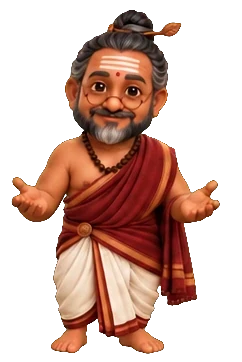
“Narayan… Narayan…” is the sound that, in Hindu scripture, travels freely across Swarga, Prithvi and Patala. It belongs to Devarishi Narada Muni — Brahma’s manasputra, the wandering sage with the veena, and the classical voice of bhakti. Each year, on Narada Jayanti, devotees mark his birth anniversary and turn again to the path of devotion he taught.
Whether you are observing the day in Chennai, New Jersey, London or Sydney, the heart of the observance is the same: Vishnu worship, nama sankirtana, and a renewed attention to truth and seva. This guide sets out the 2026 date and tithi, the scriptural background, the principal legends, and the practical way the day is kept.
You can confirm the day’s tithi, nakshatra and rahukalam for your own city on the free daily panchang, and place Narada Jayanti beside other observances on the festival calendar.
What Is Narada Jayanti
Narada Jayanti is the birth anniversary of Devarishi Narada Muni, one of the most distinctive sages in the Puranic tradition. The name itself is often glossed as the giver of knowledge: nara as the water or stream of wisdom, and da as the one who bestows it. Narada is not a forest hermit who withdraws from the world; he is the perpetual traveller of the three worlds, carrying news, counsel and the name of the Lord.
Scripture presents him as a manasputra of Lord Brahma — born of Brahma’s mind rather than of ordinary parentage — and therefore ranked among the highest of the rishis. He is also remembered in modern India as the figure behind Patrakar Diwas, Journalists’ Day, because tradition casts him as the first divine communicator: the one who ensured the right word reached the right being at the right time.
For the devotee, the day is less a biography and more a call back to bhakti. Narada’s own Narada Bhakti Sutras treat devotion not as a mere rite but as a living orientation of the heart toward the Supreme. Observances on his Jayanti therefore centre on Vishnu puja, chanting, and the reading of those sutras.
Narada Jayanti 2026: Date and Tithi
Narada Jayanti 2026 falls on Saturday, 2 May 2026. On the Hindu panchang the day is Pratipada of Krishna Paksha — Jyeshtha in the North Indian Purnimanta reckoning, and Vaishakha in the South Indian Amanta reckoning. Both calendars meet on the same civil date. The observance usually comes the day after Buddha Purnima, so early May is already thick with sacred markers.
Tithi timings in IST for 2026 are as follows:
- Pratipada begins: 10:52 PM on 1 May 2026
- Pratipada ends: 12:49 AM on 3 May 2026
Common puja windows cited for 2 May 2026 (IST) include Brahma muhurat from about 4:13 AM to 5:01 AM, and the madhyahna (midday) window from about 10:58 AM to 1:37 PM, which many households treat as the principal stretch for Vishnu worship. Rahu Kalam on that Saturday is given as roughly 9:05 AM to 10:44 AM and is traditionally avoided for the main offering.
Devotees abroad often convert the IST madhyahna span to their own zone — morning in the UK and Gulf, late night or very early morning on the US East and West Coasts, afternoon in eastern Australia — and then keep the spirit of the midday offering at a practical local hour.
astrobhava.com
Narada Jayanti 2026
Devarishi Narada Muni — the wandering voice of bhakti
- SAT 2 MAYNarada Jayanti 2026
- PRATIPADAKrishna Paksha tithi
- 10:58 AM–1:37 PMmadhyahna window, IST
Tithi timings (IST)
- Pratipada begins 10:52 PM, 1 May 2026
- Pratipada ends 12:49 AM, 3 May 2026
- Brahma muhurat about 4:13 AM to 5:01 AM
- Rahu Kalam about 9:05 AM to 10:44 AM, avoided
Same date, two reckonings
North — Purnimanta
- Month read as Jyeshtha
- Krishna Paksha Pratipada
- Saturday, 2 May 2026
South — Amanta
- Month read as Vaishakha
- Krishna Paksha Pratipada
- Saturday, 2 May 2026
Who Narada is
- Manasputra born of Brahma's mind
- Teacher of the Narada Bhakti Sutras
- Emblem: the divine veena
- Unbroken nama — "Narayan… Narayan…"
- Remembered on Patrakar Diwas
Where the midday span falls awkwardly abroad, sunrise worship in local time is traditionally accepted
Vishnu puja, nama sankirtana, satya and seva
bhakti · satya · seva
ASTROBHAVA.COMVedic rituals, never a group ceremony, telecast live
Why the Day Matters in Tradition
The significance of Narada Jayanti is layered. First is bhakti itself. Narada is the classical teacher of Bhakti Yoga; the Narada Bhakti Sutras describe devotion as a continuous turning of consciousness toward the Divine, not a transaction of favours. Marking his Jayanti is, in that sense, a recommitment to that path.
Second is lineage. Tradition holds that Narada guided figures who shaped the whole corpus of Hindu narrative and devotion — Valmiki toward the Ramayana, Vyasa in the great stream of Itihasa and Purana, and the child-devotees Dhruva and Prahlada in their steadfast Vishnu-bhakti. Honouring Narada is therefore honouring a root of that literature.
Third is satya, truth spoken in season. Popular retellings call Narada a mischief-maker; the Puranic reading is subtler. Episodes that look like provocation repeatedly end in the restoration of dharma and the liberation of souls. His Jayanti is kept as a reminder that right speech, rightly timed, serves righteousness — which is also why the day is linked with Patrakar Diwas.
Households that wish to frame the day within a wider sadhana of devotion often look to rites gathered under spiritual growth and devotion homas, keeping the emphasis on nama and Vishnu-seva rather than on any promised result.
Legends of Narada Muni
The Puranas give Narada more than one origin story, and each carries a teaching.
Born of Brahma’s mind. After creating the worlds, Brahma wished to people them. From his mind alone he brought forth Narada. Brahma intended him to aid the multiplication of creation; Narada instead fixed himself on the service of Lord Vishnu and the path of renunciation. The ensuing curse, accepted without bitterness, becomes part of the sage’s freedom to wander the three worlds as Vishnu’s messenger.
The previous life of humble seva. In a prior birth he is described as the son of a maidservant who served a company of sages through the monsoon. Simple, sincere service opened the door to their wisdom. Reborn with memory of that grace and with an innate love for Vishnu, he stands as a scriptural witness that even the smallest seva offered to the wise can redirect a life.
The veena and the name. Narada’s emblem is the divine veena, from which he draws the melodies of the Lord’s glory. His unbroken “Narayan… Narayan…” is nama sankirtana — the singing of the Name — which the Bhagavata Purana places among the highest forms of worship in this age.
The so-called mischief. Stories in which Narada appears to stir conflict between gods, kings or consorts almost always resolve toward the defeat of adharma and the freeing of bound souls. Tradition reads him as a cosmic catalyst, not a gossip: the drama of the universe is nudged, again and again, toward its rightful end.
Narada and Lord Vishnu
If one relationship defines Narada, it is his bond with Lord Vishnu. He is held up as the ideal bhakta: music and praise without bargaining, grievance or demand. The Srimad Bhagavatam lingers on scenes at Vaikuntha where Narada plays and sings, and the Lord receives that undemanding love.
It was Narada who gave the young Dhruva the dwadasakshara mantra and set him on the tapas that tradition links with the Pole Star. It was Narada who, while Prahlada was still in the womb of Kayadhu, planted the Vishnu-bhakti that Hiranyakashipu’s terror could not uproot. It was Narada who turned Valmiki toward the telling of Rama’s story. In each case the sage’s hand points back to Vishnu.
On Narada Jayanti, Vishnu-centred worship is therefore the most natural observance. Families who keep a homa on the day often choose a Narayana-facing rite such as the Narayana Sukta Homa, performed by the ashram’s priests and telecast live, as a classical way of offering the day’s devotion.
How Tradition Observes the Day
Because Narada’s life is given wholly to Vishnu, the day’s practice is Vishnu worship, nama, and simple restraint.
Morning. Many wake in the Brahma muhurat, bathe, and wear clean clothes. A lamp and incense are lit before an image of Lord Vishnu. Tulsi, yellow flowers, chandan, kumkum and fruit are the usual offerings. The dwadasakshara mantra is often recited 108 times; guidance on pace and pronunciation is set out in the house’s note on how to chant a mantra correctly.
Principal texts and chants. Vishnu Sahasranama is widely recited. Even a few sutras from the Narada Bhakti Sutras steady the mood of the day. The simplest thread running through the hours remains “Narayan Narayan.”
Vrat. A Narada Jayanti vrat, where observed, typically means abstaining from grains and pulses; fruit, milk and milk preparations are allowed. The fast is broken after evening aarti.
Satyanarayan Katha. The Skanda Purana links the Satyanarayan Vrat to a dialogue in which Narada seeks a straightforward path for human welfare and the Lord describes this vrat. Listening to or arranging the katha on or near Narada Jayanti is therefore a long-standing custom, especially in the days around Vaishakha Purnima.
Daan and evening. Food, clothes or other gifts offered to those in need, or support given to a temple’s worship, are the usual forms of daan. Where a full jagaran is not possible, the evening hours spent in aarti, bhajan and quiet japa are still kept with care.
Questions devotees ask
Padmavathi Narasimhan writes on daily devotional practice — what is kept at home, how it is kept, and why.