Have you ever heard a story where someone wins an entire kingdom — actually, three entire worlds — with just three steps? Sounds impossible, right? But that’s exactly what happens in one of the most fascinating and profound tales from Hindu mythology. We’re talking about the Vamana Avatar of Vishnu, the fifth incarnation of Lord Vishnu, and honestly, it’s one of those stories that gets better every time you hear it.
Whether you’ve grown up with this tale or you’re discovering it for the first time, there’s something deeply moving about how a tiny dwarf brahmin outsmarted a demon king not through brute force, but through humility, wit, and cosmic power. So let’s dive in.
 Who Is Vamana? A Quick Introduction
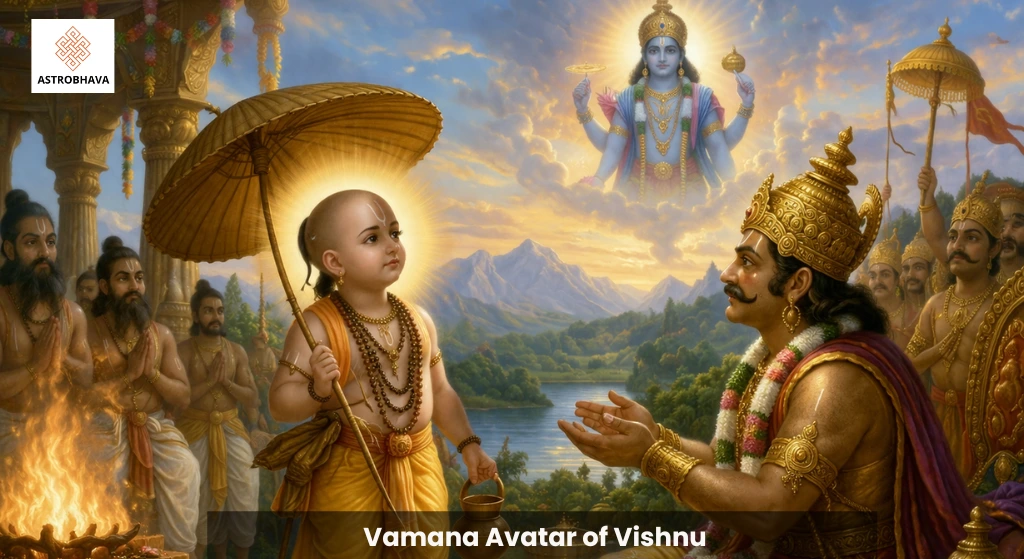
Vamana is the fifth avatar in Vishnu’s Dashavatara — the ten principal incarnations. The name “Vamana” literally means dwarf in Sanskrit. Unlike the fierce forms of Narasimha or the warrior stance of Parashurama, Vamana appears as the most unassuming figure imaginable: a short, stout brahmin boy carrying a wooden umbrella and a water pot.
But appearances, as this story teaches us beautifully, can be wildly deceiving.
The Vamana Avatar of Vishnu is considered one of the most theologically rich avatars because it deals with themes of ego, power, surrender, and cosmic order — all wrapped in a story that feels like a blend of mythology, philosophy, and pure drama.
Align with cosmic balance by honoring all ten avatars of Vishnu in one powerful Homa.
The Context: How Did Vamana Come to Be?
To understand why Vishnu took the form of Vamana, we need to back up a little and talk about Mahabali — also known as Bali Chakravarti.
Mahabali was a descendant of the great Prahlada (yes, the same Prahlada whose devotion prompted Vishnu’s Narasimha avatar). He was an asura king, but unlike most demons in the scriptures, Mahabali was extraordinarily virtuous. He was generous beyond measure, righteous in his governance, and deeply devoted. Under his rule, the three worlds — earth, the heavens, and the netherworld — prospered. He was, by all accounts, a genuinely good ruler.
The problem? He became too powerful. The devas (gods) had been pushed out of their heavenly abode, Indra had lost his throne, and the cosmic balance was tipping dangerously. The gods went to Vishnu, pleading for help, and that’s when the plan for the Vamana avatar was set into motion.
The Birth of Vamana
Lord Vishnu decided to be born as the son of the sage Kashyapa and his wife Aditi. Aditi had performed severe penance, observing a rigorous vow called the “Payovrata” to please Vishnu and request his help in restoring her sons (the devas) to their rightful place.
Vishnu was moved by her devotion and promised to be born as her son. And so, Vamana arrived — a radiant but diminutive brahmin boy with a top knot, a sacred thread, a wooden umbrella, a water pot, and a deer skin. He looked like an ordinary young brahmin scholar, but his eyes carried the light of the cosmos.
The Grand Yagna of Mahabali
Meanwhile, King Mahabali was conducting a massive yajna (fire sacrifice) called the Vishvajit Yagna on the banks of the Narmada river. This was no ordinary ritual — it was so powerful that anyone who came and asked for a boon during this yajna could not be refused. Mahabali had taken a vow that he would never turn away anyone who came to him with a request during this sacred ceremony.
This was precisely the opening Vishnu was waiting for.
Vamana Arrives at the Yajna
Young Vamana walked into the grand sacrificial hall, and despite his small stature, his presence was undeniable. Everyone felt it — a strange, overwhelming energy radiating from this little brahmin boy. Even the wise sage Shukracharya, Mahabali’s guru, immediately recognized that this was no ordinary child. He warned Mahabali, telling him directly: “This is Vishnu himself, and he has come to take everything away from you. Do not grant his wish.”
But here’s where Mahabali’s character shines. He turned to his guru and said something remarkable: “What greater fortune could there be than this? If the Lord himself has come to my door as a beggar, then I am blessed. I will give him whatever he asks, even if it costs me my kingdom, my life, or my pride.”
This is honestly one of the most powerful moments in Hindu mythology — a so-called “demon” choosing devotion and honor over self-preservation.
Invite divine humility and abundance into your life with a powerful Vamana Puja.
Three Steps, Three Worlds
Mahabali welcomed the small brahmin with full honors, washed his feet, and asked him what he desired. Young Vamana smiled and said, “O great king, I am but a simple brahmin. I do not need much. Please grant me only as much land as I can cover in three steps.”
The courtiers laughed. Three steps? That’s all this little man wants? Mahabali himself smiled warmly and said, “Ask for more! You deserve more — ask for entire kingdoms!”
But Vamana was firm. Three steps of land was all he wanted.
Mahabali agreed and picked up his water pot to pour water and formally seal the promise. At that very moment, Shukracharya tried one last time to stop him — he actually transformed himself into a tiny insect and blocked the spout of the water pot so the water couldn’t flow. Vamana (knowing this) took a blade of grass and poked the spout clear, which blinded Shukracharya in one eye.
The water flowed. The promise was made.
The Cosmic Transformation
And then — everything changed.
Vamana began to grow.
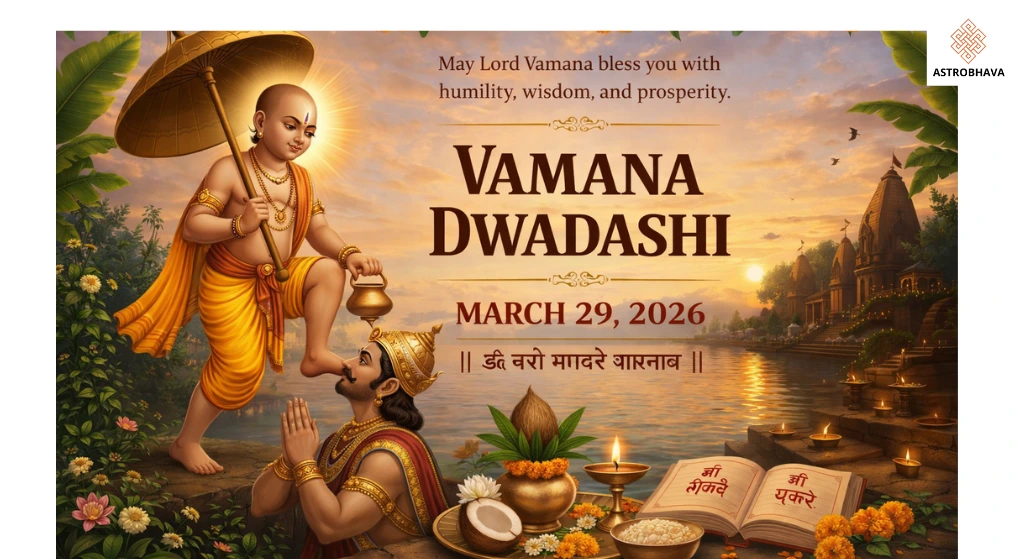
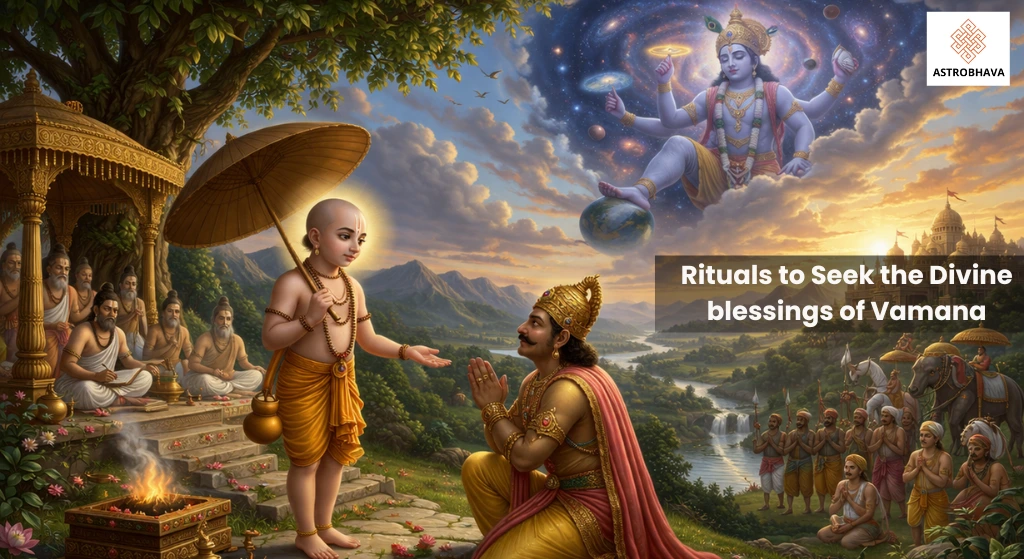
He grew, and grew, and grew. The dwarf brahmin boy expanded until he filled the entire universe. With his first step, he covered the entire earth. With his second step, he crossed the heavens — the entire sky and the higher realms were covered in one stride. The gods watched in awe. Indra wept with joy. The devas realized their protector had come.
And then Vamana looked down at Mahabali. There was no third step’s worth of space left anywhere in the three worlds. The entire universe had been measured in just two.
“O King,” Vamana said gently, “you have given me your word. Tell me — where shall I place my third step?”
Mahabali’s Greatest Moment
This is where the story becomes truly transcendent.
Mahabali didn’t flinch. He didn’t rage or feel humiliated. He bowed his head, folded his hands, and said quietly: “Place your third step on my head, O Lord.”
And Vishnu did. He placed his foot on Mahabali’s head and pushed him gently down into the netherworld — Sutala. But this wasn’t a punishment. Far from it.
Vishnu, deeply moved by Mahabali’s integrity and surrender, blessed him profoundly. He promised that Mahabali would rule Sutala as its king, that the realm would be free of suffering and disease, and that he — Vishnu himself — would stand guard at the gates of Sutala as his doorkeeper. And he granted Mahabali the boon that once every year, Mahabali could return to earth to see his beloved people.
That annual visit is what we celebrate today as Onam in Kerala — one of the most joyous festivals in India.
Also explore: Dashavatar of Lord Vishnu
The Deeper Meaning of the Vamana Avatar of Vishnu
Now here’s where things get really interesting, because the Vamana Avatar of Vishnu isn’t just a thrilling story — it’s loaded with symbolism and spiritual teaching.
Ego and Humility: Mahabali’s power had grown to such a degree that even the cosmic order was disrupted. His ego — even if well-intentioned — had overstepped cosmic bounds. The Vamana avatar teaches that no matter how great we become, genuine surrender before the divine is the highest act.
The Illusion of Ownership: Vamana asks for only three steps of land. What seems laughably small turns out to be everything. This is a beautiful metaphor — we think we “own” things, but in reality, everything belongs to the cosmos. We are caretakers at best.
True Devotion Transcends Logic: Mahabali knew (after Vamana revealed himself) that he was being “defeated,” yet he surrendered with joy. That kind of devotion — which doesn’t waver even when it costs you everything — is the highest form of bhakti.
Dharma Restored: The Vamana avatar restored the natural cosmic order. The devas were returned to their rightful place, and Mahabali was honored not punished — because true dharma honors virtue even in an adversary.
Vamana in Astrology and Remedies
 Vamana in Astrology and Remedies
In Vedic tradition, the Vamana avatar is also associated with specific cosmic energies and planetary influences. Worshipping Vamana is believed to help balance the energy of Saturn (Shani) and Jupiter (Brihaspati), both of which govern karma, dharma, expansion, and discipline. Devotees often observe fasting and prayers on Vamana Dwadashi (the twelfth day of the bright fortnight in the Bhadrapada month) to seek blessings for humility, abundance, and relief from karmic debts.
✨ Looking for Vamana-related Rituals to deepen your spiritual practice?
If this story has resonated with you and you want to bring the energy of the Vamana Avatar of Vishnu into your home and daily sadhana, AstroBhava has a beautiful collection of Vamana-related items — from sacred idols and yantras to specially energized puja items that carry the blessings of this extraordinary avatar.
Whether you’re looking to establish a dedicated altar, perform Vamana Dwadashi puja, or simply keep a sacred reminder of this story close to you, AstroBhava’s handpicked collection is worth exploring.
👉 [Explore AstroBhava’s Vamana Puja, Homa and Japa Rituals here] — because sometimes the smallest form holds the greatest power.
Vamana in Different Texts and Traditions
The story of the Vamana Avatar appears across several important scriptures. The Bhagavata Purana (Srimad Bhagavatam), particularly in the 8th Canto, gives the most elaborate account. You’ll also find versions in the Vishnu Purana, the Vamana Purana, and the Mahabharata.
What’s interesting is that while the core story remains consistent, different texts emphasize different aspects. Some focus more on Mahabali’s devotion and generosity, almost casting him as a tragic hero. Others emphasize Vishnu’s divine play (lila) and the cosmic necessity of restoring dharma. A few regional traditions even celebrate Mahabali as the true hero of the story — which is exactly why Onam is celebrated with such love and pride in Kerala.
This multi-layered quality is what makes Hindu mythology so endlessly rich. There’s no single “correct” reading — every lens reveals something new.
Vamana and the Modern World
You might be wondering — what does a story from thousands of years ago have to do with us today?
Quite a lot, actually.
We live in a world obsessed with more — more power, more wealth, more influence. Mahabali’s story is a mirror held up to that obsession. He had everything, and he was a good ruler, but the accumulation of power itself became a problem. The lesson isn’t that ambition is wrong. It’s that attachment to power, to ownership, to our sense of “I have conquered everything” — that’s where things go sideways.
And Vamana? He shows us that the divine doesn’t always arrive in a thunderclap or a warrior’s battle cry. Sometimes it arrives quietly, humbly, looking like the least threatening thing in the room — and then it measures the universe in two steps.
That’s a metaphor for grace, isn’t it? Grace doesn’t announce itself. It arrives simply, asks for very little, and transforms everything.
Seek the divine blessings of lord Vishnu: Join our live homa now
Conclusion
The Vamana Avatar of Vishnu is so much more than a mythological tale about a dwarf and a demon king. It’s a profound teaching about cosmic balance, the nature of ego and surrender, the beauty of keeping your word even when it costs you everything, and the mysterious ways in which the divine operates in the world.
Mahabali’s greatness wasn’t diminished by Vamana — it was consecrated. He’s remembered not as someone who lost, but as someone who gave everything willingly, and was honored for it for eternity.
And Vamana — this tiny, unassuming brahmin boy — reminds us that divinity doesn’t need scale to be powerful. It needs only presence.
The next time you feel overwhelmed by someone or something that seems small and easily dismissed, remember Vamana. The smallest things sometimes measure the entire universe.
FAQs About the Vamana Avatar of Vishnu
Q1. Why is Vamana considered the fifth avatar of Vishnu?
Vamana comes fifth in the Dashavatara sequence, following Matsya (fish), Kurma (tortoise), Varaha (boar), and Narasimha (half-lion). Each avatar corresponds to an evolving level of consciousness and complexity, and Vamana — the first fully human-form avatar — represents the emergence of intelligent, dharmic human society.
Q2. Who was King Mahabali and was he a villain?
Not at all. Mahabali was a virtuous and generous asura king, beloved by his subjects. He was a great-grandson of Hiranyakashipu but followed the path of righteousness. His story is so beloved that the people of Kerala celebrate his annual return with the festival of Onam.
Q3. What is Vamana Dwadashi?
Vamana Dwadashi (also called Vamana Jayanti) is the day believed to be the birth anniversary of the Vamana avatar. It falls on the twelfth day of the bright fortnight in the month of Bhadrapada (usually August–September). Devotees observe fasting and perform puja to seek blessings of humility, prosperity, and relief from karma.
Q4. What does the three-step story symbolize spiritually?
The three steps represent the three worlds (earth, sky/heaven, and the netherworld), but they also symbolize the three states of consciousness — waking, dreaming, and deep sleep — all of which are encompassed by and belong to the divine. Some traditions also link it to the three aspects of time: past, present, and future.
Q5. Is the Vamana Avatar story connected to any festivals?
Yes! The most prominent connection is with Onam, the harvest festival of Kerala, which celebrates Mahabali’s annual return to earth as promised by Vishnu. It’s one of the grandest festivals in South India, marked by flower arrangements (pookalam), boat races, feasts, and cultural performances.
Q6. How can one worship the Vamana Avatar?
Devotees worship Vamana through prayers, fasting on Vamana Dwadashi, chanting Vishnu Sahasranama, and installing Vamana idols or yantras in their puja space. Offering tulsi leaves, yellow flowers, and performing a simple ritual with water (recalling the water-pot ceremony from the story) are common practices.