Have you ever wondered what it feels like when the universe itself steps in to protect the innocent? That is exactly the energy of Narasimha Jayanti — a festival that does not just celebrate a mythological event, but carries a living, breathing promise: dharma will always be protected, no matter how impossible the odds look.
2026 Narasimha Jayanti is one of the most powerful Vaishnava observances of the year, and if you have been planning to observe it with full devotion, you are in the right place. This guide covers everything — the correct date and timings, the divine story behind the festival, puja vidhi, fasting rules, powerful mantras, and answers to every question you might have.
Let’s dive in.
What Is Narasimha Jayanti?
Narasimha Jayanti, also known as Narsingh Chaturdashi, is the sacred appearance day of Lord Narasimha — the fierce, half-man, half-lion avatar of Lord Vishnu. It is observed every year on the Chaturdashi Tithi (14th lunar day) of Shukla Paksha in the Hindu month of Vaishakha.
This is not just a birthday celebration. It is a spiritual event that marks the moment when divine justice descended on earth in a form that defied every known rule of existence. Lord Narasimha appeared at the intersection of day and night, neither fully indoors nor outdoors, in a form neither fully human nor fully animal — to honour every clause of a boon while still delivering absolute cosmic justice.
The festival is observed with tremendous devotion across India, especially in South Indian states like Andhra Pradesh, Telangana, Karnataka, and Tamil Nadu, as well as in Odisha, West Bengal, and Varanasi.
2026 Narasimha Jayanti Date and Time
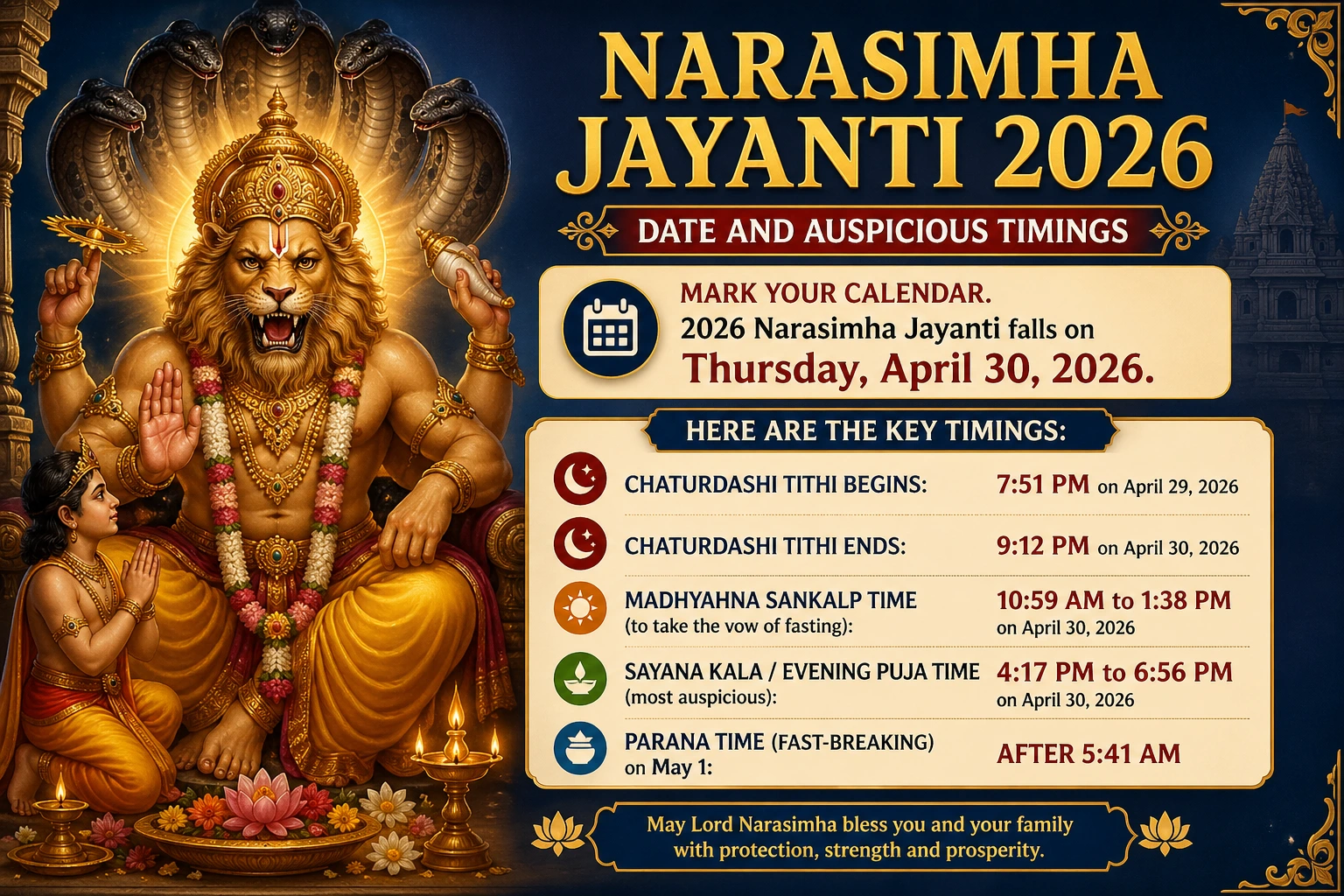
Mark your calendar. 2026 Narasimha Jayanti falls on Thursday, April 30, 2026.
Here are the key timings:
Chaturdashi Tithi Begins: 7:51 PM on April 29, 2026
Chaturdashi Tithi Ends: 9:12 PM on April 30, 2026
Madhyahna Sankalp Time (to take the vow of fasting): 10:59 AM to 1:38 PM on April 30
Sayana Kala / Evening Puja Time (most auspicious): 4:17 PM to 6:56 PM on April 30
Parana Time (fast-breaking) on May 1: After 5:41 AM
The evening puja window between 4:17 PM and 6:56 PM is considered the most auspicious time to worship Lord Narasimha because, according to the Puranas, the Lord appeared during Sandhya Kala — the transitional period between day and night. This is why temple celebrations typically peak during this twilight window.
Note: Timings may vary slightly depending on your geographical location. Always verify with our panchang for the most precise muhurat.
The Sacred Story Behind Narasimha Jayanti
Every great festival has a story, and the story of Narasimha Jayanti is one of the most dramatic, emotionally layered, and spiritually rich narratives in all of Hindu mythology.
The Rise of Hiranyakashipu
Long ago, a powerful demon king named Hiranyakashipu performed intense tapas and obtained a boon from Lord Brahma. The boon was extraordinarily specific: he could not be killed by man or animal, neither during the day nor at night, neither inside a building nor outside, neither on the ground nor in the sky, and not by any weapon.
With this seemingly unbreakable boon in hand, Hiranyakashipu declared himself the supreme lord of the universe and ordered everyone — gods, humans, and demons alike — to worship only him. Anyone who chanted the name of Vishnu faced severe punishment.
The Unshakeable Devotion of Prahlada
But Hiranyakashipu’s own young son, Prahlada, refused. Born with an innate love for Lord Vishnu that no amount of fear or punishment could extinguish, Prahlada continued chanting Vishnu’s name with complete surrender and joy. He was thrown into fire — he emerged unharmed. He was pushed off a mountain — he landed safely. Venomous snakes were sent to kill him — they retreated. Every attempt to end Prahlada’s life was countered by an invisible, loving protection.
Furious beyond reason, Hiranyakashipu finally confronted his son. “Where is your Vishnu?” he demanded. “Show me your God!”
Prahlada calmly replied, “Lord Vishnu is everywhere. He is in every particle of creation. He is even in this pillar.”
Hiranyakashipu laughed in scorn and struck the palace pillar with his mace.
The Appearance of Lord Narasimha
What happened next changed the universe forever.
The pillar burst open with a deafening roar. From within it emerged a form that had never been seen before — neither fully a man nor a lion, but both simultaneously. Blazing eyes. A roaring maw. Arms as powerful as the earth’s core. This was Lord Narasimha — Vishnu’s fourth avatar, manifested to fulfil every condition of Brahma’s boon while delivering absolute divine justice.
It was Sandhya Kala — the twilight hour. The Lord placed Hiranyakashipu on his thighs — neither earth nor sky. He sat at the threshold of the palace — neither inside nor outside. He used his bare claws — not a weapon. And he destroyed the demon once and for all.
Prahlada’s faith was vindicated. Dharma was restored. And that moment is what we celebrate as Narasimha Jayanti every year.
Also Read: Powerful Benefits of Worshipping Lord Narasimha on Narasimha Jayanti
Why Is 2026 Narasimha Jayanti Especially Significant?
Every year’s Narasimha Jayanti carries its own energy, but 2026’s observance falls on a Thursday — the day sacred to Lord Vishnu himself. Thursdays are associated with Guru energy, divine blessings, protection, and wisdom. Observing a Jayanti of a Vishnu avatar on his own day amplifies the spiritual merit of all rituals and prayers performed.
If you have been facing persistent obstacles, enemies, legal battles, health issues, or simply feel like your life is weighed down by fear and negativity, 2026 Narasimha Jayanti is a particularly potent window to seek the Lord’s intervention.
Narasimha Jayanti Puja Vidhi: Step-by-Step Guide
Whether you are performing the puja at home or planning to visit a temple, here is a simple, devotion-filled puja vidhi you can follow.
- Preparation the Day Before On April 29, consume only one meal (Prahar Bhojan) before sunset. Avoid grains, non-vegetarian food, onion, and garlic. Set your intention for the fast.
- Early Morning Ritual on April 30 Wake up before sunrise, take a purifying bath, and wear clean clothes — preferably yellow or saffron, colours sacred to Lord Vishnu.
- Sankalp (Taking the Vow) Between 10:59 AM and 1:38 PM, take the formal Sankalp in front of Lord Narasimha’s idol or image. Offer water, flowers, and tulsi leaves while stating your intention to observe the vrat for the Lord’s blessings.
- Setting Up the Puja Space Place an image or idol of Lord Narasimha (ideally with Goddess Lakshmi). Offer the following: fresh flowers, tulsi leaves, sandalwood paste, saffron, fruits, Panchameva (five dry fruits), sesame seeds, coconut, and a ghee lamp. The use of sandalwood paste is especially traditional in Narasimha worship.
- The Evening Puja — The Heart of the Celebration Between 4:17 PM and 6:56 PM on April 30, perform the main puja. Chant the Narasimha Stuti, recite the Narasimha Kavach (protective armour prayer), and offer Arati. If possible, read from the seventh canto of the Bhagavata Purana, which narrates Prahlada’s story in moving detail.
- Jagran (Night Vigil) Staying awake through the night while chanting bhajans or meditating on Lord Narasimha is considered highly meritorious. Many devotees observe this practice to completely align with the energy of the festival.
- Parana on May 1 Break your fast after 5:41 AM on May 1, once the Chaturdashi Tithi has ended and you have offered morning prayers.
 Most Powerful Narasimha Mantras to Chant on This Day
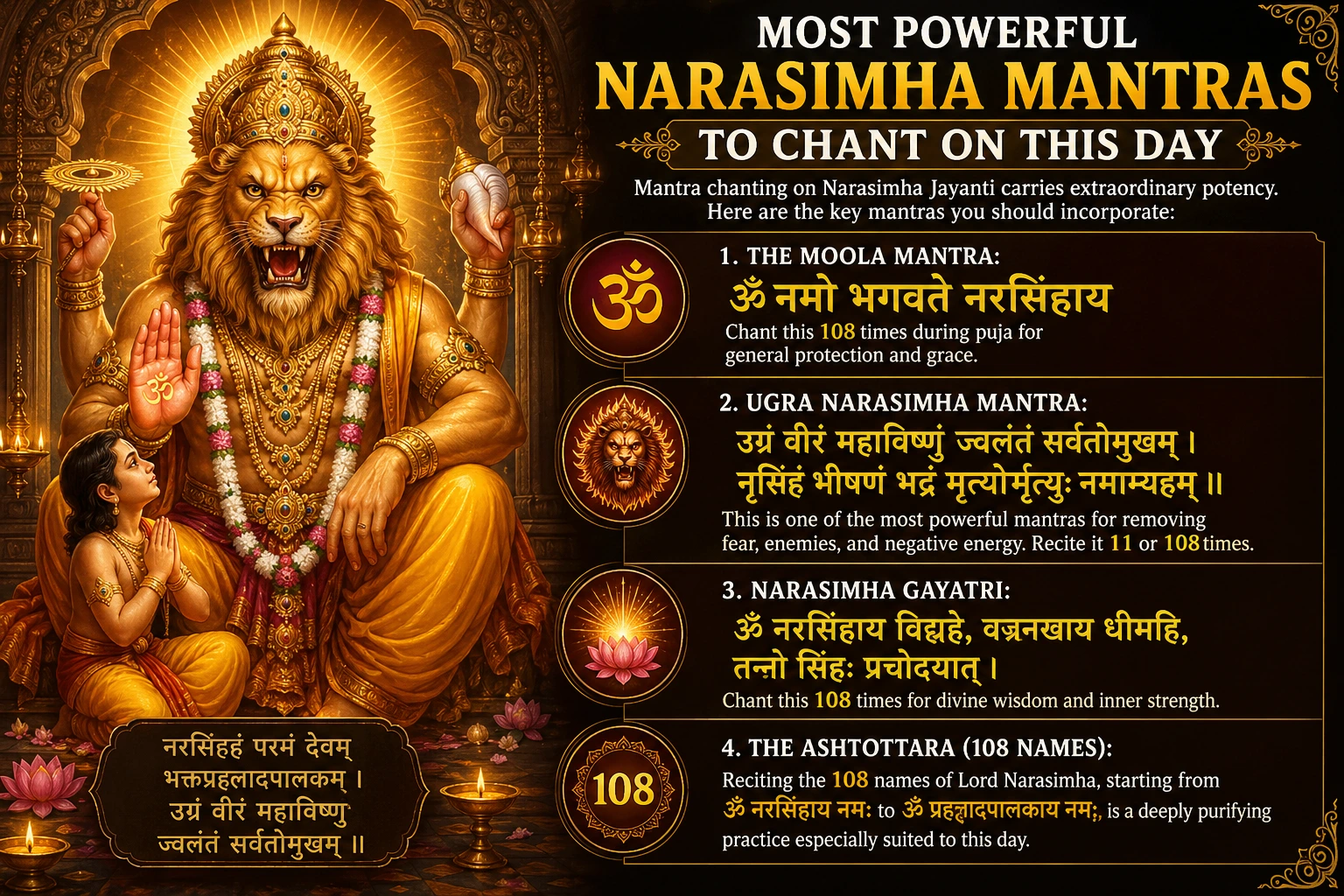
Mantra chanting on Narasimha Jayanti carries extraordinary potency. Here are the key mantras you should incorporate:
The Moola Mantra: Om Namo Bhagavate Narasimhaya Chant this 108 times during puja for general protection and grace.
Ugra Narasimha Mantra: Ugram Veeram Mahavishnum Jvalantam Sarvatomukham Nrisimham Bheeshanam Bhadram Mrityor Mrityum Namamyaham This is one of the most powerful mantras for removing fear, enemies, and negative energy. Recite it 11 or 108 times.
Narasimha Gayatri: Om Narasimhaya Vidmahe, Vajranakhaya Dhimahi, Tanno Simhah Prachodayat Chant this 108 times for divine wisdom and inner strength.
The Ashtottara (108 Names): Reciting the 108 names of Lord Narasimha, starting from Om Narasimhaya Namah to Om Prahladapalakaya Namah, is a deeply purifying practice especially suited to this day.
Narasimha Kavach: Your Shield Against All Negativity
The Narasimha Kavach is one of the most revered protective prayers in Hindu tradition. Reciting it on Narasimha Jayanti is believed to create an impenetrable spiritual shield around you and your family. It invokes Lord Narasimha’s protection over every limb, every direction, and every aspect of your life — from your home and health to your finances and relationships.
Even if you cannot recite the full kavach, listening to it with reverence on this day is profoundly beneficial.
Narasimha Jayanti Fasting Rules
The fasting rules for Narasimha Jayanti are similar to those observed on Ekadashi. Here is what to keep in mind:
- Eat only one simple meal the evening before (April 29)
- Avoid all grains, cereals, and pulses throughout the fast
- Fruits, milk, nuts, and specific vrat-friendly foods are permitted
- Avoid alcohol, non-vegetarian food, onion, and garlic
- Maintain mental purity — avoid anger, harsh speech, and negative thoughts
- Fast-breaking (Parana) is done after sunrise on May 1, once the Chaturdashi Tithi has ended
Fasting on this day is not merely a physical act — it is a conscious redirection of your body’s energy toward spiritual absorption. When you deny the senses their usual indulgences, the inner channels open wider to receive divine grace.
Spiritual Benefits of Observing Narasimha Jayanti
The Puranas and Vaishnava tradition describe numerous blessings that flow to sincere devotees who observe Narasimha Jayanti with proper faith and ritual:
Protection from enemies as well as evil forces — Lord Narasimha is specifically worshipped as the destroyer of enemies and negative influences. His protection is considered absolute.
Removal of the fear — One of the most deeply rooted problems in modern life is anxiety and fear. Narasimha’s energy directly dissolves fear at its root.
Courage and victory — Devotees who regularly worship Lord Narasimha are said to develop inner strength, boldness, and the ability to face adversity without crumbling.
Removal of sins and negative karma — Sincere observance of the vrat and puja on this day is believed to cleanse accumulated karma.
Prosperity and abundance — Worshipping Lakshmi Narasimha (Lord Narasimha with Goddess Lakshmi) invites both spiritual protection and material well-being.
Moksha and Liberation — For those on the path of liberation, devotion to Lord Narasimha is described in the Bhagavata Purana as a direct highway to liberation.
2026 Narasimha Jayanti for Children: Teaching the Prahlada Story
If you have children at home, Narasimha Jayanti is a beautiful opportunity to transmit timeless wisdom through storytelling. The story of Prahlada teaches children that truth is worth standing for, that genuine faith is unshakeable, and that no bully — however powerful — can ultimately prevail against what is right.
Read the story together, light lamps, sing bhajans, and if possible, take them to a temple. Letting children participate in rituals — even in simple ways like offering flowers or ringing the temple bell — plants seeds of devotion that often bloom for a lifetime.
Conclusion: Let 2026 Narasimha Jayanti Be Your Turning Point
There is something profoundly moving about Lord Narasimha’s appearance. He did not come as a king with an army. He did not come with political power or social approval. He came from a pillar — from the very thing that was struck in arrogance and doubt — to answer one child’s pure and unwavering love.
2026 Narasimha Jayanti on Thursday, April 30 is not just a date on a calendar. It is an invitation. An invitation to bring your fears, your struggles, your doubts, and your enemies — seen and unseen — to the feet of the one deity who specialises in the impossible.
Whether you observe the full fast, perform an elaborate puja, or simply sit quietly and chant Om Namo Bhagavate Narasimhaya with a sincere heart, you are tapping into one of the most powerful spiritual currents in the Hindu tradition.
May Lord Narasimha roar away every obstacle in your life this Jayanti. Jai Narasimha!
Frequently Asked Questions (FAQs) About 2026 Narasimha Jayanti
Q1. When is Narasimha Jayanti in 2026?
2026 Narasimha Jayanti falls on Thursday, April 30, 2026. The Chaturdashi Tithi begins at 7:51 PM on April 29 and ends at 9:12 PM on April 30.
Q2. What is the best time to perform Narasimha Jayanti puja in 2026?
The most auspicious puja time is the Sayana Kala (evening) window from 4:17 PM to 6:56 PM on April 30, 2026. This aligns with the time Lord Narasimha is believed to have appeared.
Q3. Is Narasimha Jayanti and Narsingh Chaturdashi the same?
Yes, both names refer to the same sacred festival. Narsingh Chaturdashi is the more commonly used name in North India, while Narasimha Jayanti is widely used in South India.
Q4. What should I eat while fasting on Narasimha Jayanti?
You can consume fruits, milk, nuts, sweet potatoes, and other vrat-friendly foods. All grains, cereals, pulses, onion, garlic, and non-vegetarian food must be strictly avoided.
Q5. When can I break my Narasimha Jayanti fast in 2026?
You can break your fast (Parana) on May 1, 2026, after 5:41 AM, once the Chaturdashi Tithi has ended.
Q6. Which mantra is most powerful for Narasimha Jayanti?
The Ugra Narasimha Mantra (Ugram Veeram Mahavishnum…) is considered extremely powerful for protection from enemies and fear. The Moola Mantra Om Namo Bhagavate Narasimhaya is the most accessible for daily chanting.
Q7. Can women observe Narasimha Jayanti fast?
Yes, absolutely. Women can and do observe the Narasimha Jayanti fast with full ritual participation. There are no gender-based restrictions on this observance.
Q8. What is the significance of the evening puja on Narasimha Jayanti?
According to Puranic tradition, Lord Narasimha appeared at Sandhya Kala — the twilight period between day and night. The evening puja window (4:17 PM to 6:56 PM) directly honours this cosmic moment, making it the most potent time for worship.
Q9. Is it necessary to stay awake all night on Narasimha Jayanti?
Jagran (night vigil) is highly recommended and considered especially meritorious, but it is not compulsory. Devotees who cannot stay up all night can simply perform thorough evening prayers and retire with devotional intent.
Q10. Can I worship Lord Narasimha at home if I cannot visit a temple?
Absolutely. Lord Narasimha is said to be present wherever there is sincere devotion. A home puja performed with genuine faith, proper ritual, and heartfelt mantras is fully valid and deeply beneficial.