Have you ever sat in a room filled with the fragrance of incense, the warmth of a ghee lamp glowing softly, and the sound of Sanskrit shlokas filling every corner of the house? If you’ve been part of a Satyanarayan Katha, you already know the feeling — that deep sense of peace, of something sacred settling over the entire family.
For millions of Hindu families across India and around the world — from New Jersey to New South Wales, from London to Dubai — the Satyanarayan Katha is not just a ritual. It is a homecoming. A sacred conversation between a family and the divine.
But if you’re new to it, or if you’ve grown up watching it without quite understanding what each part means, this guide is for you. We’ll walk you through everything — what the Katha is, why it matters, when to perform it, the step-by-step puja vidhi, the five chapters (Adhyayas), and the auspicious dates in 2026. Consider this your definitive handbook.
What Is Satyanarayan Katha — And Why Does It Matter?
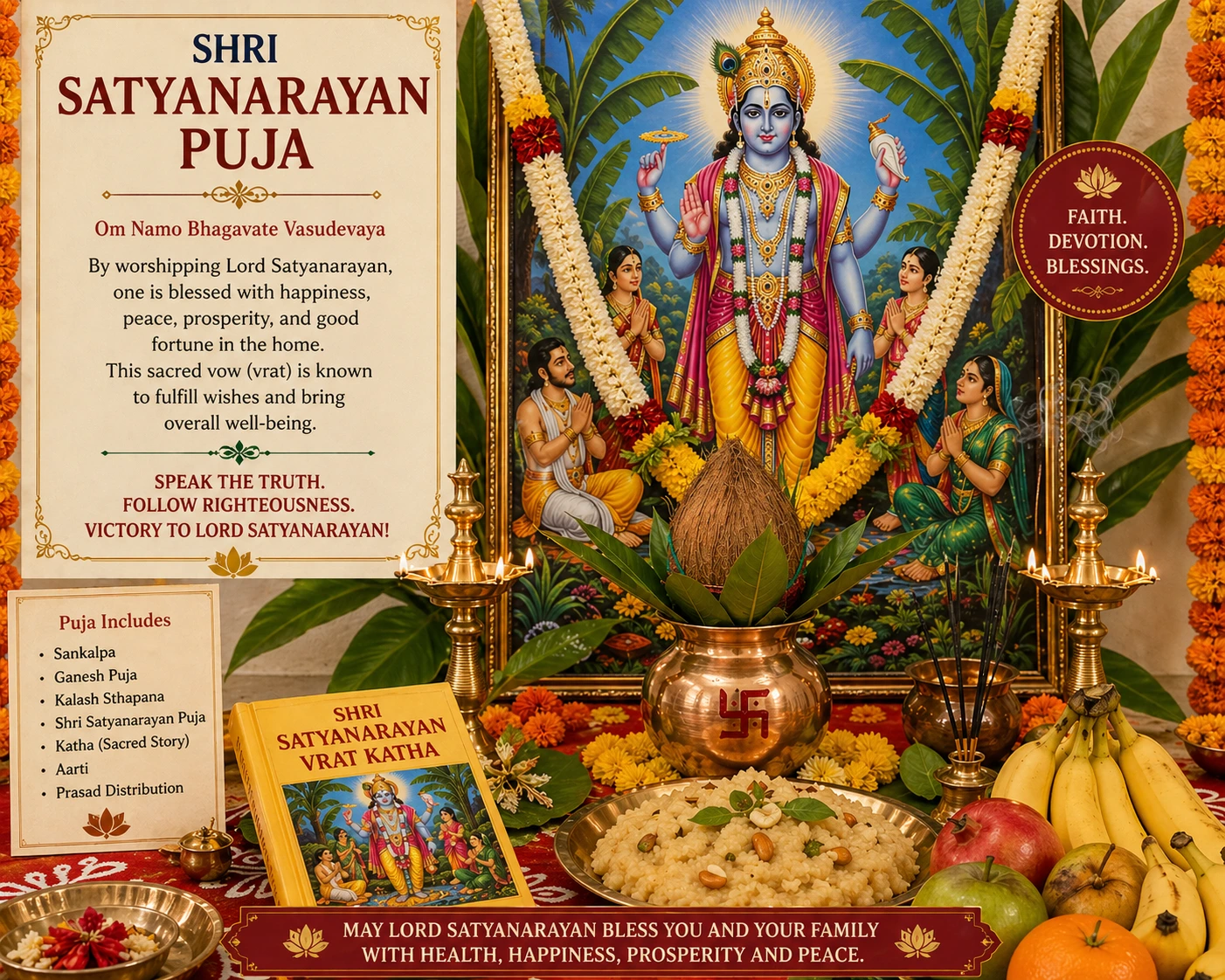
At its heart, the Satyanarayan Katha is a sacred narrative — a story — dedicated to Lord Satyanarayan, who is a form of Lord Vishnu. The name itself tells you everything: Satya means Truth, and Narayan means the Supreme Sustainer of the Universe. So when you perform this Katha, you are essentially invoking the power of divine truth into your home and life.
The origin of this ritual is found in the Skanda Purana. The sage Narada Muni once approached Lord Vishnu, troubled by the suffering of human beings on Earth, and asked: “O Lord, what simple act can relieve humans of their grief and bring them lasting peace?” Lord Vishnu responded by prescribing the Satyanarayan Vrat — a simple, accessible, deeply powerful ritual that anyone can perform regardless of their social standing, financial condition, or level of scholarship.
That accessibility is what makes this Katha so universally beloved. It does not demand grand temples or elaborate arrangements. A clean space, a few ritual items, a willing heart, and the presence of the Katha — that’s truly all you need.
Why does it matter?
Because the Satyanarayan Katha is more than a recitation. The five stories embedded within it are moral tales — they illustrate what happens when people are devoted, truthful, and grateful, and what happens when they are not. These are not meant to frighten; they’re meant to remind us that the universe responds to sincerity. Families who perform this puja together report not just spiritual upliftment, but a tangible sense of unity, clarity, and renewed purpose.
For NRIs and families living abroad, performing the Satyanarayan Katha is also an act of cultural preservation — a way of passing something irreplaceable to your children that no classroom can teach.
 When Should You Perform Satyanarayan Katha?
One of the most beautiful aspects of this ritual is that there is no single “must-do” occasion. The Satyanarayan Katha is extremely flexible and can be performed during a wide range of life events and auspicious periods.
Traditionally, it is performed on:
Purnima (Full Moon Day) — This is the most auspicious time. The energy of Purnima amplifies devotion and enhances the spiritual benefits of the puja. Each month’s Purnima carries a different name and significance, but all are considered ideal for Satyanarayan worship.
Ekadashi — The 11th day of both the waxing and waning lunar phases is sacred to Lord Vishnu, making it a naturally powerful day for any Vishnu-related puja, including Satyanarayan Katha.
Thursdays (Guruvar) — Thursday is traditionally considered the day of Lord Vishnu and Brihaspati (Jupiter). Many families choose to hold their Satyanarayan Katha on a Thursday for this reason.
Special Life Events — This is perhaps the most common reason families hold the Katha. It is traditionally performed:
- After purchasing a new home (Griha Pravesh)
- At the birth of a child
- Before or after a wedding
- When starting a new business or career
- After recovering from a serious illness
- To fulfil a vow (mannat) made to Lord Satyanarayan
- On anniversaries and birthdays
- At the beginning of a new year
There is truly no “wrong” time for this puja. The only requirement is a pure heart and the genuine desire to seek Lord Satyanarayan’s blessings.
Satyanarayan Katha Auspicious Dates 2026
If you’re planning to hold a Satyanarayan Katha this year, here are the verified Purnima tithi dates for 2026 (IST), which are the most auspicious days for this ritual:
| Month | Purnima Name | Date |
| January | Pausha Purnima | Saturday, 3 January 2026 |
| February | Magha Purnima | Sunday, 1 February 2026 |
| March | Hutasani / Holi Purnima | Tuesday, 3 March 2026 |
| April | Chaitra Purnima | Wednesday, 1 April 2026 |
| May | Vaishakha Purnima (Buddha Purnima) | Friday, 1 May 2026 |
| June | Jyeshtha / Deva Snana Purnima | Monday, 29 June 2026 |
| July | Guru Purnima | Wednesday, 29 July 2026 |
| August | Shravana Purnima (Raksha Bandhan) | Thursday, 27 August 2026 |
| September | Bhadrapada Purnima | Saturday, 26 September 2026 |
| October | Sharad Purnima | Sunday, 25 October 2026 |
| November | Kartika Purnima | Tuesday, 24 November 2026 |
| December | Margashirsha Purnima | Wednesday, 23 December 2026 |
A note for devotees outside India: If you are in the USA, UK, Canada, Australia, or any other country, the Purnima tithi timings will vary by your time zone. It is important to calculate the correct local tithi before scheduling your Satyanarayan Katha. Our pandits at Astrobhava can help you identify the most auspicious timing based on your location.
Especially recommended dates in 2026:
- Guru Purnima (29 July) — Performing Satyanarayan Katha on Guru Purnima is considered exceptionally meritorious, combining the blessings of Lord Vishnu and Brihaspati.
- Sharad Purnima (25 October) — The full moon of Sharad is said to be energetically the most potent of the year, making this a prime date for the Katha.
- Kartika Purnima (24 November) — Held during the sacred month of Kartik, this Purnima is especially dear to Lord Vishnu.
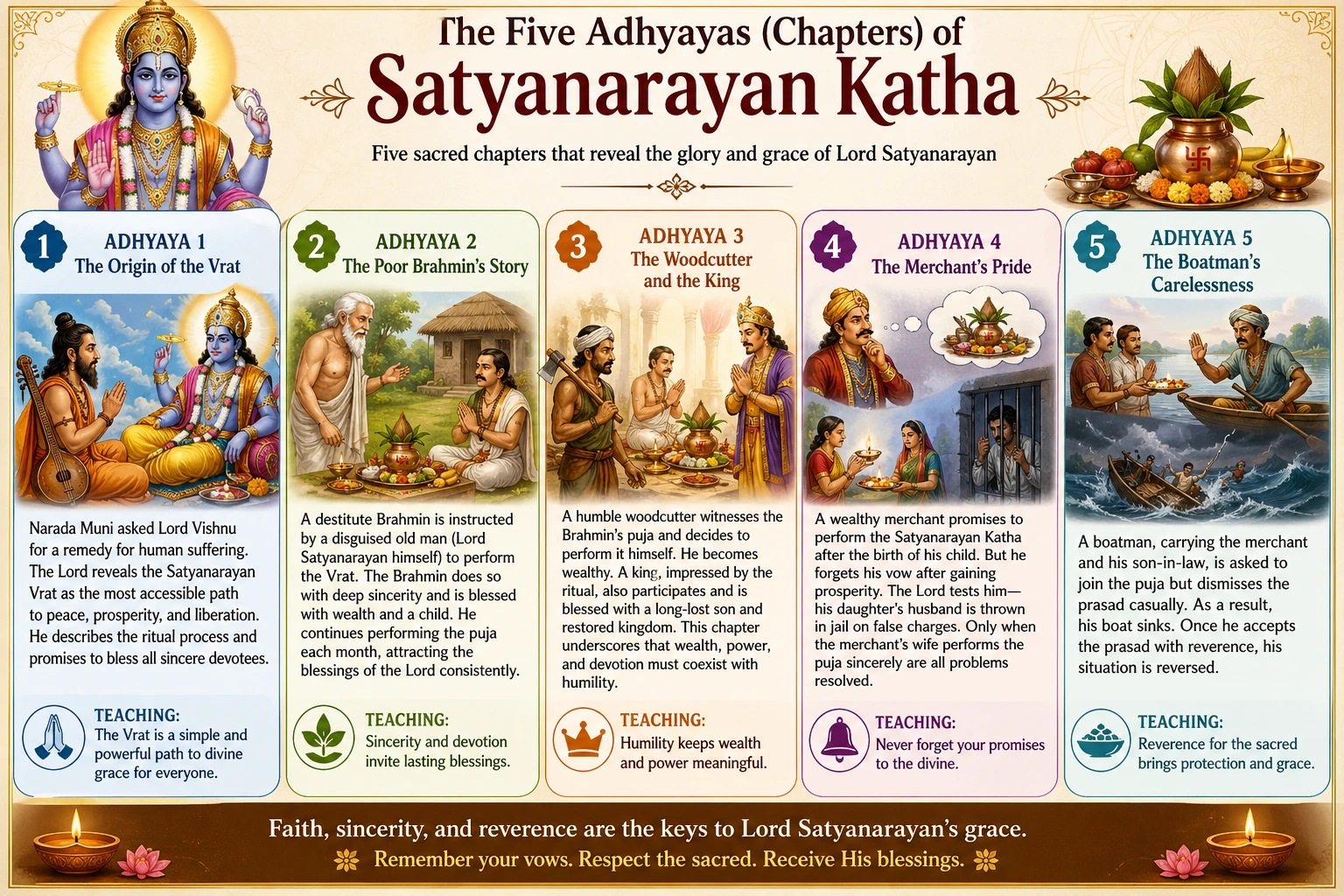 The Five Adhyayas (Chapters) of Satyanarayan Katha
The Satyanarayan Katha is composed of five Adhyayas — five sacred chapters, each carrying a distinct story that illustrates the glory and grace of Lord Satyanarayan. Here’s a brief, meaningful overview of each:
Adhyaya 1 — The Origin of the Vrat This chapter recounts how Narada Muni asked Lord Vishnu for a remedy for human suffering. The Lord reveals the Satyanarayan Vrat as the most accessible path to peace, prosperity, and liberation. He describes the ritual process and promises to bless all sincere devotees.
Adhyaya 2 — The Poor Brahmin’s Story A destitute Brahmin is instructed by a disguised old man (Lord Satyanarayan himself) to perform the Vrat. The Brahmin does so with deep sincerity and is blessed with wealth and a child. He continues performing the puja each month, attracting the blessings of the Lord consistently.
Adhyaya 3 — The Woodcutter and the King This chapter tells the story of a humble woodcutter who witnesses the Brahmin’s puja and decides to perform it himself. He becomes wealthy. A king, impressed by the ritual, also participates and is blessed with a long-lost son and restored kingdom. This chapter underscores that wealth, power, and devotion must coexist with humility.
Adhyaya 4 — The Merchant’s Pride A wealthy merchant promises to perform the Satyanarayan Katha after the birth of his child. But he forgets his vow after gaining prosperity. The Lord tests him — his daughter’s husband is thrown in jail on false charges. Only when the merchant’s wife performs the puja sincerely are all problems resolved. This chapter teaches us: never forget your promises to the divine.
Adhyaya 5 — The Boatman’s Carelessness A boatman, carrying the merchant and his son-in-law, is asked to join the puja but dismisses the prasad casually. As a result, his boat sinks. Once he accepts the prasad with reverence, his situation is reversed. This final chapter is a reminder that even the smallest act of disrespect toward the sacred can carry consequences — and that reverence must be wholehearted.
Each Adhyaya is more than a story. Together, they form a complete philosophy: be truthful, be grateful, honour your commitments, and treat the divine with sincerity and respect.
Satyanarayan Puja Vidhi — Step-by-Step Process
Whether you are performing the puja at home or participating in a temple event, here’s a complete, easy-to-follow guide to the Satyanarayan Puja Vidhi:
What You’ll Need (Puja Samagri):
- A clean puja space with a wooden plank (chowki) covered in yellow or red cloth
- Idol or image of Lord Satyanarayan (or Shaligram stone)
- Panchamrit (mixture of milk, yogurt, honey, ghee, and sugar)
- Tulasi (holy basil) leaves
- Yellow flowers, especially marigolds
- Sandalwood paste (chandan)
- Incense sticks (agarbatti) and a ghee lamp (diya)
- Camphor (kapoor)
- Fruits, particularly bananas
- Panjiri or sheera (roasted wheat halwa) as prasad
- Gangajal (sacred water)
- Betel leaves and nuts (paan-supari)
- Yellow turmeric and kumkum
Step-by-Step Vidhi:
Step 1 — Sankalpa (Resolve and Intention) Begin by stating your intention before Lord Satyanarayan. Hold water in your right hand and declare the date, your name, your gotra, and the purpose of the puja — whether it is for gratitude, the fulfilment of a wish, or a life occasion. Pour the water as an offering.
Step 2 — Ganesh Puja Always begin any Hindu ritual with the worship of Lord Ganesha to remove obstacles. Offer flowers, incense, and a simple prayer to Ganesha before proceeding.
Step 3 — Kalash Sthapana (Sacred Pot Installation) Place a copper or clay pot (kalash) filled with water, mango leaves, and a coconut on your right side. This kalash represents Lord Varuna and the cosmic waters. It sanctifies your puja space.
Step 4 — Shodashopachara Puja (16 Steps of Worship) Invite Lord Satyanarayan into the space through Avahana (invocation). Then offer the 16 forms of service — a seat (asana), water for his feet (padya), water for sipping (achamaniya), a bath with panchamrit (abhisheka), fresh clothes (vastra), the sacred thread (yagnopaveeta), sandalwood (gandha), flowers (pushpa), incense (dhupa), the lamp (deepa), food offerings (naivedya), water for mouth rinsing after the meal (achamana), betel leaves (tambul), circumambulation (pradakshina), and a final prayer (prarthana).
Step 5 — Recitation of Satyanarayan Katha This is the heart of the entire puja. All family members and guests must be seated facing the deity. The pandit (or a senior member of the family) recites all five chapters of the Katha aloud. Everyone should listen attentively, with folded hands. During the Katha, no one should leave the room or show disrespect. When the boatman’s story is recited in the fifth chapter, everyone holds the prasad plate in their hands as a mark of humble acceptance.
Step 6 — Aarti After the Katha, the Aarti of Lord Satyanarayan is performed by circling a camphor flame before the deity while the entire family sings the aarti hymn together. This is typically the most joyous part of the ritual — the music rises, the fragrance of camphor fills the air, and everyone feels the collective uplift of devotion.
Step 7 — Prasad Distribution The panjiri or sheera prasad, along with fruits and tulasi leaves, is then distributed to everyone present. The prasad must be accepted with both hands and consumed reverently. Remember the fifth Adhyaya — careless treatment of prasad is considered deeply inauspicious.
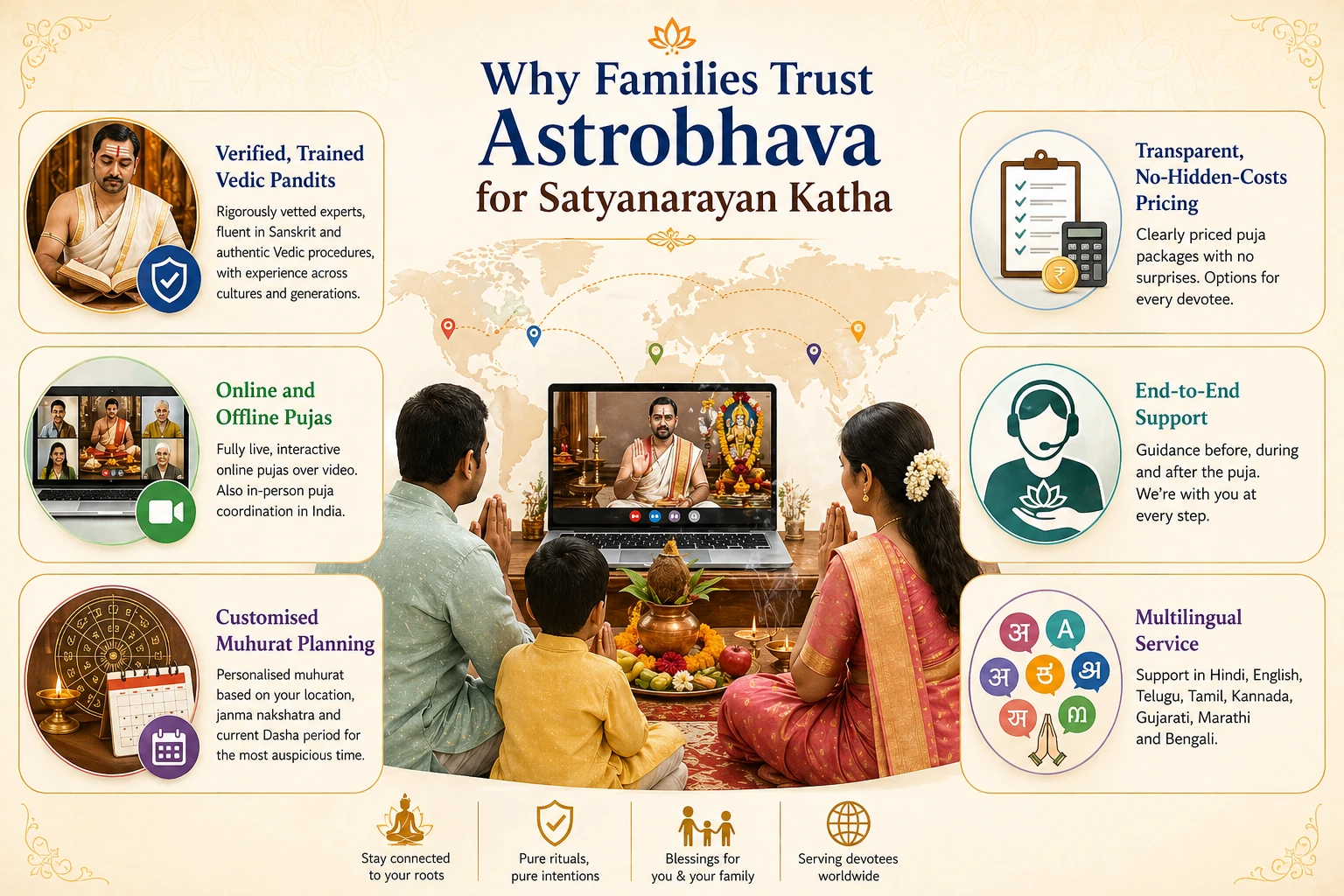 Why Families Trust Astrobhava for Satyanarayan Katha
Living outside India doesn’t mean living outside your spiritual roots. At Astrobhava, we understand that whether you’re in Houston or Helsinki, in Toronto or Tokyo, the pull of your traditions never fades. It becomes, if anything, stronger with distance.
Here’s why thousands of families choose Astrobhava for their Satyanarayan Katha:
Verified, Trained Vedic Pandits — Every pandit on our platform is rigorously vetted. They are fluent in Sanskrit, trained in authentic Vedic procedures, and experienced in conducting rituals for families across different cultural backgrounds and generations.
Online and Offline Pujas — Can’t travel to India? No problem. We conduct fully live, interactive online pujas over video so you and your family can participate in real time, see the rituals, ask questions, and receive your prasad blessings. For those in India or visiting, we also arrange in-person puja coordination.
Customised Muhurat Planning — We don’t just give you a generic date. Our astrologers calculate the most auspicious muhurat for your specific location, your family’s janma nakshatra, and your current Dasha period, ensuring your puja is held at precisely the right cosmic moment.
Transparent, No-Hidden-Costs Pricing — We believe sacred rituals should be accessible. Our puja packages are clearly priced with no surprise additions. From basic Satyanarayan Katha to elaborate Narayan Sukta Homa ceremonies, there’s something for every devotee.
End-to-End Support — From helping you understand what puja to perform and why, to guiding you through the sankalpa, to following up with you after the ritual — our team is with you at every step. We’re not just a booking service; we’re your spiritual partners.
Multilingual Service — Our pandits and support team communicate in Hindi, English, Telugu, Tamil, Kannada, Gujarati, Marathi, and Bengali — so language is never a barrier to your bhakti.
Conclusion
The Satyanarayan Katha is one of Hinduism’s most timeless gifts — simple enough for anyone to perform, yet deep enough to transform a household. It is a ritual that bridges generations, connects hearts, and anchors families in truth, gratitude, and divine grace.
Whether you’re holding it for the first time in your new home abroad, fulfilling a long-standing vow, or simply gathering your family together on a Purnima night — the Lord is always ready to receive you. As the Katha itself teaches: sincerity matters more than grandeur. One lamp, one heart, one sincere prayer — that is enough.
Don’t let distance, busy schedules, or lack of resources stop you from honouring this beautiful tradition. Astrobhava is here to make it simple, authentic, and deeply meaningful — no matter where in the world you call home.
Om Namo Bhagavate Vasudevaya 🙏
Frequently Asked Questions (FAQs)
Q1. How long does a Satyanarayan Katha take?
A complete Satyanarayan Puja with all five chapters of the Katha typically takes between 2 to 3 hours. If a Narayan Sukta Homa is added, allow an additional 45 to 60 minutes.
Q2. Can Satyanarayan Katha be performed at home without a pandit?
Yes, technically the puja can be performed at home by a senior family member who is familiar with the procedure. However, for the fullest spiritual benefit and procedural accuracy — especially for significant life occasions — it is recommended to have a trained Vedic pandit conduct it.
Q3. What is the significance of panjiri or sheera as prasad?
The prasad for Satyanarayan Puja is traditionally made from roasted wheat flour (sooji or atta), ghee, sugar or jaggery, and banana. These ingredients are considered sattvic (pure) and are associated with Lord Vishnu’s nourishing grace. It is offered to the deity first and then distributed to all attendees.
Q4. Can women perform Satyanarayan Puja?
Absolutely. The Satyanarayan Katha and Puja are for everyone — men, women, children, and elders alike. There are no gender restrictions. Women can perform the puja independently, lead the Katha, and conduct the entire vidhi themselves.
Q5. Is fasting mandatory for Satyanarayan Puja?
Fasting on the day of the puja is traditionally recommended, but it is not strictly mandatory. If fasting is not possible due to health or other reasons, you may observe a partial fast (avoiding non-vegetarian food, alcohol, and eating a simple sattvic meal). Your devotion and sincerity are what matter most.
Q6. Can Satyanarayan Katha be performed online (virtually)?
Yes. Online Satyanarayan Katha has become increasingly common, especially for families living abroad. A Vedic pandit conducts the complete puja and Katha live over video, while you and your family participate from your home. At Astrobhava, we offer a seamless, sacred online puja experience specifically designed for the global Hindu community.
Q7. What is the difference between Satyanarayan Puja and Satyanarayan Katha?
These two terms are often used interchangeably, but there is a subtle difference. The “Satyanarayan Puja” refers to the entire ritual — the invocation, the 16-step worship, the offerings, and the aarti. The “Satyanarayan Katha” specifically refers to the recitation of the five sacred chapters (Adhyayas). The Katha is an essential and integral part of the Puja — you cannot have a complete Satyanarayan Puja without the Katha being recited.
Q8. What is the Narayan Sukta Homa, and how is it related to Satyanarayan Puja?
The Narayan Sukta Homa is a sacred fire ritual (yajna) in which the Narayan Sukta — a powerful Vedic hymn from the Taittiriya Upanishad — is chanted while oblations are offered into the sacred fire. It is performed to invoke the cosmic, all-pervading form of Lord Narayan. It can be performed as a standalone homa or as an enhanced addition to the Satyanarayan Puja for amplified blessings, especially for major life occasions, business launches, or serious obstacles.
Q9. How many people need to be present for Satyanarayan Katha?
There is no minimum number. Even if only one or two family members are present, the Katha holds the same sacred power. Traditionally, the more family members and friends who gather to listen to the Katha together, the more spiritually potent the experience — but individual or small-family performances are equally valid and blessed.
Q10. Can I schedule Satyanarayan Katha on a day other than Purnima?
Yes. While Purnima is the most auspicious day, the Satyanarayan Katha can be performed on Ekadashi, Thursdays, or any personally significant day such as a birthday, anniversary, or housewarming. The Lord’s grace is not confined to a calendar. What matters is your intention and devotion.
Related posts:
 Online Puja Booking Guide: Temple Blessings From Wherever You Are
 What is Rudra Abhishek Pooja? A Complete Guide to This Sacred Hindu Ritual
 Gauri Puja before Marriage: The Complete Guide to This Sacred Pre-Wedding Ritual
 Pujas for Success Over Enemies: Your Complete Guide to Reclaiming Power, Peace, and Victory