There is a silent grief that many Hindu families carry without realizing it — a sense of stagnation, recurring obstacles, unexplained delays in marriage or progeny, chronic health issues that no doctor can fully explain, or a creeping feeling that something in the household is simply not at peace. In most such cases, Vedic wisdom points to one root cause: unsatisfied ancestors, or what is known as Pitru Dosha.
And the most powerful remedy prescribed by ancient rishis across the Garuda Purana and Dharma Shastra texts is clear — perform Thila Homam.
This blog answers the most searched question surrounding this sacred ritual: who should perform Thila Homam, when must it be performed, what exactly happens during the ceremony, and how devotees living in the USA, UK, Canada, Australia, and across the NRI diaspora can access this powerful Vedic fire ritual without traveling to India.
What Is Thila Homam?
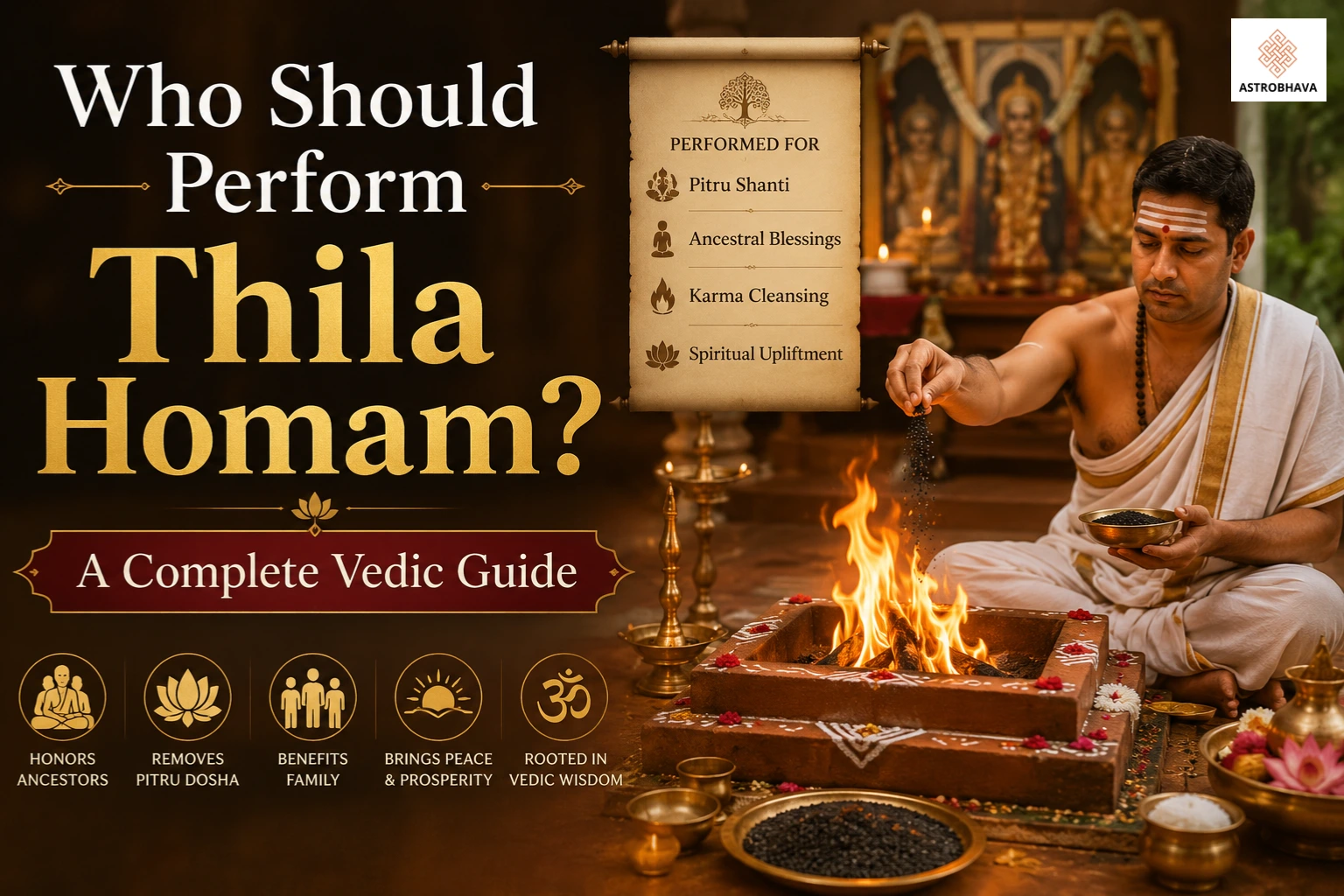
Thila Homam (also spelled Tila Homam) is a Vedic fire ritual in which black sesame seeds — called “thila” in Sanskrit — are offered into a sacred fire along with ghee, barley, and sacred herbs, accompanied by the chanting of Pitru mantras and the Moola Mantra of Lord Narayana: “Om Namo Narayanaya.”
Black sesame seeds hold a unique position in Vedic ritual science. They are considered the most sacred offering for departed souls, symbolizing immortality and nourishment for the Pitrus (ancestral beings) residing in the subtle realms. When offered into the consecrated fire with proper sankalpa and mantra, these seeds are believed to reach the astral planes where ancestors dwell, satisfying their hunger, granting them peace, and releasing them from energetic bondage.
The Homa is rooted in the ancient understanding that the living and the departed are bound by an invisible spiritual thread. When that thread is honored through ritual, the entire family lineage benefits — and when it is neglected, the ancestors’ dissatisfaction ripples forward through generations, manifesting as doshas, obstacles, and suffering in the lives of descendants.
 Who Should Perform Thila Homam? (The Definitive List)
This is the question that brings most devotees here. According to Vedic tradition and the guidance of experienced purohits, the following categories of people must perform Thila Homam at least once in their lifetime — and in several cases, repeatedly.
1. Those With Pitru Dosha in the Horoscope
Pitru Dosha occurs when the Sun, Moon, Rahu, or Saturn is afflicted in the 9th house, or when certain planetary combinations indicate ancestral karma. If your Kundali shows Pitru Dosha, performing Thila Homam is one of the most direct remedies recommended in classical Jyotisha texts. The homa neutralizes the malefic effects of Pitru Dosha and prevents it from affecting future generations.
Not sure if you have Pitru Dosha?
Check your birth chart using Astrobhava’s Free Kundali tool for an instant analysis.
2. Families Whose Ancestors Died an Unnatural or Sudden Death
Souls of those who departed suddenly through accidents, violence, suicide, or unexpected illness are believed to remain restless in the subtle realms, unable to progress to higher planes. This unrest creates a direct spiritual burden on their living descendants. Performing Thila Homam is the prescribed Vedic method to pacify such souls, release them from earthly attachment, and invite their blessings rather than their distress.
3. Those Who Have Neglected Ancestral Rituals (Tarpanam and Shraddha)
If your family has not regularly performed Mahalaya Amavasya Tarpanam, Pitru Paksha Shraddha, or annual death anniversary rituals (Tithi) for several years or generations, the ancestors may be dissatisfied. This neglect — often unavoidable due to migration, modern lifestyle, or lack of awareness — creates accumulated Pitru karma. Performing Thila Homam is the most effective single-ritual remedy to clear this backlog of spiritual debt.
4. Individuals Facing Recurring Problems in Marriage, Career, or Finances
When practical efforts fail and doors remain closed despite genuine hard work, Vedic astrology often identifies ancestral karma as the invisible root. Persistent delays in marriage alliances, failed pregnancies, business losses with no logical explanation, stagnant career growth, prolonged court cases, or chronic financial instability — all these can be symptoms of Pitru Dosha arising from unsatisfied ancestors. Perform Thila Homam to clear these energetic blocks at the source.
5. Those Experiencing Paranormal or Negative Occurrences at Home
Unexplained sounds, recurring nightmares, family members seeing departed relatives in distressing dreams, persistent negative energy in the home, or a general feeling of being spiritually heavy — these experiences in Vedic tradition are interpreted as signs of ancestral presence or unease. The Thila Homam, centered on Lord Narayana and the Pitru deities, directly addresses these disturbances and restores peace to the household.
6. Families Planning Major Life Events
Any significant transition — a marriage, the birth of a child, a housewarming (Griha Pravesh), a major business launch, or children moving to a new country — is considered an ideal and important time to perform Thila Homam. Invoking ancestral blessings before such milestones ensures the event unfolds under protective and auspicious energies, with the lineage’s accumulated merit flowing forward.
7. Those Under Prolonged Sade Sati or Shani Dasha
Saturn’s transit over the natal Moon (Sade Sati) or a long Saturn period (Shani Mahadasha or Antardasha) can amplify the effects of Pitru Dosha significantly. During these 7.5-year phases, the individual’s karmic debts — including ancestral ones — are brought to the surface for resolution. Performing Thila Homam during this period provides measurable relief from Saturn’s malefic effects by addressing the ancestral karma that Saturn is forcing into awareness.
🕉️ Facing Saturn’s wrath? Pair your Thila Homam with Mrityunjaya Puja on Astrobhava for complete protection of health and longevity.
8. Anyone Who Has Lost Parents or Elderly Elders
When parents pass on, Hindu tradition places a strong obligation on children to perform the prescribed ancestral rites. If proper Antyesti (last rites), Shraddha, and annual Tithi rituals have not been performed, or if circumstances prevented them at the time of death, performing Thila Homam is the most comprehensive compensatory ritual to honor the departed and ensure their journey forward in the subtle planes.
9. NRIs and Diaspora Devotees Living Abroad
For Hindus living in the USA, UK, Canada, Australia, Singapore, UAE, and across Europe, the geographical distance from India does not exempt them from ancestral karma — in fact, it often intensifies it, because diaspora families frequently lose access to the ritual infrastructure needed to perform Tarpanam and Shraddha. The ancestors’ need for remembrance does not diminish because of a time zone. Performing Thila Homam online through a trusted Vedic platform like Astrobhava ensures that your ancestral debt is cleared with the same authenticity as if you were present in person.
10. Devotees Experiencing Unexplained Health Issues Across Generations
When a pattern of a specific illness — heart disease, reproductive issues, mental health challenges, or early death — repeats across multiple generations of a family, Vedic tradition sometimes attributes this to an ancestral health karma that needs ritual clearing. Thila Homam, by addressing the root Pitru karma, can help break such generational cycles over time when combined with appropriate medical care.
The Sacred Significance of Black Sesame in Thila Homam
One of the most frequently asked questions about this ritual is: why black sesame seeds specifically?
In the Garuda Purana, sesame seeds (thila) are described as having originated from the sweat of Lord Vishnu, making them inherently sacred and deeply connected to the energy of preservation and liberation. Black sesame seeds in particular are associated with Saturn (Shani), who rules karma, death, and the ancestral realm. Offering thila into the sacred fire is therefore a direct bridge between the world of the living and the subtle world of the Pitrus.
The seeds also symbolize the countless lives and experiences accumulated by departed souls — by offering them with devotion, the devotee acknowledges and honors the entire weight of their ancestral journey.
How to Worship Lord Shiva: 9 Powerful Ways to Seek Blessings
When Should Thila Homam Be Performed? Auspicious Timings
Timing is a critical element of Vedic ritual science. While Thila Homam can be performed year-round on the right muhurta, certain periods carry heightened potency for ancestral rituals:
Pitru Paksha (September–October): The 16-day period during the Krishna Paksha of Bhadrapada/Ashwin month is the most sacred window for all ancestral rituals. In 2026, Pitru Paksha falls from September 7 to September 22. Performing Thila Homam during this fortnight delivers amplified results.
Mahalaya Amavasya: The last day of Pitru Paksha, known as Sarva Pitru Amavasya or Mahalaya Amavasya, is considered the most powerful single day for ancestral rites in the Hindu calendar. In 2026, this falls on September 22. A Thila Homam performed on this day reaches the entire ancestral lineage simultaneously.
Monthly Amavasya (New Moon): Each monthly Amavasya tithi is traditionally associated with the Pitrus. Performing Thila Homam on any Amavasya of the year is deeply auspicious.
Masa Shivaratri: The monthly Shivaratri, which falls on the Krishna Chaturdashi before Amavasya each month, is also considered appropriate for Thila Homam, particularly when ancestors died on this day or have a strong Shiva connection.
Death Anniversaries (Tithi Shraddha): The annual Tithi of a deceased parent or ancestor is one of the most personally powerful times to perform Thila Homam, as the ancestral soul is believed to be most accessible to blessings and offerings on this day.
Beyond these key periods, Astrobhava’s astrologers select a personalized auspicious muhurta for each booking based on your specific birth details, ensuring maximum efficacy regardless of when you book.
📿 Deepen your spiritual protection between ritual occasions
Step-by-Step Puja Vidhi: How Thila Homam Is Performed at Astrobhava
Understanding the ritual procedure helps you participate with genuine awareness, whether you are present physically or joining via live telecast from overseas. Here is the complete Thila Homam procedure as performed by Astrobhava’s Vedic priests:
Sankalpa: The ceremony opens with the devotee declaring their name, gotra, intention, and the names of family members for whom blessings are sought. This sankalpa (sacred intention-setting) is the energetic anchor of the entire ritual.
Ashtadikbalagar Pratishta: The guardians of the eight directions are invoked to create a protective ritual space and ensure that only positive, divine energies are present during the ceremony.
Homa Kunda Preparation: The sacred fire pit is decorated with auspicious symbols, flowers, and ritual designs according to Agama Shastra guidelines.
Ganapati Puja: Lord Ganesha is worshipped first to remove all potential obstacles from the ritual’s path.
Agni Pratishta: The sacred fire is lit with precise mantras, invoking the god Agni as the divine messenger who will carry the offerings to the Pitrus and Lord Narayana.
Punyavachanam and Pranayama: The priests perform ritual purification through sacred water and breathing practices, elevating the vibrational field of the ceremony.
Mantra Chanting: The Pitru mantras and the Moola Mantra of Lord Narayana — “Om Namo Narayanaya” — are chanted with precision, each recitation sending reverberations into the subtle planes.
Principal Offerings: Black sesame seeds (thila), pure ghee, barley, and a selection of sacred herbs are poured into the fire in successive rounds. These offerings are the core substance of the ritual, each ingredient carrying its specific energetic signature.
Multiple Avarthis: The offerings are repeated in multiple rounds (avarthis) to amplify the energy generated and ensure the intentions reach their intended destinations.
Poornahuti and Arati: The ceremony reaches its peak with the Poornahuti — the final, conclusive offering that seals all the energies generated during the homa. This is followed by the Arati, expressing gratitude to the divine.
Vishnu Yantra Energization: During the homa itself, a Vishnu Yantra is energized within the ritual field and later dispatched to the devotee as a lifelong protective talisman — sealed in a sacred silver amulet for continuous ancestral protection.
Sattvic Prasadam: A spiritually purified meal is offered to all participants as a symbol of nourishment for both body and soul, completing the ritual cycle.
What Benefits Can You Expect After Performing Thila Homam?
When Thila Homam is performed correctly with the right sankalpa, proper vidhi, and genuine devotion, the following transformations are observed:
Departed ancestors find peace in the subtle planes, and their restless energy no longer creates obstructions for descendants. Pitru Dosha is neutralized in the birth chart, removing karmic blocks from marriage, progeny, finances, and career. Families experience a gradual restoration of harmony, reduced conflict, and renewed unity. Chronic obstacles that have persisted for years begin to dissolve. Health improves as ancestral health karma is addressed at the root. Individuals under Sade Sati or Shani Dasha notice reduced severity of Saturn’s effects. A sense of spiritual relief, lightness, and deep peace settles over the family home. The entire lineage — past, present, and future — receives the merit generated by this ritual.
🔱 Don’t wait for circumstances to worsen
— Book your Individual Thila Homa with Astrobhava
100% personalized, live worldwide, with free yantra and prasad delivery.
Thila Homam vs. Tarpanam: What Is the Difference?
Many devotees wonder whether they should perform Thila Homam or simply do Tarpanam, and whether one replaces the other.
Tarpanam is a shorter, regularly performed offering of water and sesame seeds to the ancestors, done ideally every Amavasya or during Pitru Paksha. It is a maintenance practice — keeping the ancestral connection nourished on an ongoing basis.
 Thila Homam, by contrast, is a deep-cleansing, transformative ritual involving the sacred fire. It addresses accumulated Pitru karma in a way that Tarpanam alone cannot. Think of Tarpanam as daily nourishment and Thila Homam as a comprehensive healing intervention. Classical texts recommend performing both — Thila Homam at least once in a lifetime (or whenever Pitru Dosha is active), and Tarpanam regularly to sustain the ancestral peace achieved.
Can Women Perform Thila Homam?
This is a question frequently asked, particularly by women who have lost parents or who are managing family spiritual responsibilities. The answer, as per the broader Vedic tradition, is yes — women can and do perform Thila Homam, particularly when they are the primary caretakers of ancestral remembrance in the family, or when there is no male heir. At Astrobhava, the ritual is performed on behalf of the devotee by experienced priests, meaning that the sankalpa — the intention — is set in the name of whoever is booking and seeking the blessings, regardless of gender.
Thila Homam for NRIs: How Astrobhava Makes It Accessible Worldwide
One of the greatest spiritual challenges for Hindu families living abroad is maintaining ritual continuity. In the USA, UK, Canada, or Australia, there are few temples equipped to perform the elaborate Thila Homam with proper vidhi, an experienced priest trained in ancestral rites, and all the required samagri including black sesame, specific herbs, and a consecrated homa kunda.
Astrobhava solves this completely. Every Thila Homam booking is an individual, personalized ceremony — never a group ritual. Your name, gotra, and sankalpa are declared at the opening of the ceremony and the entire homa is directed solely toward you and your immediate family. The ritual is performed live from Astrobhava’s sacred Yagna Ashram in India by certified Vedic priests trained in traditional Padashalas under the guidance of Brahmashree Shivaaya. You receive a live YouTube telecast link to join in real time from anywhere in the world.
After the ceremony, the energized Vishnu Yantra and blessed prasadam are shipped to your doorstep, anywhere in the world, completely free of charge. Over 40 countries trust Astrobhava for genuine Vedic ritual experiences.
Conclusion
The question of who should perform Thila Homam has a broad and important answer: almost every Hindu family, at some point in their lineage journey, carries the need for this ritual. Whether it is the presence of Pitru Dosha in a horoscope, a pattern of recurring family obstacles, the departure of loved ones whose rites were incomplete, or simply the desire to honor ancestors and invite their blessings — Thila Homam is the Vedic tradition’s most comprehensive, time-tested response.
Performing Thila Homam is not a superstition or a cultural formality. It is an act of cosmic responsibility — an acknowledgment that we are part of an unbroken chain of souls, and that our prosperity, health, and peace are intimately connected to those who came before us.
For NRIs and devotees around the world, the geographical distance from India is no longer an obstacle. With Astrobhava’s live online Thila Homa, you can honor your lineage with full Vedic authenticity, from wherever you are.
Book your Individual Thila Homa with Astrobhava today →
Frequently Asked Questions (FAQs)
Q1. Who exactly should perform Thila Homam?
Anyone with Pitru Dosha in the horoscope, families whose ancestors died suddenly or unnaturally, those who have neglected ancestral rites like Tarpanam and Shraddha, individuals facing recurring problems in marriage, career, health, or finances, those under Sade Sati, and NRIs who cannot regularly perform ancestral rituals in India.
Q2. How many times should one perform Thila Homam in a lifetime?
Classical texts prescribe performing Thila Homam at least once in a lifetime. However, those with active Pitru Dosha, those under Sade Sati, or those who have lost multiple elders in succession may benefit from performing it annually during Pitru Paksha or on Mahalaya Amavasya.
Q3. What is the best time to perform Thila Homam in 2026?
The most auspicious period is Pitru Paksha, which runs from September 7 to September 22, 2026, with Mahalaya Amavasya (Sarva Pitru Amavasya) falling on September 22 being the single most potent day. Monthly Amavasya tithis and the annual death anniversary (Tithi) of a parent or elder are also highly recommended.
Q4. Can Thila Homam be performed online?
Yes. Astrobhava performs Thila Homam live from their sacred Yagna Ashram in India. Devotees receive a YouTube live telecast link and can join in real time from any country. An energized Vishnu Yantra and prasadam are shipped free worldwide post-ceremony.
Q5. What is the difference between Thila Homam and Narayana Bali?
Thila Homam is a fire ritual primarily directed at appeasing all ancestors and removing Pitru Dosha through sesame seed offerings and Narayana mantras. Narayana Bali is a more specific and elaborate ritual performed when a close family member has died an unnatural death and requires a separate set of post-death rites. Both rituals can be combined when recommended by a Vedic astrologer.
Q6. Does Thila Homam help with marriage delays?
Yes. Marriage delays caused by Pitru Dosha or ancestral karma are among the most commonly cited reasons to perform Thila Homam. The ritual clears ancestral obstruction energy that may be blocking the formation of auspicious alliances.
Q7. What is offered into the fire during Thila Homam?
The primary offering is black sesame seeds (thila), accompanied by pure ghee, barley, and sacred herbs. These are offered in multiple rounds (avarthis) along with the chanting of Pitru mantras and “Om Namo Narayanaya.”
Q8. Does Astrobhava personalize the Thila Homam for individual families?
Yes. Every Thila Homam at Astrobhava is a 100% individual ceremony. Your name, gotra, and specific sankalpa are declared at the opening of the ritual. No group homas are conducted.
Q9. What do I receive after the Thila Homam?
You receive a complimentary energized Vishnu Yantra sealed in a sacred silver amulet, blessed prasadam, and the spiritual merit of a fully completed Vedic ancestral ritual — all shipped free to your address worldwide.
Q10. Can I perform Thila Homam if I don’t know my gotra?
Yes. If your gotra is unknown, the priest uses “Kashyapa Gotra” as a universal default, which is the standard Vedic practice in such cases. This does not reduce the efficacy of the ritual.