Of all the goddesses in the vast Hindu pantheon, few radiate the extraordinary combination of beauty, supreme power, and transcendent wisdom that Goddess Tripura Sundari embodies. Revered as the third of the Dasa Mahavidyas — the Ten Great Wisdom Goddesses — she is simultaneously the most beautiful being in all three worlds and the ultimate reality underlying all of existence. To understand Tripura Sundari is to glimpse the very heart of Shakta philosophy and tantric wisdom.
Whether you are a devout seeker, an astrology enthusiast, or simply someone drawn to the mysteries of the divine feminine, this exploration of Tripura Sundari will offer you a deeper understanding of who she is, the stories that define her, and why her worship remains profoundly relevant today.
Who Is Goddess Tripura Sundari?
The name Tripura Sundari is itself a revelation. Tripura means “the one who pervades the three worlds” — Bhuloka (the earth realm), Antarloka (the subtle realm), and Sivaloka (the celestial realm) — while Sundari simply means “the most beautiful.” She is, therefore, the Beautiful One who exists in and beyond all three planes of creation. Her very name declares that beauty, in the deepest sense, is not merely aesthetic — it is cosmic, all-pervading, and divine.
She goes by many names: Shodashi (the sixteen-year-old, representing the perfection of the sixteen phases of the moon), Lalita (the playful one), Rajarajeshwari (queen of queens), Kameshwari (goddess of love and desire), and Srividya (the auspicious wisdom). Each name illuminates a different facet of her boundless nature.
Key Attributes at a Glance:
- Also Known As: Shodashi, Lalita, Rajarajeshwari, Kameshwari
- Position among Mahavidyas: 3rd (or sometimes regarded as 1st and highest)
- Complexion: Red/rose-gold radiance, like the rising sun
- Sacred Yantra: Sri Yantra (Shri Chakra)
- Primary Mantras: Panchadashi (15 syllables) / Shodashi (16 syllables)
- Cosmic Association: The 16 lunar phases (kalas)
- Planetary Association: Venus (Shukra)
Iconography: Seeing the Goddess
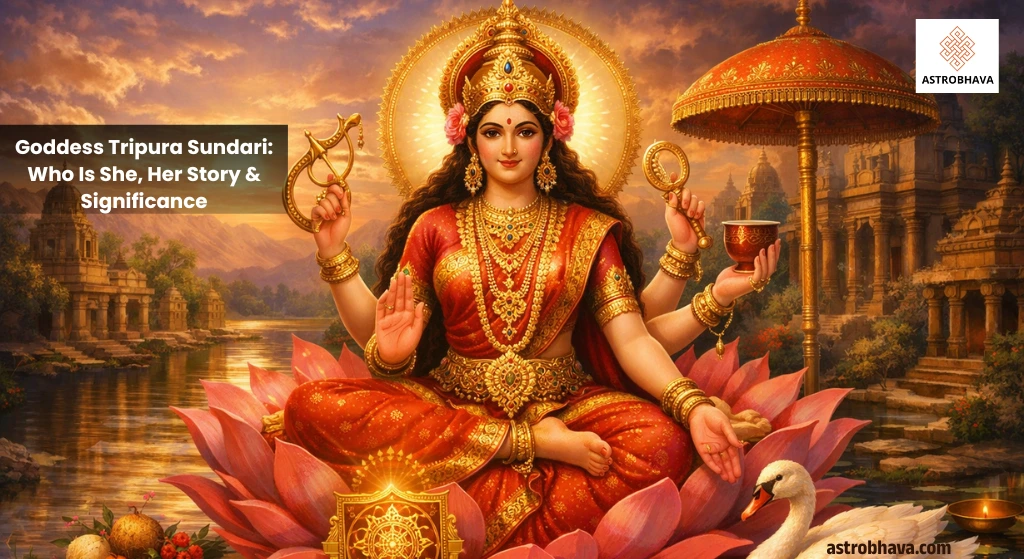
The iconographic representation of Tripura Sundari is one of the most elaborate and symbolically rich in all of Hindu tradition. She is most commonly depicted as a radiant sixteen-year-old girl — the Shodashi — with a complexion that glows like the rising sun, sometimes described as red like a ruby or the colour of a thousand suns combined into one gentle flame.
She sits on a throne that is itself a cosmos. Her seat is a lotus resting upon the body of Shiva, who lies still as the embodiment of pure, inactive consciousness. Beneath Shiva are Brahma, Vishnu, Rudra, and Ishvara — the four cosmic architects — who form the four legs of the throne. This imagery is not merely decorative. It declares that Tripura Sundari, as pure Shakti, is the power that animates even the highest gods. Without her, consciousness cannot act; without her, the universe cannot breathe.
She holds four objects in her four hands:
- Pasha (noose): Binds the devotee to her with divine love
- Ankusha (goad): Removes all obstacles on the spiritual path
- Sugarcane bow: Represents the mind transformed from worldly craving into spiritual longing
- Five flower arrows: Represent the five senses purified and offered back to the divine
Together, these instruments tell us that she controls the entire field of consciousness and its interactions with the manifest world.
The Sri Yantra — the sacred geometric diagram associated with Tripura Sundari — is considered the most powerful of all yantras. Consisting of nine interlocking triangles radiating from a central point (bindu), it represents the complete map of existence: the five downward-pointing triangles symbolise Shakti (the feminine) and the four upward-pointing triangles symbolise Shiva (the masculine). Their union generates 43 sub-triangles that encompass every aspect of reality.
The Story of Tripura Sundari
Her Origin from the Devi Bhagavata Purana
Among the most celebrated accounts of Tripura Sundari’s manifestation is found in the Devi Bhagavata Purana and the Brahmanda Purana’s Lalita Mahatmyam. The story begins when the demon Bhandasura — born from the ashes of Kamadeva (the god of love) who was burned by Shiva’s third eye — amassed terrifying power and began to conquer the three worlds. The gods, rendered powerless, prayed fervently to the Supreme Goddess.
In response to their prayers, a great fire sacrifice (homa) was performed. From the divine flames arose Tripura Sundari in her form as Lalita — the Supreme Goddess — riding in her chariot called Chakra Raja Ratha, accompanied by an entire divine army. She was sixteen years old, radiant beyond all description, and equipped with every weapon of cosmic power.
The battle that followed was epic in scale. The Goddess dispatched her general Dandanatha and her minister Mantrini (who takes the form of Shyamala or Matangi) to lead different wings of her army. In the final confrontation, Lalita Tripura Sundari destroyed Bhandasura with the Mahakameshwara astra — a weapon of supreme divine love — for even demonic power cannot withstand the force of unconditional cosmic love. The three cities (Tripura) that Bhandasura had constructed as his strongholds were annihilated, and she was henceforth celebrated as Tripura Sundari: the beautiful one who conquered the three cities.
The Deeper Esoteric Interpretation
Behind this narrative lies a profound inner teaching. Bhandasura represents the ego bound to the ashes of burned desire — a state where desire is suppressed but its energy remains, making it more dangerous than ordinary craving. The three cities represent the three states of waking, dreaming, and deep sleep in which the ego takes refuge. Tripura Sundari’s victory is therefore the awakening of consciousness that transcends all three states and recognises its own true, ever-free nature. Her weapon of divine love is the only force that can dissolve the deep-seated illusion of separateness.
🛕 Deepen Your Devotion with Astrobhava
Are you called to bring Tripura Sundari’s energy into your home and spiritual practice? Explore our range of authentically crafted and ritually energised tools:
- Energised Sri Yantra (Copper) — Handcrafted and consecrated for home worship and meditation. Shop Now →
- Tripura Sundari Yantra — Sacred yantra for focused sadhana and devotional worship. Shop Now →
- Lalita Sahasranama — Divine hymn of one thousand names japa. Book Now →
- Tripura Sundari Puja Kit — Complete ritual kit with complementary yantra. Shop Now →
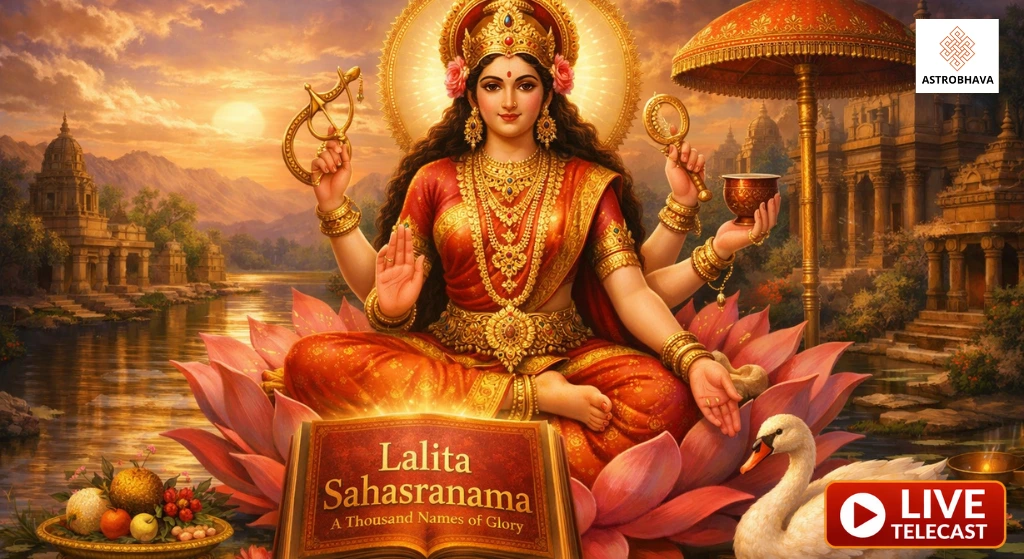 Lalita Sahasranama: A Thousand Names of Glory
One of the greatest scriptural tributes to Tripura Sundari is the Lalita Sahasranama — a hymn of one thousand names contained within the Brahmanda Purana. These names are not mere epithets; each is a mantra that encodes a different aspect of the Goddess’s nature and power. Recited regularly, the Sahasranama is considered one of the most potent forms of worship, capable of bestowing liberation, prosperity, health, and wisdom upon the sincere devotee.
Some of her names in the Sahasranama reveal her cosmological scope:
- Jagadamba — Mother of the universe
- Chidagni Kunda Sambhuta — Born of the fire of pure awareness
- Devakarya Samudyata — She who manifests for the benefit of the gods
- Maha Pralaya Sakshini — The witness of the great cosmic dissolution
Taken together, these names reveal a goddess who is not separate from the cosmos but is the cosmos itself — perceived through the eyes of wisdom as infinite beauty and love.
Significance of Tripura Sundari Worship
Spiritual Significance
Tripura Sundari sits at the apex of the Srividya tradition, one of the most philosophically sophisticated and spiritually transformative paths within Hinduism. Her worship integrates mantra, yantra, and tantra into a unified system aimed at the direct recognition of one’s own consciousness as identical with the divine. Unlike paths that see the divine as wholly external, Srividya sadhana guides the practitioner to discover the Goddess within — in the very nature of awareness itself.
The Panchadashi mantra (fifteen syllables) and the Shodashi mantra (sixteen syllables) associated with her are considered among the most sacred mantras in the entire tradition. Initiation into these mantras from a qualified guru is traditionally required, reflecting the potency and the responsibility that comes with this path.
Astrological and Cosmic Significance
In Jyotisha (Vedic astrology), Tripura Sundari is associated with the number sixteen — the sixteen kalas (phases) of the moon — and with Venus (Shukra), the planet of beauty, love, creativity, and material abundance. Devotees born under strong Venus placements or seeking to strengthen their connection with Venusian energies are often guided toward her worship. Her red-golden complexion, her association with Kameshwara (Lord of Desire) as her consort, and her governance of the five senses all speak to a goddess who does not reject the beauty of the material world but transforms it into a vehicle for the highest realisation.
The Sri Yantra Connection
The Sri Yantra is Tripura Sundari’s physical manifestation in two-dimensional form. Every geometric element of this diagram corresponds to a specific cosmic principle, deity, and level of consciousness. Meditating upon the Sri Yantra is considered equivalent to meditating upon the Goddess herself. Placing a Sri Yantra in one’s home or workspace is traditionally said to attract abundance, harmony, and spiritual grace — because it establishes the divine presence at the very centre of one’s life.
Tripura Sundari and the Dasa Mahavidyas
Within the pantheon of the Dasa Mahavidyas, Tripura Sundari occupies a uniquely luminous position. While goddesses like Kali embody the fierce dissolution of ego, Tara carries the devotee across the ocean of existence, and Bhairavi burns away ignorance, Tripura Sundari represents the ultimate state — the recognition that reality is not merely power or wisdom, but is at its core pure, radiant beauty and bliss. The Sanskrit term Ananda — divine bliss — is inseparable from her nature.
Some Tantric texts place her as the first and highest of the Mahavidyas, understanding all other forms of the Goddess as expressions of her singular, all-encompassing nature. In this view, the fierce forms are she herself taking on different aspects to address different kinds of spiritual obstacles, but her ultimate nature remains the same: infinite, blissful, beautiful awareness.
How to Connect with Tripura Sundari: Practical Guidance
For those who feel drawn to the Goddess, there are several traditional ways to deepen the connection:
Daily Practice:
- Recite the Lalita Sahasranama — no initiation is required, and it is one of the most accessible and powerful devotional practices available.
- Meditate upon the Sri Yantra, beginning with the outer square, moving inward through the lotus petals and triangles, and resting at the central bindu (point).
Auspicious Times for Worship:
- Fridays — associated with Venus (Shukra), her primary planetary association
- Full moon days (Purnima) — especially powerful for Shodashi worship
- Navratri — particularly Sharada Navratri in autumn
- Panchami (fifth tithi) of each lunar fortnight
Offerings (Upachara):
- Red hibiscus flowers (Japa kusuma) — her most beloved offering
- Red sandalwood paste (rakta chandana)
- Kumkum (red vermillion)
- Honey, sugarcane, and sweetmeats such as payasam
- Camphor, jasmine or rose incense, and ghee lamps
Above all, the tradition emphasises that she is not merely worshipped externally but is to be recognised within — as the very awareness by which one reads these words and seeks the divine.
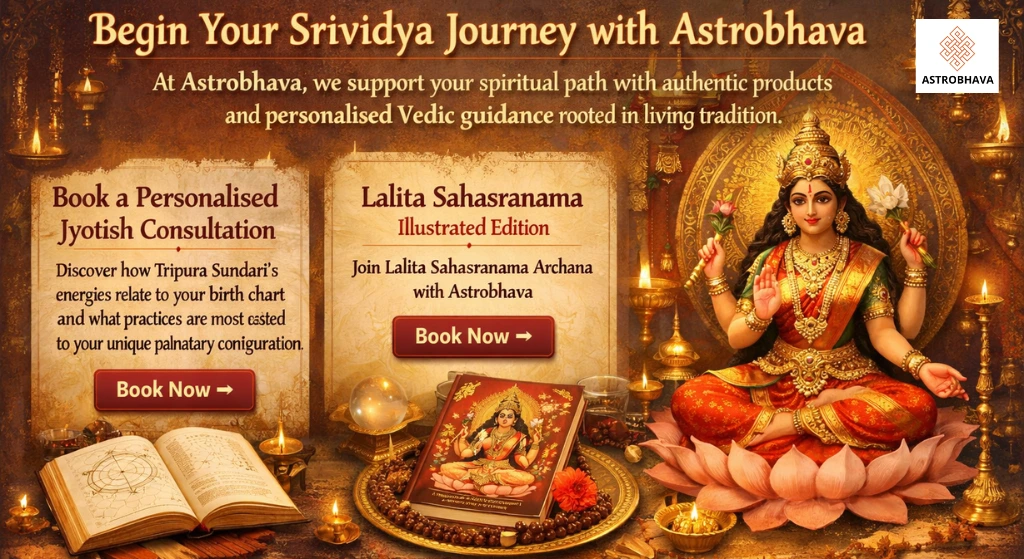 🌟 Begin Your Srividya Journey with Astrobhava
At Astrobhava, we support your spiritual path with authentic products and personalised Vedic guidance rooted in living tradition.
- Book a Personalised Jyotish Consultation — Discover how Tripura Sundari’s energies relate to your birth chart and what practices are most suited to your unique planetary configuration. Book Now →
- Lalita Sahasranama — Illustrated Edition — Join Lalita Sahasranama Archana with Astrobhava. Book Now →
- Browse All Spiritual Products — Sri Yantras, malas, puja kits, incense, and more. Visit the Store →
Conclusion
Goddess Tripura Sundari is far more than a deity of aesthetic beauty. She is the living affirmation that consciousness, at its deepest level, is beautiful — that reality is not neutral or indifferent but is shot through with grace, love, and luminosity. Her worship is an invitation to discover that beauty not in the objects of the world alone, but in the very nature of the awareness that perceives them.
Whether you approach her through devotional prayer, mantra recitation, yantra meditation, or Jyotisha, what she offers remains the same: a direct encounter with your own deepest nature, recognised as the Supreme Mother who has never abandoned you, who is always present, and who is — as the Lalita Sahasranama declares again and again — your very self.
At Astrobhava, we are dedicated to supporting your journey with authentic tools, guidance, and knowledge rooted in the living tradition of Sanatana Dharma. May Lalita Tripura Sundari’s grace illuminate your path.
Frequently Asked Questions
Q1. What is the difference between Tripura Sundari and Lalita?
They are different names for the same goddess. Lalita (meaning “the playful one”) is the name most commonly used in the Lalita Sahasranama and the Brahmanda Purana, emphasising her spontaneous, playful nature as the cosmic creator. Tripura Sundari emphasises her all-pervading beauty across the three worlds. Shodashi is another name emphasising her sixteen-phase completeness. All names refer to the same Supreme Goddess.
Q2. What is the Sri Yantra and why is it connected to Tripura Sundari?
The Sri Yantra (also called the Shri Chakra) is the sacred geometric form of Tripura Sundari. It consists of nine interlocking triangles surrounding a central point (bindu). The five downward triangles represent Shakti and the four upward triangles represent Shiva. Their intersection creates 43 smaller triangles, each associated with a specific aspect of the Goddess. Meditating upon the Sri Yantra is considered equivalent to meditating upon the Goddess herself and is said to bring spiritual clarity, prosperity, and harmony.
Q3. Which day of the week is most auspicious for Tripura Sundari worship?
Friday is considered the most auspicious day, as it is associated with Venus (Shukra) — the planet she is cosmically connected to in Vedic astrology. Full moon days (Purnima) and the days of Navratri — especially Sharada Navratri in autumn — are also highly favoured. The fifth tithi (Panchami) of each lunar fortnight is another traditionally auspicious time for Shodashi worship.
Q4. Do I need initiation to worship Tripura Sundari?
For basic devotional practices such as reciting the Lalita Sahasranama, offering prayers, or worshipping the Sri Yantra at home, no initiation is required. However, for the specific Srividya mantras — particularly the Panchadashi (15-syllable) and Shodashi (16-syllable) mantras — initiation from a qualified guru is traditionally considered essential. These are among the most potent mantras in the tradition, and proper guidance ensures they are practised safely and effectively.
Q5. What flowers and offerings are appropriate for Tripura Sundari puja?
Red hibiscus flowers (Japa kusuma) are her most beloved offering and are considered especially auspicious. Other offerings include red or pink lotuses, red sandalwood paste (rakta chandana), kumkum (red vermillion), honey, sugarcane, and sweetmeats such as panakam or payasam. Camphor, fragrant incense (particularly jasmine or rose), and ghee lamps complete a traditional offering. The colour red throughout the puja reflects her nature as the goddess of divine love and vital energy.
Q6. How does Tripura Sundari relate to Vedic astrology (Jyotisha)?
In Jyotisha, Tripura Sundari is associated with Venus (Shukra) and the number 16 (the sixteen kalas of the moon). Those with a prominent Venus in their birth chart — placed in Taurus, Libra, or in a Kendra house — often have a natural affinity for her energy. Propitiating Tripura Sundari is recommended in Jyotisha when Venus is afflicted, as her grace can help resolve issues related to relationships, creativity, wealth, and material harmony. Our Jyotisha consultants at Astrobhava can guide you on whether her worship is particularly suited to your chart.
Q7. What is the significance of Tripura Sundari being called “sixteen years old”?
The description of Tripura Sundari as a sixteen-year-old (Shodashi) is deeply symbolic, not literal. The number sixteen represents completeness and perfection in the Vedic tradition — there are sixteen kalas (phases) of the moon, sixteen samskaras (rites of passage), and sixteen digits of consciousness. A sixteen-year-old is considered to be at the peak of beauty and vitality. As Shodashi, the Goddess embodies the fullness of all sixteen phases — the complete moon, pure, luminous, and without any diminishment. She is the perfection of consciousness itself.