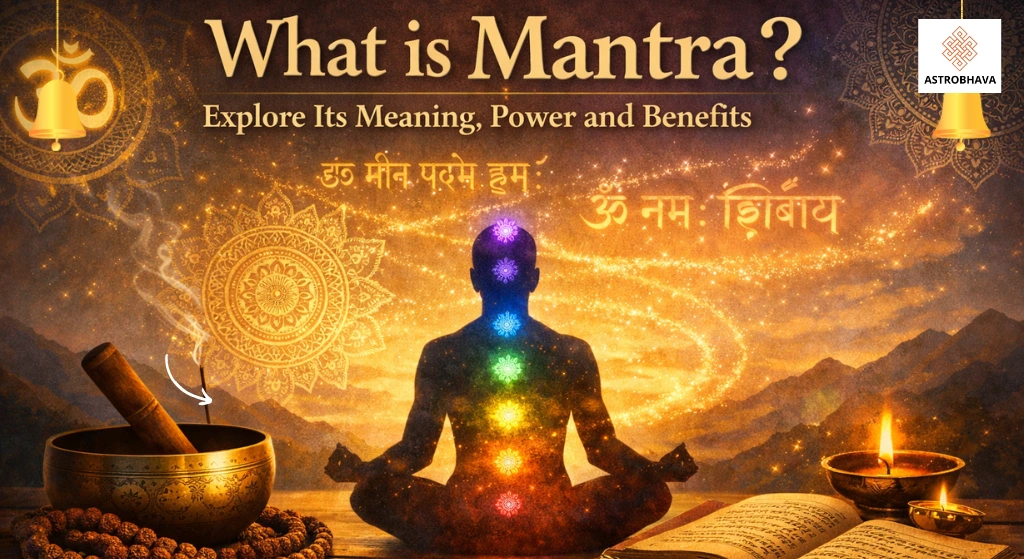
Have you ever caught yourself humming “Om” absentmindedly, or felt a strange peace wash over you when someone chanted in a temple nearby? That’s not coincidence. That’s the power of mantra working on you — even without your knowing it.
Have you ever wondered why monks chant for hours, why your grandmother murmurs prayers under her breath every morning, or why millions of people worldwide are now turning to sound-based meditation? The answer to all of this begins with one simple question: what is mantra?
It sounds like a small question. But once you start pulling at that thread, you find yourself inside one of the most profound, ancient, and scientifically fascinating traditions humanity has ever developed. In this blog, we’re going to explore what mantra really means, where it comes from, why it works, and how it can change your life — in the most practical, grounded way possible.
So let’s begin.
What is Mantra? Let’s Start From the Very Beginning
The word mantra comes from two Sanskrit roots: “man” meaning mind, and “tra” meaning tool or instrument. So at its most literal level, a mantra is simply a tool for the mind.
But that definition barely scratches the surface.
In the Vedic tradition — which gave birth to mantras thousands of years ago — a mantra is understood as a sacred sound, syllable, word, or group of words that carries a specific vibrational frequency. It’s not just what the words mean in a linguistic sense; it’s what the sound does when it is spoken, chanted, or silently repeated. Ancient sages believed that the universe itself was born from sound — the primordial vibration of Om — and that certain sounds could directly interact with the fabric of reality, the human nervous system, and the field of consciousness.
That’s a big idea. And honestly? Modern science is starting to catch up with it.
Neuroscientists and researchers studying meditation have found that repetitive chanting of mantras activates specific regions of the brain, reduces the stress hormone cortisol, slows the heart rate, and synchronises brainwave activity into calmer, more coherent states. When you ask what is mantra, the answer turns out to be both ancient and surprisingly modern: it is sound technology for the human mind and body.
Experience the transformative power of Mrityunjaya Japa: Book Now
The History of Mantras: Older Than You Think
Mantras are not a new-age trend. They are among the oldest spiritual tools known to humanity, appearing in the Rigveda — one of the world’s oldest texts, composed somewhere between 1500 and 1200 BCE, though some scholars place its oral origins much earlier.
The Vedic seers (called Rishis) did not claim to have invented mantras. They said they received them — that during deep states of meditation, the sacred sounds revealed themselves. This is why the Vedas are called Shruti, meaning “that which was heard.” The mantras weren’t composed like poetry; they were perceived, the way a radio receiver picks up a frequency that was already there.
Over time, mantras became central to every major Indian spiritual tradition — Hinduism, Buddhism, Jainism, and Sikhism all developed rich mantra traditions of their own. The Tibetan Om Mani Padme Hum, the Sikh Waheguru, the Hindu Gayatri Mantra, the Buddhist Om Tare Tuttare — these traditions span centuries and cultures, yet they all converge on the same insight: sound has power.
The Structure of a Mantra: What Makes It Work?
Now that we’ve answered the basic question of what is mantra, let’s look at why it actually works. A traditional Vedic mantra typically has several components:
The Bija (Seed Syllable): Every mantra contains at least one bija — a single-syllable sound that carries enormous energetic potency. Om, Hreem, Kleem, Shreem, Aim — these are all bija mantras. They don’t translate neatly into language because they aren’t really words; they are pure sound forms that resonate with specific cosmic energies. Think of them as tuning forks for different dimensions of reality.
The Devata (Deity Principle): Most mantras are associated with a specific deity or cosmic principle — Lakshmi for abundance, Saraswati for wisdom, Durga for protection, Shiva for transformation. This doesn’t mean you have to be religious to use them. The deity simply represents a particular quality of consciousness, and the mantra is the sonic key that unlocks it.
The Kilaka (The Pin): This is the specific syllable or phrase that “unlocks” the mantra’s full power. In traditional practice, the kilaka is often given by the guru at the time of mantra initiation (diksha).
Repetition (Japa): Mantras are meant to be repeated — typically 108 times, which is why the traditional mala (prayer beads) has 108 beads. The repetition isn’t mindless; it’s the gradual deepening of the mind’s alignment with the mantra’s frequency, like tuning an instrument more and more precisely.
What is Mantra? Understanding Its Different Types
Not all mantras are the same. Depending on your purpose, tradition, and level of practice, there are several broad categories:
Vedic Mantras are the oldest and most formal, drawn directly from the four Vedas. The Gayatri Mantra is the most famous — a prayer to the Sun (Surya) as the source of all light and wisdom, chanted by millions of Hindus every day at dawn.
Tantric Mantras are more esoteric and often centre on the bija syllables. They are typically received through initiation from a qualified teacher and are used for specific spiritual or material purposes.
Saguna Mantras are addressed to a deity with form — like Om Namah Shivaya (dedicated to Shiva) or Om Namo Bhagavate Vasudevaya (dedicated to Vishnu). These mantras cultivate a personal, devotional relationship with the divine.
Nirguna Mantras address the formless, absolute reality — like So Hum (“I am That”) or Aham Brahmasmi (“I am Brahman”). These are more philosophical, used in non-dual meditation traditions to dissolve the sense of separate self.
Healing Mantras like the Maha Mrityunjaya Mantra are chanted specifically for health, protection from danger, and overcoming fear of death. They are commonly used during illness, surgery, or times of crisis.
Feeling stressed? Explore mantras to overcome negativity and reduce stress.
The Science Behind Mantra: Why It Actually Works
Let’s be honest — a lot of people today approach spirituality with healthy scepticism. So let’s talk about what science actually says about mantras, because the research is genuinely fascinating.
Sound and Vibration: Everything in the universe is vibrating at different frequencies — including the cells in your body. When you chant a mantra, the vibrations produced by your voice travel through your body, resonating with your tissues, organs, and nervous system. Studies on cymatics (the study of sound made visible) show that different sounds create strikingly different geometric patterns in matter. Sacred syllables like Om produce remarkably symmetrical, beautiful forms.
The Vagus Nerve: Chanting activates the vagus nerve — the body’s primary “rest and digest” pathway — which reduces inflammation, lowers heart rate, and triggers the parasympathetic nervous system. This is why you feel genuinely calmer after chanting, not just psychologically, but physiologically.
Brainwave Entrainment: Studies using EEG have shown that mantra meditation shifts brainwave activity from the frantic beta waves of anxious thinking into the calmer alpha and theta states associated with creativity, relaxation, and deep insight. Regular practitioners often show increased gamma wave activity — the brainwave signature of heightened awareness and compassion.
The Default Mode Network: One of the most exciting findings in meditation research is that mantra practice quiets the brain’s Default Mode Network (DMN) — the system responsible for mind-wandering, rumination, and the endless self-referential chatter we all know too well. A quieter DMN means a quieter mind. And a quieter mind is a more peaceful, creative, and effective mind.
When you understand this, the question of what is mantra stops being a mystical one and starts feeling like a very sensible question about acoustics, neurology, and human wellbeing.
 The Real Benefits of Mantra Practice
Enough theory. Let’s talk about what a regular mantra practice can actually do for your life.
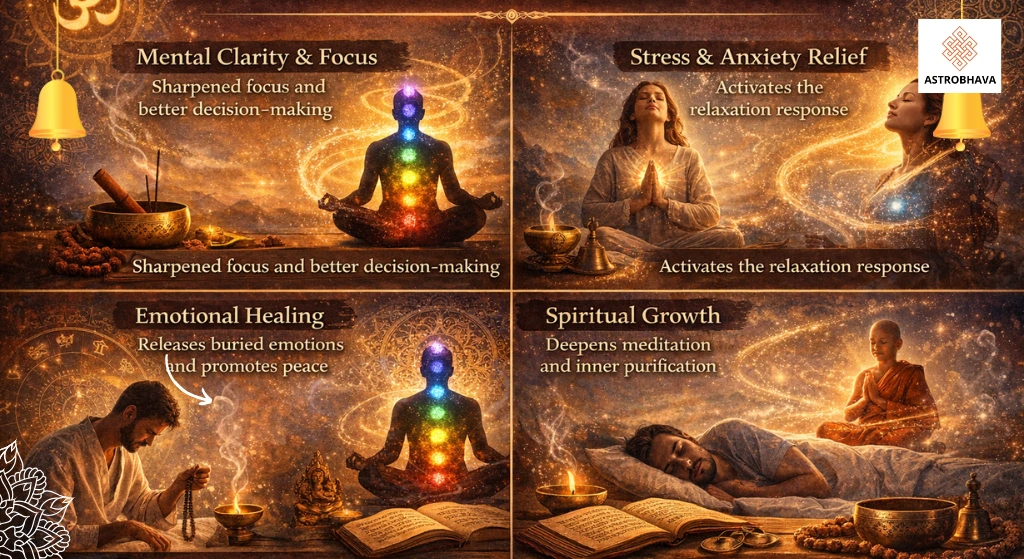
Mental Clarity and Focus: The very act of anchoring your attention to a repeated sound trains the mind to concentrate. Over weeks and months of practice, this translates into sharper focus, better decision-making, and a significantly reduced tendency to get lost in anxious thought spirals.
Stress and Anxiety Relief: This is probably the most widely experienced and scientifically documented benefit. Mantra meditation activates the relaxation response, reduces cortisol, and creates a reliable inner refuge — a place you can return to no matter how chaotic life gets.
Emotional Healing: Certain mantras work directly on emotional wounds. The Maha Mrityunjaya Mantra is traditionally used to overcome fear and grief. Om Shanti invokes peace. So Hum gently dissolves the ego’s defences. Many people report that sustained mantra practice brings buried emotions to the surface — not to overwhelm, but to finally release them.
Spiritual Growth: For those on a conscious spiritual path, mantras are among the most powerful tools available. They deepen meditation, accelerate the process of inner purification, and create a felt sense of connection to something larger than oneself. Many sincere practitioners report spontaneous experiences of bliss, expanded awareness, and deep stillness during mantra japa.
Planetary and Karmic Remedies: In Vedic astrology, specific mantras are prescribed as remedies for malefic planetary positions in one’s birth chart. Chanting the Surya Mantra for a weak Sun, the Chandra Mantra for lunar imbalances, or the Shani Mantra for Saturn-related challenges are all time-tested remedies that have helped millions of people navigate difficult karmic periods.
Better Sleep: Many people who struggle with insomnia find that chanting or listening to mantras before bed significantly improves sleep quality. The calming of the nervous system and quieting of mental chatter creates the ideal conditions for deep, restorative rest.
How to Begin a Mantra Practice: Practical Tips
If you’re new to all of this, the whole thing can feel a bit overwhelming. Here’s the good news: you don’t need to be an expert, and you don’t need hours of free time. You just need to start.
Choose one mantra. Don’t overwhelm yourself trying to learn ten mantras at once. Pick one that resonates — Om, So Hum, or the Gayatri Mantra are all excellent starting points for beginners.
Set a consistent time. Early morning (especially the hour before sunrise, called Brahma Muhurta) is considered the ideal time for mantra practice in the Vedic tradition. But honestly, the best time is the one you’ll actually stick to.
Start small. Even 5–10 minutes of daily japa is genuinely transformative over time. You don’t need to begin with 108 repetitions. Sit quietly, close your eyes, and simply repeat the mantra — aloud, in a whisper, or silently — with as much attention and sincerity as you can.
Use a mala. A mala (prayer bead necklace with 108 beads) is a beautiful and practical tool for keeping count during japa. It also gives your hands something to do, which helps anchor attention.
Be patient. Mantras work gradually, the way sunlight warms the earth — steadily, reliably, and deeply. Don’t expect fireworks in the first week. Trust the process and let consistency be your teacher.
Listen to our powerful Durga Mantra podcast and start chanting these mantras.
Common Mantras and What They Mean
Here are a few mantras you’ve probably heard, and what they actually signify:
Om (Aum): The primordial sound of the universe. It represents the three states of consciousness (waking, dreaming, deep sleep) and the silent awareness that underlies them all. Chanting Om alone is a complete practice.
Om Namah Shivaya: “I bow to Shiva” — or more deeply, “I bow to the divine consciousness within me.” One of the most beloved mantras in the Hindu tradition, known as the Panchakshara (five-syllable) mantra.
Gayatri Mantra: A prayer to the Sun as the source of all wisdom, asking that our intellect be illuminated. It is traditionally chanted at dawn, noon, and dusk.
So Hum: “I am That” — a mantra that aligns naturally with the breath (So on the inhale, Hum on the exhale) and dissolves the boundary between individual self and universal consciousness.
Om Mani Padme Hum: The most widely chanted mantra in Tibetan Buddhism, associated with Avalokiteshvara (the bodhisattva of compassion). It is said to contain the entire teaching of the Buddha within it.
Maha Mrityunjaya Mantra: The great mantra of Lord Shiva that conquers death, disease, and fear. It is one of the most powerful healing mantras in the Vedic tradition.
Conclusion
So, what is mantra? By now, you know that it’s far more than a word or a religious chant. A mantra is a living technology — one that has been refined and transmitted across thousands of years because it genuinely works. It works on your mind, your nervous system, your emotions, your spiritual awareness, and even your karmic circumstances.
Whether you approach mantras through the lens of neuroscience, Vedic philosophy, devotional spirituality, or simple curiosity, the invitation is the same: try it yourself. Sit quietly. Close your eyes. Choose a sound. Repeat it with sincerity. And then notice what changes.
The ancient sages said the mantra reveals its power not to those who merely study it, but to those who practice it. In a world that is louder and more distracted than ever, the path inward through sacred sound may be exactly what we all need.
Start with one mantra. Start today. The rest will unfold.
🌸 Astrobhava — Begin Your Mantra Journey With Guidance
Whether you’re looking for a mantra aligned with your birth chart, a guided puja for planetary peace, or a personalised remedy for life’s challenges — Astrobhava’s Vedic experts are here to walk the path with you.
Frequently Asked Questions (FAQs)
Q1. What is mantra and how is it different from prayer? A mantra is a sacred sound or syllable repeated systematically to harness specific vibrational frequencies. Prayer is generally a conversation with the divine — asking, thanking, or expressing emotion. A mantra works more like a precise sonic tool: through repetition, it gradually reshapes your mental and energetic state. Many spiritual traditions actually combine both — using mantras as the form their prayer takes.
Q2. Do I need to understand Sanskrit to benefit from a mantra? Not at all. The power of a mantra lies primarily in its sound and vibration, not in your intellectual understanding of the meaning. That said, knowing the meaning adds depth and intention to your practice, which enhances the experience. You can start chanting Om or So Hum without knowing a word of Sanskrit and still receive profound benefits.
Q3. How long does it take for a mantra to show results? This varies widely depending on the mantra, the sincerity of practice, and the individual. Some people notice a sense of calm and mental clarity within days. Deeper transformations — emotional healing, spiritual breakthroughs, or relief from karmic patterns — typically unfold over weeks to months of consistent practice. The traditional guideline is 40 days of unbroken daily japa for a mantra to begin “setting” in the consciousness.
Q4. Can mantras be chanted silently or do they need to be spoken aloud? Both are valid. The Vedic tradition recognises three modes of japa: Vaikhari (spoken aloud), Upamshu (whispered), and Manasik (mental/silent). Silent repetition is actually considered the most subtle and powerful form, though it requires greater concentration. Beginners often find it easier to start with spoken or whispered chanting and gradually move toward silent japa.
Q5. Is mantra practice compatible with other religions? Yes, for the most part. Many Christians, Muslims, and people of other faiths practise mantra-based meditation (like TM, or Transcendental Meditation) without any conflict with their own beliefs. Mantras like So Hum or Om are essentially non-sectarian — they work on the level of consciousness and physiology, not religious doctrine. Of course, this is a personal decision, and each individual should approach it in a way that feels authentic to them.
Q6. What is the best mantra for beginners? Om and So Hum are widely recommended as starting points because they are universal, gentle, and deeply effective. If you’re drawn to a particular deity or tradition, a simple mantra like Om Namah Shivaya or Om Namo Narayanaya is also excellent for beginners. The best mantra is ultimately the one you feel genuinely drawn to — that resonance itself is meaningful.
Q7. How can Astrobhava help me choose the right mantra? Astrobhava’s expert Vedic astrologers analyse your birth chart to identify your planetary strengths, weaknesses, and karmic patterns. Based on this, they recommend specific mantras, gemstones, and rituals precisely calibrated to your unique cosmic blueprint — making your practice far more targeted and effective than a general approach.