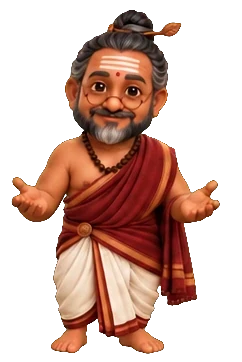
Lord Dattatreya is revered in the Vedic tradition as the Adi Guru—the first teacher—and as the single form in which Brahma, Vishnu and Shiva stand together. The name records the Purāṇic account: the Trimurti were “given” (datta) to sage Atri and his wife Anasuya. Seekers turn to him for clarity of mind, the grace of the guru-tattva, and the quieting of ancestral burdens spoken of as Pitru Dosha.
The Dattatreya Mantra is a short, complete invocation that tradition holds is answered by mere remembrance. It is preserved in the Dattatreya Upanishad attached to the Atharva Veda and has been carried by the Nath and related sampradayas. Householders and sādhakas recite it across India, especially where Dattatreya temples and maṭhas keep the living practice.
This article sets out the mantra in Devanagari and transliteration, explains each phrase, traces its origin, and gives the classical method of chanting. Those who wish to place the japa beside a fire offering may look to the house’s spiritual-growth homas and dosha-nivāraṇa rites; the mantra itself needs only attention, a clean seat and steady count.
The Mantra in Sanskrit and Transliteration
The form most widely used in japa is the following complete address to Dattatreya:
In Roman letters the same line is commonly written: Om Namo Bhagavate Dattatreyaya Smarana Matra Samtushtaya. A shorter household form, Om Dattatreyaya Namah, is also current; both belong to the same current of remembrance.
In Tamil the longer mantra is rendered ஓம் நமோ பகவதே தத்தாத்த்ரேயாய ஸ்மரண மாத்ர ஸந்துஷ்டாய; parallel forms exist in Malayalam, Telugu and Kannada. The sound-body is kept close to the Sanskrit so that the vibration of the name is not lost.
Meaning of Each Phrase
The mantra is a single continuous bow. Broken into its parts it reads:
- Om — the primordial syllable that stands for the whole of sound and creation.
- Namo — “I bow” or “salutations.”
- Bhagavate — “to the Blessed Lord,” the one possessed of the six divine attributes.
- Dattatreyaya — “to Dattatreya,” the son given to Atri, who holds the three powers of the Trimurti in one form.
- Smarana-matra — “by mere remembrance.”
- Santushtaya — “who is contented / pleased.”
Taken together the line means: “Om. I bow to the Blessed Lord Dattatreya, who is pleased by mere remembrance.” Tradition emphasises the last clause: the guru-tattva does not demand elaborate ritual; sincere recollection itself is held to draw his attention. Each syllable is therefore treated as a living name rather than a string of sounds.
astrobhava.com
Dattatreya Mantra
The classical Vedic invocation to Lord Dattatreya
- 108 daysMany keep 1 008 counts for 21, 40 or 108 days
Meaning of Each Phrase
- Om — the primordial syllable that stands for the whole of sound and creation
- Namo — “I bow” or “salutations.”
- Bhagavate — “to the Blessed Lord,” the one possessed of the six divine attributes
- Dattatreyaya — “to Dattatreya,” the son given to Atri
- Smarana-matra — “by mere remembrance.”
Side by side
| Aspect | Recommended practice |
|---|---|
| Best time | Brahma muhūrta (roughly 4–6 a.m.) or at sunrise |
| Direction | Face east or north |
| Āsana | Sukhāsana or Padmāsana on a clean wool or silk seat |
| Mālā | Rudrākṣa or Tulasī, 108 beads |
| Daily count | Minimum one mālā (108); longer sādhanā may take 1 008 |
Check the day’s tithi, nakṣatra and rāhu-kālam on the daily panchang before fixing a long sitting
Observances, Precautions and Companion Practice
sankalpa · vidhi · agni
ASTROBHAVA.COMVedic rituals, never a group ceremony, telecast live
Scriptural Origin and the Form of Dattatreya
Dattatreya appears in the Mahābhārata and Rāmāyaṇa as a sage of uncommon wisdom. The full birth narrative is told in the Mārkaṇḍeya, Bhāgavata and Brahma Purāṇas: the Trimurti, pleased by the tapas of Atri and the chastity of Anasuya, grant the couple a son who embodies their combined śakti. He is shown with three heads (Brahma, Vishnu, Śiva) and often with four dogs that stand for the four Vedas, and a cow that stands for the earth and dharma.
The mantra itself is rooted in the Dattatreya Upanishad of the Atharva Veda, which presents him as the supreme reality beyond name and form, yet accessible as the inner guru. Later the Nath sampradāya took him as Adi Guru; stotras and short mantras circulated from that stream into household practice. In the south, temples and maṭhas in Karnataka, Andhra, Tamil Nadu and Kerala preserved daily recitation, especially on Dattatreya Jayanti—the full-moon day of Mārgaśīrṣa—and on Thursdays, the weekday of Guru.
Iconography and text alike stress detachment and knowledge. The Tripura Rahasya and related works present Dattatreya as the teacher who leads the disciple past duality. The mantra is therefore not a petition for a single worldly favour; it is an act of remembering the guru who already stands within.
How to Chant the Dattatreya Mantra
Classical japa does not require a temple or a priest. The following pattern is the one most often taught for householders. Fuller guidance on posture, breath and mala is set out in the house’s note on how to chant a mantra correctly.
| Aspect | Recommended practice |
|---|---|
| Best time | Brahma muhūrta (roughly 4–6 a.m.) or at sunrise |
| Direction | Face east or north |
| Āsana | Sukhāsana or Padmāsana on a clean wool or silk seat |
| Mālā | Rudrākṣa or Tulasī, 108 beads |
| Daily count | Minimum one mālā (108); longer sādhanā may take 1 008 |
| Duration of a vow | 21, 40 or 108 consecutive days |
| Saṅkalpa | A quiet vow of intention before the first bead |
| Simple offerings | Flower, incense, a ghee lamp; optional naivedya |
Begin and end the sitting with three Oṃs. For the first weeks many teachers advise audible japa so that the vibration settles; later the same count may be taken as upāṃśu (whispered) or mānasika (mental). A dedicated corner with a small image or yantra of Dattatreya helps steady attention. If a day is missed, the practice is simply resumed; doubling the next day’s count is a matter of personal resolve, not a rule of the mantra.
Thursdays and Dattatreya Jayanti are traditionally preferred for beginning a fixed count. Women may keep the japa on all days; during the first days of the monthly cycle many switch to silent mental repetition while maintaining the same devotion.
Guru Kripa, Pitru Dosha and the Chart
Because Dattatreya is the Adi Guru, the mantra is classically linked with the guru principle and with Jupiter in the horoscope. Tradition also places it among practices used when ancestral affliction—Pitru Dosha—is read in the chart or felt as repeated family obstruction. The same current of remembrance is held to steady the influence of the nodes and of Saturn when those grahas weigh heavily, though the mantra is never presented as a mechanical substitute for a full graha-śānti.
A devotee who wishes to see whether Mangal, Kaal Sarp, Pitru, Kemadruma or Śani dosha is indicated may first run a quiet check on the free dosha-check tool. Where the chart or the family history points to ancestral unrest or to a disturbed guru-tattva, the japa is often kept alongside a formal fire rite. The house performs dosha-nivāraṇa homas and the Navagraha Homam for planetary balance; these are separate offerings and are not required for the mantra itself.
No outcome is promised. What tradition prescribes is regular, clean japa offered without bargaining. Clarity, steadiness and a sense of being guided are the fruits devotees have recorded across centuries; the rest is left to the guru’s will.
Observances, Precautions and Companion Practice
Chant after a bath and in clean clothes. Avoid japa when the mind is seized by anger, intoxication or acute grief; wait until the seat can be steady. A short guru-pūjā or a single dīpa before a forty-day count is customary. Charity on Thursdays—especially annadānam—is a classical companion to guru-mantra practice.
The Dattatreya Mantra sits well beside any iṣṭa-devatā japa; it does not displace other forms. Some sādhakas add the brief Om Dattatreyaya Namah between longer stotras. Intensive counts are best begun after a glance at the birth chart and current transits, so that the vow is taken with open eyes rather than in haste.
End each sitting with a quiet thank-you and a short prayer for the welfare of all beings. The practice is complete when the name has been remembered; nothing further need be added for the mantra to stand on its own ground.
Questions devotees ask
The AstroBhava Editorial Desk chooses the topics for this blog and decides what is published.