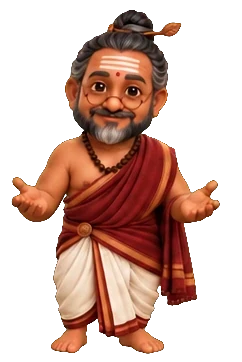
The Kamadeva Mantra is a Gayatri addressed to Kamadeva—also known as Manmatha or Ananga—the deity who embodies love, desire and attraction in the Hindu tradition. He is pictured as the celestial archer whose bow is of sugarcane, strung with bees, and whose arrows are tipped with fragrant flowers rather than iron.
In traditional practice the mantra has long been recited in the context of marriage, relationship harmony and the refinement of desire. It follows the standard Gayatri metre and appears in later mantra compendia such as the Mantra Mahodadhi of Mahidhara. The house performs the related fire rite, the Kamadeva Homam, at the Yagna Ashram in Pollachi, Coimbatore District.
What follows is the text of the mantra, a phrase-by-phrase sense of the words, the Puranic stories that frame Kamadeva, and the method of chanting observed in traditional japa. Readers who wish to see how partnership houses stand in their own chart may begin with a free birth chart before deciding on further practice.
The mantra text
The standard form used in japa is the Gayatri:
Common Roman transliteration:
Om Kamadevaya Vidmahe Pushpabanaya Dhimahi Tanno Ananga Prachodayat
The same line is recited in Tamil, Malayalam, Telugu and Kannada communities with only the script changing; the syllables remain those of the Sanskrit Gayatri. Clear, even pronunciation matters more than the script chosen. A short guide to breath and cadence is given under how to chant a mantra correctly.
Meaning of each phrase
Like every Gayatri, the mantra moves from recognition of the deity, through meditation, to a request for inspiration.
- Om — the primordial syllable that steadies the mind before the name is uttered.
- Kamadevaya — “to Kamadeva,” the one who kindles desire and attraction in living beings; the address treats love as a sacred force rather than a mere impulse.
- Vidmahe — “we seek to know” or “we meditate upon,” stating the intention to internalise the deity’s qualities.
- Pushpabanaya — “to the one whose arrows are flowers.” Jasmine, mango blossom and lotus are the traditional tips; the image teaches that true attraction works through softness and beauty, not force.
- Dhimahi — “we hold in contemplation,” the call to keep the mind fixed on that form.
- Tanno Ananga — “may that Ananga (the bodiless one).” After Shiva reduced Kamadeva’s body to ash, he continued as Ananga; love is therefore understood as an energy that outlasts physical form.
- Prachodayat — “may he inspire / impel us,” the closing prayer that the same energy guide thought and conduct toward harmonious expression.
Taken together, the line is a meditation on desire refined rather than suppressed, and on love that is not confined to the body.
astrobhava.com
Kamadeva Mantra
The Kamadeva Gayatri is a classical Vedic mantra addressed to the deity of love and desire
Meaning of each phrase
- Om — the primordial syllable that steadies the mind before the name is uttered
- Kamadevaya — “to Kamadeva,” the one who kindles desire and attraction in living beings
- Vidmahe — “we seek to know” or “we meditate upon,” stating the intention to internalise the deity’s qualities
- Pushpabanaya — “to the one whose arrows are flowers.” Jasmine
- Dhimahi — “we hold in contemplation,” the call to keep the mind fixed on that form
Side by side
| Aspect | Recommended practice |
|---|---|
| Time | Brahma muhurta before sunrise, or evening sandhya |
| Count | 108 repetitions daily on a mala |
| Duration of a round | Often kept for a continuous period of forty days |
| Posture and direction | Sukhasana or Padmasana, facing east or north |
| Mala | Rudraksha or a simple tulasi or crystal mala |
Maintain ordinary purity of food and speech on the days of japa. If a day is missed, resume without self-reproach; consistency over weeks matters more than perfection on any single day
Traditional context and related practice
sankalpa · vidhi · agni
ASTROBHAVA.COMVedic rituals, never a group ceremony, telecast live
Origin and classical background
The mantra is preserved in the Mantra Mahodadhi and follows the classical Gayatri metre used throughout the Vedic corpus for invoking a deity’s wisdom and protection. The figure of Kamadeva himself is elaborated in the Shiva Purana and the Bhagavata Purana.
In the creation narratives, Brahma calls upon Kamadeva so that living beings may feel the urge toward union and the world may continue. Later, when Shiva sits in fierce meditation after Sati’s death, the gods send Kamadeva to stir him. Shiva opens his third eye and reduces Kamadeva to ashes. Moved by the pleas of Rati, Kamadeva’s consort, Shiva restores him in a formless state—Ananga. The story is read as a teaching that love cannot be annihilated; it only becomes subtler and more pervasive.
Temples and smaller shrines to Kamadeva and Rati are found in several regions; the mantra is traditionally heard during spring observances such as Vasant Panchami and Holi, and in South India during wedding seasons and certain Navaratri and Karthigai rites. The lineage of transmission is guru-shishya; the house continues the same text in its live telecast rites without altering the metre or the deity addressed.
How to chant
Traditional japa of this Gayatri is simple and does not require formal diksha, though guidance from a teacher is valued. The following table summarises the customary framework:
| Aspect | Recommended practice |
|---|---|
| Time | Brahma muhurta before sunrise, or evening sandhya |
| Count | 108 repetitions daily on a mala |
| Duration of a round | Often kept for a continuous period of forty days |
| Posture and direction | Sukhasana or Padmasana, facing east or north |
| Mala | Rudraksha or a simple tulasi or crystal mala |
| Lamp and offering | Ghee lamp; fresh flowers (jasmine or rose) after the count |
Begin with a brief prayer to Ganesha for an unobstructed sitting. Keep the mind on the meaning rather than on any hoped-for event. The waxing fortnight (Shukla Paksha) is traditionally preferred for rites connected with growth and attraction; the day’s tithi and nakshatra can be checked on the daily panchang.
Women and men both recite the mantra; there is no gender restriction in the classical sources. Those who already follow a heart-centred meditation may rest attention lightly at the chest while the syllables move.
Traditional context and related practice
In household and temple custom the Kamadeva Gayatri is recited by those facing delay in marriage, coolness in an existing partnership, or a general sense that affection does not flow freely. It is also used by artists and performers who treat creative passion as a form of the same energy. Astrologically the rite is often considered alongside the strength of Shukra (Venus) and the condition of the fifth, seventh and twelfth houses; a chart check for Mangal or other partnership strains can be run through the free dosha check, and compatibility for a proposed match through kundli matching.
Chanting is frequently paired with a fire offering. The house’s Love & Marriage homam catalogue groups the Kamadeva Homam with allied rites such as Swayamvara Kala Parvathi and related shanti procedures. The homam is performed by named priests and telecast live; the devotee’s sankalpa is taken in the usual way. Tradition prescribes these observances for the cultivation of harmony and the removal of inner and outer obstruction; it does not treat them as instruments that compel another person’s will.
Charity of sweets or flowers on a Friday, the weekday of Shukra, is a common accompanying observance. The practice is kept quiet during a dedicated sadhana period; gratitude to Kamadeva and Rati closes each sitting.
Questions devotees ask
The AstroBhava Editorial Desk chooses the topics for this blog and decides what is published.