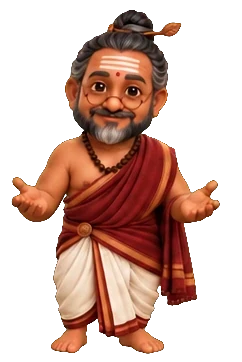
The Prithvi Mantra, also called the Prithvi Gayatri Mantra, is a short Gayatri dedicated to Prithvi Devi or Bhudevi, the divine embodiment of Mother Earth. In the Vedic view she is not inert matter but a living, conscious mother who stands for solidity, nourishment, patience and the ground that sustains every form of life.
Its deeper source is the Atharva Veda’s Prithvi Sukta, a hymn of sixty-three verses that praise the Earth in her thousand forms. The Gayatri concentrates that praise into a single, meditative chant that householders and sadhakas can keep in daily practice. The mantra addresses the need for rootedness—connection to the physical plane, the body, land and the qualities of endurance the tradition links with the earth element.
At AstroBhava the related fire rite is the Bhu Sukta Homam, performed by named priests at the Yagna Ashram in Pollachi, Coimbatore District, and telecast live. Yantra Pujas are performed in our consecrated sanctum. Devotees who wish to place the mantra inside a fuller Vedic framework often begin there, or first check the day’s tithi and nakshatra on the free panchang.
Prithvi Mantra in Sanskrit and Transliteration
The classical form used in japa is:
Regional scripts preserve the same sound. In Tamil it is written ஓம் ப்ருத்வி தேவ்யை வித்மஹே சஹஸ்ர மூர்த்தாயை ச தீமஹி தன்னோ ப்ருத்வி ப்ரசோதயாத்; parallel renderings exist in Malayalam, Telugu and Kannada. Pronunciation should follow a clear Vedic recording; the guide on how to chant a mantra correctly sets out breath, cadence and common faults.
Meaning of the Three Parts
Like every Gayatri, the Prithvi Mantra moves in three measured steps.
Om Prithvi Devyai Vidmahe — “Om, let us know / meditate upon the Goddess of Earth.” Vidmahe calls for conscious awareness of Bhudevi as a sentient divine mother, not as soil alone.
Sahasra Murthaye Cha Dhimahi — “We contemplate the one of a thousand forms.” The line acknowledges her infinite appearances—fields, mountains, forests, rivers and the very body that houses the jiva—while remaining one nurturing presence. Dhimahi is deep, sustained contemplation.
Tanno Prithvi Prachodayat — “May that Prithvi inspire and illumine our intellect.” The prayer seeks right understanding and dharmic action: the patience, forgiveness and steadiness the Earth herself displays. The whole mantra therefore joins physical rootedness with inner clarity.
Origin in the Vedas and Later Tradition
The foundational praise of Prithvi stands in the Atharva Veda, Kanda 12—the Prithvi Sukta. Those sixty-three mantras personify the Earth as the generous mother who bears mountains, forests and all beings and who gives shelter and food without stint. Sages later distilled the same vision into the compact Gayatri form suited to daily japa.
In the Rigveda, Prithvi (“the vast one”) is paired with Dyaus as cosmic parents. In the Puranas she appears as Bhudevi, consort of Varaha, the boar avatar of Vishnu who lifts her from the cosmic waters. South Indian temple practice, especially in Tamil Nadu and Kerala, places Bhudevi beside Vishnu in many shrines. Bhumi Puja before construction or the first ploughing still invokes her directly. Over centuries the Prithvi Gayatri became a household chant for land rites, grihapravesha and any undertaking that asks for the Earth’s steady support.
astrobhava.com
Prithvi Gayatri at a Glance
Bhudevi, Mother Earth, in a three-part chant
- 3 LINESclassical Gayatri form
- 63 VERSESPrithvi Sukta source
- 21 OR 40 DAYSclassical sankalpa frame
The Three Parts
- Vidmahe — let us know the Goddess of Earth
- Dhimahi — contemplate her thousand forms
- Prachodayat — may she illumine the intellect
Japa Practice
- Brahma muhurta or sunrise; evening also used
- Face east or north
- 108-bead rudraksha or tulsi mala
- 11, 108 or 1008 repetitions
- Water, flowers, fruit or a touch of soil
Kept by Tradition
- Clean space, settled seat, gratitude as intention
- Prithvi Mudra held while chanting
- Sattvic diet and restraint in speech
- Close with silent namaskaram to Bhudevi
Mechanical speed is never the aim; meaning and steady breath come first
Bhu Sukta Homam is the related fire rite, telecast live
rootedness · patience · steadiness
ASTROBHAVA.COMVedic rituals, never a group ceremony, telecast live
How to Chant the Prithvi Mantra
The method is simple and does not require a temple setting, yet tradition asks for cleanliness, a settled seat and a clear intention of gratitude.
| Aspect | Recommended practice |
|---|---|
| Best time | Brahma muhurta or sunrise; evening is also used |
| Direction | Face east or north |
| Posture | Cross-legged on the floor or a straight-backed seat; barefoot on clean ground when possible |
| Mala | 108-bead rudraksha or tulsi |
| Count | 11, 108 or 1008 repetitions |
| Sadhana length | A continuous stretch of 21 or 40 days is the classical minimum for a sankalpa |
| Offerings | Water, flowers, fruit, or a simple touch of soil offered with reverence |
Additional points kept in the ashram tradition:
- Begin with a short Ganapathi invocation or a few rounds of Om so that obstacles to the japa itself are first addressed.
- Prithvi Mudra (tip of the ring finger touching the tip of the thumb) may be held while chanting.
- A sattvic diet and restraint in harsh speech are observed for the length of the sankalpa.
- Close each session with silent namaskaram to Bhudevi.
Earth Element, Astrology and Related Rites
In the scheme of the pancha mahabhutas the earth element governs solidity, structure, bones, land and the sense of security. Classical texts therefore place Prithvi japa among practices that steady the muladhara and support matters connected with property, home and endurance. In a birth chart the same concerns often appear through the influence of Saturn, Mars and the fourth house; a free look at the chart through the kundli tool or a check for land- and security-related patterns on the dosha check can show whether the earth element is under stress.
Tradition does not treat the mantra as a substitute for medical, legal or financial counsel. It treats it as a means of aligning the chanter’s attention with Bhudevi’s qualities. When a fuller ritual container is wanted, the house performs the Bhu Sukta Homam and, where vastu or planetary pacification is indicated, related rites from the homam catalogue. Timing for any such sankalpa is best read from the day’s panchang.
Precautions Kept by Tradition
Chant in a clean space. Avoid mechanical repetition; keep the meaning and a simple visualisation of the Earth’s steady support in mind. During an intensive sankalpa, non-vegetarian food and intoxicants are set aside. Pregnant women and those under serious medical care are advised to take guidance from their own guru or physician before beginning a long count. If restlessness arises, reduce the number of repetitions and walk barefoot on clean ground rather than forcing the japa.
Charity that touches the earth—anna dana, planting of trees, or care of land—has long been paired with this mantra as an outward expression of the same reverence.
Questions devotees ask
The AstroBhava Editorial Desk chooses the topics for this blog and decides what is published.