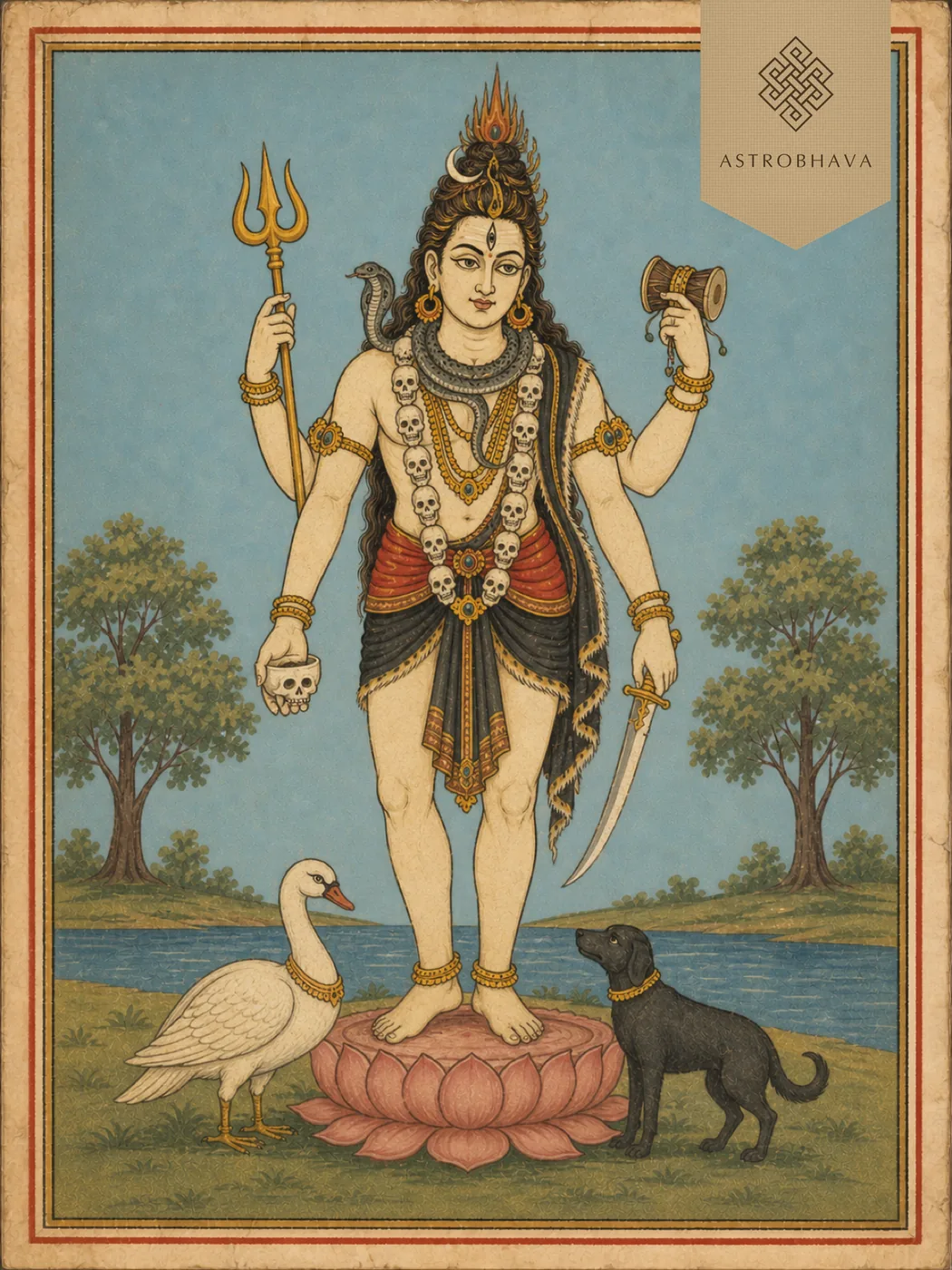
Asitanga Bhairava Mantra
ॐ असिताङ्गभैरवाय नमःIn Devanagari, Tamil, Telugu, Kannada, Malayalam and English — with the meaning of every word, and the one syllable most people pronounce wrongly.
Who Asitanga Bhairava is
Asitanga Bhairava is the first among the eight Bhairavas who issue from Shiva’s body in the classical Tantric enumeration. His name means the black-limbed one; he is dark as collyrium, three-eyed, and bears trident, drum, noose and skull-cup. In the directional scheme he is stationed in the east and is paired with the shakti Brahmani, the matrika who governs the creative impulse. The Rudrayamala Tantra and the Mantra-mahodadhi present him as the Bhairava who presides over srishti, the outpouring that brings forms into being. He is distinct from Kala Bhairava in that his darkness is the fertile void preceding manifestation rather than the devouring darkness of time. Temples that maintain the full Ashta Bhairava circuit, especially in Tamil Nadu and certain Himalayan shrines, install him as the opening figure whose contemplation inaugurates the sequence of the eight.
First Emergence of the Eight
The Tantras, notably the Rudrayamala and passages echoed in the Ahirbudhnya Samhita, recount that when the gods were oppressed by the demon Andhaka, Shiva’s wrath condensed into a dark radiance. From that radiance eight forms stepped forth, each a Bhairava charged with one quarter of the cosmos and one function of consciousness. The first to emerge was Asitanga, black of limb, whose body was the compacted energy of creation itself. He received the eastern direction, the quarter of the rising sun, together with the shakti who embodies the creative word. In a parallel account the eight arise when Shiva multiplies the original Bhairava form in order to extend protective presence; Asitanga is then the face that turns toward the dawn. The Sharada Tilaka Tantra assigns him the specific bija and mantra that call upon the power to originate. Thus Asitanga Bhairava stands at the head of the ashta-bhairava cycle as lord of the initial impulse that sets the wheel of manifestation turning.
The mantra, in six scripts
The seed mantra, and the form most devotees chant daily. No initiation is required — it is open to anyone, including a parent chanting for a child.
- ॐ
- oṃ — Om
- असिताङ्गभैरवाय
- asitāṅgabhairavāya — to Asitanga Bhairava
- नमः
- namaḥ — salutation
The syllable people get wrong
The conjunct ṅga inside asitāṅga is often reduced by speakers to a simple “nga” or even “na,” so that the name collapses into “asitana” rather than the full “asi-tāṅ-ga.” The velar nasal ṅ must be formed against the soft palate before the g is released; without that distinct nasal stop the very limb (aṅga) that the name declares to be black disappears from the utterance.
When Asitanga Bhairava is chanted
Weekday. Monday
Questions
Have your chart read before you decide
Chanting is yours to do, and free. But which deity your situation calls for — and whether a mantra alone is the right response — depends on your chart. Sometimes it is; sometimes it is not.
- Over 30 years in the Guru–Sishya Parampara, from the age of five
- He reads every chart himself — 60 minutes, one to one, never delegated
- Charts are read only between sunrise and sunset, following tradition
Related
Chanting is yours to do. Some things are performed for you.
Where a matter carries real weight — an examination that decides a course, a performance, a child whose studies have stalled — devotees sponsor the homa alongside their own practice. Performed for you and any family members you name, at our Yagna Ashram, in your name and gotra, on a muhurta calculated from your chart, and telecast live so you can watch it done for you.