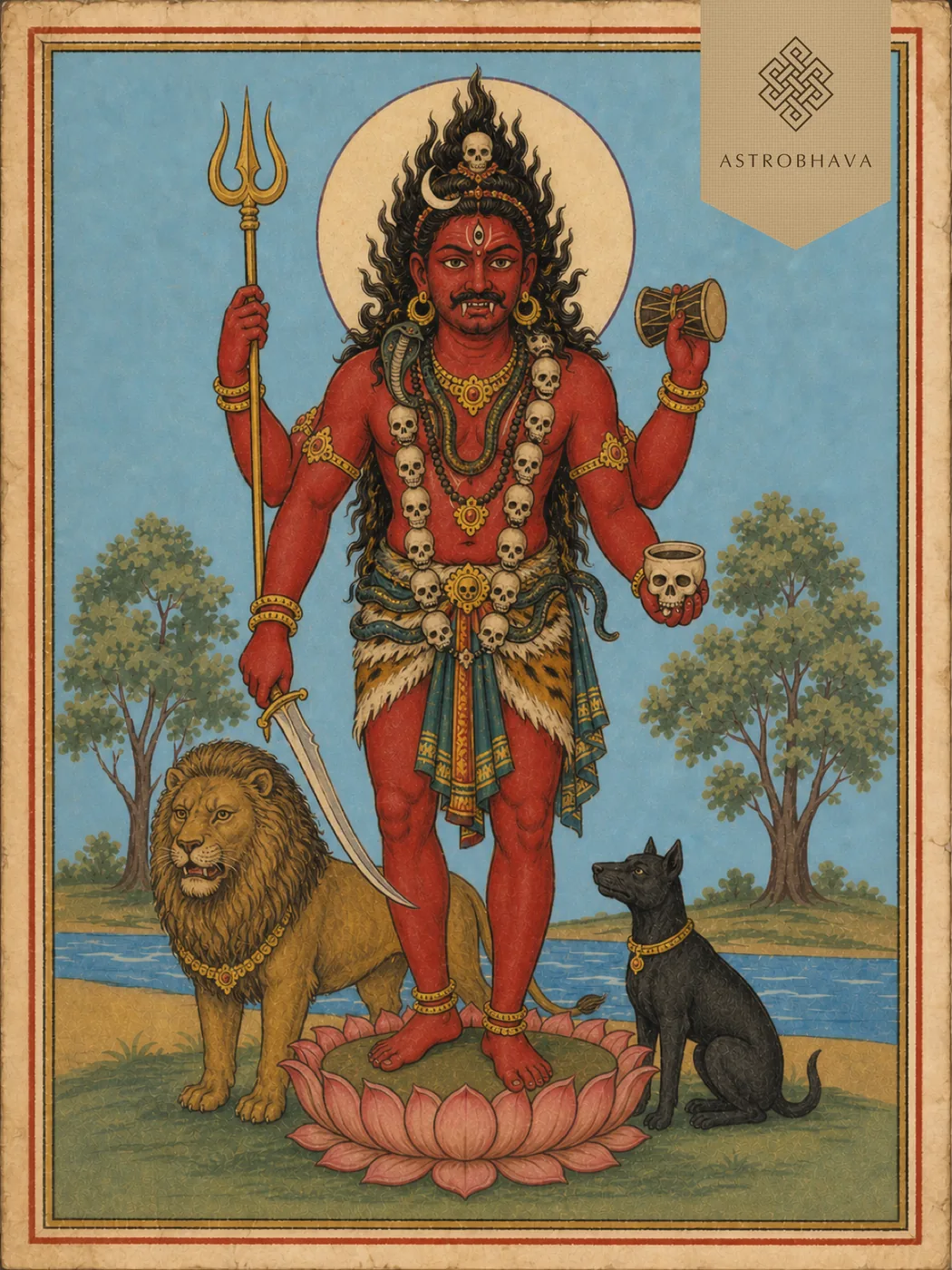
Bhishana Bhairava Mantra
ॐ भीषणभैरवाय नमःIn Devanagari, Tamil, Telugu, Kannada, Malayalam and English — with the meaning of every word, and the one syllable most people pronounce wrongly.
Who Bhishana Bhairava is
Bhīṣaṇa Bhairava is the seventh of the eight Bhairavas in the Śaiva tantric enumeration that stations fierce forms of Śiva at the quarters and links each to a mātṛkā. The adjective bhīṣaṇa means terrifying, dreadful, that which causes hair to stand on end; joined to Bhairava it names the hypostasis whose essence is fear itself made visible and therefore finite. Iconographic digests describe him of dark or tawny complexion, fangs bared, wearing garlands of still-living serpents or fresh entrails, holding a pointed weapon and a severed head. He is paired with the mātṛkā Caṇḍikā or Mahālakṣmī according to the krama in use and occupies the seventh seat of the aṣṭaka. In the liturgy he is not invoked to frighten enemies but as the deity in whom the root of fear is confronted without remainder. His presence in the maṇḍala completes the circuit that began with Asitāṅga and will close with Saṃhāra, so that terror is given a face, a direction and a name.
Terror Given a Fixed Seat
The aṣṭa-bhairava cycle, as redacted in tantric sources dependent on the Rudrayāmala and the later paddhatis of the Śaiva siddhānta and Kaula streams, does not narrate a separate birth story for each guardian; rather it distributes the single fierce energy of Bhairava into eight directional moods. Bhīṣaṇa is the seventh of those moods: the moment at which dread ceases to be an amorphous threat and becomes a deity who can be faced. Purāṇic background is supplied by the wider mythology of Bhairava’s wanderings after the beheading of Brahmā’s fifth head, when the very sight of the ash-smeared, skull-bearing figure struck terror into gods and mortals alike. From that collective fright the tradition crystallises Bhīṣaṇa Bhairava, installing him in the quarter assigned by the local āgama and pairing him with his mātṛkā so that terror and its answering power regard one another. The texts emphasise that once fear has a seat and a name it is no longer free to haunt every threshold; it is bound within the maṇḍala as the seventh guardian.
The mantra, in six scripts
The seed mantra, and the form most devotees chant daily. No initiation is required — it is open to anyone, including a parent chanting for a child.
- ॐ
- oṃ — the primordial syllable
- भीषणभैरवाय
- bhīṣaṇabhairavāya — to Bhīṣaṇa-Bhairava
- नमः
- namaḥ — homage
The syllable people get wrong
The consonant ṣ in bhīṣaṇa (भीषण) is the retroflex sibilant, produced with the tongue curled back; it is commonly replaced by a plain palatal ś or by an English sh, yielding bhīśana or bheeshana. That substitution flattens the name’s harsh texture, which the tradition treats as inseparable from the deity’s dreadful character.
When Bhishana Bhairava is chanted
Weekday. Monday
Questions
Have your chart read before you decide
Chanting is yours to do, and free. But which deity your situation calls for — and whether a mantra alone is the right response — depends on your chart. Sometimes it is; sometimes it is not.
- Over 30 years in the Guru–Sishya Parampara, from the age of five
- He reads every chart himself — 60 minutes, one to one, never delegated
- Charts are read only between sunrise and sunset, following tradition
Related
Chanting is yours to do. Some things are performed for you.
Where a matter carries real weight — an examination that decides a course, a performance, a child whose studies have stalled — devotees sponsor the homa alongside their own practice. Performed for you and any family members you name, at our Yagna Ashram, in your name and gotra, on a muhurta calculated from your chart, and telecast live so you can watch it done for you.