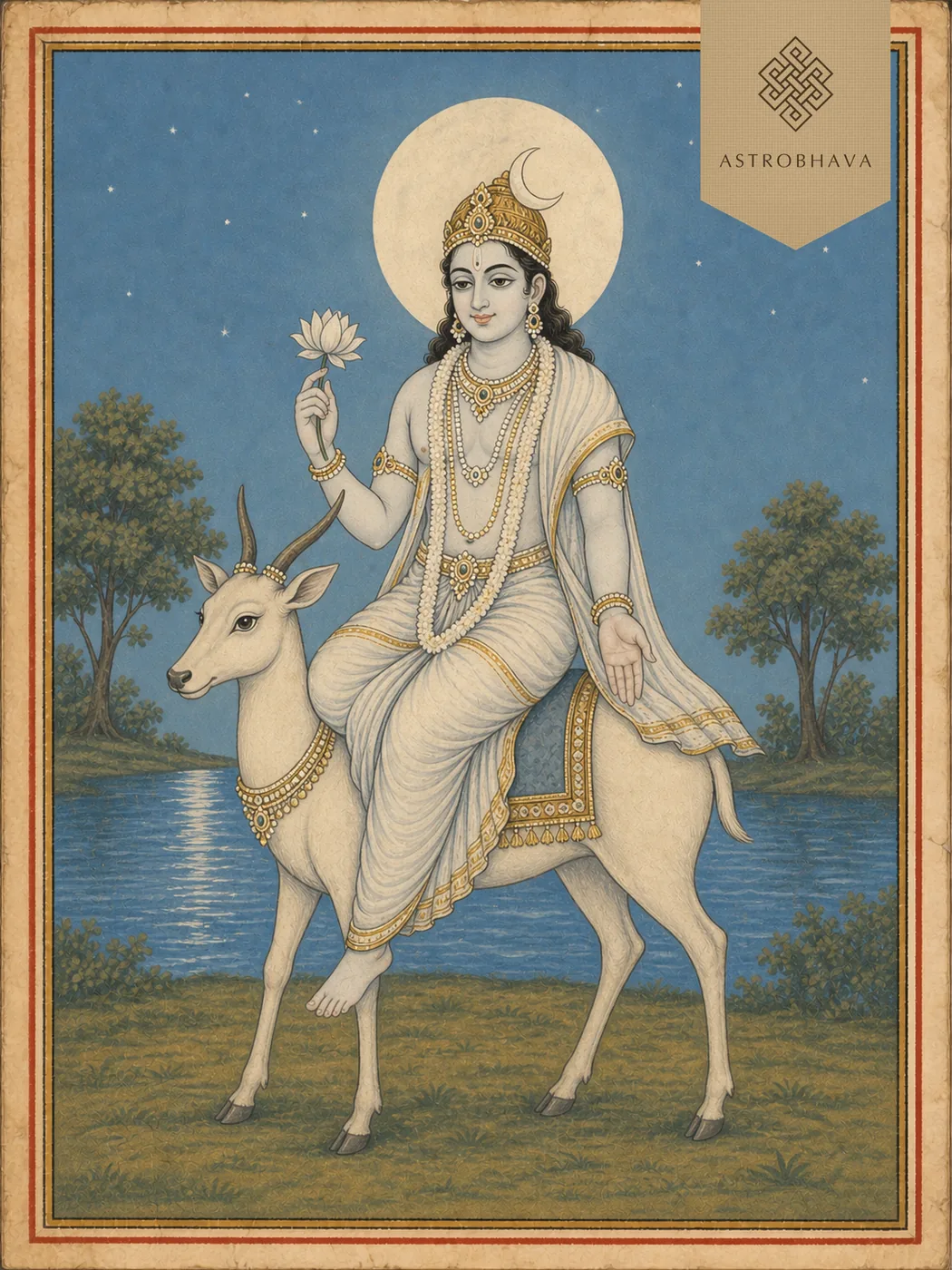
Chandra Gayatri Mantra
ॐ क्षीरपुत्राय विद्महे अमृततत्त्वाय धीमहि तन्नश्चन्द्रः प्रचोदयात्In Devanagari, Tamil, Telugu, Kannada, Malayalam and English — with the meaning of every word, and the one syllable most people pronounce wrongly.
Who Chandra Gayatri is
Chandra is the lunar sovereign of the night sky, identified in the Vedas with Soma, the cooling draught that nourishes gods and seers alike. He rides a chariot drawn by ten white horses or an antelope, his face marked by the dark shadow of the hare. As the guardian of the mind and the fluids of the body, he governs the waxing and waning cycles that measure time itself. Born as the son of the sage Atri and Anasuya, or in another account rising from the Ocean of Milk, Chandra is husband to the twenty-seven Nakshatras, the lunar mansions. His pale light is said to sustain the plant world and to temper the fierce heat of the solar principle. In the planetary scheme he is the karaka of the mother, of memory, and of the reflective faculty that receives and returns every impression.
Curse of the Waning Moon
The Brahmanda Purana and the Vishnu Purana recount how Chandra, radiant after emerging from the churning of the ocean, wed the twenty-seven daughters of Daksha yet showed exclusive love to Rohini. The neglected sisters complained to their father. Daksha’s curse caused Chandra to waste away, night after night, until the gods intervened. They persuaded Daksha to modify the curse so that the moon would diminish for one half of the month and regain his fullness during the other. From that mitigation arose the eternal rhythm of Krishna and Shukla paksha. The same episode explains why Chandra bears the mark of a dark stain: the residual shadow of the curse that even divine mediation could not wholly erase. Worshippers recall this narrative whenever the moon is observed in its slender crescent, remembering that the deity’s beauty is inseparable from periodic loss and recovery.
The mantra, in six scripts
The seed mantra, and the form most devotees chant daily. No initiation is required — it is open to anyone, including a parent chanting for a child.
- ॐ
- oṃ — the primal sound
- क्षीरपुत्राय
- kṣīraputrāya — to the son of the milk-ocean
- विद्महे
- vidmahe — we know / we meditate upon
- अमृततत्त्वाय
- amṛtatattvāya — to the essence of nectar
- धीमहि
- dhīmahi — we contemplate
- तन्नश्चन्द्रः
- tannaścandraḥ — may that Moon
- प्रचोदयात्
- pracodayāt — impel / awaken
The syllable people get wrong
In kṣīraputrāya the opening conjunct kṣī joins a guttural-palatal stop to a long ī. Speakers commonly shorten the vowel and voice the cluster as a quick “kshi,” producing “kshiraputra” instead of the measured “kṣee-ra-pu-traa-ya.”
When Chandra Gayatri is chanted
Festival. Sharad Purnima
Questions
Have your chart read before you decide
Chanting is yours to do, and free. But which deity your situation calls for — and whether a mantra alone is the right response — depends on your chart. Sometimes it is; sometimes it is not.
- Over 30 years in the Guru–Sishya Parampara, from the age of five
- He reads every chart himself — 60 minutes, one to one, never delegated
- Charts are read only between sunrise and sunset, following tradition
Related
Chanting is yours to do. Some things are performed for you.
Where a matter carries real weight — an examination that decides a course, a performance, a child whose studies have stalled — devotees sponsor the homa alongside their own practice. Performed for you and any family members you name, at our Yagna Ashram, in your name and gotra, on a muhurta calculated from your chart, and telecast live so you can watch it done for you.