Dakshinamoorthy Mantra
ॐ नमः श्रीदक्षिणामूर्तयेIn Devanagari, Tamil, Telugu, Kannada, Malayalam and English — with the meaning of every word, and the one syllable most people pronounce wrongly.
Who Dakshinamoorthy is
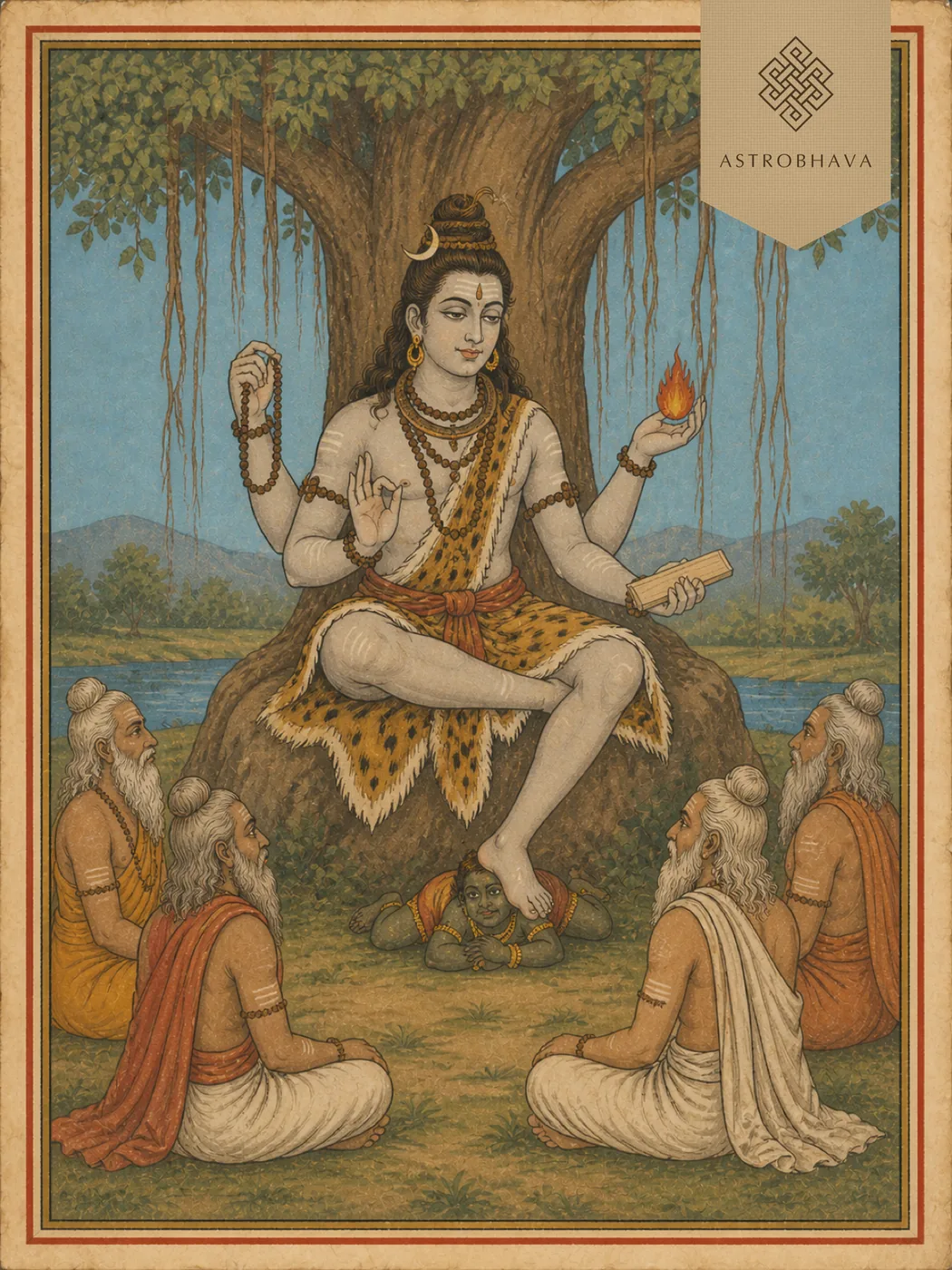
Dakshinamoorthy is Śiva in his aspect as the silent, south-facing preceptor who transmits the highest knowledge without uttered speech. Seated beneath the banyan, youthful yet primordial, he forms the cinmudrā with his right hand while the left rests upon the thigh or holds a palm-leaf manuscript. The four mind-born sons of Brahmā—Sanaka, Sanandana, Sanātana and Sanatkumāra—sit before him as the first disciples. In temple architecture his shrine occupies the southern wall of the sanctum, confronting the direction of Yama and thereby declaring that knowledge of the Self stands beyond death. He is the ādī-guru from whom every authentic teaching lineage traces its descent, distinct from Naṭarāja the dancer, Bhairava the fierce guardian, or Ardhanārīśvara the united form. Contemplation of this mūrti is bound to the stilling of mental proliferation and the recognition that the knower, the known and the means of knowledge are one.
Silence Beneath the Banyan
The episode is preserved in the Śiva Purāṇa, the Dakṣiṇāmūrti Upaniṣad and the commentarial tradition surrounding Ādi Śaṅkara’s Dakṣiṇāmūrti Stotram. At the dawn of a cycle of creation the four Kumāras issued from Brahmā’s mind already mature in austerity yet still unsettled by the riddle of multiplicity and liberation. They wandered the three worlds seeking a teacher equal to their doubt. On a Himalayan slope they beheld a youth seated in perfect stillness under an ancient banyan, his body turned toward the south. That youth was Śiva as Dakshinamoorthy. No word passed his lips; the teaching was given entirely through the cinmudrā and the unbroken silence of his presence. In that silence the Kumāras’ questions dissolved, and they beheld the non-dual Self directly. Śaṅkara later sang that the universe itself is the city reflected in the mirror of consciousness, and that the silent guru awakens the disciple to this recognition. South-facing shrines throughout the Tamil country and beyond continue to mark the place where speech ends and knowledge begins.
The mantra, in six scripts
The seed mantra, and the form most devotees chant daily. No initiation is required — it is open to anyone, including a parent chanting for a child.
- ॐ
- oṃ — the praṇava
- नमः
- namaḥ — salutations
- श्रीदक्षिणामूर्तये
- śrīdakṣiṇāmūrtaye — to the glorious Dakshinamoorthy
The syllable people get wrong
The long ū in the syllable mūr of dakṣiṇāmūrtaye is the point at which many recitations falter. It is commonly shortened to a brief u, producing “murtaye” instead of the full, sustained mūr that the dignity of the name requires. The lips must remain rounded for the entire length of the vowel before releasing into the following ta.
When Dakshinamoorthy is chanted
Weekday. Monday
Festival. Guru Pūrṇimā receives special observance at Dakshinamoorthy shrines, and in numerous South Indian Śiva temples the Thursday pūjā is dedicated to this form alone.
Questions
Have your chart read before you decide
Chanting is yours to do, and free. But which deity your situation calls for — and whether a mantra alone is the right response — depends on your chart. Sometimes it is; sometimes it is not.
- Over 30 years in the Guru–Sishya Parampara, from the age of five
- He reads every chart himself — 60 minutes, one to one, never delegated
- Charts are read only between sunrise and sunset, following tradition
Related
Chanting is yours to do. Some things are performed for you.
Where a matter carries real weight — an examination that decides a course, a performance, a child whose studies have stalled — devotees sponsor the homa alongside their own practice. Performed for you and any family members you name, at our Yagna Ashram, in your name and gotra, on a muhurta calculated from your chart, and telecast live so you can watch it done for you.