Gan Gan Ganat Bote
गण गण गणात बोते ॥Also known as Gani Gan Ganant Bote
In Devanagari, Tamil, Telugu, Kannada, Malayalam and English — with the meaning of every word, and the one syllable most people pronounce wrongly.
 A reading of your birth chartBook →
What the Gan Gan Ganat Bote is
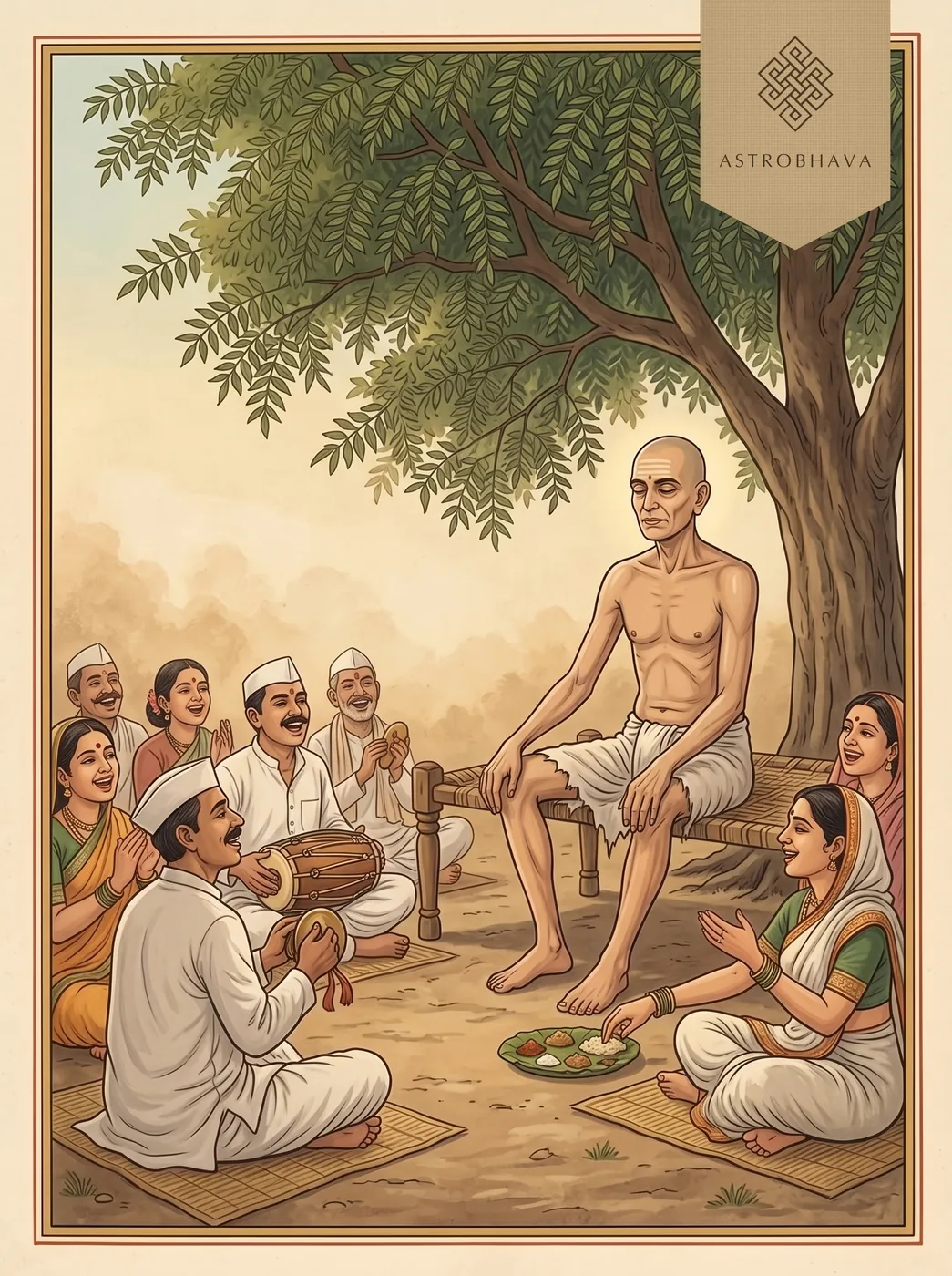
Gan Gan Ganat Bote is the Marathi chant of Shri Gajanan Maharaj, the saint who appeared at Shegaon in the Vidarbha region of Maharashtra in 1878 and lived there until 1910. It is not a hymn composed by a poet but a single line of four words that he repeated constantly, and devotees took it up from him. Mantra 1 is the line as it is sung today, 'gan gan ganat bote'. Mantra 2 is the older written form, 'gani gan ganant bote', recorded in the ninth chapter of the Shri Gajanan Vijay, the verse life of the saint by Das Ganu. The words are cryptic and no reading is settled. Tradition takes 'gan' as the individual soul and 'ganant' as 'within the whole', so that the line says the soul dwells in the Supreme and is never apart from it. The last word, 'bote', is old and obscure. The sung form also opens the Gajanan Bawanni, a later devotional poem in praise of the saint.
The refrain heard beside a restless horse
According to the Shri Gajanan Vijay, Shegaon first saw the saint on 23 February 1878, Magh Vadya Saptami. Bankatlal Agarwal and Damodarpant Kulkarni noticed a young man, almost unclothed and with a glowing face, outside the house of Devidas Paturkar, picking grains of leftover food from discarded leaf plates and drinking from water kept for cattle. Bankatlal took him for a realised soul, and the town slowly came to agree. The chant enters the written record in the ninth chapter. A kirtan singer, Govindbuva Takalikar, had come to Shegaon with a horse so wild that no one could handle it, and it was tied at a Shiva temple for the night. In the dark, Gajanan Maharaj lay down among the animal's four legs and kept singing his refrain. Govindbuva rose again and again to check, and each time found the horse standing perfectly still. Das Ganu stops the story at this point to explain the words, reading 'gani' as counting or knowing the soul as one with Brahman and 'bote' as a worn-down word for the mind. He also notes that Shegaon sang the line in two ways. Devotional accounts say the refrain became so closely tied to him that the townspeople named him after it. He took samadhi at Shegaon on 8 September 1910, Rishi Panchami, after thirty-two years in the town.
The mantra, in six scripts
- गण
- gaṇa — soul (gana)
- गण
- gaṇa — soul, repeated
- गणात
- gaṇāta — within the whole (the Supreme)
- बोते
- bote — old word, sense unclear
Gan Gan Ganat Bote lyrics in full
The chant as sung today, followed by the older form recorded in the saint's verse biography.
All 2 verses, in Marathi, Tamil, Telugu, Kannada, Malayalam and English, each with its meaning. Choose a script:
Download the Gan Gan Ganat Bote PDFAll 2 verses with their meanings, in Marathi. Free to print and keep.
गण गण गणात बोते ॥
கண கண கணாத போதே ॥
గణ గణ గణాత బోతే ॥
ಗಣ ಗಣ ಗಣಾತ ಬೋತೇ ॥
ഗണ ഗണ ഗണാത ബോതേ ॥
gaṇa gaṇa gaṇāta bote ||
The chant as devotees sing it today, Shri Gajanan Maharaj's own constant refrain. The words are cryptic; they are usually taken to say that the individual soul (gana) lives within the Supreme and is never apart from it, while 'bote' is an old word whose sense is unclear.
गणी गण गणांत बोते ॥
கணீ கண கணாம்த போதே ॥
గణీ గణ గణాంత బోతే ॥
ಗಣೀ ಗಣ ಗಣಾಂತ ಬೋತೇ ॥
ഗണീ ഗണ ഗണാംത ബോതേ ॥
gaṇī gaṇa gaṇāṃta bote ||
The older written form of the same chant. Read word by word it is taken as: count (gani) the soul (gana) as being within (ganant) the Supreme; that is, know the self as one with the Divine. 'Bote' is read as a worn-down word pointing to the mind.
The syllable people get wrong
In 'gaṇāta' (गणात) the final short a is silent in Marathi and the n is retroflex, so it is said 'guh-NAAT', with the tongue tip curled back for the ṇ, and not 'ga-NAA-ta' as a Sanskrit reading would give it.
When the Gan Gan Ganat Bote is chanted
Festival. Gajanan Maharaj Prakat Din, Magh Vadya Saptami
Questions
Have your chart read before you decide
Chanting is yours to do, and free. But which deity your situation calls for — and whether a mantra alone is the right response — depends on your chart. Sometimes it is; sometimes it is not.
- Over 30 years in the Guru–Sishya Parampara, from the age of five
- He reads every chart himself — 60 minutes, one to one, never delegated
- Charts are read only between sunrise and sunset, following tradition
