Gange Cha Yamune Chaiva
गङ्गे च यमुने चैव गोदावरि सरस्वति । नर्मदे सिन्धु कावेरि जलेऽस्मिन् सन्निधिं कुरु ॥Also known as Gange Cha Yamune Mantra
In Devanagari, Tamil, Telugu, Kannada, Malayalam and English — with the meaning of every word, and the one syllable most people pronounce wrongly.
 A reading of your birth chartBook →
What the Gange Cha Yamune Chaiva is
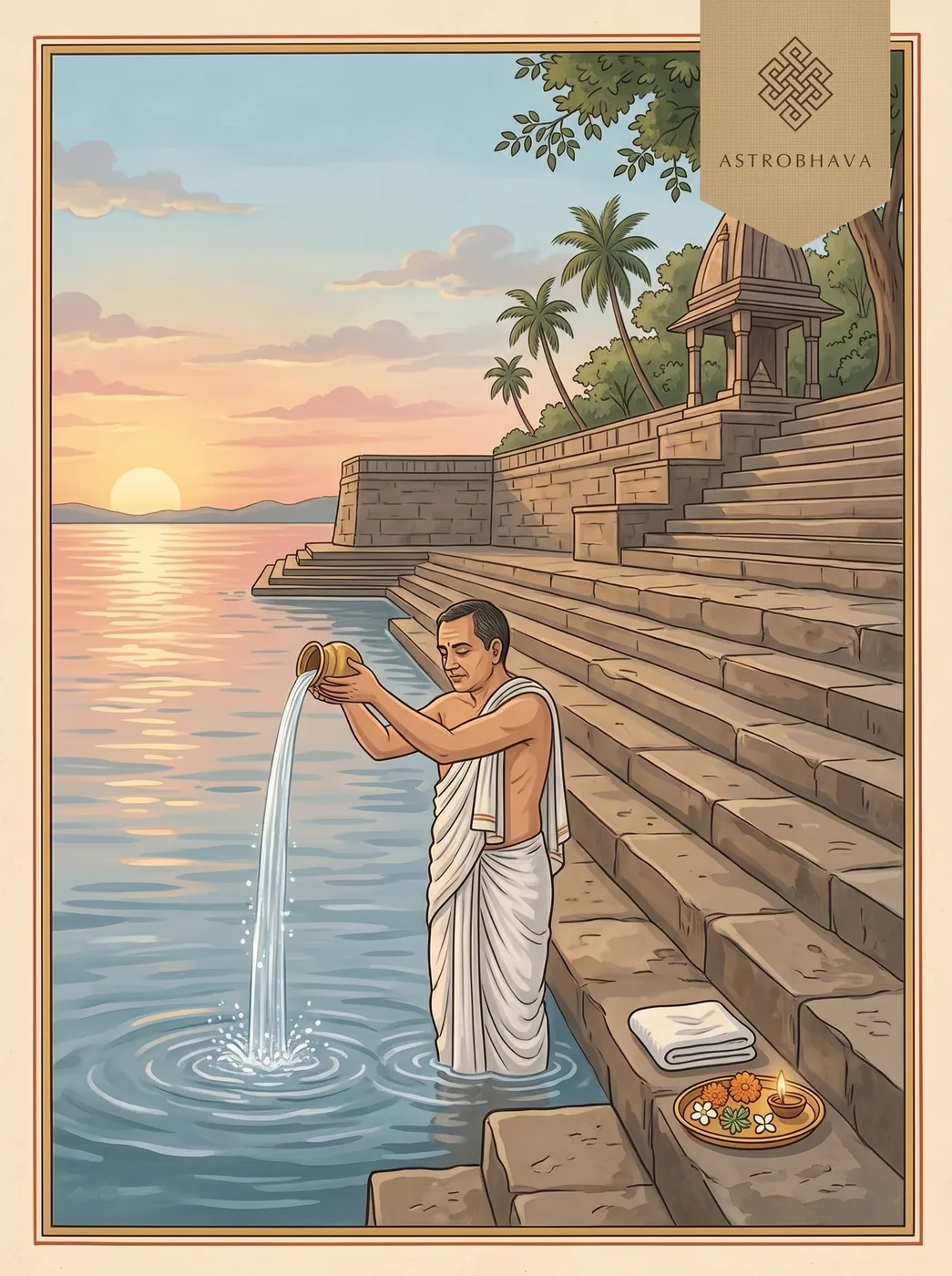
Gange Cha Yamune Chaiva, the verse that begins 'gange cha yamune chaiva Godavari Sarasvati', is a single Sanskrit shloka spoken over water, naming seven rivers and asking them to be present in it. No author is known, and no Purana or smriti is given as its source; it has come down as an anonymous prayer of the household and the temple. It is built in the anushtubh pattern, four quarters of eight syllables each. The first line calls four rivers, Ganga and Yamuna joined by 'cha' and 'chaiva', 'and also', then Godavari and Sarasvati. The second line adds Narmada, Sindhu and Kaveri. Every name stands in the vocative, so each river is addressed as a goddess who can hear. Only in the last quarter does the request arrive, carried by one verb, kuru, 'make': jale'smin sannidhim kuru, 'make your presence in this water'. The verse asks nothing for the speaker, neither health nor merit; it asks only that the rivers come. The Ganga Stotram page gives the longer hymn to the Ganga alone, attributed to Adi Shankaracharya.
Seven rivers called into one vessel
The verse has no tale of its own composition. Its setting is the act it accompanies. Tradition holds that a purifying bath is most complete in the waters of the holy rivers, and few people can stand in them each morning, so the rivers are invited into the bucket, the tank or the well instead. The same words are said in puja when water is set aside for worship. In the South Indian order of kalasha worship, the priest announces the rite of the vessel and then recites this verse over the water in the kalasha. The seven names cover the subcontinent. Ganga and Yamuna are the rivers of the north. Sarasvati, according to tradition, still flows, hidden underground, and joins the other two from below at their confluence at Prayag. Sindhu is the Indus, which rises in Tibet and reaches the Arabian Sea through Sindh. The Narmada, flowing west from Amarkantak to the Gulf of Khambhat, is traditionally counted as the line between north and south. South of it run the Godavari and the Kaveri, and the Kaveri, rising at Talakaveri in the Western Ghats, has long been called the Ganga of the South. One printed collection of hymns makes this the first of six verses in a Tirthastuti, which goes on to name Kurukshetra, Gaya, Prabhasa and Pushkara.
The mantra, in six scripts
- गङ्गे
- gaṅge — O Ganga
- च
- ca — and
- यमुने
- yamune — O Yamuna
- चैव
- caiva — and also
- गोदावरि
- godāvari — O Godavari
- सरस्वति
- sarasvati — O Sarasvati
- नर्मदे
- narmade — O Narmada
- सिन्धु
- sindhu — O Sindhu (Indus)
- कावेरि
- kāveri — O Kaveri
- जलेऽस्मिन्
- jale'smin — in this water
- सन्निधिं
- sannidhiṃ — presence
- कुरु
- kuru — make
Gange Cha Yamune Chaiva lyrics in full
One verse of two lines, as it is said over water at the bath and in worship.
All 1 verses, in Sanskrit, Tamil, Telugu, Kannada, Malayalam and English, each with its meaning. Choose a script:
Download the Gange Cha Yamune Chaiva PDFAll 1 verses with their meanings, in Sanskrit. Free to print and keep.
गङ्गे च यमुने चैव गोदावरि सरस्वति ।
नर्मदे सिन्धु कावेरि जलेऽस्मिन् सन्निधिं कुरु ॥
கங்கே ச யமுநே சைவ கோதாவரி ஸரஸ்வதி ।
நர்மதே ஸிந்து காவேரி ஜலேஸ்மிந் ஸந்நிதிம் குரு ॥
గఙ్గే చ యమునే చైవ గోదావరి సరస్వతి ।
నర్మదే సిన్ధు కావేరి జలేఽస్మిన్ సన్నిధిం కురు ॥
ಗಙ್ಗೇ ಚ ಯಮುನೇ ಚೈವ ಗೋದಾವರಿ ಸರಸ್ವತಿ ।
ನರ್ಮದೇ ಸಿನ್ಧು ಕಾವೇರಿ ಜಲೇಽಸ್ಮಿನ್ ಸನ್ನಿಧಿಂ ಕುರು ॥
ഗങ്ഗേ ച യമുനേ ചൈവ ഗോദാവരി സരസ്വതി ।
നര്മദേ സിന്ധു കാവേരി ജലേഽസ്മിന് സന്നിധിം കുരു ॥
gaṅge ca yamune caiva godāvari sarasvati |
narmade sindhu kāveri jale'smin sannidhiṃ kuru ||
O Ganga, and Yamuna too, O Godavari and Sarasvati, O Narmada, Sindhu and Kaveri: be present in this water.
The syllable people get wrong
In jale'smin, 'in this water', the mark after jale (the avagraha) shows that the first a of asmin has dropped away after the e, so the word is said in three syllables, ja-LE-smin, not 'jale asmin' with a fourth syllable, which would break the eight-syllable quarter.
When the Gange Cha Yamune Chaiva is chanted
Festival. The daily bath and kalasha worship
Questions
Have your chart read before you decide
Chanting is yours to do, and free. But which deity your situation calls for — and whether a mantra alone is the right response — depends on your chart. Sometimes it is; sometimes it is not.
- Over 30 years in the Guru–Sishya Parampara, from the age of five
- He reads every chart himself — 60 minutes, one to one, never delegated
- Charts are read only between sunrise and sunset, following tradition
