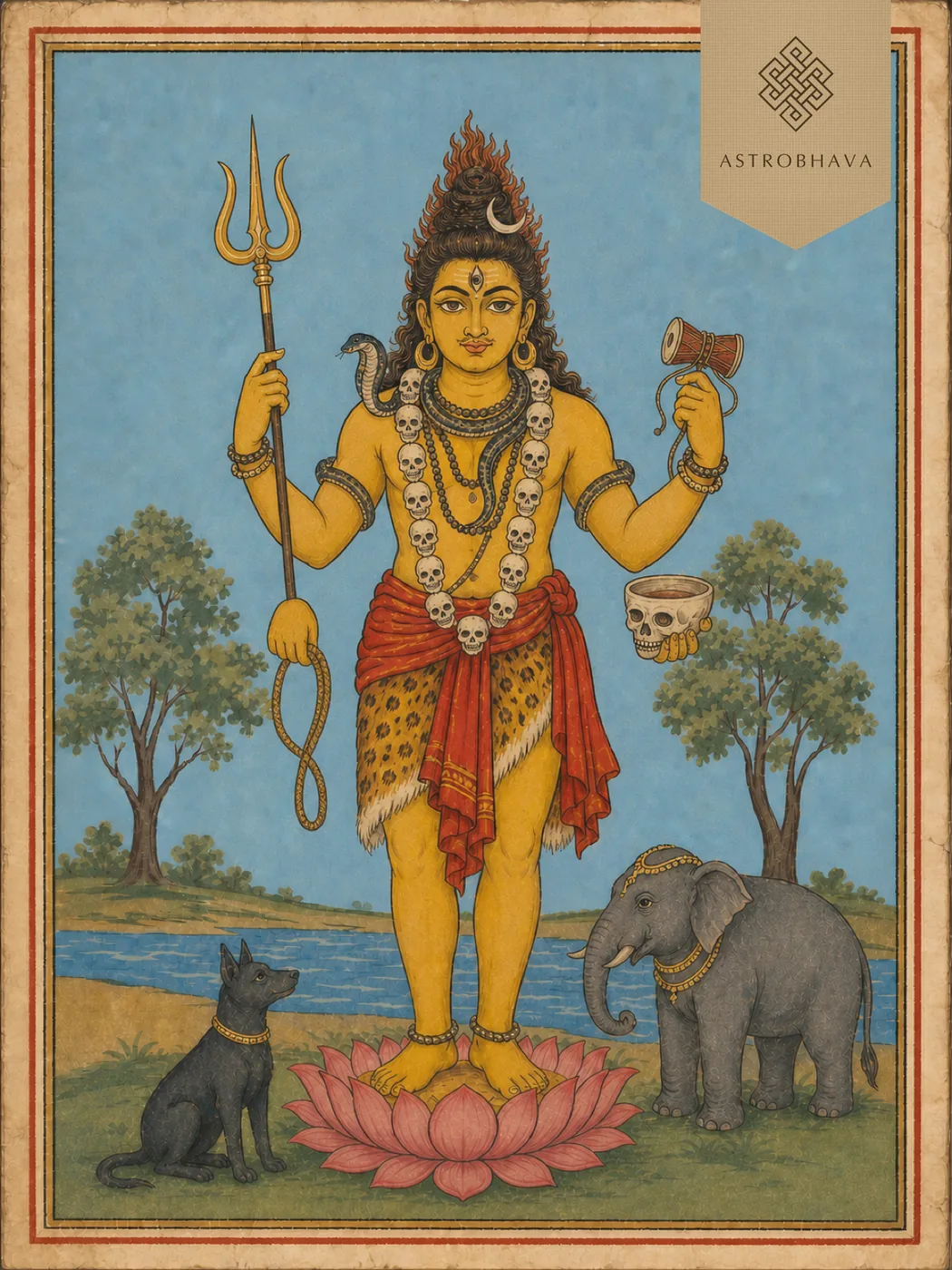
Kapala Bhairava Mantra
ॐ कपालभैरवाय नमःIn Devanagari, Tamil, Telugu, Kannada, Malayalam and English — with the meaning of every word, and the one syllable most people pronounce wrongly.
Who Kapala Bhairava is
Kapāla Bhairava is the sixth of the eight Bhairavas in the directional and mātṛkā-linked scheme of Śaiva tantra. His name is formed from kapāla, the skull or skull-cup, and Bhairava, so that the deity is literally the Terrible One who bears the skull. The attribute is not incidental: it ties him to the Kāpālika stream in which the skull is both the residue of Brahmā’s fifth head and the begging-bowl of the renunciant who has stepped outside household dharma. Iconographic sources describe him of smoky or deep hue, adorned with bone ornaments, holding the kapāla together with a khatvāṅga or a cleaver. He is paired with the mātṛkā Indrāṇī or Cāmuṇḍā according to regional krama and occupies the sixth station of the aṣṭaka. Within that liturgy he embodies the stance of one who has already relinquished claim upon the body and its extensions, the visual theology of detachment rendered as a guardian of the maṇḍala rather than as a bestower of possessions.
The Skull That Would Not Fall
Śaiva purāṇic and tantric accounts, especially those that elaborate the Brahmā-śiras episode found in the Kūrma and Skanda traditions and later absorbed into the Rudrayāmala cycle, tell that the fifth head of Brahmā remained fixed to Bhairava’s hand until the sin of brahmahatyā was expiated at Kāśī. From the long period during which the skull served as both burden and alms-bowl the tradition isolates the distinct form Kapāla Bhairava, sixth among the eight. In the paddhatis he continues to carry that same kapāla, now understood as the sign that attachment to name, form and purity has already been cut. Temple manuals place him in his appointed direction beside his mātṛkā, so that the skull-bearing guardian and the goddess face each other across the diagram. The narrative is preserved not as a tale of crime and cleansing alone but as the mythic charter for a deity whose very name keeps the skull visible: detachment is not an abstract virtue here but the concrete refusal to set the kapāla down.
The mantra, in six scripts
The seed mantra, and the form most devotees chant daily. No initiation is required — it is open to anyone, including a parent chanting for a child.
- ॐ
- oṃ — the primordial syllable
- कपालभैरवाय
- kapālabhairavāya — to Kapāla-Bhairava
- नमः
- namaḥ — homage
The syllable people get wrong
In kapāla the second syllable carries a long ā (पा), which must be held: ka-pā-la. Reciters frequently shorten it to a quick pa, yielding ka-pa-la, which erases the etymological link to the skull-cup and is the characteristic fault in the pronunciation of this Bhairava’s name.
When Kapala Bhairava is chanted
Weekday. Monday
Questions
Have your chart read before you decide
Chanting is yours to do, and free. But which deity your situation calls for — and whether a mantra alone is the right response — depends on your chart. Sometimes it is; sometimes it is not.
- Over 30 years in the Guru–Sishya Parampara, from the age of five
- He reads every chart himself — 60 minutes, one to one, never delegated
- Charts are read only between sunrise and sunset, following tradition
Related
Chanting is yours to do. Some things are performed for you.
Where a matter carries real weight — an examination that decides a course, a performance, a child whose studies have stalled — devotees sponsor the homa alongside their own practice. Performed for you and any family members you name, at our Yagna Ashram, in your name and gotra, on a muhurta calculated from your chart, and telecast live so you can watch it done for you.