Karagre Vasate Lakshmi
कराग्रे वसते लक्ष्मीः करमध्ये सरस्वती । करमूले तु गोविन्दः प्रभाते करदर्शनम् ॥Also known as Kara Darshanam
In Devanagari, Tamil, Telugu, Kannada, Malayalam and English — with the meaning of every word, and the one syllable most people pronounce wrongly.
 A reading of your birth chartBook →
What the Karagre Vasate Lakshmi is
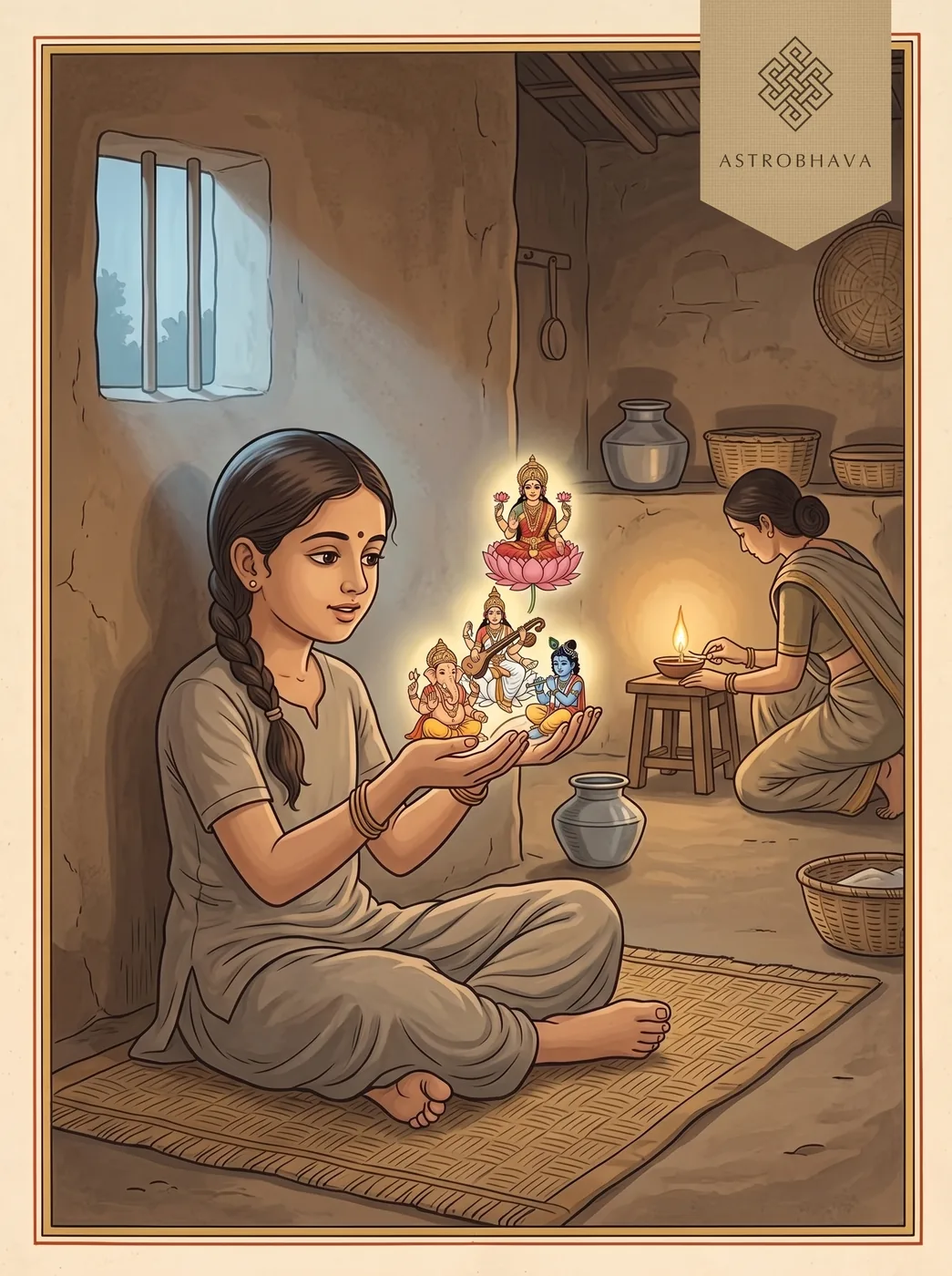
Karagre vasate lakshmi, the opening words of the verse recited on first looking at one's own hands at daybreak, names a single anushtubh shloka of four eight-syllable quarters, known from its last word as the Kara Darshanam, 'the seeing of the hand'. No author or source text is known; it travels without a name in the printed collections of morning prayers. The verse maps the hand from tip to root. The first quarter places Lakshmi, goddess of fortune, at karagra, the tips of the fingers. The second places Sarasvati, goddess of learning and speech, at karamadhya, the middle of the palm. The third places Govinda, a name of Vishnu, at karamula, the root of the hand where it meets the wrist. The fourth quarter has no deity in it: prabhate karadarshanam, 'at dawn, the sight of the hand', states the act the verse accompanies. So the shloka is less a petition than a caption for a gesture, telling the one who wakes what to see in their own open palms.
A verse said before the feet touch ground
The shloka has no legend of composition, and none is claimed for it. Its setting is the household routine called pratah smarana, 'remembrance at dawn', a string of short verses said between waking and the start of the day's work. Most printed sequences put the Kara Darshanam first, said while still sitting up in bed with the palms opened before the eyes. The verse that usually follows is Samudra Vasane, which addresses the Earth as Vishnu's consort, clothed in the ocean, and asks her pardon for the touch of the feet that is about to come. The order is deliberate: the hands are looked at and honoured before the body rises and stands on the ground. The words for the parts of the hand are old ones. Manusmriti 2.59, describing the ritual sipping of water, uses the same terms, agra for the tips and mula for the root, and calls the fingertips the deva-tirtha, the part of the hand sacred to the gods. A widely repeated reading of the verse ties its three images to the hand's use: fortune comes through work done with the fingers, learning is held in the palm, and the root of the hand, from which every movement starts, is given to the Lord. The verse is among the first that Hindu children learn, in India and abroad.
The mantra, in six scripts
- कराग्रे
- karāgre — at the tip of the hand
- वसते
- vasate — dwells
- लक्ष्मीः
- lakṣmīḥ — Lakshmi
- करमध्ये
- karamadhye — in the middle of the hand
- सरस्वती
- sarasvatī — Sarasvati
- करमूले
- karamūle — at the root of the hand
- तु
- tu — and indeed
- गोविन्दः
- govindaḥ — Govinda (Vishnu)
- प्रभाते
- prabhāte — at daybreak
- करदर्शनम्
- karadarśanam — the seeing of the hand
Karagre Vasate Lakshmi lyrics in full
One verse of four quarters, given in its most widely printed form.
All 1 verses, in Sanskrit, Tamil, Telugu, Kannada, Malayalam and English, each with its meaning. Choose a script:
Download the Karagre Vasate Lakshmi PDFAll 1 verses with their meanings, in Sanskrit. Free to print and keep.
कराग्रे वसते लक्ष्मीः करमध्ये सरस्वती ।
करमूले तु गोविन्दः प्रभाते करदर्शनम् ॥
கராக்ரே வஸதே லக்ஷ்மீஃ கரமத்யே ஸரஸ்வதீ ।
கரமூலே து கோவிந்தஃ ப்ரபாதே கரதர்ஶநம் ॥
కరాగ్రే వసతే లక్ష్మీః కరమధ్యే సరస్వతీ ।
కరమూలే తు గోవిన్దః ప్రభాతే కరదర్శనమ్ ॥
ಕರಾಗ್ರೇ ವಸತೇ ಲಕ್ಷ್ಮೀಃ ಕರಮಧ್ಯೇ ಸರಸ್ವತೀ ।
ಕರಮೂಲೇ ತು ಗೋವಿನ್ದಃ ಪ್ರಭಾತೇ ಕರದರ್ಶನಮ್ ॥
കരാഗ്രേ വസതേ ലക്ഷ്മീഃ കരമധ്യേ സരസ്വതീ ।
കരമൂലേ തു ഗോവിന്ദഃ പ്രഭാതേ കരദര്ശനമ് ॥
karāgre vasate lakṣmīḥ karamadhye sarasvatī |
karamūle tu govindaḥ prabhāte karadarśanam ||
Lakshmi dwells at the tips of the fingers, Sarasvati in the middle of the palm, and Govinda at the base of the hand. So at daybreak one looks at one's hands.
The syllable people get wrong
The first word karāgre (कराग्रे) is kara 'hand' joined to agre 'at the tip', and the join makes a long ā. Say it ka-RAA-gre, holding the second syllable, not a clipped 'ka-RAG-ray'; the e at the end is a pure long e, as in 'grey' without the glide.
Questions
Have your chart read before you decide
Chanting is yours to do, and free. But which deity your situation calls for — and whether a mantra alone is the right response — depends on your chart. Sometimes it is; sometimes it is not.
- Over 30 years in the Guru–Sishya Parampara, from the age of five
- He reads every chart himself — 60 minutes, one to one, never delegated
- Charts are read only between sunrise and sunset, following tradition
