Today Mon 5 Oct TithiDashami NakshatraPushya PlaceColumbusUse my location Full Panchang & horoscope →

Rituals

All HomasAradhanaNadi AstrologyMantra Guides

Astrology

All Free ToolsVedic AstrologyToday's PanchangFree KundliDaily Horoscope

More

BlogAsk NirnayaContact

Your account

Sign inCart
Home › Mantras › Karpura Gauram Mantra
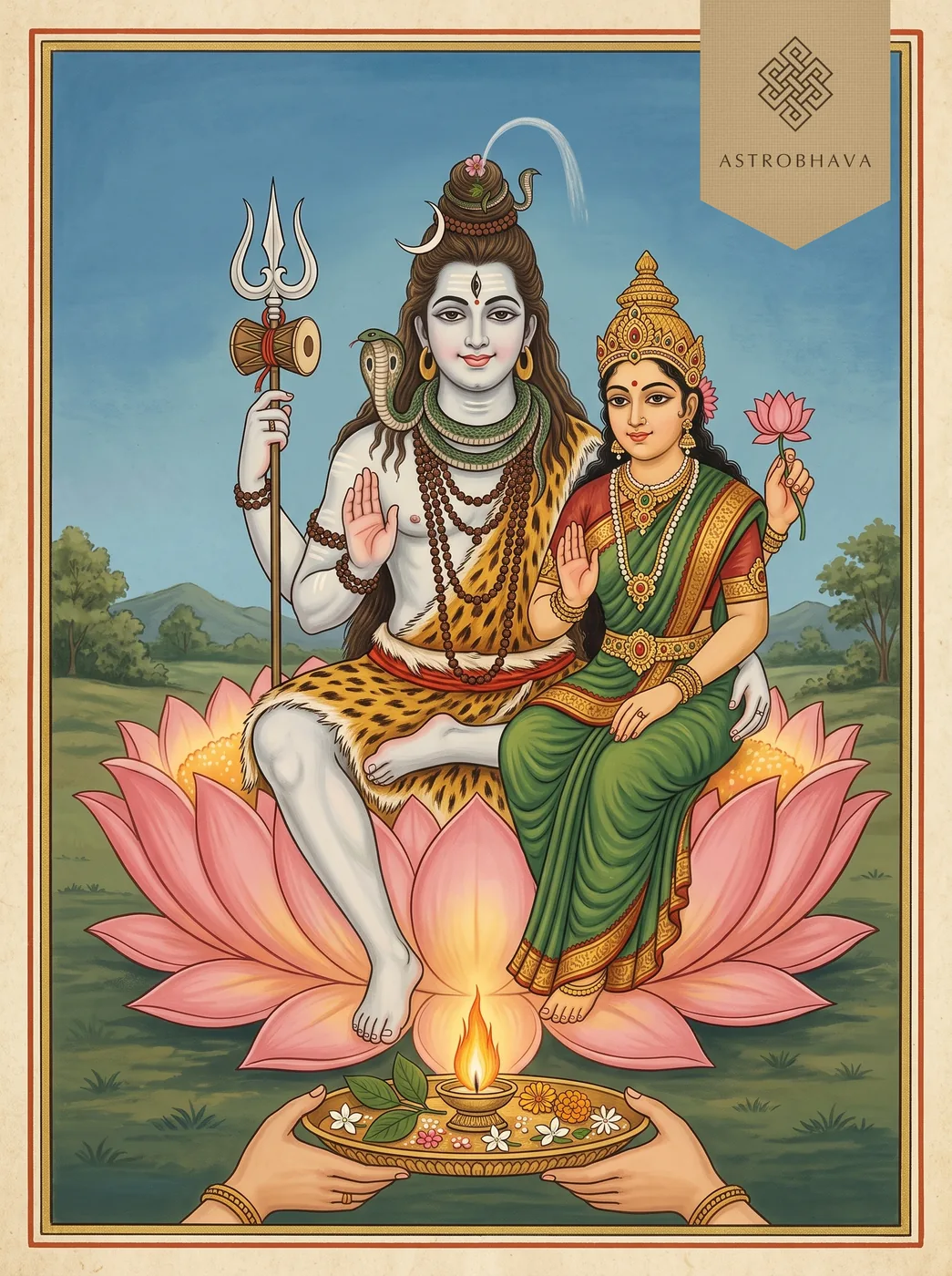
Rudra (Shiva) Karpura Gauram Mantra: camphor-white Shiva with a serpent garland and Parvati on a lotus, a camphor flame below
Camphor-white Shiva with Bhavani on the lotus of the heart, and the camphor flame
Mantra · Four quarters on camphor-white Shiva, sung as the aarti flame closes

Karpura Gauram Mantra

कर्पूरगौरं करुणावतारं संसारसारं भुजगेन्द्रहारम् । सदा वसन्तं हृदयारविन्दे भवं भवानीसहितं नमामि ॥

Also known as Karpur Gauram Karunavataram Mantra

In Devanagari, Tamil, Telugu, Kannada, Malayalam and English — with the meaning of every word, and the one syllable most people pronounce wrongly.

What the Karpura Gauram is

Karpura Gauram is a single Sanskrit verse of four quarters addressed to Shiva under the name Bhava, with his consort Bhavani, that is Parvati, beside him. Each quarter does one thing. The first gives two epithets: karpuragauram, white as camphor, and karunavataram, compassion itself come down in form. The second calls him samsarasaram, the essence of worldly existence, and bhujagendraharam, the one who wears the king of serpents as a garland. The third says where he lives: sada vasantam hridayaravinde, ever dwelling in the lotus of the heart. The fourth names the pair and holds the verse's only main verb, namami, I bow. No author is known. The metre is Upajati, a classical form that mixes eleven-syllable Indravajra and Upendravajra lines; here the first two quarters run in Indravajra and the last two in Upendravajra.

A ritual-manual verse that became the aarti close

No author's name has travelled with this verse, and two attributions repeated in many printed and recorded versions do not hold, so they are worth correcting gently. The first calls it a Yajurveda mantra. Its Upajati metre belongs to classical Sanskrit poetry rather than to the Vedic metres, and it does not appear in the mantra index of the Shukla Yajurveda. The confusion is understandable: in the Rudrapanchakam, a manual of Rudra worship, the verse stands with an Om prefix as the meditation verse placed directly before Namaste Rudra Manyave, the opening of the Yajurveda's Rudra chapter. The second attribution says Vishnu sang it at the wedding of Shiva and Parvati, as told in the Shiva Purana. No chapter or verse is ever given for this, and the Sanskrit text of the Shiva Purana, including the wedding chapters of the Parvati Khanda in its Rudra Samhita, does not contain the verse. Where it can be traced is the ritual digests. The Dikshaprakasha, a manual of initiation and worship, sets it among the dhyana verses for Shiva, right after Dhyayen nityam Mahesham, so that the worshipper holds the deity's form in mind before worship begins. From that use it passed into household and temple aarti, where it is sung as the camphor flame is offered, often followed by Mangalam Bhagavan Vishnuh and Sarva Mangala Mangalye.

The mantra, in six scripts

DevanagariSanskrit & Hindiकर्पूरगौरं करुणावतारं संसारसारं भुजगेन्द्रहारम् । सदा वसन्तं हृदयारविन्दे भवं भवानीसहितं नमामि ॥
Tamilகர்பூரகௌரம் கருணாவதாரம் ஸம்ஸாரஸாரம் புஜகேந்த்ரஹாரம் । ஸதா வஸந்தம் ஹ்ருதயாரவிந்தே பவம் பவாநீஸஹிதம் நமாமி ॥
Teluguకర్పూరగౌరం కరుణావతారం సంసారసారం భుజగేన్ద్రహారమ్ । సదా వసన్తం హృదయారవిన్దే భవం భవానీసహితం నమామి ॥
Kannadaಕರ್ಪೂರಗೌರಂ ಕರುಣಾವತಾರಂ ಸಂಸಾರಸಾರಂ ಭುಜಗೇನ್ದ್ರಹಾರಮ್ । ಸದಾ ವಸನ್ತಂ ಹೃದಯಾರವಿನ್ದೇ ಭವಂ ಭವಾನೀಸಹಿತಂ ನಮಾಮಿ ॥
Malayalamകര്പൂരഗൌരം കരുണാവതാരം സംസാരസാരം ഭുജഗേന്ദ്രഹാരമ് । സദാ വസന്തം ഹൃദയാരവിന്ദേ ഭവം ഭവാനീസഹിതം നമാമി ॥
EnglishRoman transliterationkarpūragauraṃ karuṇāvatāraṃ saṃsārasāraṃ bhujagendrahāram | sadā vasantaṃ hṛdayāravinde bhavaṃ bhavānīsahitaṃ namāmi ||
“I bow to Bhava (Shiva), white as camphor, compassion come down in form, the essence of worldly existence, who wears the king of serpents as a garland. Together with Bhavani (Parvati), he dwells always in the lotus of the heart.”
कर्पूरगौरं
karpūragauraṃ — white as camphor
करुणावतारं
karuṇāvatāraṃ — compassion embodied
संसारसारं
saṃsārasāraṃ — essence of worldly existence
भुजगेन्द्रहारम्
bhujagendrahāram — garlanded with the serpent king
सदा
sadā — always
वसन्तं
vasantaṃ — dwelling
हृदयारविन्दे
hṛdayāravinde — in the lotus of the heart
भवं
bhavaṃ — Bhava (Shiva)
भवानीसहितं
bhavānīsahitaṃ — together with Bhavani
नमामि
namāmi — I bow

The syllable people get wrong

In hṛdayāravinde, 'in the lotus of the heart', the short a after hṛd is often swallowed, giving 'hridyaarvinde'. Sound all six syllables, hri-da-YAA-ra-VIN-de, with ṛ as a short vowel close to 'ri' and the long ā held, since the metre needs that short da.

When the Karpura Gauram is chanted

Weekday. Monday

Questions

Sara is the pith or essential part of a thing, its substance as opposed to its husk. Samsara is the round of birth, death and worldly life. The compound therefore calls Shiva the essence of samsara. Translators read this two ways: as the one reality underlying a changing world, or as the one thing of lasting worth within it. Either way the epithet places Shiva inside the world rather than outside it, which prepares for the next quarter, where he dwells in the heart.
Both readings exist. The aarti form sung today, and given on this page, has sada vasantam hridayaravinde, 'ever dwelling in the lotus of the heart'. The older ritual manuals, among them the Dikshaprakasha and the Rudrapanchakam, read sada ramantam, 'ever sporting' or 'ever delighting' in the lotus of the heart. The metre is the same either way, since vasantam and ramantam have identical syllable weights, so the change does not disturb the verse.
None. It is often labelled a Yajurveda mantra, but it is a classical Sanskrit verse in Upajati metre, a form Vedic hymns do not use, and the Shukla Yajurveda does not contain it. Its likely route into that label is the Rudrapanchakam, where it is placed as a meditation verse just before the Yajurveda's Rudra chapter, so readers of the manual met the two side by side. It is best described as a traditional verse of the worship manuals and the aarti.
Bhava, 'existence' or 'becoming', is a name of Shiva, and Bhavani is the feminine formed from it, 'the consort of Bhava', a name of Parvati. The closing quarter sets the two names next to each other, bhavam bhavanisahitam, 'Bhava together with Bhavani', so the bow at the end is made to the couple, not to Shiva alone. This follows on from the third quarter: the pair, not a solitary god, is pictured as dwelling in the lotus of the heart.
Not sure a mantra is enough?

Have your chart read before you decide

Chanting is yours to do, and free. But which deity your situation calls for — and whether a mantra alone is the right response — depends on your chart. Sometimes it is; sometimes it is not.

Brahmashree Shivaaya
Chief Operating Officer & Head of Astrological & Spiritual Solutions
  • Over 30 years in the Guru–Sishya Parampara, from the age of five
  • He reads every chart himself — 60 minutes, one to one, never delegated
  • Charts are read only between sunrise and sunset, following tradition
Book a consultation Ask Nirnaya — free
+91 96295 55442 WhatsApp us support@astrobhava.com Closed now · Mon–Sat, 9:30–18:00 IST (0:00–8:30 EDT your time) — WhatsApp and email are answered the next working morning
Continue

Related

Chanting is yours to do. Some things are performed for you.

Where a matter carries real weight, devotees sponsor the homa alongside their own practice. Performed for you and any family members you name, at our Yagna Ashram, in your name and gotra, on a muhurta calculated from your chart, and telecast live so you can watch it done for you.

Nirnaya

AstroBhava’s automated guide

Nirnaya is AstroBhava’s automated guide. What you tell it — including birth details — is kept to recommend rites and is reviewed by our team to improve it. It does not predict. Conversations are anonymised 12 months after your last message; you can delete them sooner from your account. Privacy policy

Speak to someone at the ashram

Message the ashram on WhatsApp or by email. We answer Mon–Sat, 9:30–18:00 IST (0:00–8:30 EDT your time).

Message on WhatsAppsupport@astrobhava.com

WhatsApp opens in a new tab; nothing is sent from this page.