Karuppasamy Mantra
த்விபுஜம் பீன க்ருஷ்ணாங்கம் பப்ருச்மச்ரு சிரோருஹம் கதாம் கட்கம்ச பிப்ராணம் மஹாகாலம் வயம் நுமஃAlso known as Om Krum Asitangaya
In Tamil and English — with the meaning of every word, and the one sound most people pronounce wrongly.
 A reading of your birth chartBook →
What the Karuppasamy Mantra is
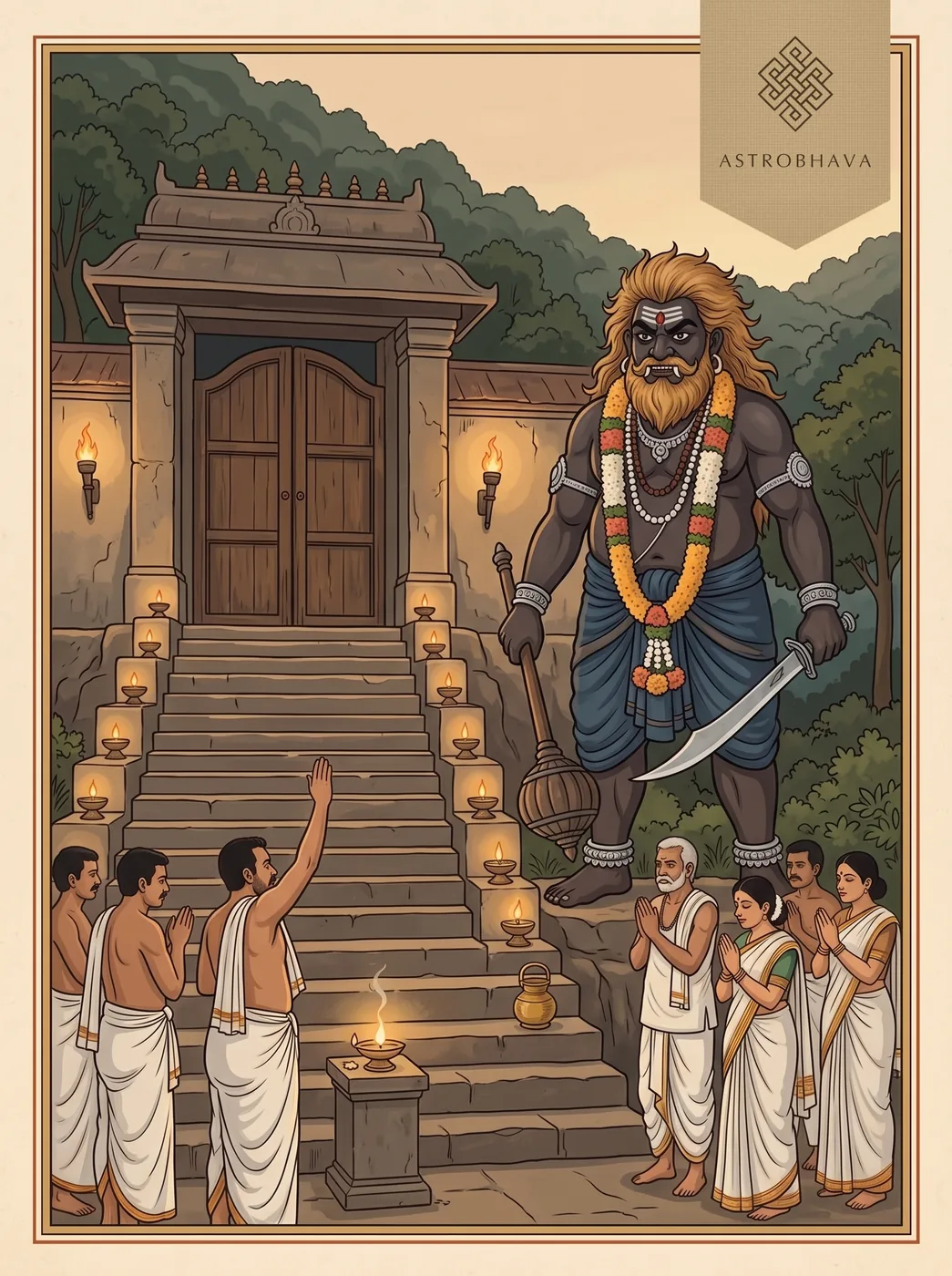
The Karuppasamy mantra, also called the Karuppannasamy moola mantra, is the short Sanskrit formula used in the worship of Karuppasamy, the dark guardian god (kaval deivam) of Tamil villages, whom many clans also keep as their kula deivam, the family deity. It has no known author: it circulates anonymously, printed in Tamil script with Grantha letters. The text comes in two parts. A two-line dhyana shloka first pictures the god: two-armed, stout and dark, with tawny beard and hair, holding a mace and a sword, and addressed as Mahakala. The moola mantra then opens with Om and the seed syllable krum and names him through twelve epithets, each offered to him: dark-limbed, a hero of great valour, mace-bearer, smoky-eyed, fearsome with tusks, garlanded, clad in dark blue, remover of all sins and of all fears, son of Shiva, wrathful, and a store of compassion. It closes with svaha, the word that marks an offering.
Guardian of the eighteen steps
Karuppasamy has no single scripture of his own; his history is kept in temple legend and village song. The best-known account belongs to the Azhagar temple at Thirumalirumcholai near Madurai. According to temple tradition, a Chera king who coveted the image of Lord Azhagar sent eighteen men skilled in mantra and tantra to carry it away. They were caught and buried, one beneath each of the eighteen steps at the entrance. The guardian spirit who had come with them was so taken with the Lord's beauty that it offered to watch over the gate in return for the temple's night offering, and it has stood there since as Pathinettampadi Karuppannasamy. Local custom holds that an oath sworn before those steps is not broken lightly, and village disputes have long been settled there. A second tradition, from Maranadu in Sivaganga district, tells of a god whose power was sealed in a wooden box after a priest's curse; rains sent by Bhadrakali carried the box down the Vaigai until a village woman, Karuppayi, drew it out in trance. Other tellings make him the companion Shiva sent to Ayyappa, which is why a Karuppasamy shrine stands beside the eighteen steps at Sabarimala, where pilgrims make an offering before they climb.
The opening lines, in Tamil and English
- ஓம்
- oṃ — the sacred syllable Om
- க்ரூம்
- krūṃ — seed syllable krum
- அசிதாங்காய
- asitāṅgāya — to the dark-limbed one
- மகாவீர
- mahāvīra — great hero
- பராக்ரமாய
- parākramāya — of mighty valour
- கதாதராய
- gadādharāya — to the bearer of the mace
- தூம்ர
- dhūmra — smoke-coloured
- நேத்ராய
- netrāya — to the one with such eyes
- தம்ஷ்ட்ரா
- daṃṣṭrā — tusks
- கராளாய
- karāḷāya — to the one fearsome with
- மாலாதராய
- mālādharāya — to the wearer of the garland
- நீலாம்பரதாய
- nīlāmbaradāya — to the one clad in dark blue
- சர்வ
- sarva — all
- பாபக்னே
- pāpaghne — destroyer of sins
- சர்வ
- sarva — all
- பயாக்னே
- bhayāghne — destroyer of fears
- சிவபுத்ராய
- śivaputrāya — to the son of Shiva
- க்ருத்தாய
- kruddhāya — to the wrathful one
- க்ருபாகராய
- kṛpākarāya — to the store of compassion
- ஸ்வாஹா
- svāhā — svaha, this offering is his
Karuppasamy Mantra lyrics in full
A two-line dhyana shloka addressing the god as Mahakala, followed by the twelve-line moola mantra.
All 14 lines, in Tamil and English, each with its meaning. Choose a script:
Download the Karuppasamy Mantra PDFAll 14 lines with their meanings, in Tamil. Free to print and keep.
த்விபுஜம் பீன க்ருஷ்ணாங்கம் பப்ருச்மச்ரு சிரோருஹம்
கதாம் கட்கம்ச பிப்ராணம் மஹாகாலம் வயம் நுமஃ
dvibhujaṃ pīna kṛṣṇāṅgaṃ babhruśmaśru śiroruham
gadāṃ khaḍgaṃ ca bibhrāṇaṃ mahākālaṃ vayaṃ numaḥ
We bow to Mahakala, who has two arms and a stout, dark body, whose beard and hair are tawny, and who holds a mace and a sword.
ஓம் க்ரூம் அசிதாங்காய
மகாவீர பராக்ரமாய
கதாதராய
தூம்ர நேத்ராய
தம்ஷ்ட்ரா கராளாய
மாலாதராய
நீலாம்பரதாய
சர்வ பாபக்னே
சர்வ பயாக்னே
சிவபுத்ராய
க்ருத்தாய
க்ருபாகராய ஸ்வாஹா
oṃ krūṃ asitāṅgāya
mahāvīra parākramāya
gadādharāya
dhūmra netrāya
daṃṣṭrā karāḷāya
mālādharāya
nīlāmbaradāya
sarva pāpaghne
sarva bhayāghne
śivaputrāya
kruddhāya
kṛpākarāya svāhā
Om, Krum: to the dark-limbed one, the great hero of mighty valour, the bearer of the mace, the smoky-eyed one, fearsome with his tusks, wearer of the garland, clad in dark blue; to the destroyer of all sins and of all fears, the son of Shiva, the wrathful one who is also a store of compassion - svaha (this offering is his).
The syllable people get wrong
In தம்ஷ்ட்ரா (daṃṣṭrā, tusk) the Tamil letter த stands for a voiced d, so the word is said daṃ-ṣṭrā, not 'tamshtra'; the ṣṭr cluster is retroflex, with the tongue curled back, and it runs straight on into karāḷāya, fearsome with tusks.
When the Karuppasamy Mantra is chanted
Festival. Masi Kalari festival at Maranadu
Questions
Have your chart read before you decide
Chanting is yours to do, and free. But which deity your situation calls for — and whether a mantra alone is the right response — depends on your chart. Sometimes it is; sometimes it is not.
- Over 30 years in the Guru–Sishya Parampara, from the age of five
- He reads every chart himself — 60 minutes, one to one, never delegated
- Charts are read only between sunrise and sunset, following tradition
